
The cost of sustainable packaging is the question that most often delays or prevents food service businesses from making the switch from conventional plastic alternatives. The concern is understandable: the unit price of bagasse food containers, water-based coated cups and wooden cutlery is typically higher than equivalent plastic formats, and for high-volume operations, packaging cost per cover is a meaningful line in the P&L.
But the unit price comparison is the wrong starting point. For food service operations in European markets, the true cost comparison between plastic and sustainable packaging requires a complete analysis that includes regulatory costs, compliance obligations, operational factors and brand value — all of which have changed significantly in the past few years as plastic taxes, single-use plastic levies, EPR schemes and procurement requirements have expanded.
This guide provides a complete sustainable packaging cost analysis for restaurants, cafés, food delivery brands and horeca distributors in European markets. Not marketing language — actual cost factors with real implications for procurement decisions.
What Is the Real Cost of Sustainable Packaging?
The real cost of sustainable packaging is not its unit price. For food service operations in European markets, the true cost of sustainable packaging is the net figure after accounting for plastic-specific taxes and levies avoided, EPR fee differences, inventory simplified and B2B accounts unlocked. When buyers ask about the cost of sustainable packaging and compare only the invoice price against plastic, they reach a conclusion that is technically correct but commercially misleading.
At unit price level, sustainable packaging typically carries a higher price than equivalent plastic formats; how much higher depends on format, volume and print. But at total cost level, in markets with plastic-specific taxes and levies, the effective gap is frequently much narrower, and in specific categories close to cost-neutral. The sections below break down each factor that determines the real cost of sustainable packaging for your operation.
Why Unit Price Is the Wrong Comparison
When a food service operator compares the invoice price of a bagasse food container with a PP plastic container of the same size, the instinctive response is that sustainable packaging is simply more expensive. This comparison is not wrong — but it is incomplete in ways that matter significantly for EU market operations.
Unit price captures only the invoice cost of the packaging item itself. It does not capture:
- The plastic packaging taxes and single-use plastic levies applied to the plastic alternative in your market
- The EPR fee differences between materials, and the extra documentation that plastic items need under the Single-Use Plastics Directive (marking, SUP-specific EPR)
- The inventory management cost differential between single-SKU and multi-SKU packaging systems
- The waste management cost differential between conventional and compostable packaging in markets with composting infrastructure
- The brand value and customer retention contribution of verified sustainable packaging credentials
- The regulatory risk cost of using packaging formats that face increasing restriction or future ban
When these factors are included in the analysis, the effective cost premium of sustainable packaging over plastic alternatives is usually smaller than a unit price comparison suggests, and in some categories and markets the total cost comparison is close to neutral.
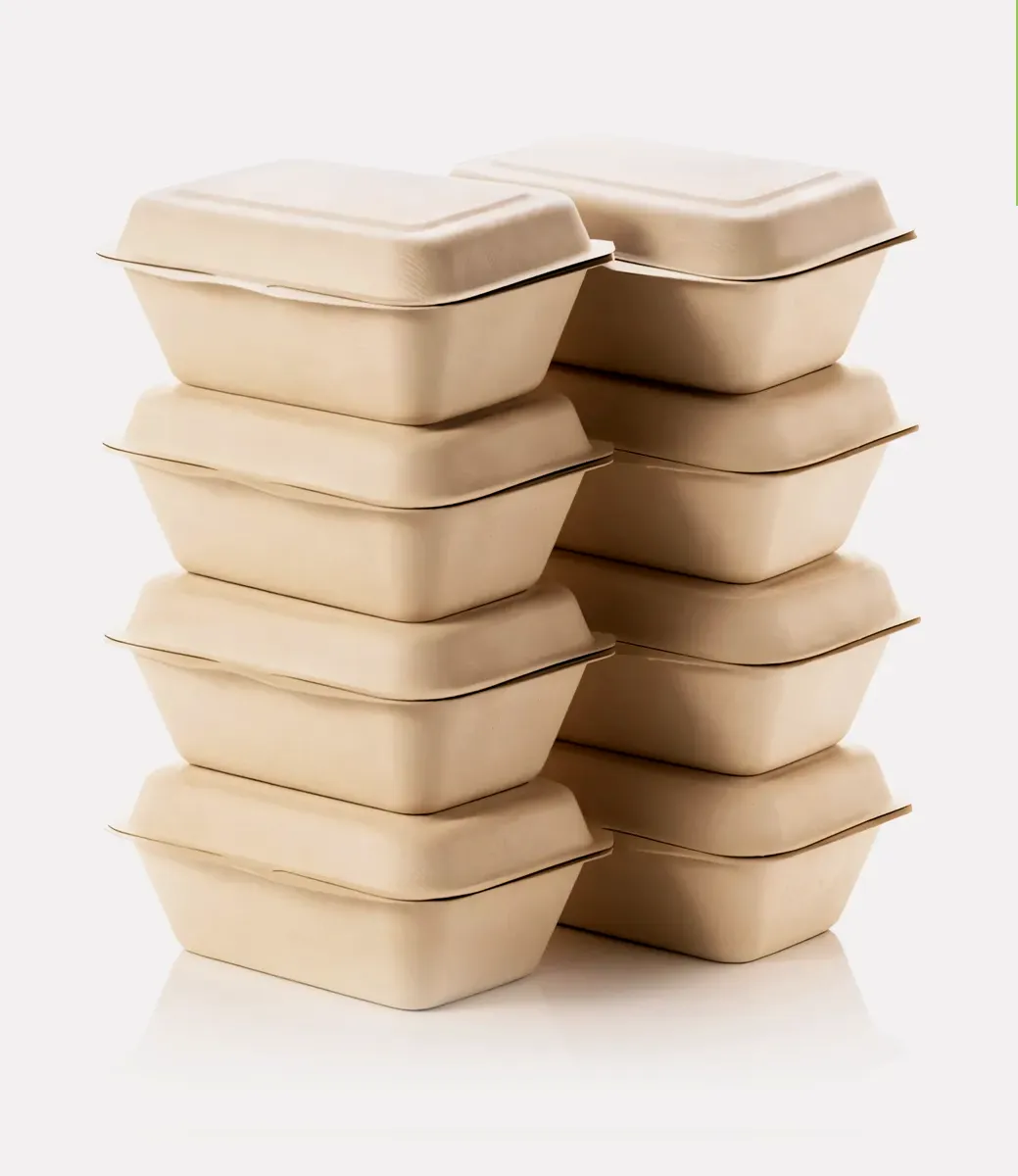
Ekoroll’s bagasse food containers are home compostable & 100% bagasse (TÜV AUSTRIA OK compost HOME; the certificate is held by the producing mill, copy on request). Because they contain no plastic, plastic-specific taxes and levies do not apply to them; general packaging EPR still does.
The EU Plastic Tax Factor
The most direct and quantifiable cost factor that changes the plastic vs sustainable packaging comparison in European markets is plastic-specific taxation and levies. EPR (extended producer responsibility) fees come on top, but they apply to every packaging material.
Where Plastic-Specific Charges Apply
As of October 2026, these are the main plastic-specific charges in European markets that affect the cost of conventional plastic food packaging:
- United Kingdom (not EU): Plastic Packaging Tax since 1 April 2022 on plastic packaging components with less than 30% recycled plastic: £223.69 per metric ton from 1 April 2025 and £228.82 per metric ton from 1 April 2026 (about £0.00023 per gram of plastic)
- Spain: Impuesto especial sobre los envases de plástico no reutilizables at €0.45 per kilogram of non-reusable plastic packaging, in force since 1 January 2023
- Germany: no plastic packaging tax, but producers of certain single-use plastic products, including beverage cups and their lids and food containers, pay into the Single-Use Plastics Fund (Einwegkunststofffonds), based on quantities placed on the market since 2024
- Portugal: a €0.30 contribution per single-use plastic or aluminium take-away or delivery ready-meal package (a per-package levy, not a per-kilogram tax)
- Italy: a €0.45/kg plastic tax has been legislated but postponed repeatedly, now to 2027; it is not in force
- France: no per-kilogram plastic packaging tax; EPR fees are eco-modulated under the AGEC law, with higher fees for less recyclable packaging
The EU’s €0.80/kg “plastic own resource” on non-recycled plastic packaging waste is paid by member states to the EU budget, not by companies.
What This Means for Per-Unit Cost
The per-unit plastic tax impact varies by market, packaging format and plastic weight. As an illustration (example weights, not Ekoroll data):
- A standard PP food container weighing approximately 15 grams carries roughly €0.007 of Spanish plastic tax (15 g at €0.45/kg)
- The same container supplied to the UK market carries roughly £0.003 of UK Plastic Packaging Tax (at the 2026 rate, if it contains less than 30% recycled plastic)
- Across 50,000 containers a month, the tax alone comes to about €340 in Spain or £170 in the UK, a line that does not apply to 100% fiber alternatives such as bagasse
For high-volume operations buying 100,000 or more units per month, plastic tax costs become a meaningful line item that partially offsets the unit price premium of plastic-free alternatives.
EPR Compliance Costs
Beyond direct plastic taxes, extended producer responsibility schemes in European markets impose compliance costs on every business that places packaging on the market, whatever the material. These costs are often not captured in unit price comparisons because they are invoiced separately from packaging procurement.
What EPR Compliance Involves
- Registration: businesses placing packaging on the market in most EU countries must register with the national EPR authority or a licensed producer responsibility organization (PRO); in Germany, every packaging item, including paper and bagasse, needs LUCID registration and VerpackG system participation
- Reporting: periodic reporting of packaging volumes placed on the market, by material and weight
- Financial contributions: payments to the EPR system based on the material and volume of packaging, with higher rates for less recyclable formats in eco-modulated schemes
- Single-use plastic items: cups, lids, food containers and other items covered by the Single-Use Plastics Directive carry additional EPR costs (in Germany, the Single-Use Plastics Fund)
- Compliance documentation: maintaining records and documentation demonstrating compliance with EPR obligations
Cost Implications
For a horeca distributor or food service brand placing PE-coated paper cups, PP food containers and plastic cutlery on multiple EU markets, EPR compliance costs across Germany, France, Italy, Spain, UK and the Netherlands can total several thousand euros per year in registration fees, PRO contributions and compliance management. Switching to 100% fiber formats does not remove the EPR obligation, but it removes the single-use-plastic layer for those items and changes the fee category. Ask your compliance provider for the rate difference per material in each market.
For a restaurant-specific breakdown, see our complete guide to eco-friendly packaging for restaurants.
Inventory Simplification Value
One of the most operationally significant but least-discussed cost benefits of specific sustainable packaging switches is inventory simplification.
The Cup and Lid Example

A café operating with conventional PE-lined cups and plastic snap-on lids manages two SKUs per cup size: the cup and the lid. For a café offering hot beverages in three sizes (8 oz, 12 oz, 16 oz), this is six separate SKUs to order, stock, store and manage. When a lid is out of stock, service is affected even if cups are available. Storage space is required for both cup and lid inventory.
Switching to lid-free cups — where the closure is integrated into the cup structure — eliminates the lid SKU entirely. Three cup sizes become three SKUs instead of six. Lid stock-outs are eliminated as a service risk. Storage space is reduced. Staff packaging training is simplified.
The operational cost saving from this simplification — in procurement administration time, storage space, stock management and service consistency — is real but typically not included in unit price comparisons. For high-volume cafés, the saving can be meaningful.
Complete System vs Fragmented Procurement
Operations that source their complete plastic-reduced packaging range from a single wholesale supplier (containers, cups, cutlery, greaseproof paper) consolidate procurement to a single supplier relationship, a single invoice, and a single set of product documents. This reduces procurement administration cost compared to managing four to six separate supplier relationships for the same packaging categories.
Cost Comparison Framework: Plastic vs Sustainable Packaging
The following framework provides a structured approach to building a complete cost comparison for your specific operation. For each packaging category you are evaluating, apply all relevant cost factors.
| Cost Factor | Plastic Packaging | Sustainable Packaging | Notes |
|---|---|---|---|
| Unit purchase cost | Lower | Higher; quoted per project | Starting point only — incomplete comparison |
| Plastic tax or single-use plastic levy | Applies — varies by market and format | None for 100% fiber formats without plastic | UK and Spain (taxes), Germany (Single-Use Plastics Fund), Portugal (per-package levy); Italy postponed to 2027 |
| EPR registration and reporting | Applies | Applies — all packaging materials | Varies by country and scheme |
| EPR fees | Applies — based on material and volume | Applies — rate depends on material | Eco-modulated: higher for less recyclable formats |
| Compliance documentation | Plastic items also need SUP marking and SUP EPR records | Food-contact and material documents per item | Simpler with a single supplier |
| Number of SKUs (cups example) | Cup + lid = 2 SKUs per size | Lid-free = 1 SKU per size | 50% SKU reduction for lid-free cups |
| Regulatory risk cost | Higher — single-use plastic items face ongoing restrictions | Lower — fewer plastic-specific measures apply; rules still evolve | Cost of reactive transition higher than proactive |
| Brand value contribution | Neutral to negative | Positive — supports premium positioning | Harder to quantify but commercially real |
| B2B account access | May exclude from tenders with packaging requirements | Can meet documented packaging requirements | Growing corporate procurement requirement |
Real Cost Scenarios by Operation Type
Applying this framework to specific operation types shows how the total cost comparison plays out in practice.
Scenario 1: High-Volume Quick Service Restaurant (200 covers per day)
A busy QSR using PP food containers, plastic cutlery and PE-lined cups at 200 covers per day processes approximately 6,000 packaging units per month. Switching to sustainable alternatives raises the invoice cost of those items; the size of the increase depends on format, volume and print, and pricing is quoted per project.
Against this: in plastic-tax markets, every plastic item carries a weight-based tax (see the Spanish and UK rates above) that does not apply to 100% fiber or wood alternatives, and at 6,000 units a month that charge recurs on every order. In Germany, the Single-Use Plastics Fund levy applies to the plastic containers and cups instead. Over 12 months, these plastic-specific cost lines erode part of the apparent cost advantage of plastic packaging and narrow the effective cost premium of the alternatives. EPR fees apply to both options and only change with the material.
Scenario 2: Café (300 takeaway cups per day)
A café serving 300 takeaway cups per day uses approximately 9,000 cups and 9,000 lids per month with conventional cup formats. Switching to lid-free cups with a water-based, PFAS-free, PE-free coating removes 9,000 plastic lids per month: their purchase cost, any plastic-specific charge on them in your market and the ordering and storage effort they require. That saving partially or fully offsets the unit cost premium on the cups themselves.
Whether the coated cup body itself falls under plastic-specific measures depends on the coating chemistry and national classification: water-based dispersion coatings can also count as plastic under the Single-Use Plastics Directive, so confirm the classification with your scheme rather than assuming the cup is exempt. Lid elimination alone is a meaningful offset against the higher unit price of lid-free cups.
Scenario 3: Horeca Distributor (supplying 50+ restaurant accounts)
A horeca distributor supplying sustainable packaging to restaurant accounts unlocks commercial opportunities not available with conventional plastic packaging. Corporate food service contracts, hotel chain supply agreements and public sector food service tenders increasingly include packaging requirements as a qualification criterion. The ability to supply documented alternatives opens access to these accounts. The revenue from a single additional hotel chain contract or corporate food service account can outweigh the extra packaging cost across the distributor’s portfolio.
The Regulatory Risk Cost
One cost factor that is rarely quantified in packaging decisions but has become increasingly material is regulatory risk cost: the cost of being forced to transition reactively after regulatory changes, rather than transitioning proactively ahead of them.
What Reactive Transition Costs
When a regulation restricts or bans a packaging format you are using, the transition is forced rather than planned. This creates several cost categories that proactive transition avoids:
- Existing stock write-off: inventory of the now-restricted format that cannot be used must be written off or disposed of
- Premium sourcing: urgently sourced alternative packaging typically costs more than the same items sourced through planned procurement with competitive pricing and volume commitments
- Operational disruption: unplanned packaging changes affect staff training, service consistency and potentially food quality during the transition period
- Customer communication: unplanned changes to packaging may require reactive customer communication rather than planned brand storytelling around the transition
The EU Single-Use Plastics Directive demonstrated this cost clearly: operations that had already transitioned away from plastic cutlery and EPS containers before the 2021 ban date avoided all of these costs. Operations still using banned formats after July 2021 faced immediate compliance exposure and unplanned transition costs simultaneously.
Brand Value and Revenue Implications
The commercial value of documented packaging credentials is real but harder to quantify than direct cost factors. Many European consumers say they prefer less plastic, and B2B buyers increasingly use packaging requirements as a supplier qualification criterion. Since 27 September 2026, Directive (EU) 2024/825 also bans generic environmental claims without proof, so the value comes from specific, verifiable statements rather than broad green wording.
Consumer-Facing Operations
For cafés, restaurants and food delivery brands, specific and verifiable packaging statements support brand positioning that can justify modest price premiums on menu items. A café that can credibly communicate “our cups use a water-based, PFAS-free, PE-free coating and need no plastic lid” has a differentiator that supports both customer loyalty and price positioning relative to competitors using conventional PE-lined cups.
B2B and Wholesale Operations
For horeca distributors, the commercial value of sustainable packaging capability is more direct: it determines which accounts you can qualify for. Corporate catering tenders, hotel chain procurement programs, airline catering contracts and public sector food service agreements all increasingly include packaging sustainability requirements. Distributors that can supply verified sustainable packaging with full documentation can access these accounts; distributors limited to conventional plastic packaging cannot.
Building Your Own Cost Analysis
To build a complete cost comparison for your specific operation, follow this process:
- List all packaging items by category with current unit cost and monthly volume
- Identify the sustainable alternative for each item and get wholesale pricing for your volume
- Calculate the unit cost premium per item at your order volume
- Calculate plastic-specific savings by applying the plastic tax or single-use plastic levy for each market you supply
- Compare EPR fees for the old and new materials with your current EPR provider (EPR applies to both)
- Quantify inventory simplification for categories like cups where lid-free formats reduce SKU count
- Assess B2B account opportunities that require sustainable packaging credentials
- Net the total — unit cost premium minus plastic tax and levy savings, EPR fee differences, inventory savings and account value
For many food service operations in markets with plastic-specific charges, this analysis produces a net cost premium smaller than unit price comparison alone suggests, and in some categories close to cost-neutral.
Wholesale Sustainable Packaging for Restaurants and Horeca
Ekoroll supplies complete sustainable packaging systems wholesale to restaurants, cafés, food delivery brands and horeca distributors across Europe: bagasse containers, cups with a water-based, PFAS-free, PE-free coating, molded fiber lids, wooden cutlery and PFAS-free greaseproof paper — all from a single wholesale supplier. Explore our complete eco-friendly packaging range or contact us for a quotation and a cost comparison for your specific volume requirements.