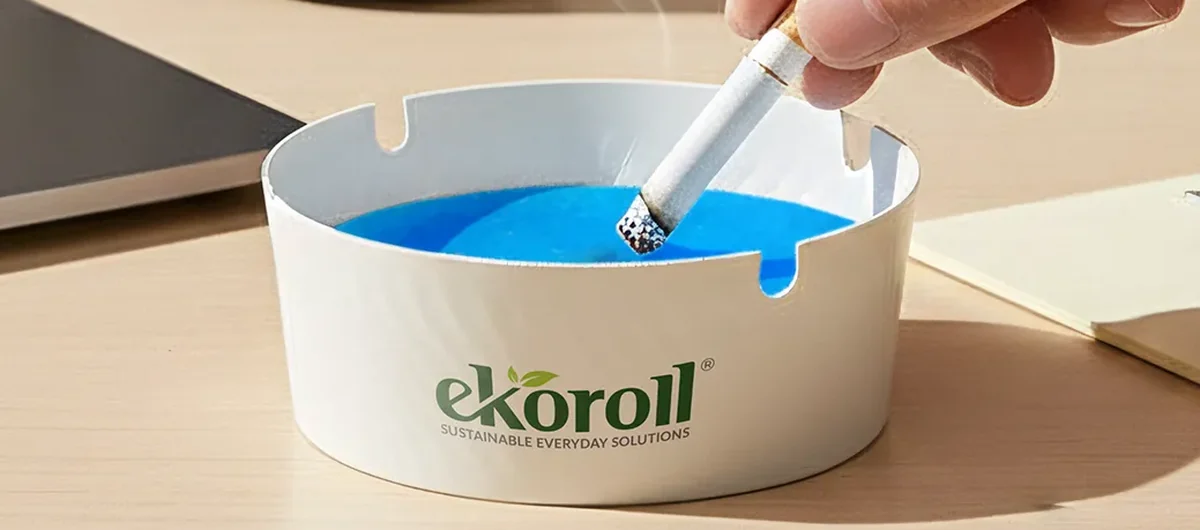
The disposable ashtray market has three distinct product categories that are routinely confused with each other: gel ashtrays, foam ashtrays and paper ashtrays. Gel and foam are often used interchangeably in search queries and product listings, but they are different products with different performance profiles. Paper ashtrays are a completely different format from both. Choosing the wrong format for your operational context — a hotel terrace, a festival site, a beach club, a municipal smoking area — creates either avoidable cost or avoidable operational problems.
This guide explains what each format actually is, where each performs well, where each fails, and which is the right choice for different operational scenarios. For the complete outdoor smoking management strategy, see: Outdoor Smoking Solutions Guide.
The Three Formats: What They Actually Are
Gel Ashtrays
A gel ashtray contains a pre-loaded water-based gel medium — typically a polymer gel similar to the material used in water-retention applications. The gel is already present in the container when purchased: it does not need to be activated. Cigarette butts are pressed into the gel surface, which holds them in position and provides some extinguishing effect through contact with the moisture in the gel.
The performance limitation of gel ashtrays is their active lifespan: the gel dries out relatively quickly when exposed to air and heat, typically within 4 to 8 hours in outdoor conditions. Once the gel has dried, it no longer holds butts effectively and the extinguishing property is largely lost. This makes gel ashtrays suitable for a single session of use — a car journey, a single outdoor sitting — but not for multi-hour or multi-day applications.
Gel ashtray summary:
- Pre-loaded gel medium — no activation required
- Active lifespan: 4 to 8 hours in outdoor use before gel dries
- Compact and portable — designed for personal carry and car use
- Unit cost: consumer retail pricing — relatively high per unit
- Not suitable for commercial distribution at scale
Foam Ashtrays
A foam ashtray uses an absorbent foam material — typically open-cell polyurethane foam — as the cigarette waste containment medium. Like gel ashtrays, foam ashtrays are a personal-use format: compact, lightweight and designed for individual carry rather than venue-wide distribution.
Foam ashtrays typically have a slightly longer active lifespan than gel ashtrays because the foam material does not dry out in the same way as gel — it absorbs ash residue and holds butts through physical containment rather than gel adhesion. However, foam ashtrays have a significant hygiene limitation: used foam collects residue that accumulates with each use, creating an increasingly unpleasant surface. This makes them unsuitable for shared use in hospitality or public environments.
Foam ashtray summary:
- Open-cell foam medium — physical containment of cigarette waste
- Longer active lifespan than gel in outdoor conditions
- Better suited for personal and travel use than gel for multi-hour applications
- Unit cost: consumer retail pricing — relatively high per unit
- Hygiene limitation: residue accumulation with each use makes shared use inappropriate
- Not designed for commercial bulk distribution
Paper Ashtrays (Water-Activated Absorbent Core)
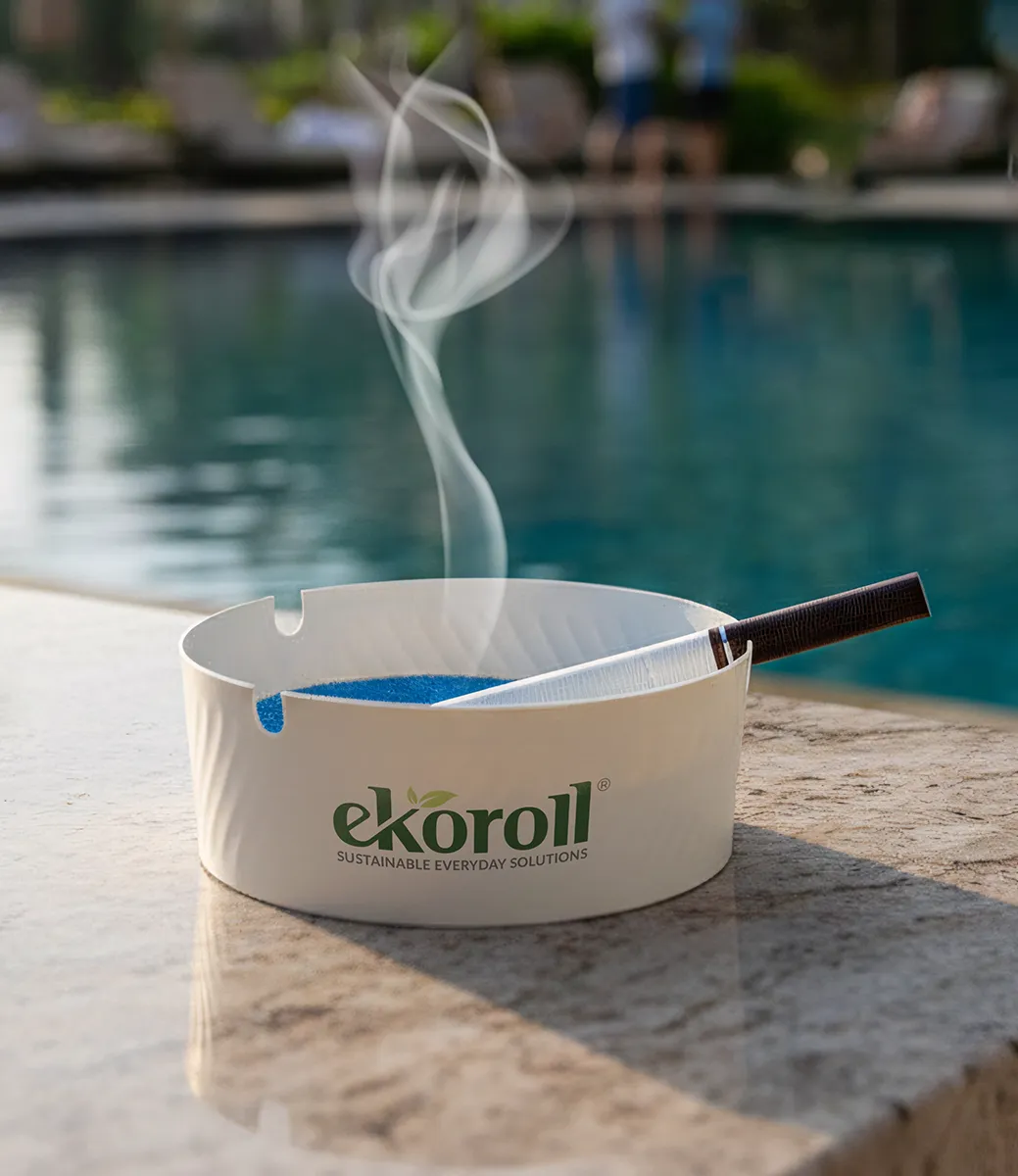
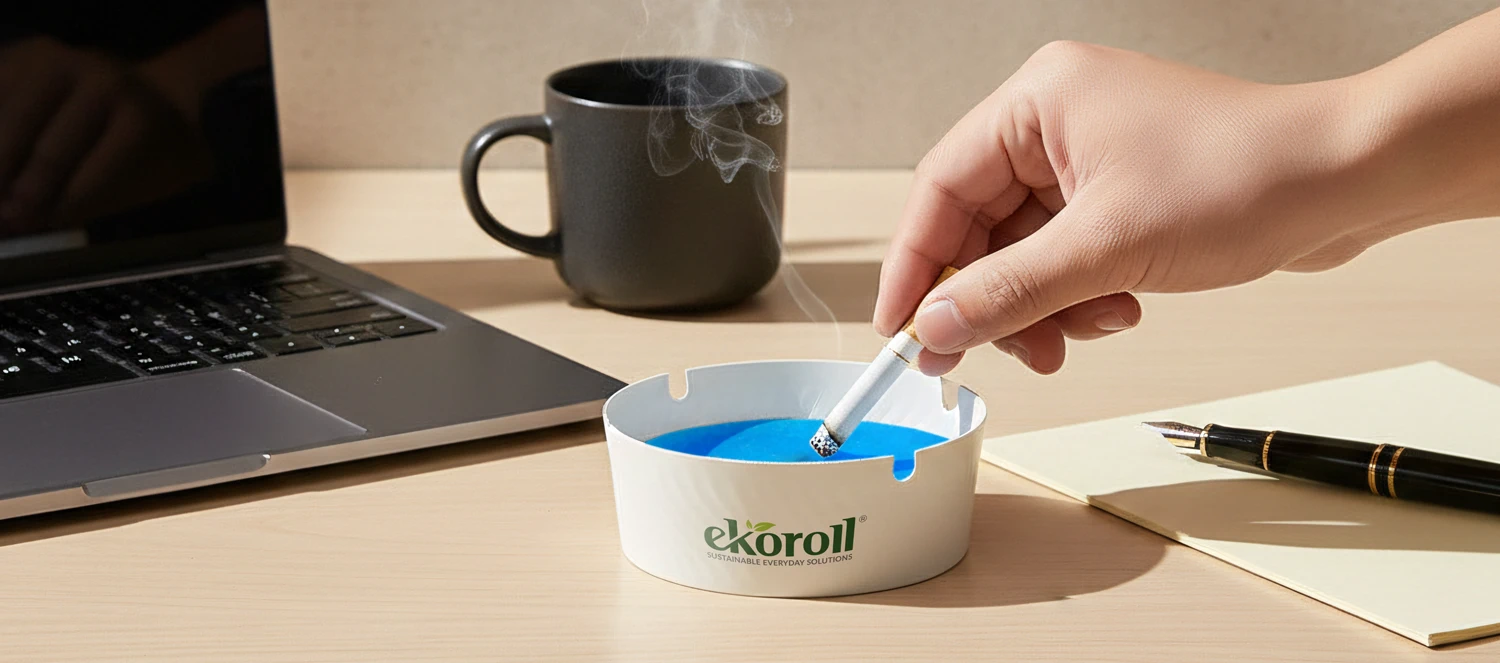
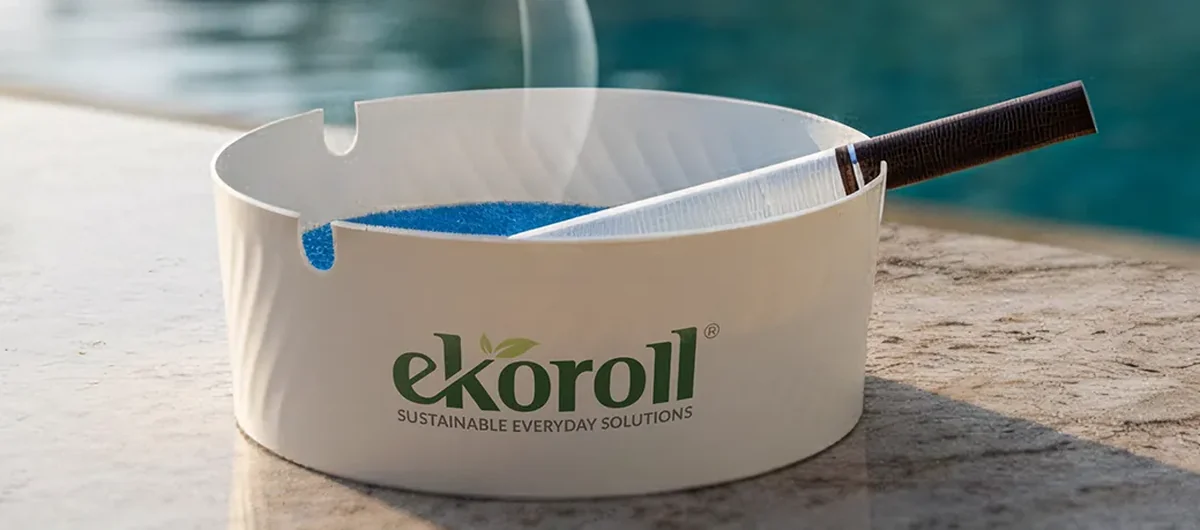
A paper ashtray is a completely different product category from gel or foam formats. It is not a personal-carry product — it is a distributed venue product designed for placement at tables, events and public spaces. The Ekoroll disposable paper ashtray uses a water-activated absorbent core that turns into a stable gel on contact with water; the gel extinguishes cigarette butts and contains ash residue.
The critical performance difference from gel and foam formats is active lifespan: the water-activated core stays active for several days of active use, depending on conditions — compared to 4 to 8 hours for gel formats. The core contains an additional component: after the initial chemical reaction has turned the water-activated core into a gel of the right consistency, this component stops the reaction and keeps the gel from drying out and hardening in the following hours. Competing products without this component keep reacting until the gel dries and hardens, which is why their core loses effectiveness within hours. This multi-day performance is what makes paper ashtrays practical for hotel terraces, beach clubs and multi-day festivals where replacement on a single-session basis would be operationally impractical.
Paper ashtray summary:
- Water-activated absorbent core — turns into a gel on contact with water
- Additional component in the core stops the reaction once the gel has formed and keeps it from drying out and hardening
- Active lifespan: several days of active use, depending on conditions — much longer than competing gel and foam products
- Designed for venue distribution — table placement, event distribution, public space deployment
- Paper-based construction
- Unit cost: wholesale pricing, noticeably lower per unit than gel or foam at volume; quoted per project
- Custom printing available for venue branding or event branding
- Suitable for bulk distribution at scale
Direct Comparison: Gel vs Foam vs Paper
| Criteria | Gel Ashtray | Foam Ashtray | Paper Ashtray |
|---|---|---|---|
| Absorbent medium | Water-based polymer gel | Open-cell polyurethane foam | Water-activated core (turns to gel) |
| Active lifespan (outdoor) | 4 to 8 hours | 4 to 12 hours | several days, depending on conditions of use |
| Designed for | Personal / car use | Personal / travel use | Venue distribution / events |
| Shared use hygiene | Poor — residue visible | Poor — residue accumulates | Excellent — single-use per cover |
| Bulk distribution suitability | Not suitable | Not suitable | Designed for bulk distribution |
| Unit cost at scale | Higher (retail pricing) | Higher (retail pricing) | Lower (wholesale; quoted per project) |
| Custom branding | Not available | Not available | Available; minimums quoted per project |
| Environmental profile | Plastic/synthetic gel | Polyurethane foam | Paper-based construction |
| Wind performance | Poor — open top | Moderate | Good — core contains ash |
Where Each Format Works: Scenario Guide
Use Gel or Foam Ashtrays When:
- The use case is genuinely personal — a car, a boat, a personal outdoor space where a single individual is the only user
- The duration is short — a single session of a few hours, not a full-day or multi-day application
- Portability in a pocket or small bag is specifically required
- Volume is very low — individual purchase rather than operational procurement
Use Paper Ashtrays When:
- Restaurant or café terrace: table placement at each cover, replaced at each table reset — the multi-day active performance means one ashtray covers multiple service periods if needed
- Hotel outdoor dining and pool areas: distributed at each outdoor seat position — paper format handles scale that gel and foam cannot
- Festivals and events: distributed at entry points and throughout the site — gel and foam have too short an active lifespan for full-day or multi-day events
- Beach clubs: placed at each sun lounger in smoking areas — the flat, stackable format allows efficient bulk transport and distribution
- Municipal smoking zones: distributed periodically through public areas — scales to footfall in a way fixed infrastructure cannot
- Any scenario requiring bulk procurement: paper ashtrays are the only format available at wholesale pricing with private label options
The Foam Ashtray Search: What People Are Actually Looking For
When buyers search for “disposable foam ashtray” or “foam ashtray bulk,” they are typically in one of two situations: they have used a foam format personally and are now looking for a commercial equivalent to distribute at a venue or event, or they are comparing formats to understand which is right for their specific use case.
In both cases, paper ashtrays are almost always the correct answer for the operational scale they are planning. The foam format they may have encountered in personal use is not designed for commercial distribution — it has a higher retail unit cost, no bulk pricing, no private label option, and an active lifespan that is too short for full-day venue use. Paper ashtrays with a water-activated absorbent core solve the same problem at significantly lower cost, with better multi-day performance and with the scale and branding options that commercial operations require.
The key performance claim to verify when comparing any absorbent core ashtray format: active lifespan before the core loses effectiveness. For gel formats, this is typically 4 to 8 hours. For the Ekoroll paper ashtray core, it is several days of active use, depending on conditions, because an additional component keeps the gel from drying out and hardening. This difference determines whether the product is practical for single-session personal use only, or for multi-session venue use.
Cost Comparison at Operational Scale
The cost comparison between formats looks very different at personal use volumes versus commercial use volumes:
Personal Use (a handful of units per month)
- Gel and foam ashtrays: bought at retail; at this volume the total spend is small and the per-unit price hardly matters
- Paper ashtray: available, but at very low volumes the cost advantage over gel or foam is limited
Commercial Use (a terrace with dozens of positions over a summer season)
- Gel and foam ashtrays: retail pricing multiplied by dozens of positions every evening for an entire season adds up to a substantial budget — and neither format is designed for terrace use
- Paper ashtray at wholesale: the same number of positions costs noticeably less, with a format designed exactly for this use case and a multi-day core that reduces replacements
At commercial volumes, paper ashtrays come out clearly lower in total cost than gel or foam formats — before accounting for the operational fit advantage. The exact difference depends on format, volume and print; paper ashtray pricing is quoted per project. Gel and foam at commercial scale are not just more expensive: they are not suitable products for the use case.
Paper Ashtrays for Commercial and Venue Use: Wholesale Supply
Ekoroll supplies disposable paper ashtrays wholesale to horeca operators, event companies, municipalities and distributors across Europe. Water-activated absorbent core, multi-day active performance, paper construction. Supplied from Turkey. Contact us for bulk pricing and samples.