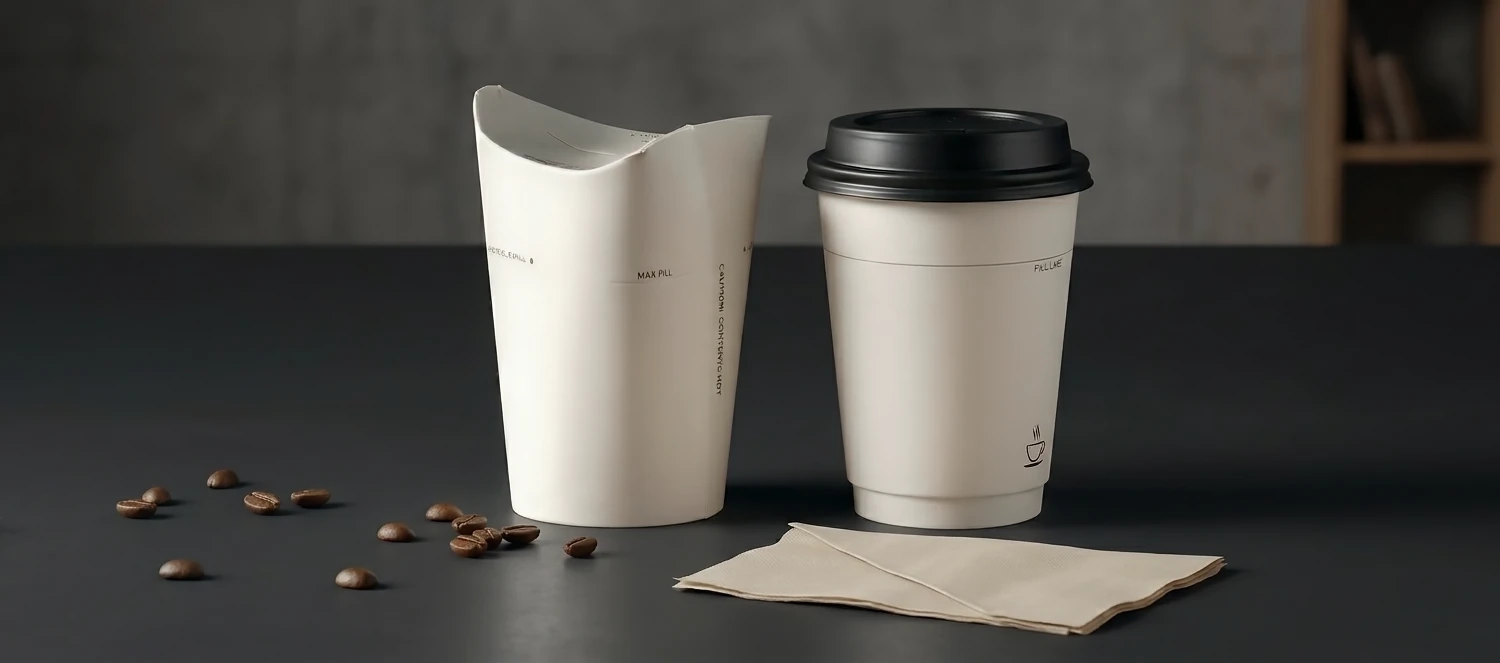
For cafés, coffee chains and horeca distributors evaluating their cup packaging, the choice between hot paper cups with lids and lid-free paper cups has moved well beyond a simple product preference. It is now a decision with operational, financial, regulatory and sustainability dimensions — each of which affects your business differently depending on your volume, customer base and market positioning.
This guide covers everything you need to make an informed decision: how each format works, how they compare on cost, sustainability and EU compliance, what the operational reality looks like in practice, and a framework for deciding which format is right for your specific operation.
For wholesale supply of both formats, explore Ekoroll lid-free hot paper cups and compostable molded fiber lids.
How Each Format Works
Hot Paper Cups With Lids
A hot paper cup with lid is the conventional takeaway coffee format: a paper cup body paired with a separate closure lid. In a sustainable packaging upgrade, the conventional plastic snap-on lid is replaced with a compostable alternative — typically a molded fiber lid made from compressed plant pulp, or a PLA-based lid made from plant-derived bioplastic.
The cup body and lid remain two separate components. Staff fill the cup, apply the lid, and hand it to the customer. The customer drinks through the lid opening. At end of use, the cup and lid are disposed of separately — ideally into compostable waste streams if both are certified compostable.
The key material decision in this format is the cup body lining. Most paper cups use PE (polyethylene) or PLA (polylactic acid) lining to make them liquid-resistant. PE is a fossil-derived plastic. PLA is a bio-based plastic. Both are plastic materials that prevent the cup from being recycled in standard paper streams. For a genuinely plastic-free cup system using this format, the cup body must use water-based coating — a plant-derived barrier technology that provides liquid resistance without any plastic lining.
Lid-Free Paper Cups
A lid-free paper cup — also called an integrated lid cup or foldable paper cup — eliminates the separate lid entirely. The closure mechanism is built directly into the cup wall. The customer folds the top of the cup to create a drinking spout and sealed closure. No separate lid is applied at any point in the service process.
The engineering behind lid-free cups has developed significantly since the format first appeared in the market. Current generation lid-free cups provide secure closure for takeaway and delivery use, maintain structural integrity at operating temperatures, and are available in the standard size range used by cafés and coffee chains. The folding mechanism is designed to be applied by the customer in a single action, without staff involvement after handover.
From a material perspective, lid-free cups with water-based coating contain zero plastic in the entire cup structure — not just in the lid. This is the key material distinction between lid-free cups and conventional cups that simply have a compostable lid added: the lid-free format addresses the full cup, not just the closure.
Real Cost Comparison
The cost comparison between the two formats is more nuanced than a simple unit price comparison. The relevant figure is the total cost per serve — including all packaging components, inventory management and waste handling.
Hot Paper Cup + Compostable Fiber Lid
The total cost per serve for a hot paper cup with compostable lid consists of two components: the cup body cost and the compostable lid cost. Compostable fiber lids carry a premium over conventional plastic lids — typically 30 to 60 percent higher per unit at standard wholesale volumes. This premium reflects the material and production cost of certified compostable fiber versus injection-molded plastic.
Additional cost factors for this format include:
- Two SKU inventory cost — maintaining separate cup and lid stock, managing size matching, and the risk of running out of one component independently of the other
- Storage space — two product lines require separate storage allocation
- Waste handling — two separate compostable waste streams if both components are certified compostable
- Staff training — ensuring correct lid sizing and application across all service staff
Lid-Free Cup With Water-Based Coating
The total cost per serve for a lid-free cup is a single unit cost. There is no separate lid component. At wholesale volumes, the unit cost of a lid-free cup with water-based coating is typically comparable to or slightly higher than a PE-lined conventional cup of equivalent size — but lower than the combined cost of a PE-lined cup plus a compostable fiber lid.
Cost advantages of this format include:
- Single SKU — one product line replaces two, reducing procurement complexity and inventory management cost
- No lid sizing risk — no mismatched lids, no service errors from incorrect lid application
- Lower storage cost — single product line requires less storage allocation
- Simpler waste handling — one compostable product rather than two separate streams
For most café operations ordering at wholesale volume, switching to lid-free cups results in a neutral to positive cost outcome per serve when the full system cost — including lid inventory and management — is factored in.
Sustainability Comparison
Plastic Content
This is the most significant material difference between the two formats, and it is often misunderstood in packaging procurement conversations.
A conventional paper cup with a compostable fiber lid eliminates plastic from the lid. If the cup body uses PE or PLA lining — which most paper cups do — the cup body itself still contains plastic. The result is a packaging system that has removed the plastic from the closure but retained it in the main component.
Research published in peer-reviewed environmental science journals has documented that PE and PLA-lined paper cups release microplastic and nanoplastic particles into hot beverages during use. Studies have found that a single PE-lined paper cup can release tens of thousands of microplastic particles per cup. PLA lining, while bio-based, has been shown to behave similarly under hot liquid conditions.
A lid-free cup with water-based coating contains zero plastic in the entire cup structure. The water-based coating provides liquid and heat resistance through a plant-derived aqueous barrier rather than a plastic film. No microplastic release has been documented for water-based coated cups under normal use conditions.
Recyclability and Compostability
PE-lined paper cups cannot be recycled in standard paper streams because the plastic lining prevents pulping. They require specialist recycling infrastructure — which is available in some markets but far from universal across Europe. PLA-lined cups have similar limitations and additionally require industrial composting infrastructure for certified end-of-life performance.
Water-based coated paper cups are fully repulpable in standard paper recycling streams. Under EN13432 certified industrial composting conditions, they are also fully compostable. This gives water-based coated cups a genuinely circular end-of-life pathway that PE and PLA-lined cups cannot match.
Carbon Footprint
The carbon footprint comparison between the two formats depends significantly on the specific materials and production processes used. As a general framework:
- Eliminating a separate lid component reduces the total material input per serve, which typically reduces the carbon footprint per serve versus a two-component system
- Water-based coating has a lower carbon footprint than PE coating on a per-kilogram basis, as it does not involve fossil-derived polymer production
- Compostable fiber lids, while better than plastic lids from an end-of-life perspective, do involve energy-intensive production processes that contribute to their carbon footprint
For operations with carbon reduction targets or ESG reporting requirements, the lid-free cup with water-based coating typically delivers better performance across both material input and end-of-life metrics.
EU Regulatory Timeline and Compliance
Understanding the EU regulatory landscape is essential for packaging procurement decisions that will affect operations over the next three to five years.
2021 — EU Single-Use Plastics Directive
The EU Single-Use Plastics Directive came into force across member states from July 2021, restricting or banning a range of single-use plastic products including plastic cutlery, plates, straws and certain food containers. For beverage cups, the Directive introduced mandatory marking requirements for cups with plastic content and placed extended producer responsibility obligations on manufacturers.
2023 to 2024 — Plastic Taxes and EPR Schemes
Multiple EU member states introduced or expanded plastic taxes and extended producer responsibility (EPR) schemes during this period. The UK plastic packaging tax, Germany's EPR system and similar schemes in France, Italy and Spain have increased the effective cost of using plastic-containing packaging across European markets. Operations using PE-lined cups are paying these costs — either directly or through supplier pricing adjustments.
2025 to 2027 — EU Packaging and Packaging Waste Regulation
The EU Packaging and Packaging Waste Regulation (PPWR), which entered the implementation phase from 2025, introduces binding recyclability and reusability requirements for packaging placed on the EU market. Under the PPWR, packaging that cannot be recycled in standard material streams — including PE-lined paper cups — faces increasing market access restrictions and compliance costs. The PPWR also introduces mandatory recycled content requirements that will affect plastic-containing packaging formats.
For distributors and operators supplying European markets, the regulatory trajectory is clear: plastic-containing packaging formats will face increasing cost and market access pressure through to 2030 and beyond. Water-based coated cups and lid-free formats are positioned well ahead of this regulatory curve.
Curious where the market is heading? See coffee cup packaging trends in Europe.
Operational Reality: What the Transition Looks Like
Switching to Compostable Lids — Typical Experience
Operations that have switched from plastic to compostable fiber lids typically report a straightforward transition. The service process is unchanged — staff continue to apply lids in the same way. The main practical consideration is ensuring that the compostable lid specifications are correctly matched to existing cup formats, as fiber lids have slightly different dimensional tolerances than plastic lids.
The transition timeline for a café operation switching lid suppliers is typically two to four weeks, covering order lead time and stock transition. No staff retraining is required beyond awareness of the new lid material and its disposal requirements.
Switching to Lid-Free Cups — Typical Experience
Operations switching to lid-free cups report that the main transition period involves customer education rather than internal process change. The service process simplifies — staff no longer apply a separate lid — but customers who have not used the format before need to understand the folding mechanism.
Most café operators report that customer adoption is faster than expected. The majority of repeat customers are comfortable with the format within the first two to three uses. For operations with a high proportion of first-time or infrequent customers — such as transport hub locations or tourist-area cafés — a brief instruction card or staff guidance at handover is typically sufficient.
The transition timeline for a full cup switch is typically four to eight weeks, covering order lead time, existing stock run-down and staff awareness. The operational simplification — eliminating lid inventory management — is typically reported as a positive outcome by operations managers within the first month.
Which Format Is Right for Your Operation?
Choose Hot Paper Cups With Compostable Lids If:
- Your operation is already set up for two-piece cup systems and a full cup transition is not feasible in the short term due to existing stock commitments or supplier contracts
- Your customer base has strong expectations for a familiar lid format and the adjustment period for a new system would meaningfully disrupt service quality or customer experience
- You want to make an immediate and meaningful sustainability improvement without changing your entire cup inventory at once — switching lids is a faster and lower-risk first step
- You operate in a market where lid-free cup awareness is still low and customer education would represent a significant operational burden
Choose Lid-Free Cups With Water-Based Coating If:
- You are building a complete plastic-free packaging program and want to address both the lid and the cup body in a single product change rather than managing a staged transition
- You want to simplify operations by eliminating a separate lid SKU and the associated inventory management, size matching and supplier coordination
- You are positioning your brand around genuine sustainability credentials and want the most complete and documentable plastic-free cup solution available in the market
- You are planning for EU packaging regulatory changes and want forward compliance positioning that addresses both the closure and the cup body lining
- You are a distributor supplying cafés and horeca operators who are increasingly asking for plastic-free solutions that go beyond lid replacement
The Sequential Transition Path
For many operations, the most practical approach is sequential. Switch to compostable fiber lids as an immediate improvement — this delivers a meaningful sustainability upgrade with minimal operational disruption. Then, at the next cup reorder cycle, transition to lid-free cups with water-based coating for the full system change.
This path works well for operations that need to manage stock run-down, supplier contract timing or customer communication phasing. It ensures that no sustainability investment is wasted — each step delivers real improvement — while managing the pace of change to fit operational capacity.
Decided on lid-free? Our lid-free paper cups wholesale guide walks through everything from sizes to sourcing.
Decision Checklist
Use this checklist to guide your format decision:
- Volume: What is your monthly cup volume? Higher volume operations benefit more from the SKU simplification of lid-free cups.
- Customer profile: What proportion of your customers are repeat visitors? Higher repeat rates accelerate lid-free cup adoption.
- Sustainability target: Are you targeting full plastic elimination or a staged reduction? Full elimination points to lid-free with water-based coating.
- Regulatory exposure: Do you supply EU markets or report under ESG frameworks? Both increase the value of the full plastic-free system.
- Timeline: How quickly do you need to make the switch? Lid replacement is faster; lid-free cup transition requires more lead time.
- Budget: Is per-unit cost or total system cost the primary constraint? Total system cost often favors lid-free at scale.
For wholesale supply of both formats with EU-compliant documentation and samples available on request, explore Ekoroll lid-free hot paper cups and compostable molded fiber lids.
Wholesale Cup and Lid Supply for Cafés and Horeca
Ekoroll supplies lid-free hot paper cups with water-based coating and compostable molded fiber lids wholesale to distributors, coffee chains and horeca operators across Europe. Factory-direct supply from Turkey with EU-compliant documentation and samples available on request.
Frequently Asked Questions
A compostable lid is a separate closure — typically made from molded fiber — that replaces a plastic snap-on lid on a conventional paper cup. A lid-free cup has the closure built directly into the cup wall, eliminating the need for any separate lid. The lid-free format simplifies operations to a single SKU and, when combined with water-based coating, makes the entire cup plastic-free rather than just the lid.
Yes. Research published in peer-reviewed journals has documented that PE-lined paper cups release microplastic and nanoplastic particles into hot beverages during normal use. Studies have found that a single PE-lined cup can release tens of thousands of microplastic particles per use. PLA-lined cups have shown similar behavior under hot liquid conditions. Water-based coated cups do not contain plastic in the cup body and have not been documented to release microplastics under normal use conditions.
Yes. Lid-free cups are used successfully in high-volume café and takeaway environments. The folding mechanism is fast to apply and eliminates lid inventory management, which typically simplifies rather than complicates high-volume service. The main transition period involves customer familiarity with the format, which most operations report resolves quickly for repeat customers. A brief instruction at point of handover is typically sufficient for new customers.
The EU Single-Use Plastics Directive restricts single-use plastic lids and introduces marking and EPR requirements for cups with plastic content. The EU Packaging and Packaging Waste Regulation, entering implementation from 2025, introduces binding recyclability requirements that affect PE and PLA-lined cups. Multiple EU member states also have plastic taxes and EPR schemes that increase the cost of plastic-containing packaging. Water-based coated cups and lid-free formats are well-positioned for both current and upcoming EU requirements.
MOQ starts at 5,000 units for plain and unprinted cups, and 10,000 units for custom printed orders. Both lid-free hot cups and compostable molded fiber lids are available at these minimums. Contact us through the quote form to discuss your volume requirements, size specifications and custom printing options. Samples are available before bulk orders are placed.
Yes. Ekoroll supplies both lid-free hot paper cups with water-based coating and compostable molded fiber lids wholesale to distributors, coffee chains and horeca operators across Europe. Sourcing both formats from a single supplier simplifies procurement, ensures consistent certification documentation and reduces logistics complexity for operations managing a staged transition between the two formats.