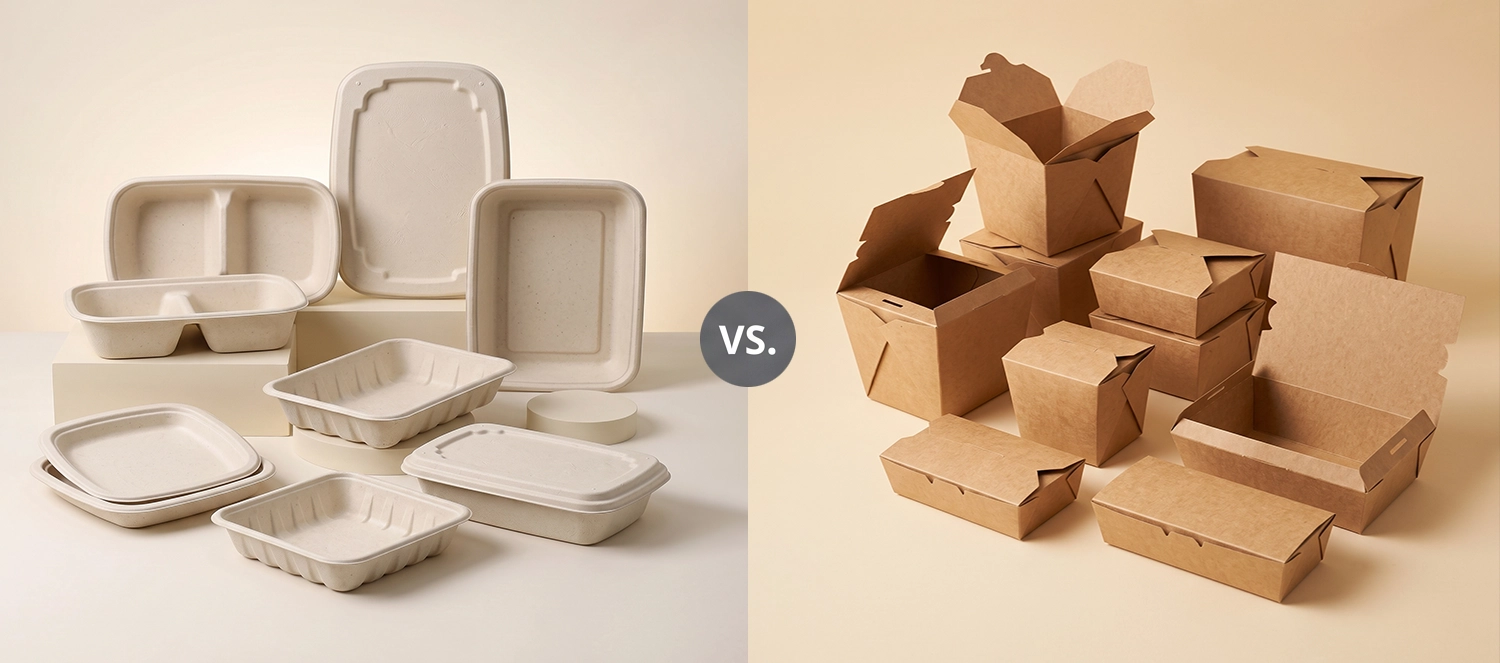
As sustainability becomes a core requirement in the food service industry, packaging is no longer just a material choice. It is a strategic business decision affecting cost, compliance, and customer perception. For horeca operators, takeaway brands and distributors, choosing between bagasse food containers and paper food containers requires a clear understanding of how each material performs under real food service conditions, how they compare on sustainability and certifications, and what the total cost picture looks like for EU market operations.
This guide provides a detailed, business-focused comparison of bagasse vs paper food containers, covering materials, performance specifications, sustainability profiles, certifications and wholesale sourcing guidance.
For wholesale sourcing, explore Ekoroll bagasse food containers for horeca and takeaway operations.
What Are Bagasse Food Containers?
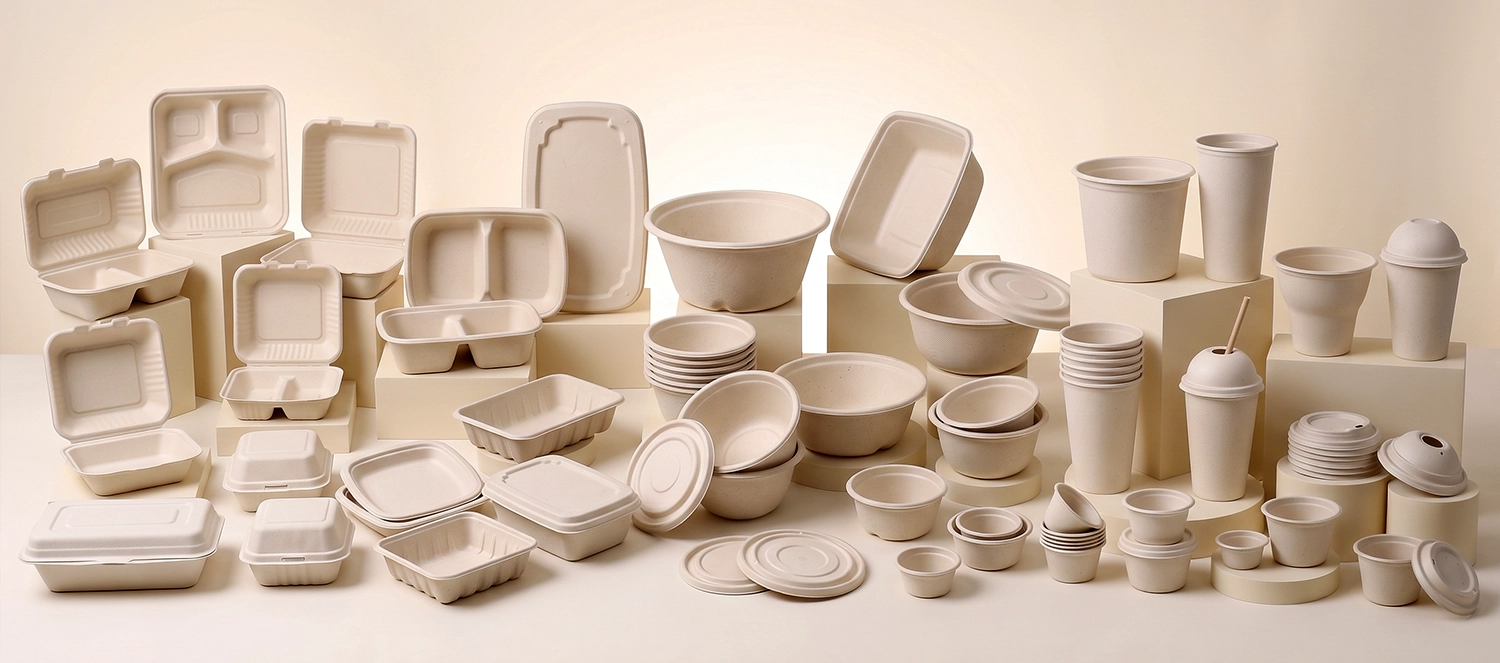
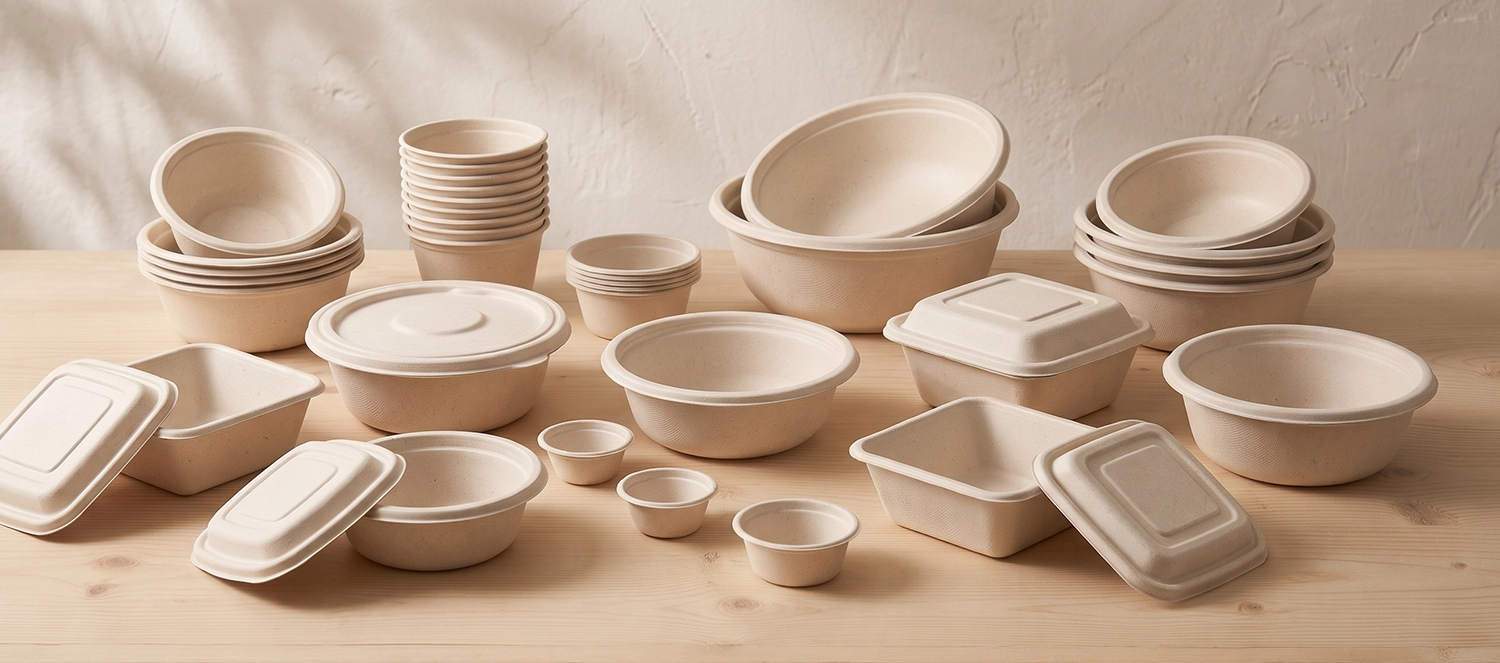
Bagasse food containers are manufactured from sugarcane fiber, the fibrous residue remaining after sugarcane stalks are crushed for juice extraction in sugar production. This agricultural byproduct is pulped, molded under heat and pressure, and dried to produce rigid, dimensionally stable containers that are naturally resistant to grease and moisture without any plastic coating.
Key material properties:
- No laminated plastic film — fiber-based container, PFAS-free (no added fluorinated grease barrier)
- Water- and oil-resistant without a plastic coating
- Suitable for hot and cold food, including soups and wet dishes
- Microwave-safe: food can be reheated directly in the container
- Freezer-safe: suitable for meal prep and cold chain use
- Compostability: Ekoroll bagasse containers are home compostable & 100% bagasse, certified by TÜV AUSTRIA (OK compost HOME); food-contact documentation is provided according to the final product specification and production route
- Agricultural byproduct sourcing — uses material that would otherwise be burned or discarded
Bagasse containers are available in clamshell, bowl, tray, rectangular container and multi-compartment formats, covering the full range of food categories served in restaurant and food delivery operations.
What Are Paper Food Containers?
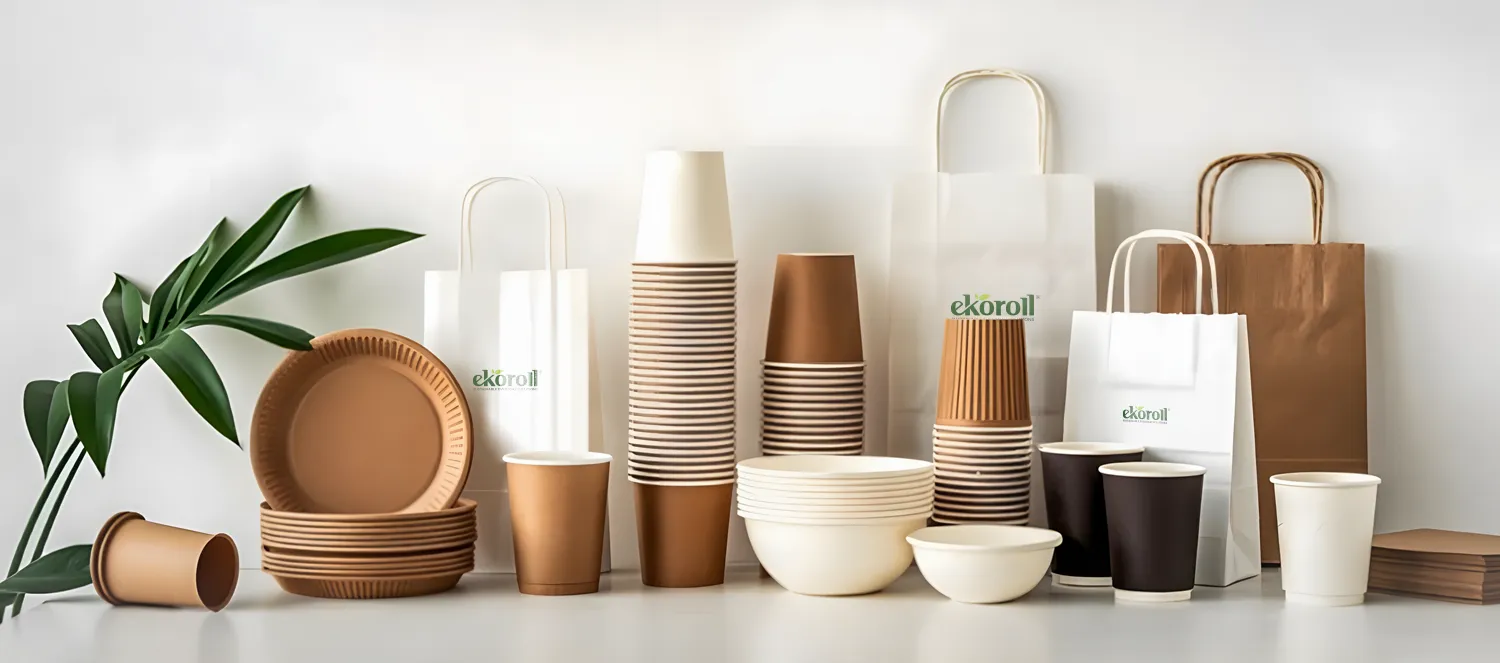
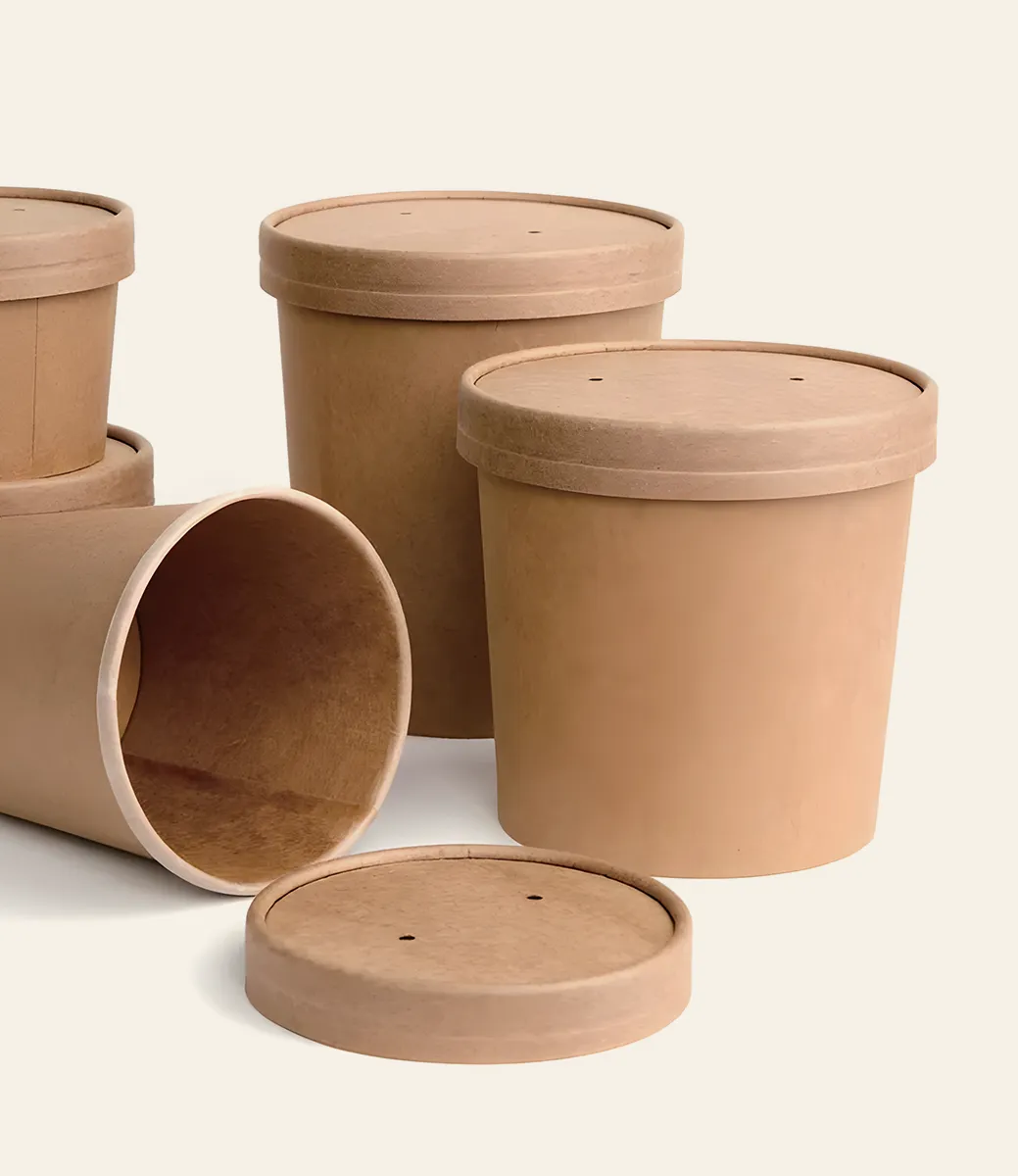
Paper food containers are manufactured from wood pulp, typically in kraft paper or bleached paperboard form. The base material itself is renewable and biodegradable, but the functional performance of paper containers in food service applications depends almost entirely on what coatings or treatments are applied to the paper surface.
PE-Coated Paper Containers
The most common paper food container format uses a polyethylene (PE) coating on the food-contact surface to provide grease and moisture resistance. PE is a petroleum-derived plastic. PE-coated paper containers cannot be recycled in standard paper streams because the plastic coating prevents pulping. They are not compostable under EN13432 conditions because the PE coating does not break down within the required timeframe. Despite their paper appearance, PE-coated containers are effectively plastic-containing packaging from a recycling and compostability perspective.
PLA-Coated Paper Containers
PLA (polylactic acid) coating is a bio-based plastic alternative used in some paper container formats marketed as compostable. PLA-coated paper containers can achieve EN13432 compostability certification under industrial composting conditions, but require specific high-temperature industrial composting infrastructure to break down correctly. They do not compost in home composting systems or in landfill conditions at meaningful rates.
Uncoated Kraft Paper Containers
Uncoated kraft paper containers contain no plastic coating and are fully recyclable in standard paper streams. However, without coating, they have very limited grease and moisture resistance, making them suitable only for dry, low-moisture food applications such as bread, pastries and dry snacks. They are not suitable for hot meals, soups, oily dishes or delivery applications where the container will be in contact with food moisture for an extended period.
Water-Based Coated Paper Containers
Water-based coating is a barrier technology (water-based, PFAS-free, PE-free) that provides grease and moisture resistance without a PE lining. Paper containers with water-based coating are designed for recycling in standard paper streams; compostability depends on the certification of the specific product. However, water-based coating provides lower heat and grease resistance compared to bagasse, making these formats better suited to moderate-temperature applications than high-heat food service use.
Performance Comparison: Bagasse vs Paper Food Containers
For food service operations, the performance comparison between bagasse and paper containers across real service conditions is the most important practical consideration.
Heat Resistance
Bagasse is suitable for hot and cold food and maintains its structural integrity with hot meals, soups and sauces at normal serving temperatures. It resists deforming, softening or leaking under sustained contact with hot food, and Ekoroll’s bagasse containers are also microwave-safe.
PE-coated paper containers have moderate heat tolerance but can soften at the seams under sustained hot liquid contact. PLA-coated containers have lower heat tolerance than PE and are not recommended for hot food applications above approximately 45 to 55°C due to PLA’s heat sensitivity. Uncoated kraft containers have no meaningful heat resistance for food applications. Water-based coated paper containers have moderate heat resistance suitable for warm rather than hot applications.
Grease and Moisture Resistance
Bagasse provides natural grease and moisture resistance without a plastic coating; Ekoroll’s bagasse containers are water- and oil-resistant and PFAS-free. This makes it one of the most reliable options for oily, saucy and wet food applications including curries, pasta dishes, stir-fries and soups.
PE-coated paper provides good grease resistance but is plastic-containing. PLA-coated paper provides limited grease resistance, particularly under heat. Uncoated kraft has minimal grease resistance and will degrade rapidly under food contact. Water-based coated paper provides moderate grease resistance suitable for lower-oil applications.
Structural Integrity in Delivery
Bagasse containers maintain rigidity under stacking weight and impact during delivery transport. Their molded structure resists compression and does not deform under the load of multiple stacked orders.
Paper containers vary significantly in structural performance depending on coating and construction. PE-coated paperboard containers are generally adequate for delivery. Uncoated kraft and PLA-coated formats can weaken significantly when the paper absorbs moisture from hot food, potentially compromising container integrity during transport.
Condensation Management
Bagasse fiber naturally absorbs surface moisture, reducing condensation buildup on the container interior during transport. This helps maintain food texture, particularly for fried items, during delivery.
Paper containers with plastic coating have smooth interior surfaces that promote condensation buildup, which can make food soggy during longer delivery times.
Microwave and Freezer Compatibility
Ekoroll’s bagasse containers are microwave- and freezer-safe, so the same container can be used from freezer storage through to customer reheating without transferring food to a separate vessel.
PE-coated paper containers have limited microwave compatibility due to plastic coating concerns. PLA-coated containers are not microwave safe as PLA softens at low temperatures. Uncoated kraft can be used in microwaves but will degrade rapidly under moisture during heating.
Full Comparison Table
| Feature | Bagasse Containers | PE-Coated Paper | PLA-Coated Paper | Uncoated Kraft |
|---|---|---|---|---|
| Plastic content | Zero | PE plastic coating | PLA bioplastic coating | Zero |
| Heat resistance (liquids) | Hot & cold food | Moderate | Limited (45 to 55°C) | Very low |
| Grease resistance | Water- and oil-resistant | Good (plastic-based) | Limited | Minimal |
| Microwave safe | Yes | Limited (caveats) | No | Degrades |
| Freezer safe | Yes | Generally yes | Limited | Yes |
| Condensation management | Good, fiber absorbs | Poor | Poor | Moderate |
| Recyclable in paper stream | No (fiber; compost route where accepted) | No (plastic coating) | No (plastic coating) | Yes |
| EN13432 compostable | Only if certified | No | Only if certified | Only if certified |
| Home compostable | Only if certified | No | No | Only if certified |
| PFAS risk | None (PFAS-free) | Potential (check spec) | Potential (check spec) | None |
| Suitable for hot delivery | Yes | Moderate | No | No |
| EU SUP Directive | Outside the plastic definition (100% fiber) | In scope (plastic coating) | In scope (PLA counts as plastic) | Outside the plastic definition |
Sustainability Comparison
Raw Material Source
Bagasse uses sugarcane fiber that would otherwise be burned or discarded as a sugar production byproduct. No additional agricultural land is required to produce the raw material. Paper containers require wood pulp from managed forestry, which does involve land use and water inputs even with certified sustainable sourcing.
Manufacturing Footprint
Both bagasse and paper container manufacturing require energy-intensive production processes. Bagasse molding uses heat and pressure forming. Paper container manufacturing involves pulping, sheeting, cutting and coating processes. Carbon footprint per unit varies by manufacturer and specific process.
End-of-Life Pathway
This is where bagasse and paper containers diverge most significantly based on the specific paper format:
- Bagasse: industrial composting where local systems accept it; Ekoroll’s bagasse containers are also home compostable & 100% bagasse, certified by TÜV AUSTRIA (OK compost HOME)
- PE-coated paper: neither recyclable in paper streams nor compostable — effectively landfill or incineration in most European waste systems
- PLA-coated paper: industrial composting only — requires certified high-temperature composting infrastructure that is not universally available
- Uncoated kraft: recyclable in standard paper streams, compostable where certified — the strongest end-of-life profile of all paper formats, but limited in food service applications due to performance constraints
Microplastic Risk
Bagasse containers are fiber-based, without a laminated plastic film, and carry no plastic-film microplastic risk under normal food service conditions. PE and PLA coatings are both plastic materials, and studies have reported microplastic release from plastic-lined paper containers and cups under hot conditions.
Cost Comparison: Bagasse vs Paper Containers
The cost comparison between bagasse and paper containers varies significantly by paper format and target application.
Uncoated Kraft vs Bagasse
Uncoated kraft containers have a lower unit cost than bagasse for equivalent sizes. However, uncoated kraft is only suitable for dry, low-moisture applications, limiting its use in most restaurant and food delivery operations. For hot meal applications, the relevant comparison is between bagasse and coated paper formats.
PE-Coated Paper vs Bagasse
PE-coated paper containers are typically lower unit cost than equivalent bagasse formats. However, for EU market operations, plastic-specific measures on the plastic content of PE-coated containers — Spain’s €0.45/kg tax on non-reusable plastic packaging, Germany’s Single-Use Plastics Fund, SUP-related EPR fees — reduce this cost advantage. PE-coated containers also face the PPWR (Regulation (EU) 2025/40), applicable since 12 August 2026, whose recyclability criteria phase in from 2028 to 2030 — a compliance exposure that 100% bagasse avoids.
PLA-Coated Paper vs Bagasse
PLA-coated paper containers are typically priced similarly to or higher than bagasse for equivalent compostability-certified formats. Given PLA’s performance limitations for hot food applications, bagasse generally delivers better value for the same or similar cost in hot food service contexts.
Total Cost Framework for EU Operations
For a complete cost comparison, evaluate:
- Unit cost per container at your order volume
- Plastic-specific levies on the plastic content of coated paper formats in your target markets, plus packaging EPR fees, which apply to every material
- Compliance documentation cost for EU market distribution
- Container failure rate and food quality impact during delivery
- Brand and customer perception value differential
When to Choose Bagasse vs Paper Containers
Choose Bagasse When:
- Your menu includes hot meals, soups, curries, stir-fries or oily dishes that require reliable grease and moisture resistance
- Your operation includes food delivery where container integrity during transport is critical
- You want containers customers can reheat at point of receipt (Ekoroll’s bagasse containers are microwave-safe)
- You are building a plastic-free food container range — Ekoroll’s bagasse containers are home compostable & 100% bagasse, certified by TÜV AUSTRIA (OK compost HOME)
- You supply EU markets where plastic-specific measures apply to plastic-coated paper formats
- You need freezer-to-microwave container functionality for meal prep operations (Ekoroll’s bagasse is microwave- and freezer-safe)
Choose Uncoated Kraft Paper When:
- Your application is dry food only — bread, pastries, sandwiches, dry snacks
- Food contact duration is short and moisture content is minimal
- Recyclability in standard paper streams is a priority for your operation or customer base
- Weight and cost minimization are the primary packaging criteria
Consider Water-Based Coated Paper When:
- Your application is moderate-heat food service where full bagasse heat performance is not required
- You want a paper format with a water-based, PFAS-free, PE-free coating, designed for paper recycling where local collection accepts it, for light food service applications
- You are combining with other packaging components such as water-based coated paper cups
Building a Complete Plastic-Reduced Packaging System
For operations building a complete plastic-reduced packaging program, bagasse food containers are typically the first and highest-volume component to switch. A complete system also covers beverage cups, lids and cutlery.
- Bagasse food containers — for meals, takeaway food and delivery orders
- Lid-free hot paper cups — for hot beverages with no separate plastic lid
- Lid-free cold paper cups — for cold beverages and iced drinks
- Molded fiber lids — for operations keeping existing cup formats
- Wooden and bamboo cutlery — for plastic-free utensil service
- PFAS-free greaseproof paper — for wrapping and lining applications
Wholesale Bagasse Food Containers for Restaurants and Horeca
Ekoroll supplies bagasse food containers wholesale to restaurants, cafés, food delivery brands and horeca distributors across Europe. Direct supply from Turkey with EU-compliant documentation and samples available on request.