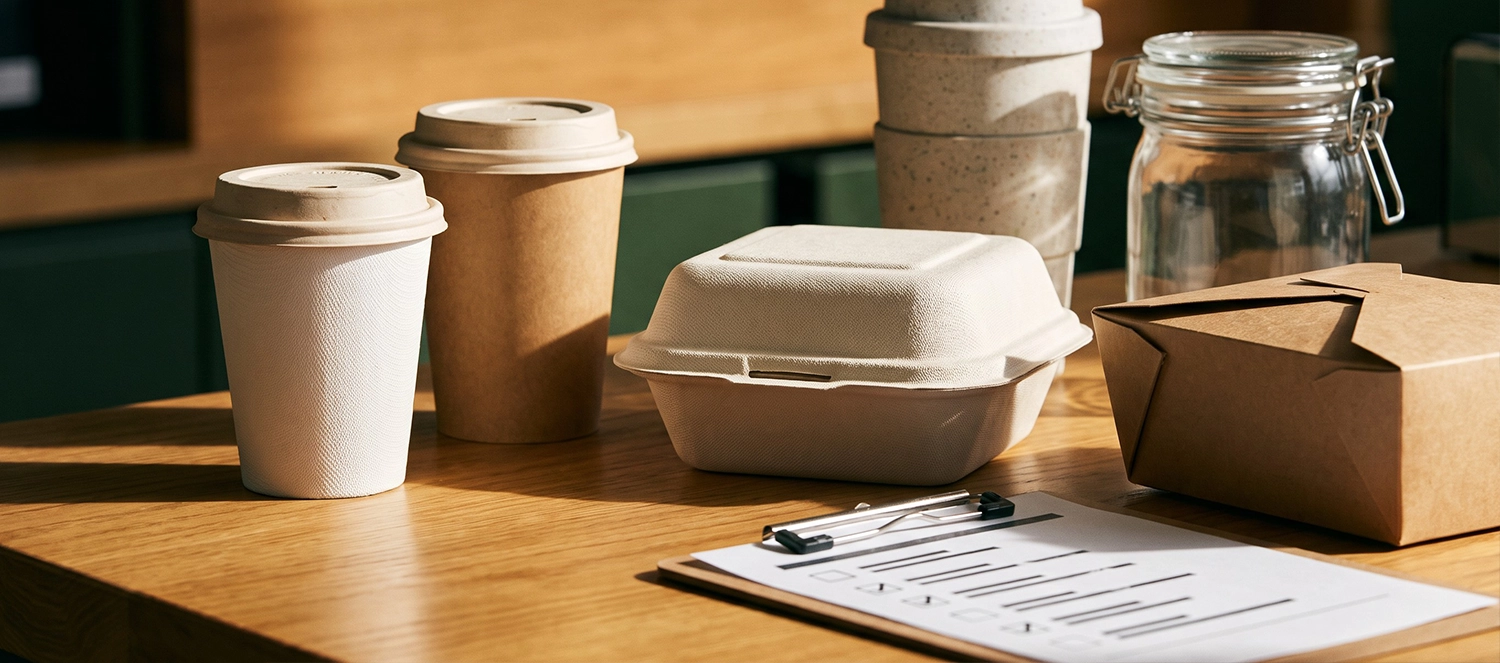
Compostable and biodegradable are two of the most frequently misused terms in sustainable packaging. For restaurants, horeca distributors, food brands and packaging buyers, the confusion between these terms has real commercial and compliance consequences: choosing a material described as “biodegradable” when your operation requires certified compostable packaging can result in failed waste management audits, non-compliance with EU procurement requirements, and greenwashing exposure.
This guide provides a complete, accurate explanation of the difference between compostable and biodegradable packaging — covering the science, the certifications, the regulatory landscape, and the practical implications for food service operations sourcing sustainable packaging for EU markets.
For bagasse specifically — how it is made and what its certifications mean — see our bagasse packaging guide.
What Does Biodegradable Mean?
Biodegradable describes any material that can be broken down by microorganisms — bacteria, fungi and other biological agents — into simpler natural substances including water, carbon dioxide and biomass. This is a chemical and biological process that occurs in nature for virtually all organic materials given sufficient time and conditions.
The critical limitation of the term “biodegradable” is that it carries no time constraint and no requirement for the end products of degradation to be safe or useful. A material that takes 500 years to break down in specific conditions is technically biodegradable. A material that partially degrades but leaves behind toxic residue or microplastic fragments is technically biodegradable. Conventional plastic is technically biodegradable over geological timeframes.
This means “biodegradable” as a standalone claim on packaging tells a buyer very little about:
- How long the material will actually take to break down under real-world conditions
- What conditions are required for breakdown to occur
- What the breakdown products are and whether they are safe
- Whether the material is recyclable or compostable under available waste infrastructure
For EU market operations, a bare “biodegradable” claim is now a legal risk: since 27 September 2026, Directive (EU) 2024/825 bans generic environmental claims, with “biodegradable” among its examples, unless they rest on recognized excellent environmental performance.
What Does Compostable Mean?
Compostable is a specific subset of biodegradable with defined performance requirements. Compostable packaging must meet verified standards that specify the timeframe, conditions and end-product quality of the biodegradation process.
Under the EU’s primary compostability standard EN13432, a packaging material is compostable if it meets all four of these criteria under industrial composting conditions:
- Biodegradation: at least 90 percent of the organic carbon must convert to CO2 within 6 months
- Disintegration: no more than 10 percent of the original dry weight may remain on a 2mm sieve after 12 weeks
- Eco-toxicity: the resulting compost must not have toxic effects on plant growth — verified by plant germination and growth tests
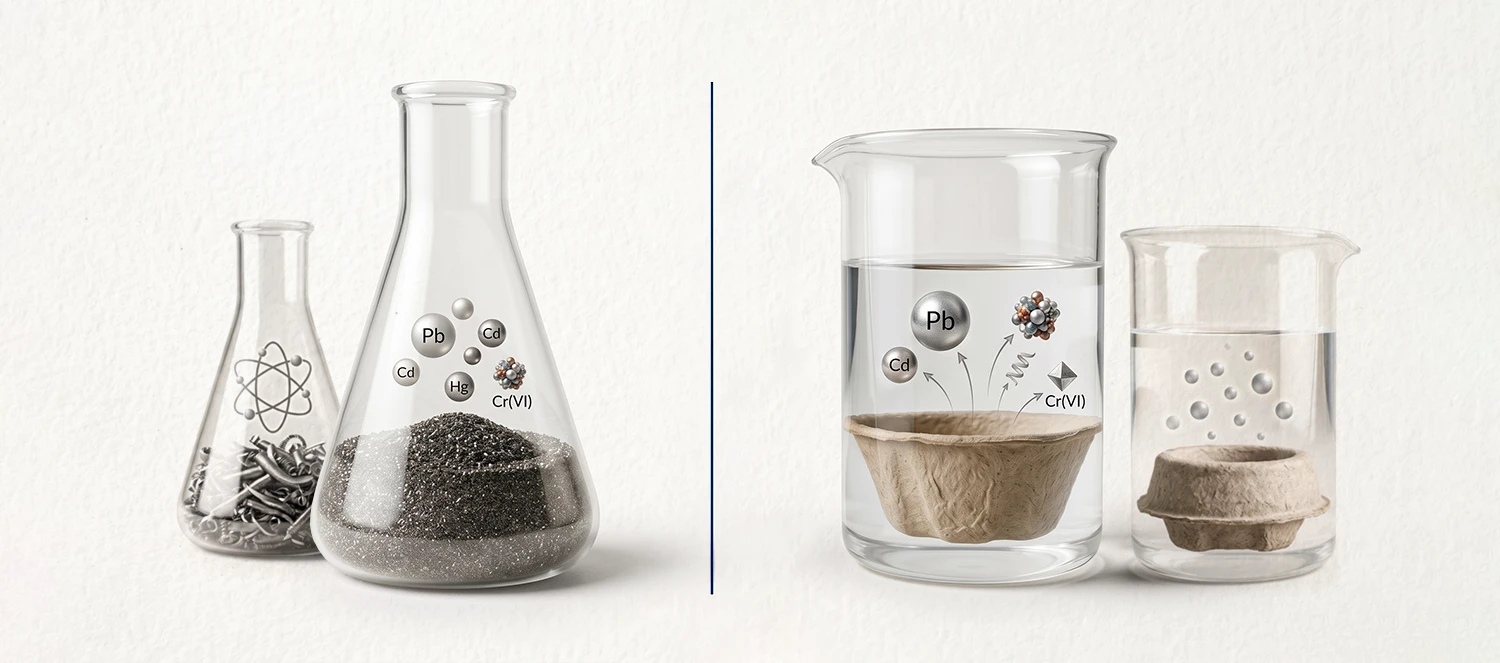
- Chemical safety: heavy metal content must be below defined limits with no harmful substances present above threshold levels
This means a certified compostable material has been independently tested and verified to break down completely, safely and within a defined timeframe under industrial composting conditions. This is a fundamentally different claim from “biodegradable”.
The Core Difference: Time, Conditions and End Products
The practical difference between biodegradable and compostable packaging comes down to three factors: how long it takes to break down, what conditions are required, and what the breakdown produces.
| Factor | Biodegradable Packaging | Compostable Packaging (EN13432) |
|---|---|---|
| Defined timeframe for breakdown | No — timeframe varies widely | Yes — 90% breakdown within 6 months |
| Specific conditions required | Variable — may require specific temperature, humidity or microbial environment | Yes — industrial composting conditions (55 to 60°C, controlled moisture and oxygen) |
| End products verified | No — may include toxic residues or microplastic fragments | Yes — CO2, water and compost with no toxic residue |
| Third-party certification | Not required — no standard definition | Required — EN13432 (EU), OK compost INDUSTRIAL or OK compost HOME (TÜV AUSTRIA), BPI (US) |
| Recyclable in paper stream | Depends on material | Depends on format and local system — PLA: no |
| Microplastic risk at end of life | Potentially yes — depends on material | No — verified by certification |
| Defensible under Directive (EU) 2024/825 | No — a generic claim, banned without proof of recognized excellent environmental performance | Yes — when the claim names the certified condition and the certificate covers the product |
| Compatible with EU waste infrastructure | Depends on material and local system | Yes — where industrial composting is available |
Industrial Composting vs Home Composting
Within certified compostable packaging, there is a further important distinction: industrial composting and home composting operate at different temperatures and conditions, and not all materials certified for industrial composting will break down adequately in a home compost system.
Industrial Composting
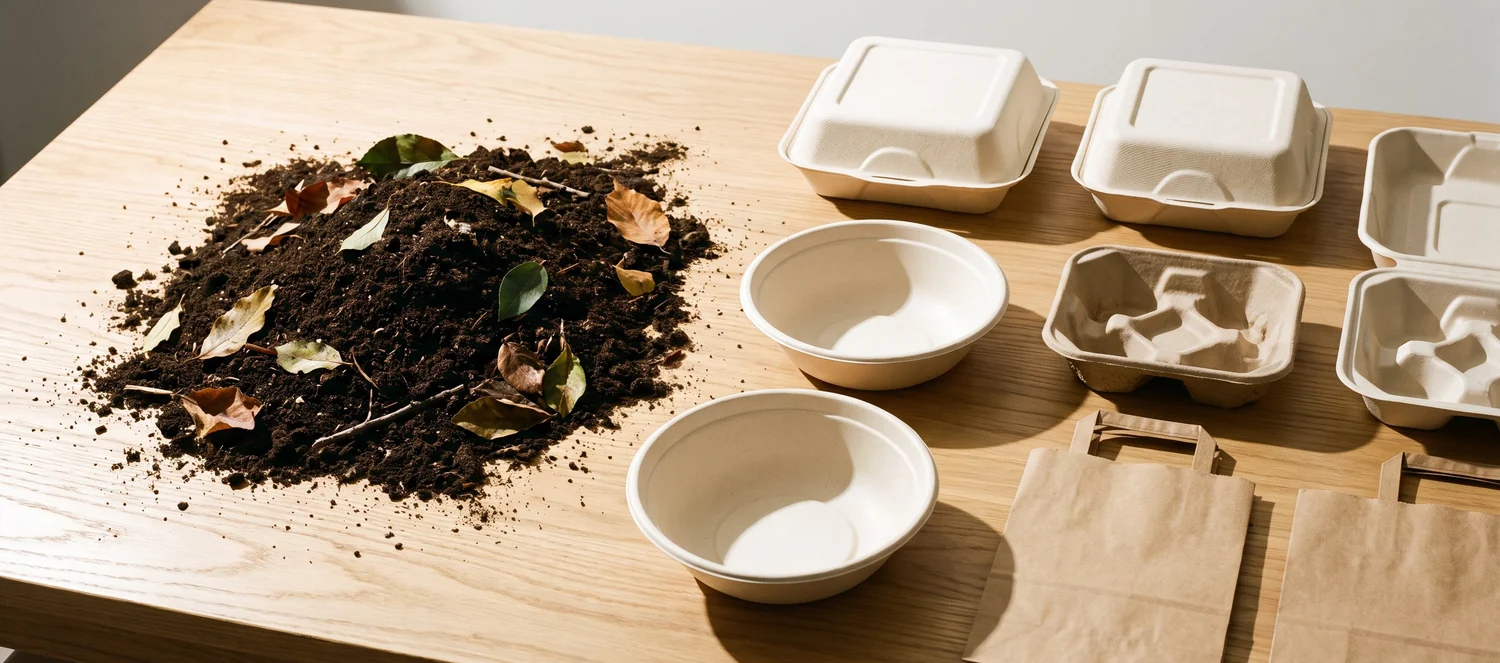
Industrial (also called municipal) composting operates at temperatures of 55 to 60°C with controlled moisture, oxygen levels and microbial activity. These elevated temperatures accelerate biodegradation significantly and are what EN13432 certification is based on. Certified industrial compostable materials break down within the required 6-month timeframe at these temperatures.
For food service operations, industrial composting is the relevant end-of-life pathway when food waste composting collection is available. Acceptance of certified compostable packaging in food waste collection varies widely by country and municipality — many systems accept only certified compostable bags, or no packaging at all — so check with the local collector before relying on this route.
Home Composting
Home composting operates at significantly lower temperatures — typically 20 to 35°C — with less controlled conditions. Materials that break down within 6 months at 55°C may take significantly longer at 25°C or may not fully disintegrate within a home composting timeframe.
OK compost HOME certification, issued by TÜV AUSTRIA as a separate certificate from OK compost INDUSTRIAL, specifically tests compostability under home composting conditions. This is a stricter certification for consumer-facing claims, confirming that the material breaks down adequately even in a garden compost pile without industrial infrastructure.
What This Means for Food Service Sourcing
For food service operations, EN13432 industrial compostable certification is the relevant standard for procurement documentation and EU market compliance. For operations that want to make explicit home compostability claims to consumers, OK compost HOME provides the additional certification needed.
Common Biodegradable and Compostable Materials in Food Service
Understanding how specific materials map to biodegradable and compostable categories helps operators make informed sourcing decisions.
Bagasse (Sugarcane Fiber)
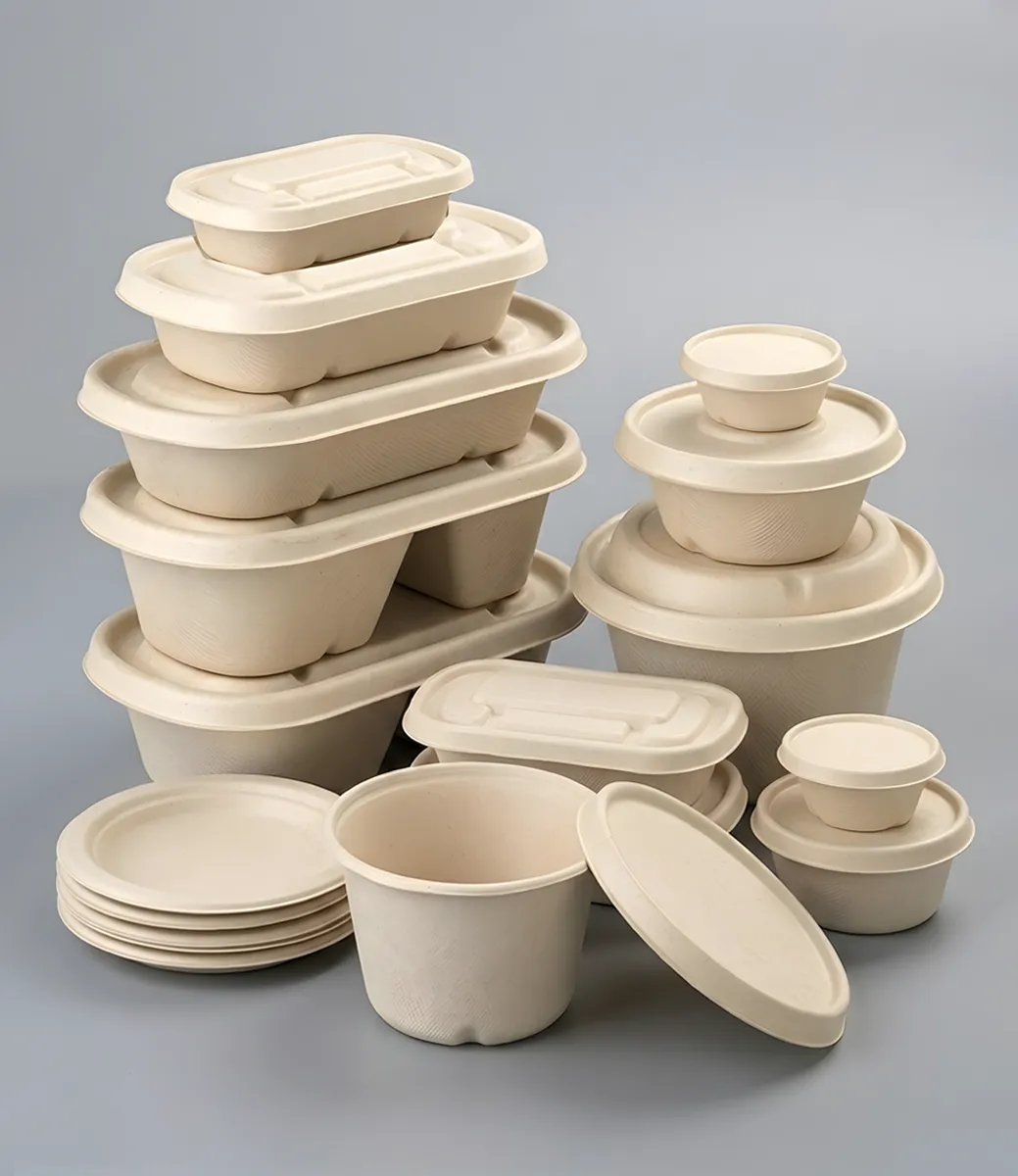
Bagasse is a plastic-free fiber material that can be composted. Whether a specific bagasse container meets EN13432 depends on its certification, so ask for the certificate covering the exact item and check who holds it. Bagasse is also biodegradable in the broader sense — it will break down in landfill conditions, though more slowly than under industrial composting. Our bagasse food containers are home compostable & 100% bagasse, certified by TÜV AUSTRIA (OK compost HOME); food-contact documentation is provided according to the final product specification and production route.
PLA (Polylactic Acid)
PLA is a bioplastic manufactured from plant starch (typically corn or sugarcane). It is biodegradable and can be certified to EN13432 as industrially compostable. However, PLA has significant limitations: it requires the elevated temperatures of industrial composting (55 to 60°C) to break down within the certified timeframe. At lower temperatures — including home composting environments and landfill conditions — PLA degrades very slowly, similarly to conventional plastic over practical timescales. PLA is not recyclable in standard paper or plastic streams. It is also not suitable for hot food applications above approximately 45 to 55°C due to its low heat deflection temperature.
Molded Fiber (Paper-Based)
Molded fiber lids and containers made from paper pulp can be compostable; whether that covers industrial or home composting depends on the certification of the specific product. They can go to paper recycling where local collection accepts them and food contamination is low. Molded fiber lids provide a practical plastic-free alternative to plastic cup lids for café and food service operations, with compostability documentation according to the final product specification and production route.
Paper with Water-Based Coating
Paper packaging with a water-based coating has no PE lining and is designed for paper recycling where local collection accepts it; it can be compostable where the specific product is certified. Ekoroll’s lid-free hot cups use a water-based, PFAS-free, PE-free coating. With water-based coating, these cups carry DIN CERTCO home compostable and industrially compostable (EN 13432) certification, held by the producing partner; copies on request. Water-based coated paper food containers carry DIN CERTCO home compostable and industrially compostable (EN 13432) certification, held by the producing partner. Our greaseproof paper is PFAS-free; we make no compostability claim for it.
PE-Coated Paper
PE-coated paper is technically biodegradable over very long timeframes, but it is not compostable and is hard to recycle in standard paper streams. The PE (polyethylene) plastic coating prevents composting within EN13432 timeframes and complicates recycling. Despite appearing to be a paper product, PE-coated packaging behaves as a plastic-containing material at end of life.
Wooden and Bamboo Cutlery
Wood and bamboo are natural materials that break down over time; a compostability claim applies only where the specific item is certified. Because they are not plastic, wooden and bamboo cutlery are a direct replacement for single-use plastic cutlery, which the EU SUP Directive bans.
EU Regulatory Framework
For food service operators and distributors in European markets, the regulatory requirements around compostable and biodegradable packaging claims are tightening significantly.
Directive (EU) 2024/825: Empowering Consumers for the Green Transition
The binding rule for environmental claims is Directive (EU) 2024/825, applicable from 27 September 2026. It bans generic environmental claims — such as “eco-friendly” or “biodegradable” — unless they rest on recognized excellent environmental performance, bans product-level “climate neutral” claims based on offsetting, and bans sustainability labels that are not based on a certification scheme or set by public authorities. Specific claims that name the condition and are backed by a certificate for the product, such as compostability certified to EN 13432 or OK compost HOME, remain possible. The separately proposed Green Claims Directive (COM(2023) 166) was not adopted: in June 2025 the Commission announced its intention to withdraw it. Unverified biodegradable claims are therefore a legal compliance risk, not just a marketing issue.
EU Single-Use Plastics Directive
The EU SUP Directive restricts or bans specific single-use plastic food packaging formats. Its scope is based on plastic content, not on compostability: bio-based or biodegradable plastics such as PLA and CPLA count as plastic even when certified to EN13432, so they are not exempt. Only materials outside the plastic definition — such as 100% unmodified natural fiber like bagasse, molded fiber without plastic, or wood — fall outside its plastic-specific measures.
EU Packaging and Packaging Waste Regulation
The PPWR, Regulation (EU) 2025/40, entered into force on 11 February 2025 and applies from 12 August 2026. It sets PFAS limits for food-contact packaging from that date, and recyclability criteria, harmonized labels and reuse targets follow in stages from 2028 to 2030. For food contact applications where recyclability is limited by contamination, certified compostable packaging with defined end-of-life pathways is well positioned under the PPWR framework compared to non-recyclable conventional plastic formats.
Key Certifications for EU Market Supply
- EN13432 — the primary European standard for industrial compostability. Required for substantiated compostable claims in EU markets
- OK compost INDUSTRIAL — TÜV AUSTRIA certification confirming EN13432 compliance
- OK compost HOME — a separate TÜV AUSTRIA certification confirming home composting performance
- BPI — Biodegradable Products Institute certification for North American markets
Practical Implications for Food Service Operations
For restaurants, food delivery operations and horeca distributors, the biodegradable vs compostable distinction has direct operational implications.
Waste Management Documentation
Operations participating in food waste composting programs — whether for compliance, ESG reporting or waste diversion targets — need certified compostable packaging, not just biodegradable packaging. Industrial composting operators typically accept only EN13432 certified materials alongside food waste. Materials labeled “biodegradable” without EN13432 certification are typically rejected by composting facilities.
B2B Procurement Requirements
Corporate food service accounts, hotel chains and retail brands increasingly specify certified compostable packaging as a procurement condition for supplier qualification. EN13432 certification is the document required to demonstrate compliance. Biodegradable claims without certification do not satisfy these procurement requirements.
Consumer Communication
Under Directive (EU) 2024/825, applicable since 27 September 2026, telling customers that packaging is “biodegradable” as a generic claim is a banned practice. Specific compostability claims, substantiated by a certificate covering the product, are the legally defensible environmental communication for food packaging in EU markets.
Choosing the Right Packaging for Your Operation
- Hot food containers and meal boxes: plastic-free bagasse — strong hot-food performance (PFAS-free, water- and oil-resistant, microwave- and freezer-safe); Ekoroll’s bagasse is home compostable & 100% bagasse, certified by TÜV AUSTRIA (OK compost HOME)
- Beverage cups: water-based coated paper cups — water-based, PFAS-free, PE-free coating with no PE lining. Lid-free cups with water-based coating carry DIN CERTCO home compostable and industrially compostable (EN 13432) certification, held by the producing partner; copies on request
- Cup lids: molded fiber lids with compostability documentation, or lid-free cup formats
- Cutlery: wooden or bamboo — natural material, not plastic under the EU SUP Directive; compostability only where the specific item is certified
- Wrapping paper: PFAS-free greaseproof paper — ask for the documentation of the specific grade
Sustainable Packaging Wholesale for Restaurants and Horeca
Ekoroll supplies fiber- and paper-based packaging wholesale to restaurants, food delivery brands and horeca distributors across Europe. Bagasse food containers, lid-free cups, molded fiber lids, wooden cutlery and PFAS-free greaseproof paper — all available from a single wholesale supplier, with food-contact documentation according to the final product specification and production route. Ekoroll’s bagasse is home compostable & 100% bagasse (TÜV AUSTRIA OK compost HOME); the certificate is held by the producing mill and a copy is available on request. Explore our complete packaging range or contact us for wholesale pricing and samples.