
If you operate a café, restaurant, food delivery business or distribute horeca packaging in European markets, 2026 is not a regulatory quiet year. The EU Packaging and Packaging Waste Regulation (PPWR) has applied since 12 August 2026, starting with PFAS limits for food-contact packaging. Directive (EU) 2024/825 on environmental claims has applied since 27 September 2026. The Single-Use Plastics Directive measures for plastic cups, lids and food containers continue to tighten through national reduction measures and levies. And plastic taxes in some markets keep rising.
This guide is a practical compliance action plan for horeca businesses in 2026. It does not repeat the background of EU packaging regulation (see: EU Plastic Ban Explained for that). It focuses on what you need to have done, verified and documented by the end of 2026 to avoid legal liability, maintain procurement stability and support the claims you make about your packaging.
The 2026 Compliance Checklist for Horeca Packaging
Work through this checklist by packaging format. Each item is either a current legal requirement, an active financial obligation or a 2026 milestone.
Beverage Cups
- Tethered caps [NOT FOR CUPS]: the SUP tethered-cap rule (since July 2024) applies to bottles and beverage cartons, not cups. Snap-on plastic cup lids are legal and do not need to be tethered. No action required on this point — but check that suppliers or advisers are not selling you a “tethered lid compliance” problem that does not exist.
- SUP measures for plastic cups and lids [CURRENT]: cups made partly of plastic (PE- or PLA-lined) must carry the SUP marking; member states apply consumption-reduction measures to single-use cups including their lids (in Germany, for example, the obligation to offer a reusable option); producers of plastic cups and lids are covered by EPR and, in Germany, pay into the Single-Use Plastics Fund. Action required: confirm the marking on your plastic-lined cups and check the reduction measures in each market. Lid-free cups and molded fiber lids remove the plastic lid from this picture.
- Plastic taxes and levies [CURRENT — UK, ES; DE fund]: plastic lids are taxed under the UK Plastic Packaging Tax and the Spanish plastic tax; in Spain, the plastic portion of PE-lined cups is taxed too. Action required: verify your actual exposure and confirm whether it is being correctly accounted for. If switching to water-based coated cups, confirm the coating type in writing from your supplier (marketing claims are not documentation).
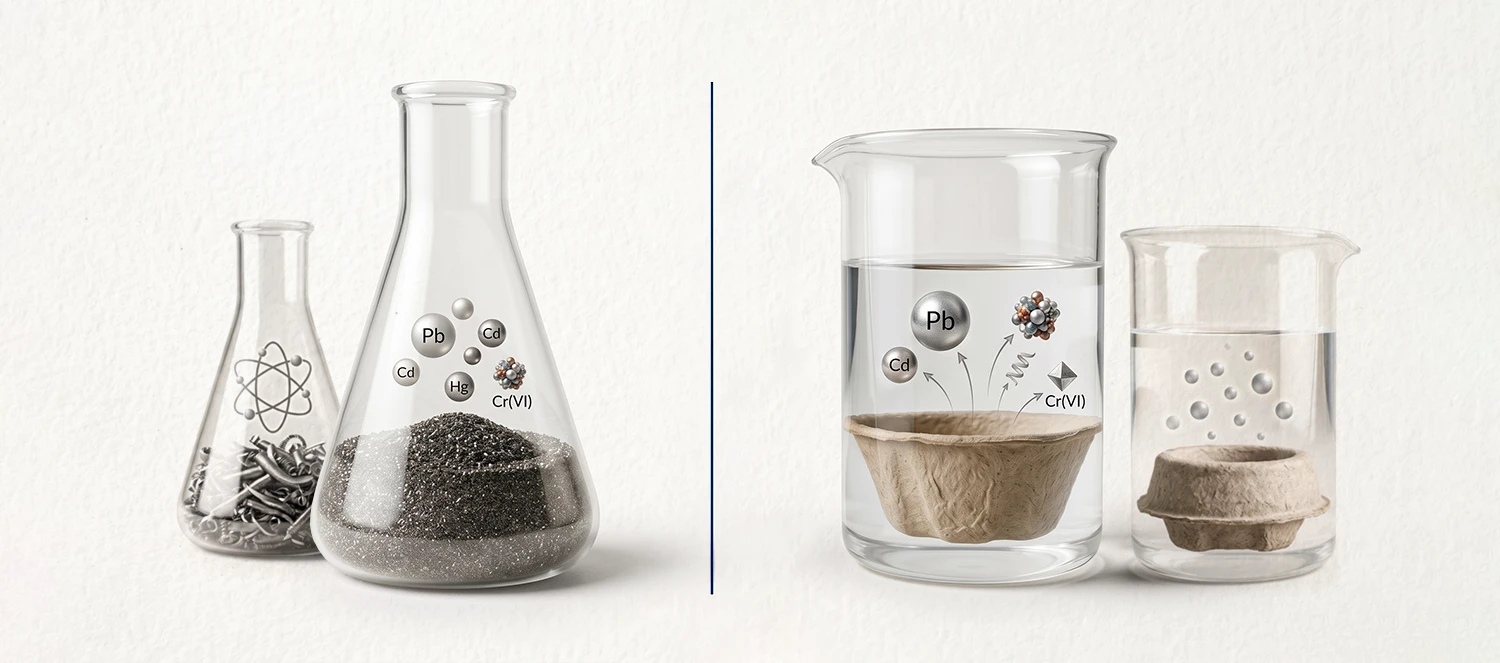
- PPWR PFAS limits [APPLYING SINCE 12 AUGUST 2026]: PFAS in food-contact packaging are limited to 25 ppb for any single PFAS, 250 ppb for the sum of PFAS and 50 ppm total PFAS including polymeric PFAS. Denmark has banned PFAS in paper and board food-contact materials since 2020. Action required: request PFAS third-party laboratory test results for your cup formats covering both paper substrate and coating. See: PFAS-Free Paper Cups Guide.
- PPWR recyclability [2028–2030]: recyclability criteria follow in stages. PE-lined cups that are hard to recycle in standard paper streams face increasing pressure. Action required: confirm your cup coating specification. If PE-lined, add a transition to water-based coated formats to your procurement roadmap.
- Environmental claims [APPLYING SINCE 27 SEPTEMBER 2026]: under Directive (EU) 2024/825, generic claims about your cups — “eco-friendly cups,” “sustainable packaging,” “green” — are banned unless you can show recognized excellent environmental performance. Action required: replace them with specific claims you can document: “PE-free coating” requires written confirmation of water-based coating (coated paper cups should not be called “plastic-free”); “PFAS-free” requires laboratory test results; “compostable” requires a certificate for the specific product.
Food Containers
- EPS containers [BANNED — current]: expanded polystyrene food containers have been banned for EU market supply since July 2021. If any EPS containers remain in your operation, remove them immediately.
- Plastic food containers — SUP and EPR [CURRENT]: PP and PET food containers fall under SUP consumption-reduction measures and EPR, and in Germany under the Single-Use Plastics Fund; in Portugal a €0.30 contribution applies per single-use plastic or aluminium take-away meal package. Action required: confirm your EPR registration status and contributions for each market you operate in.
- All packaging — EPR [CURRENT]: EPR applies to all packaging, including paper and bagasse (in Germany, for example, VerpackG system participation and LUCID registration). Bagasse avoids plastic-specific measures because it contains no plastic, but not EPR.
- Bagasse and fiber containers — compostability claims [CLAIMS RULES SINCE 27 SEPTEMBER 2026]: if you claim your containers are “compostable” in customer communications, you need a certificate for the specific container from a recognized body (TÜV AUSTRIA OK compost INDUSTRIAL or OK compost HOME — two separate certificates — or DIN CERTCO). Self-declared compostability is not sufficient.
Lids
- Plastic cup lids [CURRENT]: legal and not subject to the tethered-cap rule, but covered by SUP reduction measures, EPR, Germany’s Single-Use Plastics Fund and plastic taxes in the UK and Spain. See the beverage cups section above.
- Molded fiber lids — documentation [CLAIMS RULES]: if making compostability claims about your lids, a certificate for the specific lid is required. If making PFAS-free claims about barrier-treated fiber lids, laboratory test results are required.
Cutlery
- Plastic cutlery — SUP ban [CURRENT LAW — since July 2021]: plastic cutlery for food service is prohibited, including bio-based plastics such as PLA and CPLA. If any plastic cutlery remains in your operation, it must be replaced immediately. Wooden and bamboo FSC-certified alternatives are the standard replacement.
- Wooden cutlery — certification [CLAIMS RULES]: claims about “sustainable wood” or “FSC-certified cutlery” require FSC certification documentation. Compostability may be claimed only where the specific item is certified. Confirm this with your supplier.
Greaseproof Paper
- PFAS in greaseproof paper [PPWR LIMITS SINCE 12 AUGUST 2026; DK BAN SINCE 2020]: PFAS have been widely used in greaseproof paper for oil resistance. Action required: request PFAS laboratory test results from your supplier covering both substrate and any coating. This is the most commonly missing document in otherwise well-documented packaging systems. Do not describe greaseproof paper as compostable unless the specific product holds a compostability certificate. See: Greaseproof Paper Burger Wrap Guide.
Environmental Claims: What Changed in 2026
Directive (EU) 2024/825 (Empowering Consumers for the Green Transition) is the most significant regulatory development for horeca packaging communications in 2026. It amends the EU’s unfair commercial practices rules and has applied since 27 September 2026. The separately proposed Green Claims Directive (COM(2023) 166), which would have added detailed verification rules, was not adopted: in June 2025 the Commission announced its intention to withdraw it.
What the Directive Actually Requires
Under Directive (EU) 2024/825:
- Generic environmental claims — “eco-friendly,” “green,” “environmentally friendly” — are banned unless the trader can show recognized excellent environmental performance relevant to the claim
- Claims that a product is “climate neutral” or has a reduced climate impact based on greenhouse gas offsetting are banned
- Sustainability labels are banned unless they are based on a certification scheme or established by public authorities
- Specific claims must still be truthful and substantiated under the general rules on misleading practices — expired certificates do not support active claims
Claims and the Documentation Behind Them
| Claim | Required Documentation | Who Issues It |
|---|---|---|
| “Compostable” or “industrially compostable” | Certificate for the specific product (industrial, EN 13432 based, or home) | TÜV AUSTRIA or DIN CERTCO |
| “PE-free coated cups” | Written coating type confirmation (water-based, not PE/PLA) | Producer documentation |
| “PFAS-free” packaging | Laboratory test results covering substrate and coating | ISO 17025 accredited laboratory |
| “Recyclable” cups or containers | Written recyclability statement with its conditions | Producer or third-party verification |
| “FSC certified” cutlery | FSC certification for the specific product | FSC or PEFC |
| “Food safe” or “EU compliant” | EC 1935/2004 Declaration of Compliance for specific product | Producer declaration |
Claims You Should Stop Making
The following phrases are generic environmental claims and are banned under Directive (EU) 2024/825 unless you can show recognized excellent environmental performance:
- “Eco-friendly packaging”
- “Sustainable cups”
- “Green packaging”
- “Environmentally responsible”
The practical guidance: replace general claims with specific ones you can document. “Our cups have a water-based, PFAS-free, PE-free coating and no plastic lid” is a defensible set of specific claims if you have the documentation. “Our packaging is eco-friendly” is not.
Plastic Taxes and Levies: Current Rates and Markets
Plastic-specific taxes and levies are the most direct financial impact of packaging regulation on day-to-day procurement costs. Here is the status by market in 2026:
| Market | Measure | In Force Since | Applies To | Status 2026 |
|---|---|---|---|---|
| United Kingdom (not EU) | Plastic Packaging Tax: £223.69 per tonne from 1 April 2025, £228.82 per tonne from 1 April 2026, on components with less than 30% recycled plastic | April 2022 | Predominantly plastic packaging components, such as plastic lids | Active |
| Spain | Tax of €0.45 per kg of non-reusable plastic packaging | January 2023 | Plastic packaging, including the plastic portion of composite packaging and plastic lids | Active |
| Italy | Plastic tax of €0.45 per kg | Repeatedly postponed, now to 2027 | Single-use plastic products | Not in force |
| Germany | No plastic packaging tax. Single-Use Plastics Fund (Einwegkunststofffonds); separately, VerpackG licensing fees for all packaging | Fund payments based on quantities placed on the market since 2024 | Fund: producers of certain single-use plastic products, including cups for beverages and their lids and food containers. VerpackG: all packaging, including paper and bagasse | Active |
| France | No per-kg plastic packaging tax; eco-modulated EPR fees under the AGEC law | 2020 onward | All packaging, with fees modulated by material and recyclability | Active |
| Portugal | €0.30 contribution per single-use plastic or aluminium take-away/delivery ready-meal package (a per-package levy, not a per-kg tax) | Plastic July 2022; aluminium September 2023 | Plastic and aluminium take-away meal packaging | Active |
Separately, the EU plastic own resource (€0.80 per kg of non-recycled plastic packaging waste) is paid by member states to the EU budget; it is not a tax on companies. For operations in multiple markets, calculate your total annual exposure across all markets. For the calculation methodology and per-format cost analysis, see: Sustainable Packaging Cost Analysis.
PPWR 2026 Update: What Applies Now and What Follows
The EU Packaging and Packaging Waste Regulation, Regulation (EU) 2025/40, entered into force on 11 February 2025 and has applied since 12 August 2026. The 2026 position is:
For the complete timeline from 2026 to 2040, who carries which obligation and what is still changing, see PPWR explained.
What Applies Now
- PFAS limits for food-contact packaging since 12 August 2026: 25 ppb for any single PFAS (targeted analysis), 250 ppb for the sum of PFAS (targeted analysis), 50 ppm total PFAS including polymeric PFAS
- The PPWR replaces the earlier Packaging Directive as the EU framework for packaging, while national EPR schemes continue to apply to all packaging
What Is Coming
- From 2028 to 2030: recyclability criteria, harmonized labels and reuse targets phase in
- PE-lined cups that are hard to recycle in standard paper streams will face direct pressure as the recyclability criteria apply
- Water-based coated cups are designed for paper recycling where local collection accepts them, which positions them better for these criteria
The Procurement Implication
Operations that have not yet confirmed their cup coating specification should do so now. PE-lined cups purchased today build toward a forced transition between 2028 and 2030. The procurement decision made in 2026 determines whether you face a planned or reactive change.
2026 Action Plan by Operation Type
Independent Café
Priority actions in order:
- Replace any remaining plastic cutlery, straws or stirrers (including PLA versions) with wooden or paper alternatives
- Confirm cup coating specification in writing from your supplier, and check the SUP marking on plastic-lined cups
- Request PFAS test results for your cups and greaseproof paper against the PPWR limits
- Decide on your lid format: plastic lids are legal but carry reduction measures and levies; molded fiber lids or lid-free cups remove them
- Audit your packaging communications for generic environmental claims and replace them with specific, documented ones
Coffee Chain (Multi-Location)
Priority actions in order:
- Map the SUP consumption-reduction measures for cups and lids in every market you operate in (for example reusable-option obligations or charges on single-use cups)
- Consolidate cup specification to water-based coated formats across the network
- Build a central documentation portfolio (compostability certificates, PFAS test results, coating confirmation, EC 1935/2004) that covers all packaging formats used across locations
- Align marketing and menu communications with Directive (EU) 2024/825 — remove generic environmental claims, replace with specific documented ones
- Assess plastic tax, levy and EPR exposure across all markets operated and factor it into annual procurement cost planning
Food Delivery Operation
Priority actions in order:
- Check plastic food containers and beverage cups against SUP measures, EPR and national levies (including Portugal’s per-package contribution and Germany’s Single-Use Plastics Fund)
- Confirm PFAS status for greaseproof paper formats — this is the most commonly missing documentation in delivery packaging systems
- Verify a product-specific compostability certificate for any container claimed to be compostable
- Confirm plastic cutlery has been fully replaced with wooden or bamboo alternatives
- Build a documentation package for your plastic-reduced delivery packaging claims
Horeca Distributor
Priority actions in order:
- Audit your product range for documentation gaps — specifically: compostability certificates for compostable claims, PFAS test results for paper-based formats, coating type confirmation for cups
- Update supplier contracts to require documentation updates when product formulations change
- Build per-product customer-facing documentation packages
- Review your sales communications under Directive (EU) 2024/825 — claims made by distributors about products they sell are covered
- Identify product categories where documentation gaps expose your customers to compliance risk — address these proactively before customer procurement teams do it reactively
Building Your Documentation Portfolio
The practical output of 2026 compliance work is a documentation portfolio: a set of current, verified certificates and test results that cover every packaging format you use and every claim you make. This portfolio needs to be:
- Product-specific: blanket supplier sustainability declarations are not certification. Each specific product format needs its own documentation.
- Current: compostability certificates expire. PFAS test results can become outdated if formulations change. Set an annual review calendar for every certification in your portfolio.
- Accessible: documentation needs to be available when customers, procurement teams or regulators request it — not retrievable in three weeks from a supplier.
- Supplier-verified: if a supplier cannot provide the documentation you need, that is a supplier qualification issue, not a documentation management issue. Resolve it at the supplier level.
For the complete supplier qualification framework, see: How to Choose a Food Packaging Supplier for EU Markets. For the horeca procurement framework, see: Horeca Packaging Procurement Guide.
Packaging with Full Documentation: Ready for 2026
Ekoroll supplies horeca operators and distributors across Europe with water-based coated cups, bagasse containers, PFAS-free greaseproof paper and wooden cutlery — with product documentation including EC 1935/2004 declarations and PFAS test results, plus food-contact documentation according to the final product specification and production route. Ekoroll’s bagasse containers are home compostable & 100% bagasse, certified by TÜV AUSTRIA (OK compost HOME), with a copy of the certificate available on request. With water-based coating, the paper cups carry DIN CERTCO home compostable and industrially compostable (EN 13432) certification, held by the producing partner; copies on request. Supplied from Turkey. Contact us with your packaging requirements for a documentation review.