The coating inside a paper cup is invisible to the customer — but it determines whether the cup is recyclable, whether it releases microplastics into hot beverages, and whether it creates compliance risk for food service operations in European markets. For cafés, coffee chains, horeca distributors and packaging buyers, understanding the difference between water-based coating and PE (polyethylene) coating in paper cups is no longer a technical detail. It is a procurement decision with real operational, regulatory and commercial consequences.
This guide provides a complete, accurate comparison of water-based coating vs PE coating in paper cups, covering how each coating works, how they perform under real service conditions, their recyclability and environmental profiles, the microplastic evidence, EU regulatory status, and the practical implications for food service purchasing decisions.
For wholesale supply of water-based coated paper cups, explore Ekoroll lid-free hot cups and lid-free cold cups with water-based coating.
How Paper Cup Coatings Work
Paper alone is not a suitable material for hot liquid contact. Without a barrier layer on the interior surface, paper absorbs liquid rapidly, losing structural integrity within seconds. The coating applied to the food-contact interior surface of a paper cup creates the liquid barrier that makes the cup functional.
The choice of coating material determines the cup’s recyclability, its food safety profile, its environmental end-of-life pathway, and its regulatory compliance status in European markets.
PE (Polyethylene) Coating
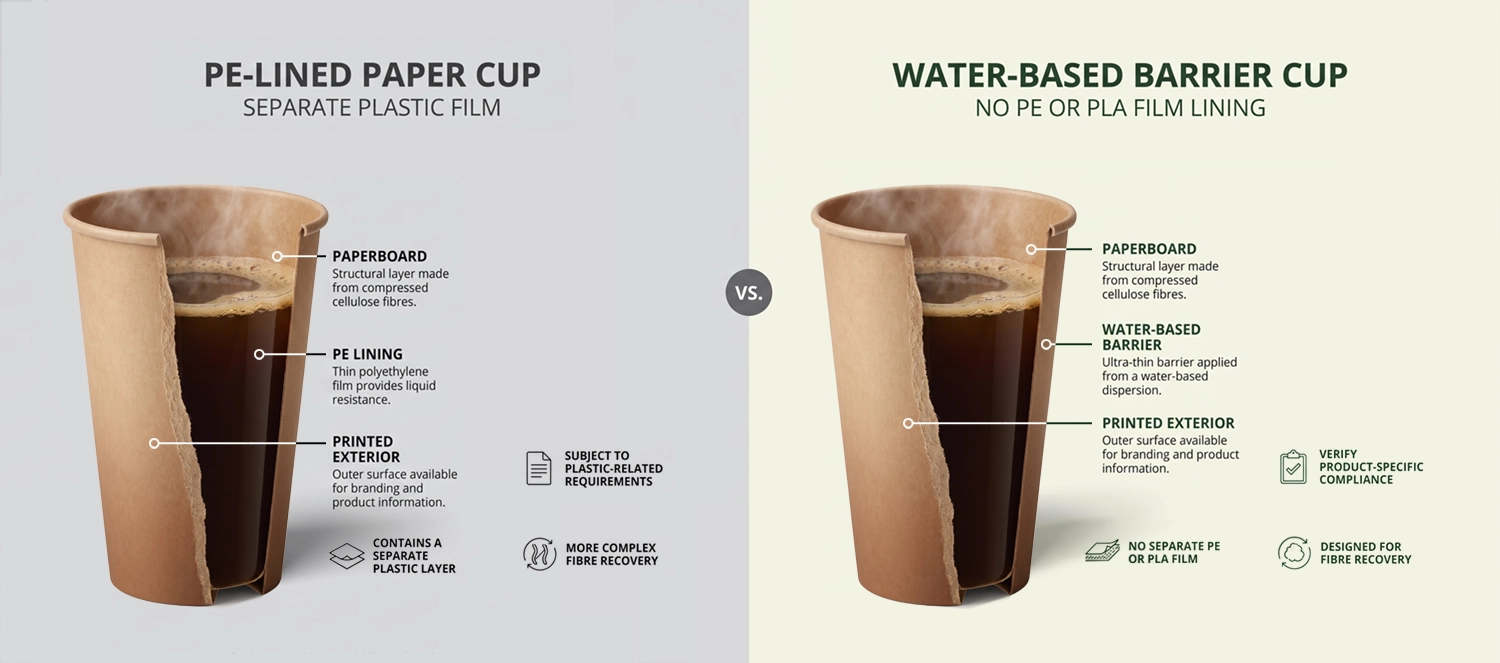
PE coating involves applying a thin layer of polyethylene — a petroleum-derived thermoplastic — to the interior surface of the paper cup during manufacturing. The PE layer is typically 5 to 15 grams per square meter, creating a smooth plastic film that is bonded to the paper substrate.
PE has been the dominant cup coating for decades due to its low cost, reliable liquid resistance and proven performance under hot beverage conditions. The majority of paper cups sold globally still use PE coating. This includes many cups marketed as “paper cups” or even as “eco-friendly” — despite containing a plastic layer that significantly affects end-of-life recyclability and food contact safety.
PLA Coating
PLA (polylactic acid) is a bio-based plastic derived from plant starch (typically corn or sugarcane) used as an alternative to PE in some cup formats marketed as “compostable.” PLA coating behaves similarly to PE in terms of the recycling problem — it prevents the cup from being recycled in standard paper streams — and requires specific industrial composting conditions to break down. PLA also has significantly lower heat tolerance than PE, softening at approximately 55°C, which creates performance limitations for hot beverage use.
Water-Based Coating
Water-based coating uses a dispersion of polymer compounds in water, applied to the interior surface of the cup and dried to form a barrier layer. Unlike PE or PLA, water-based coating carries no extruded petroleum-derived film and no extruded bio-based film. The barrier is built in place from the dried dispersion, which provides liquid resistance without an extruded plastic film in the cup structure.
Water-based coating technology has advanced significantly over the past decade. Current formulations provide liquid resistance and heat tolerance suitable for standard hot and cold beverage service, including espresso, lattes, americanos and iced drinks across the full range of café and food service conditions.
Aqueous Coating for Paper Cups: A Technical Explanation
What is aqueous coating?
Aqueous coating is a barrier applied to paperboard as a polymer dispersion carried in water. The dispersion is spread onto the board, the water evaporates during drying, and the polymer particles coalesce into a continuous barrier layer bonded to the fiber surface. In paper cup manufacturing, aqueous coating is the main alternative to extrusion coating, which laminates a pre-formed plastic film onto the board instead.
Aqueous barrier coatings are typically applied at a few grams per square meter. Published work on waterborne dispersion coatings for paperboard reports coat weights in the range of roughly 2 to 9 g/m², depending on the barrier requirement. That is a fundamentally different construction from an extruded film, and the difference matters at both ends of the cup’s life.
Aqueous coating vs extrusion coating: how the barrier reaches the board
Extrusion coating melts polyethylene and lays it onto the board as a continuous film. The film is the barrier, and it sits as a discrete plastic layer on the fiber surface. It is fast, reliable and it heat-seals well, which is why PE extrusion has been the industry default for decades.
Aqueous coating never forms a free-standing film. The barrier is built in place from a dispersion, which means the polymer is distributed into and across the fiber surface rather than laminated on top of it. This is why aqueous coated board behaves differently during repulping: an extruded film survives the pulper as a sheet of plastic that has to be screened out, while a dispersion layer is designed to break up and release the fiber.
Whether that design intent is achieved in a given product is a question for a repulpability test on that product, not an assumption you can make from the words “aqueous coating”.
Is aqueous coating the same as water-based coating?
Yes. Aqueous coating, water-based coating and dispersion coating all describe the same approach in paper cup production. Suppliers use the terms interchangeably, and technical literature tends to prefer “aqueous dispersion” or “waterborne dispersion” while commercial material more often says “water-based”.
If you are comparing quotations and one supplier writes “aqueous barrier coating” while another writes “water-based coated paper cups”, they are describing the same family of product. The difference between those two quotations will be in the polymer chemistry, the coat weight and the test evidence — not in the word.
Are water-based coated paper cups plastic-free?
This is the question behind most searches for plastic-free packaging, and the accurate answer is more useful to a buyer than a label would be.
A water-based coated cup carries no extruded plastic film — no PE and no PLA layer laminated onto the board. That is a real, verifiable difference from a conventional paper cup, and it is what changes the recycling and composting outcome. But the barrier itself is a polymer, delivered as a dispersion rather than as a film, and several regulatory definitions of “plastic” — including those used for packaging taxes and EPR schemes — are written broadly enough to capture polymer coatings as well as films.
So we do not describe our cups as plastic-free. We describe what is actually in them and what has been tested: an aqueous dispersion barrier with no extruded film, PFAS-free confirmed by total fluorine testing rather than by targeted analysis alone. With water-based coating, the cups carry DIN CERTCO home compostable and industrially compostable (EN 13432) certification, held by the producing partner; copies are available on request. In Ekoroll’s internal test, water-based coated lid-free cups filled with water for more than a month showed no leakage, no softening and no water penetration. If you are sourcing plastic-free packaging, those are the facts that let you answer your own customers, your EPR filing and your obligations under Directive (EU) 2024/825 on environmental claims. A supplier who answers the question with the word instead of the documents has not answered it.
What aqueous coating does not tell you
An aqueous coating is still a polymer. The word “aqueous” describes the carrier the barrier arrives in, not the absence of polymer from the finished cup. Technical literature classifies dispersion barrier coatings as polymeric materials, and some regulatory definitions of “plastic” are written broadly enough to capture polymer coatings as well as films. Any statement about plastic content, tax liability or end-of-life behavior has to come from the material declaration for the specific product, not from the coating category.
Aqueous coatings also vary enormously between suppliers. Barrier performance against water, grease and water vapor depends on the polymer chemistry and the coat weight, and two cups both described as aqueous coated can behave very differently with a hot drink held for twenty minutes.
What to ask about an aqueous coated cup
Four documents settle most of the questions a buyer actually has about an aqueous coated paper cup:
- The food-contact declaration for the finished cup, not for the coating raw material
- The repulpability test report for the exact format and coat weight you are buying
- The temperature and contact-time conditions the cup has been assessed against
- The material declaration, if you need to assess plastic content for a tax or EPR regime
A supplier who coats with an aqueous barrier and cannot produce these is selling you a word. Ask for the documents before you ask for the price.
Microplastics: The Critical Food Safety Issue
The most significant food safety concern with PE-coated paper cups is microplastic migration into hot beverages. This is not a theoretical risk — it is documented in peer-reviewed research.
What the Research Shows
Studies published in peer-reviewed journals have documented that PE-coated paper cups release microplastic and nanoplastic particles into hot liquid contents during normal use. When hot water or hot beverages are poured into a PE-lined paper cup, the thermal stress on the PE coating causes particles to detach and enter the liquid. Research has identified tens of thousands of microplastic particles per cup in hot beverage conditions.
The health implications of microplastic exposure are under active research; the European Food Safety Authority has said that more data are needed before the risk from micro- and nanoplastics in food can be assessed.
Why This Matters for Food Service Operations
For cafés and coffee service operations serving hundreds of hot beverages per day, the cumulative microplastic exposure from PE-lined cups across a customer base is significant. As consumer awareness of microplastics in food packaging increases — driven by media coverage and regulatory attention — this is becoming a brand risk for food service operations still using PE-lined cups.
Water-Based Coating and Microplastics
Water-based coated cups carry no extruded PE or PLA film in the cup body. There is no laminated plastic layer to shed particles into beverages under thermal stress. This removes the documented microplastic migration pathway associated with PE-lined cups under hot beverage conditions.
Recyclability: The End-of-Life Difference
The recyclability difference between PE-coated and water-based coated paper cups is one of the most commercially relevant distinctions for food service operations in European markets.
Why PE-Coated Cups Are Hard to Recycle in Standard Paper Streams
Paper recycling works by repulping paper fiber in water — a process called pulping. For this to work effectively, the paper fiber must separate from any coating or contamination. PE plastic does not dissolve or separate in the pulping process — it remains as plastic film that contaminates the paper fiber stream. As a result, many standard paper recycling facilities reject PE-coated paper cups. In most European markets, PE-lined paper cups end up in general waste — landfill or incineration — despite appearing to be paper products.
Some specialist cup recycling programs exist in specific markets (notably the UK’s Cup Recycling initiative), but these require separate collection infrastructure and cover a small fraction of total cup disposal volume.
Why Water-Based Coated Cups Are Designed for Paper Recycling
Water-based coating is designed to avoid the pulping problem of PE. The polymer dispersion is designed to break up and release the paper fiber during pulping, so the fiber can be recovered in paper recycling. Water-based coated paper cups are therefore designed for paper recycling where local collection accepts them; whether a given cup is actually recycled depends on a repulpability test for that format and on the collection rules in your market.
This is a practical advantage for food service operations whose customers are recycling-aware. Any recyclability statement you make to consumers should say exactly that, and be backed by the test report, to meet Directive (EU) 2024/825.
Compostability
Compostability has to be certified for the finished product, not inferred from the coating type — and industrial and home composting are two separate certifications, tested to different standards under different conditions. Most certified cups on the market hold the industrial one only.
With water-based coating, the cups carry DIN CERTCO home compostable and industrially compostable (EN 13432) certification, held by the producing partner; copies are available on request.
Read the scope, not just the standard. A certificate covers named board types, constructions and formats, so ask for the copy and check that it covers the specific cup you are specifying.
Apply the same test to every supplier. If one tells you a cup is compostable, ask three things: which standard, which registration number, and which exact format and construction the certificate covers. A certificate held against a coated board, rather than against the finished cup, does not make the cup compostable — and a certificate for industrial composting says nothing about what happens in a garden compost heap.
Performance Comparison: Water-Based vs PE Coating
For food service operators, functional performance under real service conditions is the primary practical consideration alongside recyclability and food safety.
| Feature | PE-Coated Paper Cups | Water-Based Coated Paper Cups | PLA-Coated Paper Cups |
|---|---|---|---|
| Plastic content | PE — petroleum-derived plastic | Aqueous dispersion — no extruded plastic film | PLA — bio-based plastic |
| Hot beverage performance | Excellent — reliable under all hot beverage conditions | Good — suitable for standard café hot beverage service | Limited — softens above approximately 55°C |
| Cold beverage performance | Good | Good | Good |
| Microplastic migration risk | Documented — PE particles released under heat | No extruded PE or PLA film to shed particles | Documented — PLA particles released under heat |
| Paper recycling | Difficult — PE film must be screened out | Designed for paper recycling where local collection accepts it — check repulpability per format | Difficult — PLA film must be screened out |
| EN 13432 industrial compostable | No | Only if certified | Only if certified |
| Home compostable | No | Only if certified | No |
| PFAS | Varies — request testing | PFAS-free — total fluorine tested | Varies — request testing |
| EU SUP Directive status | Partly plastic — marking and EPR apply | No extruded plastic film — classification depends on coating chemistry; confirm for your format | Partly plastic — bio-based plastics count as plastic under the Commission’s 2021 guidelines; marking and EPR apply |
| Plastic packaging tax exposure | Depends on each regime’s definition | Depends on each regime’s definition — ask for the material declaration | Depends on each regime’s definition — bio-based plastic is not automatically exempt |
| Unit cost | Lower | Slightly higher | Comparable to water-based |
| Available with lid-free format | Available from some suppliers | Yes — Ekoroll lid-free cups | Limited availability |
EU Regulatory Landscape
For food service operators and packaging distributors in European markets, the regulatory direction is toward less single-use plastic, recyclable packaging and documented claims, and paper cups are squarely in scope.
EU Packaging and Packaging Waste Regulation
The PPWR (Regulation (EU) 2025/40) entered into force on 11 February 2025 and applies from 12 August 2026. PFAS limits for food-contact packaging apply from that date; design-for-recycling criteria, harmonized labels and reuse targets follow in stages from 2028 to 2030. The detailed recyclability criteria for paper cups are still being set, so no cup can claim PPWR recyclability compliance yet. Cups designed for paper recycling, with a barrier that releases the fiber in repulping, are better positioned for those criteria than PE-coated cups.
For a full guide to PPWR compliance for food packaging — including the 12 August 2026 PFAS deadline and what documentation to demand from suppliers — see: PPWR-Compliant Food Packaging: PFAS-Free Cups for the 2026 Deadline.
PFAS Restrictions
PFAS are used as grease barriers in some fiber-based food packaging, and the PPWR restriction applies from 12 August 2026. Two testing approaches are in circulation and they are not equivalent: targeted analysis looks for a named list of individual compounds, while total fluorine screening measures fluorine content regardless of which compound carries it. Targeted testing can return non-detect on a product that total fluorine would flag. Ekoroll cups are PFAS-free confirmed by total fluorine testing — ask any supplier which of the two methods sits behind their PFAS statement. The water-based coated paperboard passed PPWR (EU) 2025/40 tests for PFAS, total fluorine and heavy metals (lead, cadmium, mercury, hexavalent chromium); the SGS and Eurofins reports are available on request.
Plastic Packaging Taxes
The UK and Spain tax plastic packaging (the UK only components that are mostly plastic by weight, so a PE-lined paper cup is normally outside it; Spain the plastic content of non-reusable packaging). Italy’s plastic tax is postponed to 2027 and not in force. Germany has no plastic packaging tax but charges producers of single-use plastic cups and their lids through the Single-Use Plastics Fund, and France prices plastic through eco-modulated EPR fees. EPR fees apply to all packaging, whatever the coating.
Water-based coated cups carry no extruded PE or PLA film. But each regime defines “plastic” in its own way, and several of those definitions are written broadly enough to capture polymer coatings as well as films. We therefore do not claim that any cup is exempt: check the definition that applies in your market, and ask for the material declaration for the exact format you are buying. A supplier who tells you their cup is tax-exempt without reference to a specific regime is guessing on your behalf.
EU Environmental Claims and Consumer Protection Rules
From 27 September 2026, Directive (EU) 2024/825 bans sustainability labels that are not based on a certification scheme or set by public authorities, and generic environmental claims such as “eco-friendly” without recognized excellent environmental performance. (The separate Green Claims Directive proposal was not adopted; in June 2025 the Commission announced its intention to withdraw it.) This changes what can be printed on a cup and what can be said in a catalog: a claim has to be specific and backed by evidence.
This is why registration numbers matter more than adjectives. Food service operators making recyclability or compostability claims about their cups need certificates that name the finished product and the format. Water-based coated cups with a repulpability report for the format and a compostability certificate covering the specific cup construction provide that substantiation. PE-coated cups are hard to support with a paper-recycling claim, because most standard paper streams do not take them.
Microplastics in Food Contact Materials
There is no specific EU limit today for microplastic release from food contact materials. Plastic layers in contact with food are regulated under Regulation (EU) No 10/2011, and the European Food Safety Authority has called for more data on micro- and nanoplastics in food. Watch this area, but do not base a purchasing decision on a regulation that does not yet exist.
The Lid-Free Cup: Taking Water-Based Coating Further
For food service operations that want to address both the cup body coating and the separate plastic lid in a single product change, lid-free paper cups with water-based coating remove both the separate lid and the extruded film from the format in one specification change.
Lid-free cups integrate the closure directly into the cup wall — the customer folds the top of the cup to create a drinking spout. No separate plastic lid is required. Combined with water-based coating in the cup body, this removes both the extruded film in the cup wall and the separate plastic lid in a single product:
- No PE or PLA lining in the cup body — no extruded PE or PLA film in the cup wall
- No separate plastic lid — no separate plastic lid per cup served
- Designed for paper recycling where local collection accepts it
- DIN CERTCO home compostable and industrially compostable (EN 13432) certification for the cups with water-based coating, held by the producing partner; copies on request
- PFAS-free, confirmed by total fluorine testing
- PPWR (EU) 2025/40 tests passed for PFAS, total fluorine and heavy metals; SGS and Eurofins reports on request
- No leakage, no softening and no water penetration after more than a month filled with water (Ekoroll internal test)
- No extruded PE film in contact with the drink, in the cup body or the closure
For cafés serving 300 takeaway cups per day, switching to lid-free water-based coated cups eliminates approximately 9,000 plastic lids per month and replaces PE-lined cups with PE-free paper alternatives — in a single product change.
Explore: lid-free hot cups and lid-free cold cups with water-based coating.
Choosing Between Water-Based and PE Coating
For food service operations evaluating the switch, the decision framework involves four practical factors.
Regulatory Compliance Priority
If your operation supplies EU markets and you want to reduce plastic-specific charges, prepare for the PPWR recyclability criteria due from 2028 to 2030 and simplify SUP marking questions, water-based coated cups are the stronger option. EPR applies either way. PE-coated cups face increasing pressure from single-use plastic measures across EU markets.
Food Safety and Customer Communication Priority
If your brand communicates sustainability positioning to customers and you need claims that survive scrutiny under the EU rules applying from 27 September 2026 — water-based coated cups with DIN CERTCO home compostable and industrially compostable (EN 13432) certification (held by the producing partner, copies on request) and PPWR test reports for PFAS, total fluorine and heavy metals give you documents to point at. PE-coated cups cannot support those claims.
B2B Procurement Documentation Priority
If your operation fields plastic-free packaging questions from corporate accounts, hotel chains or retail procurement teams, what those teams actually need is documentation rather than adjectives: certificate numbers, scope, validity dates and test reports for the exact format. Water-based coated cups with a compostability certificate and repulpability documentation provide that. PE-coated cups do not.
Performance-Only Priority
If your operation’s only consideration is liquid containment performance at the lowest possible unit cost, with no regulatory compliance requirement, no sustainability communication and no B2B procurement documentation requirement — PE coating provides reliable performance at lower unit cost. However, for EU market operations, this scenario is increasingly rare as regulatory, procurement and customer pressures converge.
What is PE coated paper?
PE coated paper is paperboard with a thin layer of polyethylene extruded onto one or both sides. The polyethylene is what actually holds the liquid — the paper underneath provides the structure. It is the most common barrier in the industry because it runs fast and seals reliably.
Barrier coating for paper cups: the three options
PE, PLA and water-based coatings can look almost identical in the hand. Their barrier performance, their food-contact profile and their end-of-life routes are not the same, and the differences only show up once the cup is in use.
The 49-second video explains how to tell them apart and which questions to ask a supplier before you commit to a specification.
Wholesale Sourcing Guidance
For cafés, coffee chains and horeca distributors sourcing water-based coated cups at wholesale volume, verify the following with your supplier:
- Coating confirmation: request explicit documentation confirming there is no extruded PE or PLA film in the cup body. “Eco-friendly” or “sustainable” marketing language is not sufficient — ask which barrier is used and at what coat weight
- PFAS confirmation: some paper cup coatings use PFAS chemicals as grease barriers. Ask which method sits behind the statement: targeted analysis looks for a named list of compounds, while total fluorine screening measures fluorine content regardless of which compound carries it. The two are not equivalent, and a targeted result is the weaker of the pair
- Repulpability test report: for the exact format and coat weight you are buying, not for the coating raw material or a different cup size
- Recyclability in your market: a repulpability result is not the same as acceptance. Confirm whether the recovery route in your target market takes beverage cups at all — many do not, regardless of the coating
- Compostability certification: industrial and home composting are separate certifications. EN 13432 covers industrial composting; home composting is certified against separate standards. Ask for the certificate copy and its holder, and check which formats and constructions it actually covers
- Food contact compliance: EU food contact material compliance (EC 1935/2004) Declaration of Compliance for the specific cup format
- Material declaration: if you need to assess plastic content for a packaging tax or EPR regime, this is the document that settles it
- Minimum quantities and lead times: confirm for both plain and custom printed formats
For beverage packaging that minimizes extruded plastic film across both components, water-based coated cups can be combined with molded fiber lids or specified in the lid-free format, which removes the separate lid entirely. Lids are certified separately from cups, so ask which certificate applies to each part of the combination you are specifying. Explore molded fiber lids as a compatible lid solution for operations retaining conventional cup formats.
Wholesale Water-Based Coated Paper Cups for Cafés and Horeca
Ekoroll supplies water-based coated paper cups wholesale to cafés, coffee chains and horeca distributors across Europe. Lid-free formats are available in hot and cold versions, with a water-based, PFAS-free, PE-free coating and no extruded PE or PLA film in the cup wall. With water-based coating, the cups carry DIN CERTCO home compostable and industrially compostable (EN 13432) certification, held by the producing partner; copies are available on request. The recommended fill temperature for the lid-free cups is up to 90 °C. PFAS-free status is confirmed by total fluorine testing, and the cups are designed for paper recycling where local collection accepts them. Direct supply from Türkiye with product documentation and samples available on request. Explore lid-free hot cups and lid-free cold cups.