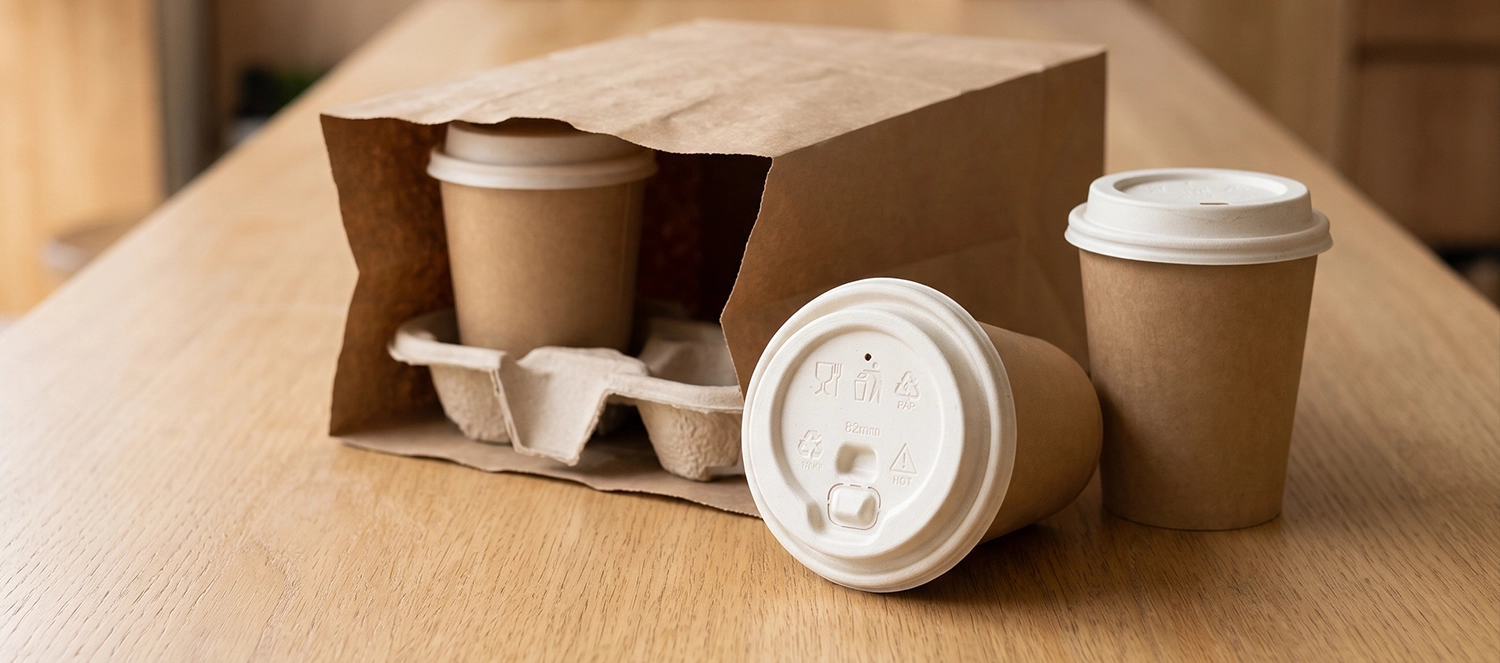

The question of whether lid-free coffee cups are worth switching to is the right question — but it is often answered with marketing language rather than actual analysis. “Sustainable,” “future-proof,” “plastic-free” — these are positioning statements, not answers to a procurement decision.
This guide answers the question directly, cost line by cost line. Is the switch to lid-free coffee cups worth it for a café, coffee chain or horeca distributor? We work through the financial case, the operational case, the regulatory case and the brand case — including the honest trade-offs — so you can make an informed decision for your specific operation rather than a generic one based on sustainability trends.
For the technical explanation of how lid-free cups work, see: What Is an Integrated Lid Cup?. For the direct system comparison, see: Lid-Free vs Plastic Lid Paper Cups.
The Financial Case: Working Through the Numbers
The financial case for lid-free cups is more nuanced than either “they cost more” or “they save money.” The answer depends on your volume, your market and what cost components you include in the comparison.
Starting Point: Unit Cost Premium
A water-based coated lid-free cup typically carries a moderate unit cost premium over an equivalent PE-lined conventional cup at comparable volumes. The size of the gap depends on format, volume and print, and pricing is quoted per project. That is the starting point — and it is the number that most cost comparisons stop at.
What Gets Left Out: The Lid Cost
The conventional cup unit price does not include the lid. It never does — cups and lids are separate line items. A plastic snap-on lid is a second purchase on every serve. The real comparison is:
- Lid-free cup: one cup per serve, at a moderately higher unit price
- Conventional cup + plastic lid: one cup plus one lid per serve
Once the lid is counted, the gap narrows sharply before any regulatory costs are included. In many operations, the cup unit premium is largely absorbed by lid cost elimination.
Adding Plastic-Specific Levies
Where plastic-specific levies apply, the comparison shifts further in favor of lid-free cups. The plastic lid is the component most directly in scope:
- UK Plastic Packaging Tax (since April 2022): £223.69 per tonne from 1 April 2025 and £228.82 per tonne from 1 April 2026, on plastic packaging components with less than 30% recycled plastic. A plastic lid is such a component.
- Spain (€0.45/kg of non-reusable plastic packaging since January 2023): charged on the plastic content of each conventional serve — the lid and the plastic share of a PE-lined cup.
- Germany has no plastic packaging tax, but producers of single-use plastic cups for beverages and their lids pay into the Single-Use Plastics Fund (Einwegkunststofffonds), based on the quantities they place on the market.
Across a month of service, these levies accrue on every conventional lid. A lid-free cup has no plastic lid and no PE lining, so the lid-related cost lines fall away entirely and the plastic content per serve drops — over 12 months, the difference becomes a noticeable recurring saving.
The Complete Cost Walkthrough (Market With Plastic Levies)
- Conventional cup + lid system: cup cost + lid cost + plastic levies on the lid (and, where charged, on the lining plastic) + EPR contributions on both components
- Lid-free cup system: cup cost at a moderately higher unit price + EPR contributions on the cup — no lid cost, no levies or EPR contributions on a lid, no PE lining
In this walkthrough, a higher cup price is set against several cost lines that disappear, so the total system cost moves in favor of lid-free cups despite the higher unit price. The balance shifts by market, by volume and by format, but the pattern is consistent: at realistic wholesale volumes in markets with plastic levies, the total system cost of lid-free cups is comparable to or lower than the conventional system.
The SKU Management Cost
One cost component that is real but harder to quantify is SKU management cost. Managing two SKUs per cup size (cup and lid) versus one creates measurable procurement administration cost, storage complexity and reorder management overhead. For a three-size operation, this is six SKUs versus three. The operational cost of this complexity — in buyer time, storage space, reorder errors and stock-out incidents — is real, even if it does not appear on an invoice.
The Operational Case: What Changes in Practice
The operational case for lid-free cups depends heavily on your service environment. The honest assessment has both positive and neutral elements.
What Genuinely Gets Better
- Lid stock-out elimination: conventional cup-and-lid systems create a service vulnerability: if lids run out, cups are unusable. This happens — especially during unexpectedly busy periods, delivery delays or inventory management errors. Lid-free cups eliminate this vulnerability entirely. Your cup stock is your entire cup inventory. Running out means running out of cups, not running out of one component of a two-component system.
- Storage simplification: eliminating lid inventory noticeably reduces cup station storage requirements, depending on your cup size range. In dense café environments where counter storage is genuinely constrained, this is material.
- Procurement simplification: one fewer SKU, one fewer order line, one fewer reorder calculation, one fewer supplier relationship if you were sourcing cups and lids from different suppliers.
What Is Neutral After the Learning Curve
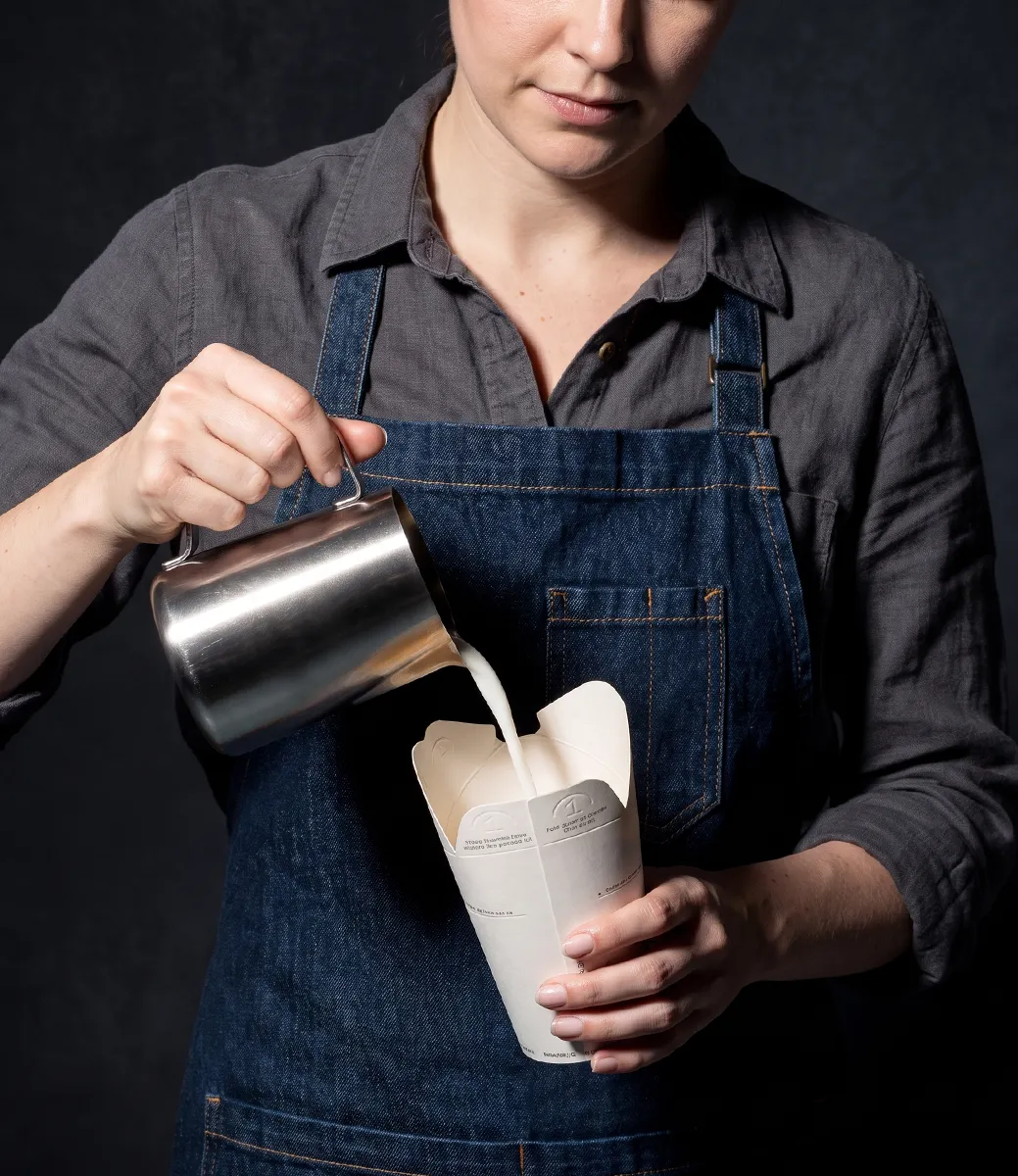
- Service speed: the fold takes approximately the same time as snapping on a lid once staff are past the initial learning period — typically two to four weeks of regular use. During the learning period, service speed may be marginally slower. After it, the difference is negligible.
- Seal and leak performance: a well-engineered lid-free cup provides comparable leak resistance to a snap-on lid under normal handling and delivery conditions. This is not a compromise — it is genuinely equivalent performance for standard beverage service.
What Requires Real Management
- Staff training: requires two to three minutes of hands-on practice per staff member. Not onerous, but it requires active management rather than passive adoption. Ensure all staff are trained before launch, not on the job.
- Customer communication during transition: the first two to four weeks require a brief customer explanation at handout. This is a managed period, not a permanent operational burden. After it, familiar customers need no explanation.
The Regulatory Case: Why Delay Has a Cost
The regulatory argument for lid-free cups is not that you must switch now — it is that delay has an increasing cost, and the direction of regulation is unambiguous.
What the SUP Directive Actually Requires of Cups
A common misreading first: the tethered-cap rule of the EU Single-Use Plastics Directive (EU) 2019/904, in force since 3 July 2024, applies to the caps and lids of beverage containers up to 3 liters — bottles and composite beverage cartons. It does not apply to cups. Snap-on plastic lids on coffee cups are legal and do not have to be tethered.
What the directive does apply to cups for beverages, including their covers and lids:
- Consumption reduction (Art. 4): member states must achieve a measurable reduction in their consumption, through national measures such as charges at the point of sale or obligations to offer a reusable alternative.
- Marking (Art. 7): cups made wholly or partly of plastic carry the printed “plastic in product” marking.
- Extended producer responsibility (Art. 8): producers of these items pay toward collection, clean-up and awareness costs.
- Ban (Art. 5): cups and food containers made of expanded polystyrene (EPS) are banned outright.
Bio-based or biodegradable plastics such as PLA count as plastic under these rules, so a PLA lid does not take a cup system out of scope. The realistic options are:
- Keep plastic lids — legal, but the lid stays inside the levies, EPR fees and consumption-reduction measures above
- Switch to fiber lids — removes the plastic lid but keeps a two-component system
- Switch to lid-free cups — removes the separate lid entirely in a single product change
For operations reviewing their cup system anyway, lid-free cups take the lid out of these plastic-specific measures while capturing the cost and operational benefits of the format. The cup itself remains a cup for beverages under the directive; ask your supplier for its documentation per specification.
Plastic Levies Differ by Market
Plastic-specific measures are national and uneven. The UK and Spain tax plastic packaging by weight; Germany charges producers of single-use plastic items through the Single-Use Plastics Fund; France works through eco-modulated EPR fees; Italy’s plastic tax has been postponed repeatedly, now to 2027. Each new or tightened measure increases the cost of continuing with plastic lids. Switching to lid-free cups builds in cost stability against that trend.
PPWR: In Application Since August 2026
The EU Packaging and Packaging Waste Regulation (EU) 2025/40 entered into force on 11 February 2025 and applies from 12 August 2026. From that date, food-contact packaging must stay below the PFAS limits (25 ppb for any single PFAS, 250 ppb for the sum of targeted PFAS, 50 ppm for total PFAS). Recyclability criteria, harmonized labels and reuse targets follow in stages from 2028 to 2030. Cups with no PE lining and a water-based, PFAS-free coating are designed for paper recycling where local collection accepts it, which puts them in a better position for those criteria. Continuing to procure PE-lined cups risks a forced transition later rather than a planned one — with the higher cost and disruption that reactive transitions create.
The Cost of Waiting
Every month of continuing to use plastic lids in markets with plastic levies adds avoidable levy and EPR cost. Every month of procuring PE-lined cups builds a future forced transition cost rather than a planned transition saving. The cost of waiting is real and measurable — it is not a hypothetical future risk.
The Brand Case: What the Research Shows
The brand argument for lid-free cups is commercial, not ideological. Sustainability-aware customers are a measurable and growing market segment in European food service, and their packaging preferences affect purchasing behavior.
Consumer Willingness to Pay
Consumer surveys suggest that many European customers are willing to pay a modest premium for beverages served in packaging with credible, documented environmental properties — particularly in urban markets and among the 25 to 45 demographic that represents the core coffee chain customer base. The premium is not large, but it can compound across high-volume operations.
B2B Account Qualification
For horeca distributors and food service operators supplying corporate catering accounts, hotel chains and public sector food service, the commercial brand argument is more direct: packaging credentials are increasingly a qualification criterion for these accounts. Being able to supply cups with no plastic lid and a water-based, PFAS-free, PE-free coating, backed by documentation, qualifies your operation for accounts that require it. The revenue value of a single qualified corporate account can exceed the total additional cost of switching to lid-free cups across your entire portfolio.
The Environmental Claims Dimension
From 27 September 2026, Directive (EU) 2024/825 on empowering consumers for the green transition applies across the EU. It bans generic environmental claims such as “eco-friendly cups” or “sustainable packaging” unless they rest on recognized excellent environmental performance, bans product-level “climate neutral” claims based on offsetting, and bans sustainability labels that are not based on a certification scheme or set by public authorities. (The separately proposed Green Claims Directive was not adopted.) Specific, documented statements — no plastic lid, no PE lining, a water-based coating with PFAS-free test documentation — are the kind of claims that stay defensible. The brand case and the legal compliance case converge here.
The Honest Trade-Offs
A fair assessment acknowledges where lid-free cups are not the better choice.
Thick Blended Beverages
For operations where thick blended drinks — smoothies, some blended coffee formats — represent a significant share of volume, the conventional dome lid format may better accommodate the viscosity and volume of these products. Test lid-free cups with your specific thick beverage formats before committing. If performance is inadequate for a significant portion of your menu, the operational trade-off may not be worth it for those specific formats.
Markets Without Plastic Levies
The financial case for lid-free cups is strongest in markets with plastic-specific levies. In markets without them, the unit cost premium is not offset by levy savings, and the total system cost comparison is closer. The operational and brand arguments remain, but the financial argument is weaker there.
Very High-Volume Operations During Transition
For very high-volume operations — hotel banqueting, stadium catering, airport food service processing thousands of cups per hour — the brief per-cup service speed impact during the staff learning period may create meaningful throughput disruption at the scale of operation. Plan the transition during a lower-volume period rather than peak season if this applies to your operation.
The Verdict by Operation Type
Independent Café (200 to 500 cups/day)
The switch is worth it. At these volumes in markets with plastic levies, total system cost is comparable or lower. Operational simplification is meaningful. Brand positioning is differentiating in competitive café markets. The learning curve is manageable. Verdict: switch.
Coffee Chain (5 to 50 locations)
The switch is clearly worth it. At chain scale, the SKU consolidation benefit is multiplied across locations. Centralized procurement simplification is significant. Levy and EPR exposure on plastic lids is removed across all locations in a single product change. Brand consistency of packaging with no plastic lid and no PE lining has compounding commercial value. Verdict: switch, and make it a brand story.
Horeca Distributor
The switch is commercially strategic. Supplying cups with no plastic lid and PE-free coating opens qualification for corporate and hotel chain accounts that require it. Private label lid-free cups create product differentiation that commodity plastic cup distribution cannot match. The revenue upside of qualified premium accounts exceeds the transition cost. Verdict: switch, and position it as a portfolio differentiator.
High-Volume Blended Drink Operation
Test first. For operations where thick blended drinks represent more than 30 percent of volume, verify lid-free cup performance with your specific products before committing. If performance is adequate — and for many blended formats it will be — the financial and regulatory arguments still apply. If performance is inadequate for a significant portion of your menu, consider a hybrid approach: lid-free for standard beverages, maintaining a conventional format only for thick blended products. Verdict: test, then decide.
Test Lid-Free Cups Against Your Specific Operation
The cost lines in this guide are generic. Your actual cost comparison depends on your volume, your market and your current pricing. Ekoroll supplies lid-free hot cups and lid-free cold cups with samples available before bulk orders and pricing quoted per project. Water-based, PFAS-free, PE-free coating. Supplied from Turkey. Quantities quoted per project. Contact us for a cost comparison specific to your operation.
For a complete overview of formats, sourcing and ordering, see our lid-free paper cups wholesale guide.