The comparison between lid-free paper cups and conventional cups with plastic lids is now one of the most commercially relevant packaging decisions for cafés, coffee chains and horeca distributors in European markets. It is no longer an environmental preference question. It is a procurement decision with direct implications for regulatory compliance, total cost, operational efficiency and supplier risk.
This guide provides a complete, data-driven comparison of lid-free vs plastic lid paper cups across every dimension that matters for food service procurement: performance, cost, regulatory status, recyclability and operational impact. We do not ignore the trade-offs — where plastic lid systems have genuine advantages, those are acknowledged. The goal is an honest comparison that supports an informed procurement decision.
For background on how lid-free cups work mechanically, see: What Is an Integrated Lid Cup?. For the wholesale buyer’s sourcing guide, see: Lid-Free Paper Cups: Wholesale Guide.
The Two Systems: A Clear Definition
Plastic Lid Cup System
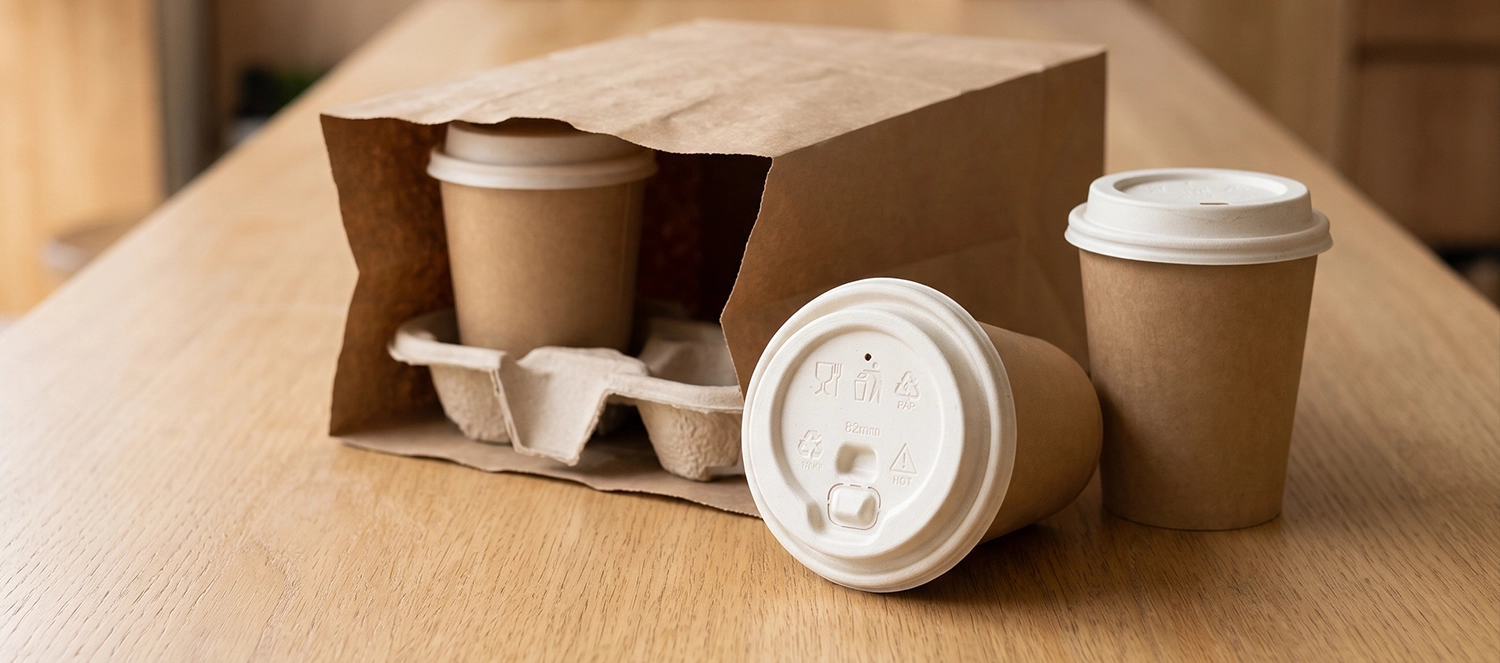
A conventional takeaway beverage cup system consists of two separate components: a paper cup with a liquid barrier coating on the food-contact interior surface (typically PE polyethylene plastic, though some use PLA bio-based plastic or water-based coating) and a separate plastic lid that snaps onto the cup rim after filling. The lid is typically made from PP (polypropylene) or PET (polyethylene terephthalate) plastic. Both components must be sourced, inventoried, stored and used together — if either is out of stock, service cannot continue.
Lid-Free Cup System
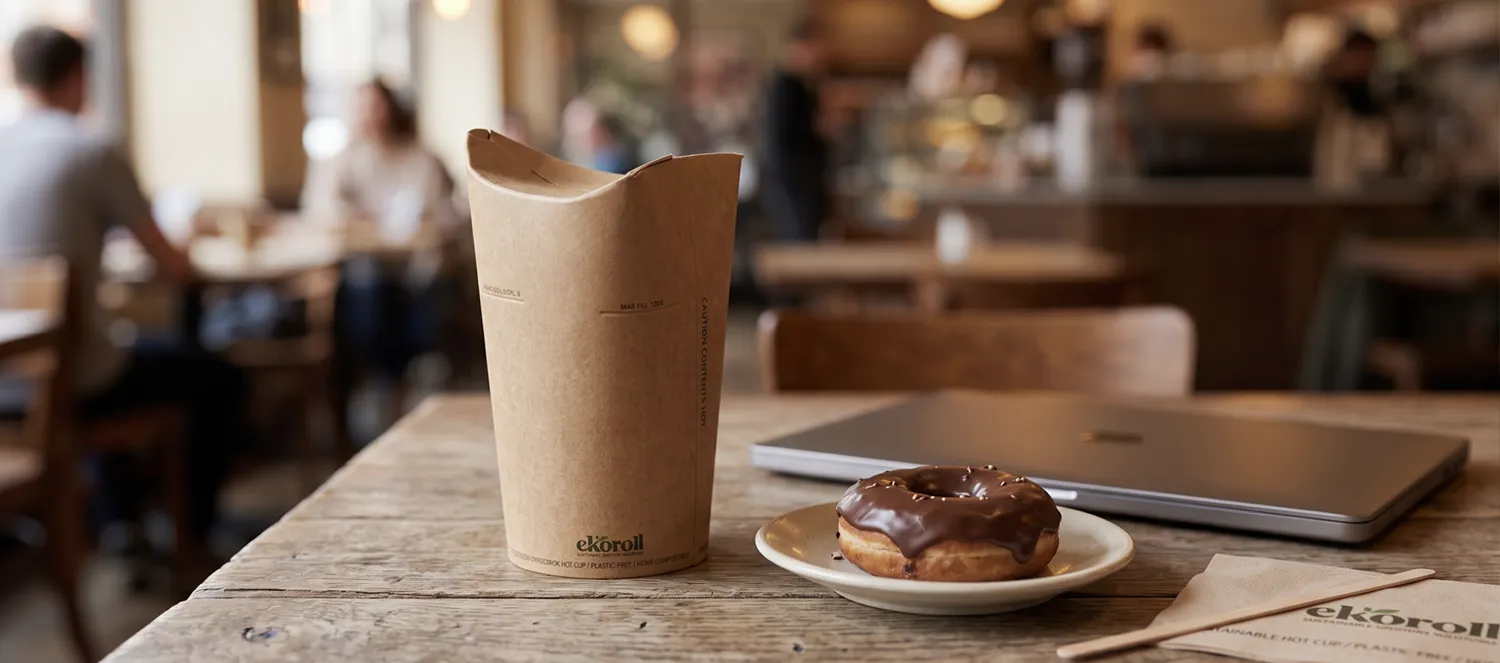

A lid-free paper cup has a folding closure mechanism engineered directly into the upper portion of the cup wall. No separate lid exists. After filling, the barista folds the top of the cup along pre-engineered score lines to create a sealed closure with a drinking aperture. The cup is a single component — one item to source, one item to stock, one item to manage. When specified with water-based, PFAS-free, PE-free coating, the cup body has no PE lining and there is no plastic lid — the complete unit is a single paper-based component.
Full Comparison: Lid-Free vs Plastic Lid Cups
| Dimension | Lid-Free Cup (water-based coated) | Plastic Lid Cup (PE-lined) | Advantage |
|---|---|---|---|
| Number of components | 1 | 2 (cup + lid) | Lid-free |
| PE lining in cup body | None — water-based, PFAS-free, PE-free coating | PE lining | Lid-free |
| Plastic in lid | None (no separate lid) | PP or PET plastic lid | Lid-free |
| PE film and plastic lid per serve | Neither | PE cup lining + PP/PET lid | Lid-free |
| Microplastic migration from PE lining | Not applicable — no PE lining | Documented from PE under heat | Lid-free |
| Paper recycling | Designed for paper recycling where local collection accepts it | PE-lined cup needs specialist cup recycling; plastic lid goes to a separate stream | Lid-free |
| Compostability | Only where the cup material is certified (ask for the certificate and its holder) | No | Lid-free |
| EU SUP tethered-cap rule (Art. 6) | Not applicable — covers beverage containers such as bottles, not cups | Not applicable — cup lids need not be tethered | Neutral |
| SUP measures for plastic cups and lids (Art. 4, 7, 8) | No plastic lid in scope; cup assessed on its coating | Plastic lid in scope; PE-lined cup carries the plastic marking | Lid-free |
| Plastic-specific levies (e.g. UK PPT, Spain, Germany’s Single-Use Plastics Fund) | No plastic lid to levy | Apply to the plastic lid and, depending on the rules, the cup | Lid-free |
| General packaging EPR | Applies (one component) | Applies (two components) | Lid-free (fewer items) |
| Unit purchase cost | Moderately higher; quoted per project | Lower (cup only) | Plastic lid (unit price only) |
| Total cost including lid | Lid-free cup only | Cup cost + lid cost combined | Comparable or lid-free |
| Total cost including levies | Cup only — no plastic lid levy | Cup + lid + plastic levies where they apply | Lid-free in levy markets |
| SKUs per cup size | 1 | 2 | Lid-free |
| Lid stock-out risk | Eliminated | Present | Lid-free |
| Storage space per size | Cup stack only | Cup stack + lid stack | Lid-free |
| Service steps per beverage | Fill, fold, hand out | Fill, place lid, hand out | Comparable |
| Customer familiarity | Novel — brief explanation needed initially | Familiar | Plastic lid (initially) |
| Heat retention in transit | Comparable to lid system | Good | Comparable |
| Spill resistance during transit | Good — folded seal contains liquid | Good — snap-on lid contains liquid | Comparable |
| Verifiable product statements | “No plastic lid” and “no PE lining” can be documented | Cannot state “no plastic lid” | Lid-free |
| Regulatory direction to 2030 | No plastic lid in scope; PPWR recyclability criteria still apply to the cup | Plastic lid and PE-lined cup stay in scope of SUP measures; PPWR applies | Lid-free |
Cost Comparison: The Complete Picture
The cost comparison between lid-free and plastic lid cup systems is frequently misrepresented as a simple unit price comparison that consistently favors plastic lid systems. The complete picture looks significantly different.
Unit Price: The Starting Point
At unit purchase level, a lid-free paper cup with water-based coating carries a moderate unit cost premium over an equivalent PE-lined conventional cup. The difference depends on format, volume and print, and pricing is quoted per project. At first glance this appears to favor the plastic lid system. But this comparison is incomplete in three important ways.
The Lid Cost That Is Often Excluded
The conventional cup unit price does not include the lid. Every serve needs a second purchased item, and at café volumes the lid becomes a recurring monthly cost line that is invisible in a cup unit price comparison but must be included in a total system cost comparison. When lid cost is included, the apparent unit cost advantage of the plastic lid system narrows significantly or disappears entirely, depending on format and volume.
Plastic Taxes and Levies
Plastic-specific charges differ by country, and they are not the same thing everywhere:
- UK (not EU): the Plastic Packaging Tax has applied since 1 April 2022 to plastic packaging components with less than 30% recycled plastic — £223.69 per tonne from 1 April 2025 and £228.82 per tonne from 1 April 2026. A plastic lid is a plastic packaging component.
- Spain: a tax of €0.45 per kg on non-reusable plastic packaging has applied since 1 January 2023; it accrues on the plastic in every lid across a month of service.
- Italy: the plastic tax has been postponed repeatedly (now to 2027) and is not in force.
- Germany: there is no plastic packaging tax. Producers of certain single-use plastic products, including cups for beverages and their lids, pay into the Single-Use Plastics Fund (Einwegkunststofffonds), based on quantities placed on the market since 2024.
- France: no per-kg plastic packaging tax; packaging EPR fees are eco-modulated under the AGEC law.
- Portugal: a €0.30 contribution applies per single-use plastic or aluminum take-away meal package — a per-package levy on ready-meal containers, not on cup lids.
A lid-free cup with water-based coating removes the plastic lid from all of these and has no PE lining in the cup body. How the coated cup body itself is classified depends on the coating and on national rules, so ask for the coating documentation.
EPR Contribution Costs
General packaging EPR (for example VerpackG system participation in Germany) applies to all packaging, paper cups included, so neither system is exempt. The difference is that a conventional system has two components to license, and in many markets fees for plastic components are higher than for paper. On top of that, the Single-Use Plastics Directive’s extended producer responsibility (Art. 8) covers plastic cups and their lids, which a lid-free cup with no plastic lid reduces to one item at most.
Total System Cost Comparison
For a café in a market with a plastic-specific levy, the cost lines compare as follows:
- Plastic lid system total cost: cup cost + lid cost + plastic levies on the lid (and on the cup where the rules include it) + packaging EPR on both components
- Lid-free system total cost: cup cost (with a moderate unit premium, quoted per project) + packaging EPR on the cup — no lid cost and no plastic lid levy
In markets with plastic-specific levies, the total system cost of lid-free cups is often comparable to the plastic lid system when all cost components are included. The unit price premium is often largely offset by lid cost elimination and levy savings combined.
Regulatory Compliance: Where the Systems Diverge Significantly
The regulatory compliance dimension is where the two systems diverge most significantly — and where the forward-looking procurement risk is most material.
Tethered Caps: A Common Misunderstanding
The tethered-cap requirement of the Single-Use Plastics Directive (EU) 2019/904 (Art. 6, applicable since 3 July 2024) applies to plastic caps and lids of beverage containers up to 3 liters — bottles and composite beverage cartons. It does not apply to cups. Snap-on plastic lids on coffee cups are legal and do not have to be tethered, so tethering is not a reason to change cup systems in either direction.
Single-Use Plastics Directive: What Does Apply to Cups and Lids
For “cups for beverages, including their covers and lids”, the directive requires member states to take consumption-reduction measures (Art. 4), requires a printed marking on cups made partly of plastic (Art. 7) and sets up extended producer responsibility (Art. 8) — in Germany through the Single-Use Plastics Fund. Expanded polystyrene cups are banned outright (Art. 5). A lid-free cup takes the plastic lid out of these measures entirely. Note that bio-based plastics such as PLA count as plastic under the Commission’s 2021 guidelines, so a PLA lid or lining is not a way out.
Plastic Taxes and Levies (Country by Country)
Plastic-specific charges remain national and uneven: the UK and Spain tax plastic packaging by weight, Germany collects Single-Use Plastics Fund payments, Italy’s tax is postponed and France works through eco-modulated EPR fees (details in the cost section above). Operations supplying several markets should check the rules in each one rather than assume a single European tax.
PPWR (Regulation (EU) 2025/40)
The EU Packaging and Packaging Waste Regulation entered into force on 11 February 2025 and applies from 12 August 2026. From that date it limits PFAS in food-contact packaging (25 ppb for any single PFAS, 250 ppb for the sum of PFAS measured by targeted analysis, 50 ppm total PFAS including polymeric PFAS). Recyclability criteria, harmonized labels and reuse targets follow in stages from 2028 to 2030. PE-lined conventional cups usually need specialist cup recycling. Water-based coated lid-free cups are designed for paper recycling where local collection accepts it, which matches the direction of PPWR’s design-for-recycling criteria; the detailed criteria are still being set.
Environmental Claims (Directive (EU) 2024/825)
From 27 September 2026, Directive (EU) 2024/825 on empowering consumers for the green transition bans generic environmental claims such as “eco-friendly” or “green” unless recognized excellent environmental performance can be shown, bans product “climate neutral” claims based on offsetting, and bans sustainability labels that are not based on a certification scheme or set by public authorities. (The separate Green Claims Directive proposal was not adopted.) Operations should therefore replace generic claims about their cups with specific, verifiable statements. Lid-free cups with water-based, PFAS-free, PE-free coating can be backed by documentation: coating declarations, PFAS test results and food-contact Declarations of Compliance, with each certificate cited under its actual holder. A plastic lid cup system cannot support a “no plastic lid” statement.
Performance Comparison: Where Each System Has Genuine Advantages
An honest comparison acknowledges that plastic lid systems have genuine performance advantages in some dimensions.
Where Plastic Lid Systems Genuinely Perform Better
- Customer familiarity: plastic lid cups are the format most customers have used for years. There is no learning curve, no explanation needed, no novelty to manage. This is a genuine short-term advantage during any transition period.
- High-volume speed at peak service: for very high-volume operations where maximum throughput speed is critical, the snap-on lid may marginally outperform the folding closure for experienced baristas during peak service. This advantage diminishes with staff practice and typically disappears within two to four weeks of transition.
- Blended and thick beverages: for operations serving thick blended drinks, the conventional cup-and-dome-lid format may better accommodate the volume and viscosity of thick beverages. Lid-free cup formats should be tested with specific thick beverage products before bulk ordering.
Where Lid-Free Systems Genuinely Perform Better
- Heat retention equivalence: the folded closure retains heat comparably to a conventional plastic lid for standard café-to-customer transit and typical delivery times
- Spill resistance: the folded seal provides comparable spill resistance to a snap-on lid under normal handling and bag transport conditions
- No lid misalignment issues: conventional plastic lids occasionally fail to snap fully, creating leak risk. The integrated fold eliminates this failure mode entirely
- Delivery bag efficiency: the single-component cup-without-lid occupies less volume in delivery packaging configurations
Which System Is Right for Your Operation?
The decision framework for choosing between lid-free and plastic lid systems depends on your operational context.
Choose Lid-Free If:
- You supply markets with plastic-specific levies on lids (for example the UK Plastic Packaging Tax, Spain’s plastic tax or Germany’s Single-Use Plastics Fund) — removing the lid improves the cost comparison
- You want specific, verifiable statements for your customers, such as “no plastic lid” and “PE-free coating”, instead of generic environmental claims
- You want fewer plastic items in scope of single-use plastic measures (marking, EPR, consumption-reduction measures)
- You want to simplify cup-related procurement and storage by eliminating the separate lid SKU
- Your operation serves primarily standard hot and cold beverages (lattes, americanos, filter coffee, iced drinks) where performance is equivalent
- You are sourcing new cups anyway and want to make the transition once rather than making a partial transition now and a full transition later
Retain Plastic Lid System If:
- You operate exclusively in markets without plastic-specific levies or single-use plastic measures for cups — though even here the direction of regulation is toward reducing single-use plastic
- You serve primarily thick blended beverages where the dome lid format provides a functional advantage your operation is not ready to transition away from
- Your operation is in an extremely high-volume context where even a brief customer familiarity learning curve creates significant throughput disruption that you cannot manage at this time
For many European café and coffee chain operations, the combination of fewer plastic items in scope of regulation, levy savings, operational simplification and verifiable customer communication makes lid-free cups a strong option to evaluate now, with samples tested under real service conditions.
Wholesale Lid-Free Cups with Water-Based Coating
Ekoroll supplies lid-free hot cups and lid-free cold cups wholesale to cafés, coffee chains and horeca distributors across Europe. Water-based, PFAS-free, PE-free coating. With water-based coating, these cups carry DIN CERTCO home compostable and industrially compostable (EN 13432) certification, held by the producing partner; copies on request. In Ekoroll’s internal test, water-based coated lid-free cups filled with water for more than a month showed no leakage, no softening and no water penetration. The water-based coated paperboard also passed PPWR (EU) 2025/40 tests for PFAS, total fluorine and heavy metals (lead, cadmium, mercury, hexavalent chromium); the SGS and Eurofins reports are available on request. The recommended fill temperature for the lid-free cups is up to 90 °C. No separate plastic lid. Supplied from Turkey. MOQ and pricing quoted per project. Samples and full certification documentation available on request.