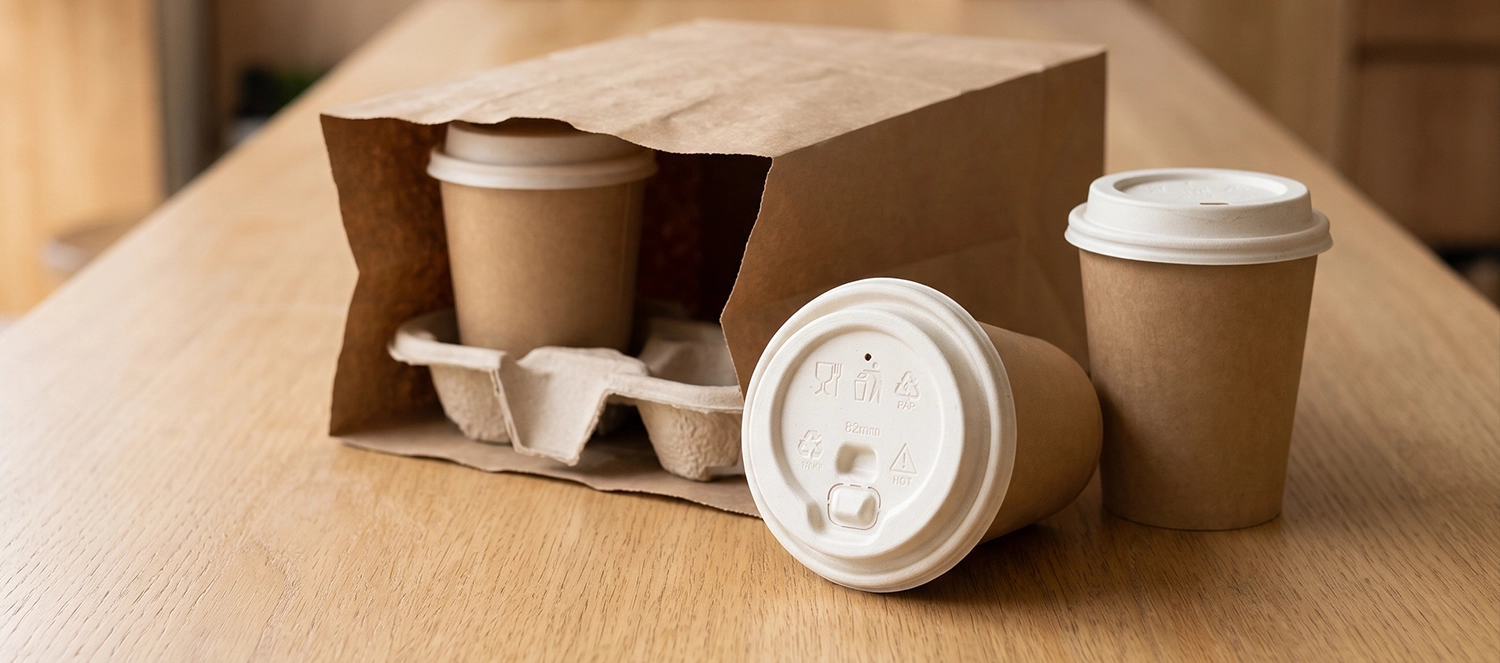
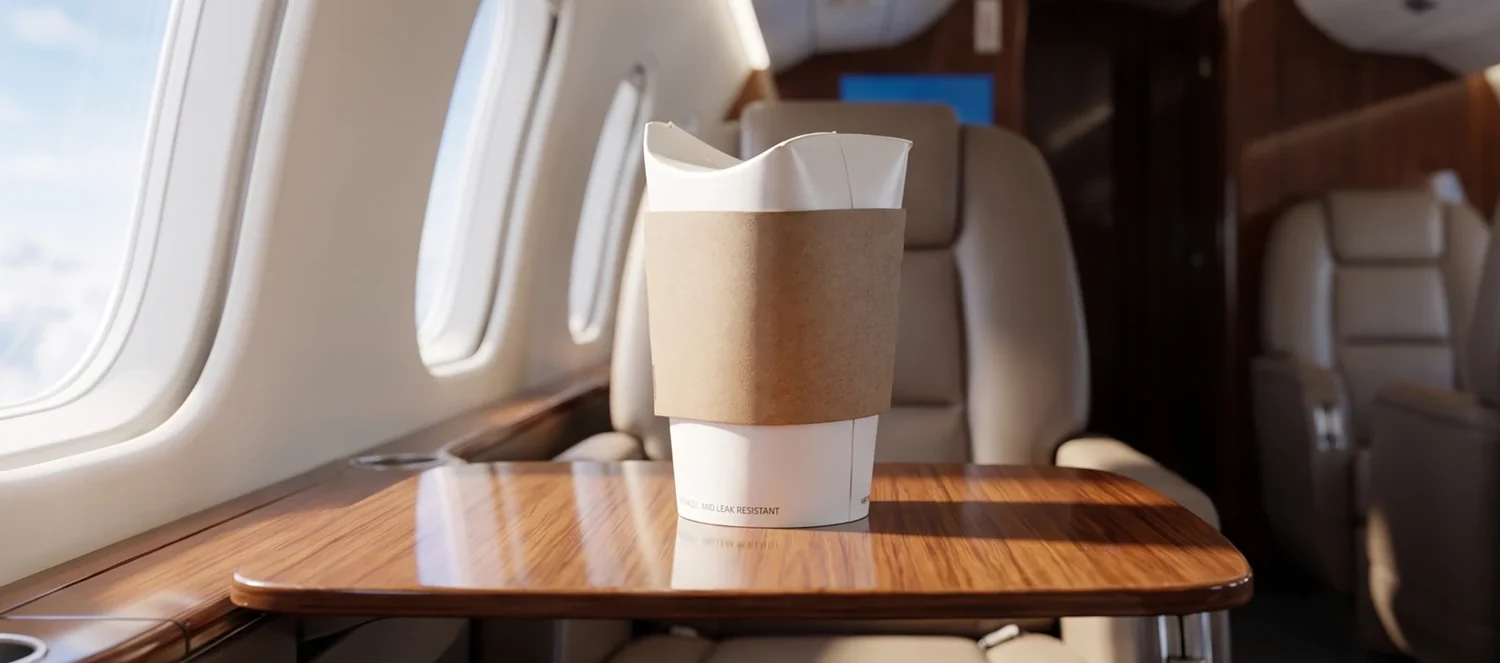
The integrated lid cup — also called a lid-free paper cup or foldable paper cup — is a takeaway beverage cup where the closing mechanism is built directly into the cup wall structure. No separate lid is required. The customer folds the top of the cup after filling to create a secure drinking spout, and the cup is ready to hand out in a single motion.
For cafés, coffee chains and food service operations, this is not just a product substitution. It is a fundamental change to the cup system: from a two-component format (cup plus separate lid) to a single-component format that eliminates the lid entirely. The operational, commercial and regulatory implications of this change are significant and are driving growing adoption across European food service markets.
This guide explains exactly what integrated lid cups are, how the folding mechanism works, how they compare to conventional cup and lid systems, what the operational advantages are and what to consider when switching. For wholesale supply, explore Ekoroll lid-free hot cups and lid-free cold cups.
How the Integrated Lid Mechanism Works

The integrated lid is engineered into the upper portion of the cup wall during manufacturing. The cup is produced with a series of pre-scored fold lines and structural panels at the rim that allow the top to be folded inward in a specific sequence to create a sealed closure with a drinking aperture.
The Folding Sequence
The closure mechanism involves a defined folding sequence that can be completed in one or two hand movements:
- Step 1: the two side panels at the top of the cup are pressed inward along the pre-scored fold lines, flattening the circular rim into a narrower oval or rectangular form
- Step 2: the front and back flaps fold down over the top, creating a sealed surface with a small drinking aperture at the front
- Step 3: the drinking aperture is shaped to allow controlled liquid flow — typically a curved or angled opening that prevents spillage during normal drinking motion
The entire folding sequence takes three to five seconds and is simple enough for customers to complete themselves if preferred, or for baristas to complete at the point of service. Staff training requires approximately two to three minutes of practice to reach full service speed.
Leak Resistance and Seal Integrity
The folded closure creates a mechanical seal that prevents spillage during normal handling and transit. The seal integrity depends on the precision of the fold line engineering and the structural rigidity of the cup wall material. High-quality integrated lid cups maintain seal integrity during typical café to customer hand-off, takeaway bag transport and food delivery conditions.
The drinking aperture is sized to control liquid flow rate — typically smaller than the opening of a conventional coffee lid, which reduces the risk of significant spillage if the cup tips during transport compared to an open cup, while providing adequate flow for comfortable drinking.
Cup Wall Construction
Integrated lid cups require a cup wall with specific structural properties: sufficient rigidity to hold the folded shape under liquid pressure and handling forces, and sufficient flexibility to fold cleanly along the engineered score lines without cracking or tearing. This requires a paper specification and structural engineering that differs from conventional single-wall cups. Most integrated lid cups use a double-wall or structured single-wall construction to achieve this balance.
For the full technical framework behind this system-level approach, see our research report: Integrated Fiber-Based Beverage Service Systems.
Integrated Lid Cup vs Conventional Cup and Lid System
Understanding the full comparison between integrated lid cups and conventional cup-and-lid systems helps evaluate the real-world implications of switching.
| Feature | Integrated Lid Cup | Conventional Cup with Plastic Lid | Conventional Cup with Fiber Lid |
|---|---|---|---|
| Number of components | 1 — cup only | 2 — cup plus plastic lid | 2 — cup plus fiber lid |
| Plastic content | No PE lining, no plastic lid (water-based, PFAS-free, PE-free coating) | PE in cup + plastic lid | PE in cup + fiber lid (no lid plastic) |
| SKUs per cup size | 1 | 2 | 2 |
| Storage space required | Cup stack only | Cup stack plus lid stack | Cup stack plus lid stack |
| Service steps | Fill, fold, hand out | Fill, place lid, hand out | Fill, place lid, hand out |
| Lid stock-out risk | Eliminated | Present — service stops if lids run out | Present |
| EU single-use plastic measures on the lid | No separate lid | Plastic lid in scope of consumption-reduction measures and EPR (snap-on lids are legal; the tethered-cap rule does not apply to cups) | A 100% fiber lid is outside the plastic definition |
| Plastic-specific charges | No lid; cup body per each regime’s definition | Lid in markets that tax or levy it; PE cup per each regime’s definition | PE cup per each regime’s definition |
| Paper recycling | Designed for paper recycling where local collection accepts it | Difficult — PE cup rarely accepted in paper streams; lid depends on local plastic collection | Cup: difficult (PE). Lid: fiber, check local collection |
| PE film in contact with the drink | None (water-based coated) | Yes — PE migration documented under heat | Yes — PE migration documented under heat |
| Customer experience | Novel — brief staff explanation recommended | Familiar | Familiar |
Integrated Lid Cup vs Molded Fiber Lids: Which to Choose?
For operations considering the transition away from plastic lids, two primary routes exist: integrated lid cups or conventional cups with molded fiber lids. Both eliminate plastic lids — the practical choice depends on operational context.
When Integrated Lid Cups Are the Right Choice
- You want to eliminate the two-component system entirely and the operational complexity of managing separate lid inventory
- Your cup sizes are consistent enough that a single cup SKU per size covers your requirements
- Your operation has capacity for brief staff training on the folding mechanism
- You want to remove the lid component from the cup system altogether — no separate lid means no lid to buy, store or dispose of
- You are transitioning to new cups anyway and want to move to water-based coated cups at the same time
When Molded Fiber Lids Are the Right Choice
- You want to retain your existing cup stock and replace only the lid
- Your customer base is likely to find the folding mechanism confusing and you want to maintain a familiar lid experience while eliminating plastic
- You operate in a high-volume, high-speed service environment where any additional customer or staff handling step creates meaningful throughput impact
- You want a transitional step toward a reduced-plastic cup system while managing the change more gradually
Both formats take the plastic lid out of the system, and both are suitable for hot and cold beverage service. A 100% molded fiber lid is outside the plastic definition of the Single-Use Plastics Directive. The integrated lid cup removes the lid component in a single product; the fiber lid provides the most operationally seamless transition from conventional plastic lids.
Operational Advantages in Detail
SKU Reduction
For a café operating with three cup sizes (small, medium, large), switching from conventional cups with lids to integrated lid cups reduces the packaging SKU count from six (three cup SKUs plus three lid SKUs) to three (three cup SKUs). This reduction has cascading operational benefits: simpler procurement management, reduced storage space, lower reorder complexity, elimination of lid stock-out risk, and simpler staff briefing on packaging inventory.
Service Speed
The folding closure step replaces the lid placement step. For experienced baristas, the folding motion takes approximately the same time as placing a snap-on lid — typically two to four seconds for either operation. The net service speed impact is neutral to marginally positive once staff are past the initial learning curve. The elimination of lid stock management and restocking time during service provides an additional operational efficiency benefit.
Storage Efficiency
Eliminating lid inventory from the cup station reduces the storage space requirement for cup-related packaging by approximately 30 to 35 percent depending on the cup-to-lid size relationship. In high-footfall café environments where counter and under-counter storage is at a premium, this space saving is operationally significant.
Procurement Simplification
One fewer SKU means one fewer order line, one fewer reorder calculation, one fewer supplier communication for restocking and one fewer item to track in inventory management. For operations managing cup and lid separately from different suppliers, consolidation to a single integrated lid cup SKU from a single supplier is a meaningful procurement simplification.
Elimination of Lid Stock-Out Risk
Conventional cup-and-lid systems create a specific operational vulnerability: if either the cup or the lid runs out, service is disrupted. Lid stock-outs are particularly disruptive because lid inventory is often managed less carefully than cup inventory. Integrated lid cups eliminate this vulnerability entirely — there is only one component to manage, and running out of cups means running out of cups, not running out of one component of a two-component system.
Regulatory Context: What Is Driving Adoption
Three sets of rules are pushing European food service operations to look at integrated lid cups. None of them bans the conventional snap-on lid, but each of them adds cost or effort to it.
Single-Use Plastics Directive: Cups and Lids
The EU tethered-cap rule that has applied since 3 July 2024 covers caps and lids of beverage containers up to 3 liters, such as bottles and composite beverage cartons. It does not apply to cups: separate snap-on plastic cup lids are legal and do not need to be tethered. What does apply to plastic cups and their lids under Directive (EU) 2019/904 is a different set of measures: member states must reduce their consumption (Germany, for example, requires larger take-away outlets to offer a reusable option), cups made wholly or partly of plastic must carry the SUP marking, and producers pay extended producer responsibility costs, in Germany through the Single-Use Plastics Fund. An integrated lid cup removes the plastic lid from all of this in one product change.
Plastic Taxes and Levies
The UK Plastic Packaging Tax applies to packaging components that are mostly plastic by weight with less than 30% recycled plastic, such as a plastic lid; Spain taxes the plastic content of non-reusable packaging at €0.45/kg; Germany has no plastic packaging tax but charges producers of plastic cups and lids through the Single-Use Plastics Fund. Italy’s plastic tax is postponed to 2027 and France prices plastic through eco-modulated EPR fees. Removing the lid removes the charge on the lid. Whether a water-based coated cup body counts as containing plastic depends on the coating chemistry and each regime’s definition, so confirm it with the material declaration. EPR fees apply to all packaging, including paper cups.
PPWR
The EU Packaging and Packaging Waste Regulation (EU) 2025/40 entered into force on 11 February 2025 and applies from 12 August 2026, starting with PFAS limits for food-contact packaging. Design-for-recycling criteria, harmonized labels and reuse targets follow in stages from 2028 to 2030, and the detailed criteria for paper cups are still being set. PE-lined cups are hard to recycle in standard paper streams. Integrated lid cups with water-based coating are designed for paper recycling where local collection accepts them — the coating is designed to release the paper fiber during pulping — which puts them in a stronger position for the coming recyclability criteria.
Customer Experience Considerations
The customer experience dimension of integrated lid cups is the most frequently cited concern when operations consider the switch. It deserves honest, practical treatment.
The Learning Curve Is Real but Brief
Integrated lid cups are a different interaction from conventional cups with lids. First-time customers who receive an integrated lid cup without explanation may be momentarily uncertain about how to drink from it. This is a real consideration, not a dismissable concern.
However, the learning curve is genuinely brief. Most customers understand the folding mechanism immediately when it is demonstrated or briefly explained. A three-second verbal explanation (“fold the top like this to create the spout”) is sufficient. Operations that have made the switch consistently report that within two to four weeks, regular customers are familiar with the format and the explanation is no longer needed.
How to Manage the Transition
- Brief all customer-facing staff on a clear, consistent explanation of the folding mechanism before launch
- Consider a brief demonstration card or small printed instruction on the cup itself during the initial transition period
- Fold the cup at the point of handout during the first few weeks so customers receive it ready to drink rather than having to fold it themselves
- Use the transition as a brand communication opportunity — brief staff on how to frame the switch accurately and positively (“we have moved to a cup that needs no plastic lid”)
Customer Feedback After Transition
Operations that have completed the transition to integrated lid cups typically report positive customer feedback within four to six weeks of launch. The format tends to be well received by customers who want less plastic. Complaints about the folding mechanism are rare after the initial transition period.
For a detailed analysis of customer experience outcomes, see: Lid-Free Coffee Cup Customer Experience.
Available Formats and Sizes
Integrated lid cups for food service are available in hot and cold drink formats across standard café size ranges.
Hot Cup Formats
Hot integrated lid cups are designed for espresso-based drinks, filter coffee, tea and other hot beverages. The cup wall construction provides heat insulation to keep the exterior comfortable to hold, and the folded closure maintains liquid temperature during transit. Standard sizes cover the full espresso bar range from single espresso through to large latte and americano formats.
Explore: Ekoroll lid-free hot cups
Cold Cup Formats
Cold integrated lid cups are designed for iced coffee, cold brew, iced tea and cold beverage service. The cup construction handles condensation on the exterior without structural degradation. Cold cup formats are available in the standard cold beverage size range for café and food service use.
Explore: Ekoroll lid-free cold cups
Coating Specification
For operations that want to remove both the plastic lid and the PE lining, specify water-based coated integrated lid cups — no PE or PLA lining in the cup body, designed for paper recycling where local collection accepts it, with PFAS-free test documentation. With water-based coating, the cups carry DIN CERTCO home compostable and industrially compostable (EN 13432) certification, held by the producing partner; copies are available on request. In Ekoroll’s internal test, water-based coated lid-free cups filled with water for more than a month showed no leakage, no softening and no water penetration. The water-based coated paperboard also passed PPWR (EU) 2025/40 tests for PFAS, total fluorine and heavy metals (lead, cadmium, mercury, hexavalent chromium); the SGS and Eurofins reports are available on request. The recommended fill temperature for the lid-free cups is up to 90 °C. This is one of the most plastic-reduced cup systems available for food service. For detail on coating types and their implications, see: Water-Based Coating vs PE Paper Cups.
Looking to source at scale? Our lid-free paper cups wholesale guide covers formats, cost factors and supplier evaluation in full.
Wholesale Integrated Lid Cups for Cafés and Horeca
Ekoroll supplies lid-free hot cups and lid-free cold cups wholesale to cafés, coffee chains and horeca distributors across Europe. Water-based, PFAS-free, PE-free coating and no separate plastic lid. Direct supply from Türkiye; minimum quantities and lead times are quoted per project. Samples available on request.