As takeaway and food delivery continue to grow across Europe, the meal box has become one of the most important packaging decisions for restaurant and horeca operations. The right meal box maintains food quality through transport, handles heat and moisture without failure, and meets the increasing EU regulatory and customer expectations around sustainable packaging.
Bagasse meal boxes are now the preferred solution for a growing number of restaurants, cloud kitchens and food delivery operations replacing plastic and coated paper containers. This guide covers everything you need to know about bagasse meal boxes — how they perform, which formats suit which operations, how to choose the right size and compartment configuration, and how to source them wholesale.
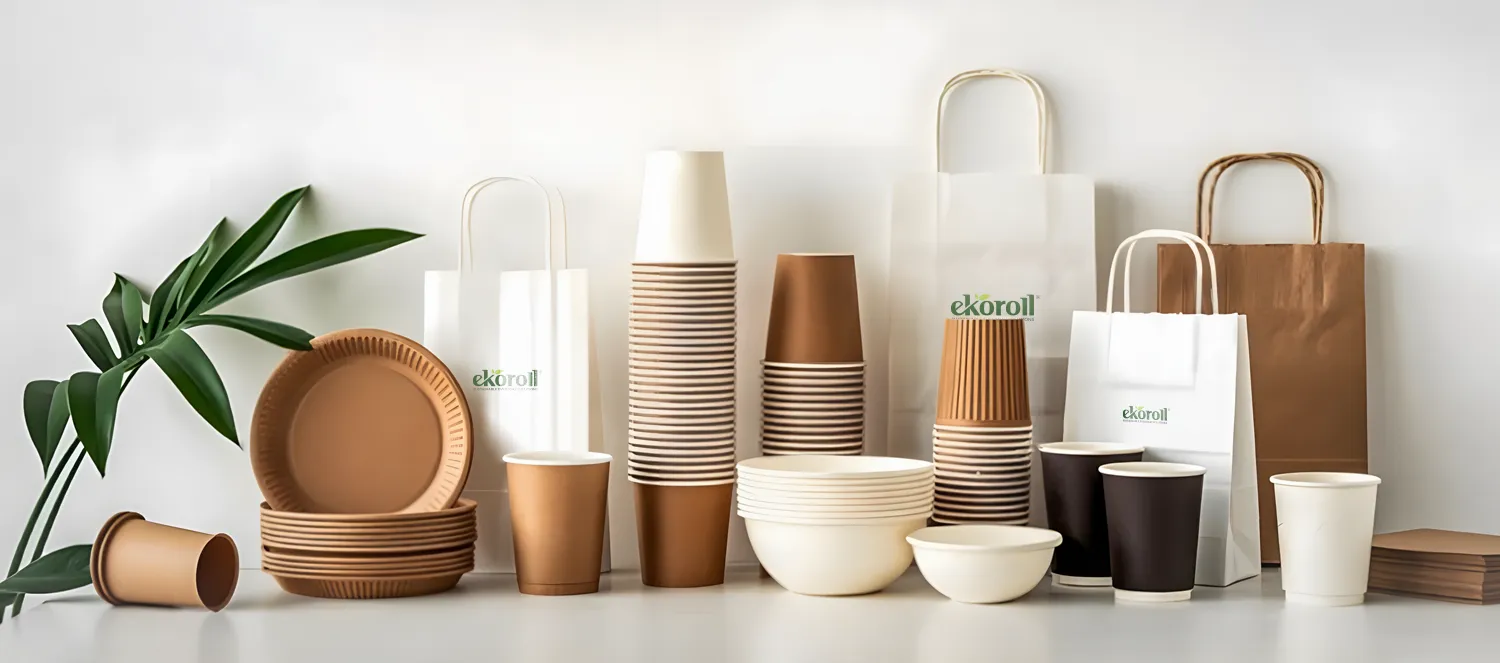
For wholesale supply, explore Ekoroll bagasse food containers including the full meal box range.
What Is a Bagasse Meal Box?
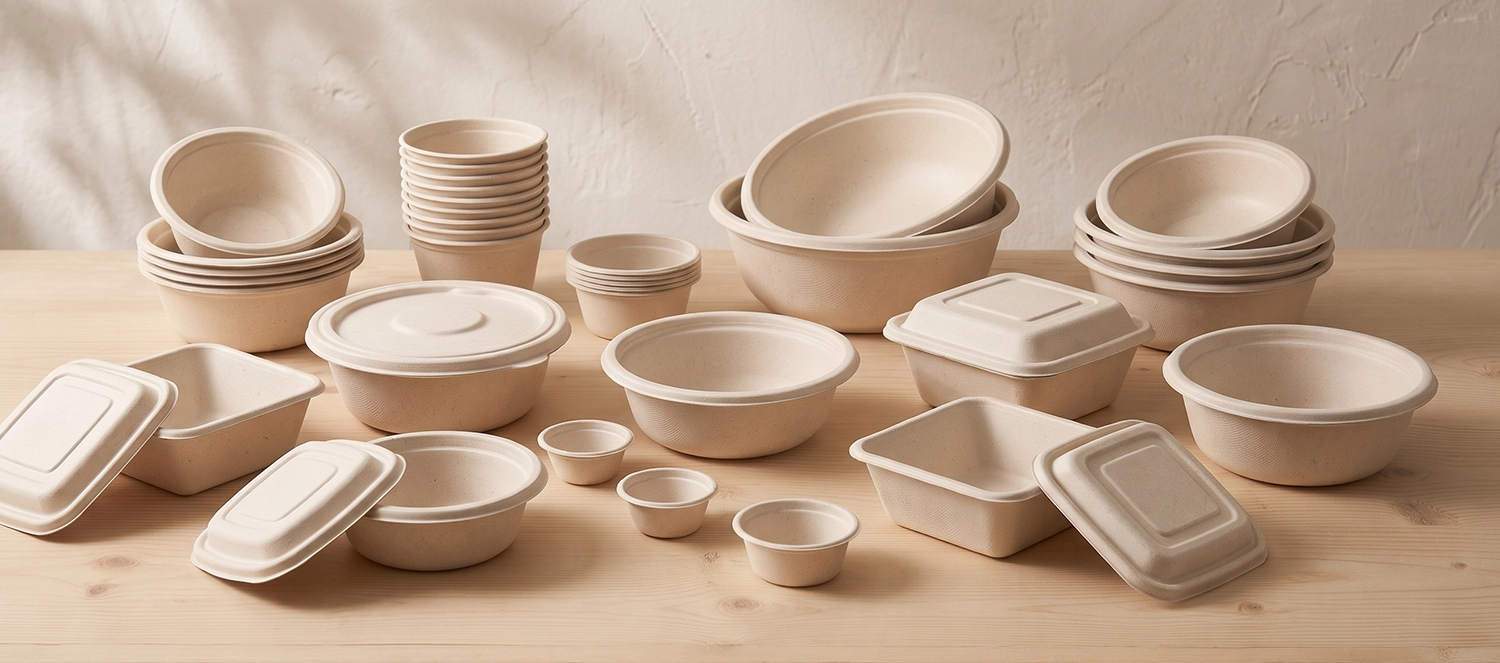
A bagasse meal box is a takeaway food container manufactured from sugarcane fiber — the fibrous residue remaining after sugarcane is crushed for sugar production. This agricultural byproduct is pulped, molded under heat and pressure, and dried to produce a rigid, heat-resistant food container that is naturally resistant to grease and moisture without any plastic coating.
The term “meal box” covers a specific category within the broader bagasse container range: containers designed primarily for complete meals, combination dishes and multi-component food service. This distinguishes them from smaller sauce pots, snack containers and flat plates, which serve different food service functions.
Key material properties relevant to meal box performance:
- No laminated plastic film — fiber-based container, PFAS-free (no added fluorinated grease barrier)
- Water- and oil-resistant without a plastic coating
- Suitable for hot and cold food, including saucy and wet dishes
- Microwave-safe: food can be reheated directly in the box
- Freezer-safe: suitable for meal prep and pre-production storage
- Structural rigidity under stacking and transport conditions
- Compostability: Ekoroll bagasse meal boxes are home compostable & 100% bagasse, certified by TÜV AUSTRIA (OK compost HOME); food-contact documentation is provided according to the final product specification and production route
Bagasse Meal Box Formats and Sizes
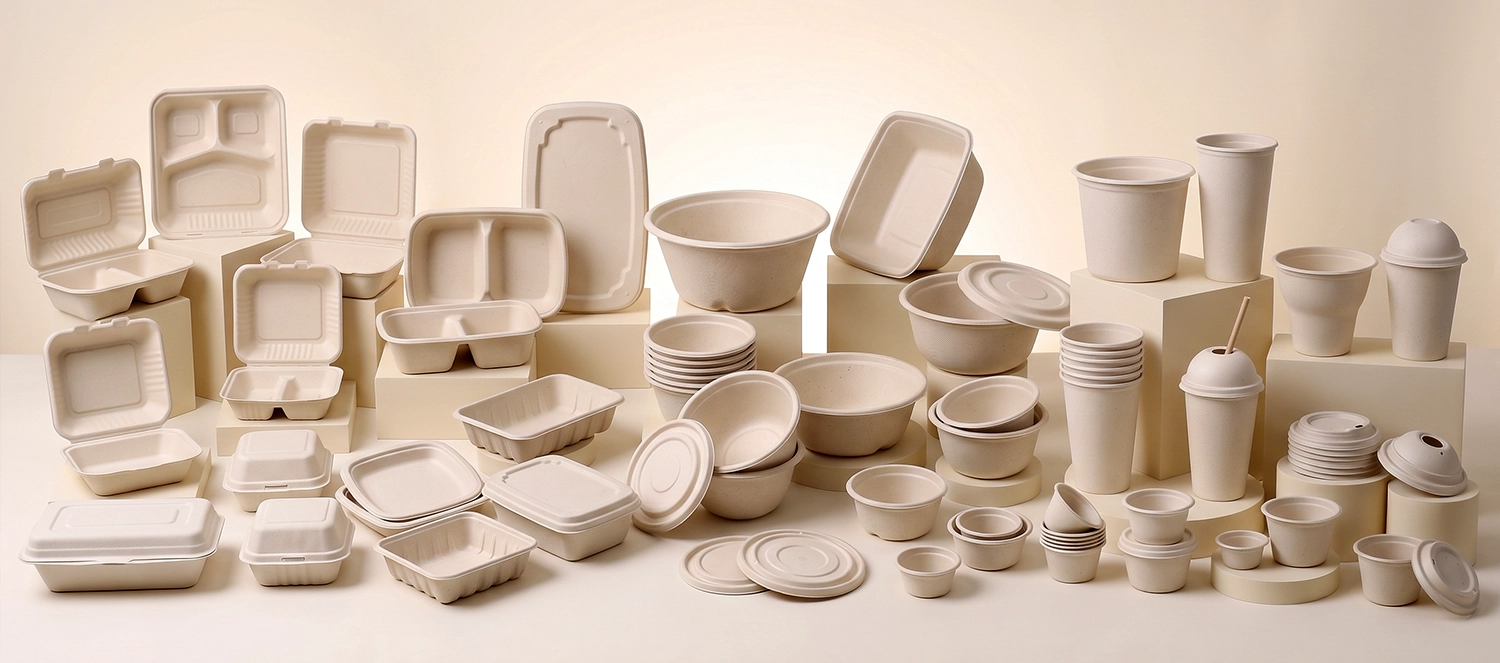
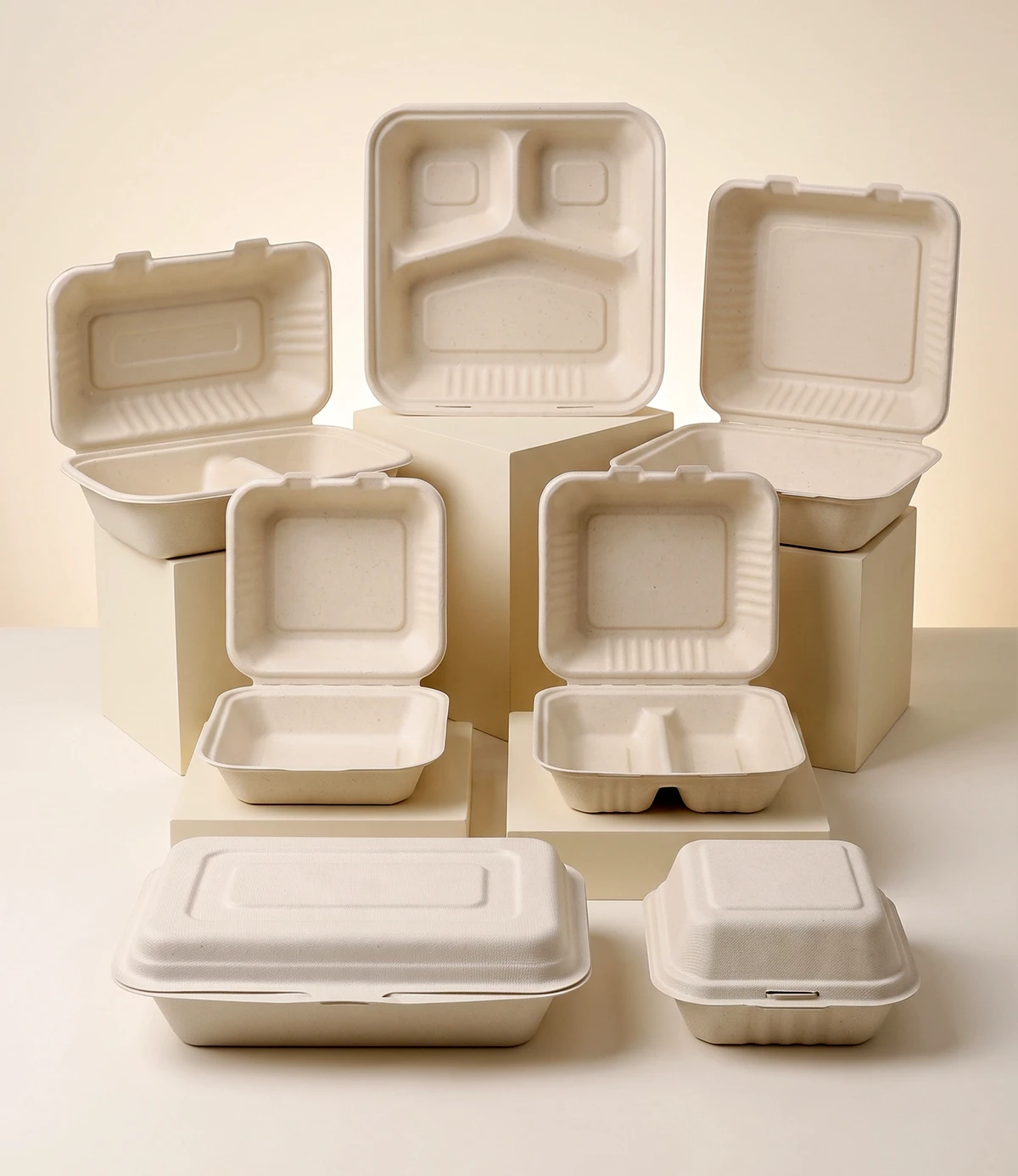
Choosing the right meal box format for your operation depends on your menu, portion sizes and service model. Bagasse meal boxes are available across several structural formats and capacity sizes.
Single-Compartment Meal Boxes
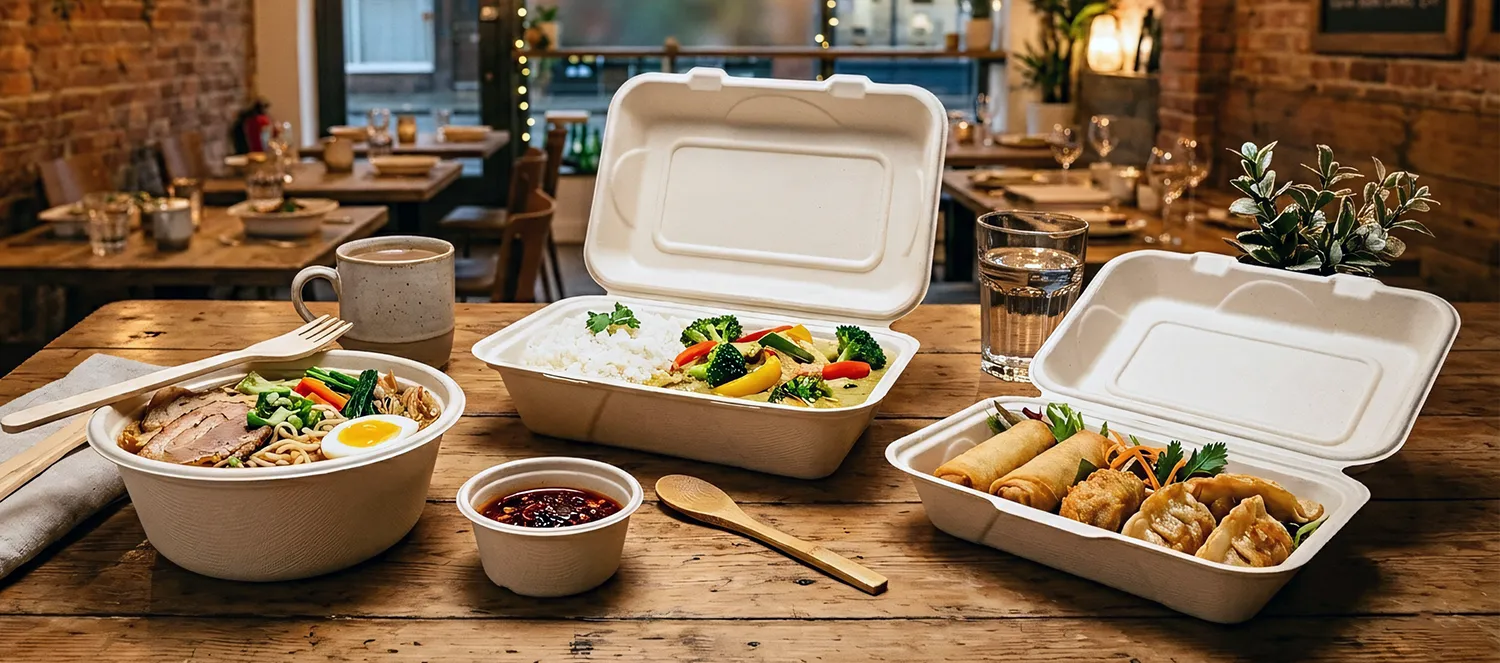
Single-compartment boxes are the standard format for meals where all components are served together — rice dishes, pasta, noodle bowls, curries, stews and similar. The single interior space allows food to be plated naturally without barriers between components. Available in capacities from approximately 500ml through to 1,100ml to cover small portions through to large meal sizes.
Two-Compartment Meal Boxes
Two-compartment boxes divide the interior into two sections, typically a larger main and a smaller side section. This format is used for meals where keeping components separate improves the eating experience — for example, rice and curry, protein and salad, or main dish and sauce. The division prevents moisture transfer between wet and dry components during transport.
Three-Compartment Meal Boxes
Three-compartment boxes provide a main section plus two smaller sections, suitable for full meals with a protein, a carbohydrate and a side or salad component. This format is widely used for meal prep, diet meal delivery and full-service meal combinations where three distinct food items are presented together.
Clamshell Meal Boxes
Hinged clamshell meal boxes have the lid and base joined by a molded hinge, eliminating the need to manage a separate lid at point of service. The hinged design provides fast, single-action closure that is reliable under delivery conditions. Clamshell formats are the preferred choice for high-volume quick service operations and delivery-focused businesses where speed of packaging is a priority.
Rectangle Containers with Separate Lids
Rectangular base-and-lid combinations provide a flat base profile that is ideal for presentation-focused food service. The separate lid allows the base to be filled and presented before closing, which suits both takeaway and retail food packaging applications. The flat profile stacks efficiently in delivery bags compared to rounded or clamshell formats.
Standard Size Range
- 500ml — small portions, children’s meals and snack-size dishes
- 650ml — standard single serving for rice, pasta and noodle dishes
- 750ml — medium portions suitable for most main course meals
- 850ml — large portions for generous servings and high-calorie meals
- 1,000ml — extra large for family portions and catering applications
- 1,100ml — maximum capacity for large meal combinations and sharing dishes
Performance in Real Delivery and Takeaway Conditions
The primary test for any meal box is how it performs under real food service conditions — not just in laboratory testing. Bagasse meal boxes are used across high-volume delivery operations, and their performance characteristics are well-documented across the conditions that matter most.
Heat Retention and Structural Integrity
Bagasse fiber has natural insulating properties that help retain food temperature during transport. The dense molded structure does not conduct heat rapidly, reducing the rate at which hot food cools during delivery. Under sustained contact with hot food at normal serving temperatures, the container maintains its shape and structural integrity without softening, leaking or deforming at the seams.
Grease and Moisture Management
The natural fiber structure of bagasse provides inherent grease resistance without a plastic coating. For wet dishes including curries, stews and saucy preparations, the dense fiber helps the container resist absorbing liquid and weakening during transport. Ekoroll’s bagasse meal boxes are water- and oil-resistant; testing your oiliest and wettest dishes with samples before ordering is still good practice.
This is a critical performance advantage over uncoated kraft paper meal boxes, which can weaken significantly when paper absorbs moisture from hot, wet food during delivery transport times of 20 to 45 minutes.
Condensation Management
Bagasse fiber naturally absorbs surface moisture, reducing condensation buildup on the container interior during transport. This helps maintain the texture of fried and crispy food items during delivery, reducing the sogginess that is a common customer complaint with plastic-surfaced containers.
Stacking and Transport Stability
Bagasse meal boxes maintain rigidity under stacking conditions in delivery bags. The molded structure resists compression under the weight of multiple stacked orders. For delivery operations where bags carry multiple orders simultaneously, this structural performance prevents container crushing and food spillage.
Microwave Reheating at Point of Receipt
Ekoroll’s bagasse meal boxes are microwave-safe, allowing customers to reheat food directly in the container without transferring to a separate vessel. This is a practical advantage for food delivery operations where the reheating experience at customer premises is part of the overall service quality.
Bagasse Meal Box vs Plastic and Paper: Comparison
| Feature | Bagasse Meal Box | Plastic (PP/EPS) | PE-Coated Paper | Uncoated Kraft |
|---|---|---|---|---|
| Plastic content | Zero | 100% plastic | PE plastic coating | Zero |
| Heat resistance | Hot & cold food | PP: 120°C / EPS: limited | Moderate | Very low |
| Grease resistance | Water- and oil-resistant; PFAS-free | Good (PP) | Good (plastic-based) | Minimal |
| Microwave safe | Yes | PP only (caveats) | Limited | Degrades |
| Freezer safe | Yes | PP: yes / EPS: variable | Generally yes | Yes |
| Condensation management | Good, fiber absorbs | Poor | Poor | Moderate |
| Structural integrity in delivery | High | Moderate (cracks under impact) | Moderate | Low under moisture |
| EN13432 compostable | Only if certified | No | No | Only if certified |
| EU SUP Directive | Outside the plastic definition (100% fiber) | In scope (EPS banned) | In scope (plastic coating) | Outside the plastic definition |
| Plastic-specific levies | None | Yes | On the plastic content, depending on market | None |
For a detailed material comparison, see: Bagasse vs Plastic Food Containers and Bagasse vs Paper Food Containers.
Choosing the Right Bagasse Meal Box for Your Operation
The right meal box format depends on three factors: your menu composition, your service model and your delivery logistics. Use this framework to identify the most appropriate configuration for your specific operation.
By Menu Type
- Single-dish meals (pasta, rice bowls, noodle dishes, curries): single-compartment box in the appropriate capacity for your portion size
- Combination meals with wet and dry components: two-compartment box to prevent moisture transfer between components
- Full meal combinations with protein, carbohydrate and side: three-compartment box for clear component separation
- Burgers, wraps and sandwiches: clamshell format for fast, single-action closure at point of service
- Salads and cold dishes: rectangular container with separate lid for presentation quality
By Service Model
- High-volume quick service and takeaway: clamshell formats for packaging speed and single-action closure
- Food delivery platforms: rectangular containers with secure separate lids for leak resistance during transport
- Meal prep and diet delivery: three-compartment boxes for consistent portioning and component separation
- Catering and event service: rectangular tray and base-and-lid formats for premium presentation quality
- Cloud kitchen operations: standardize on one or two formats to simplify kitchen operations and packaging inventory
Capacity Selection Guide
- 500 to 650ml: small portions, children’s meals, appetizers, single-item dishes
- 750 to 850ml: standard main course portions for most restaurant menus
- 1,000 to 1,100ml: large portions, generous servings, sharing dishes and catering applications
EU Regulations and Bagasse Meal Boxes
The regulatory environment for takeaway food containers in European markets is tightening progressively. Plastic-free bagasse meal boxes are well-positioned for current and upcoming requirements, and Ekoroll’s bagasse meal boxes are home compostable & 100% bagasse, certified by TÜV AUSTRIA (OK compost HOME).
- EU Single-Use Plastics Directive (EU) 2019/904: EPS foam food containers are banned across member states. Plastic food containers, including PP, PET and plastic-lined paper, fall under consumption-reduction measures and extended producer responsibility. Bio-based plastics such as PLA count as plastic.
- Plastic-specific taxes and levies: the UK (Plastic Packaging Tax, £228.82 per tonne from April 2026) and Spain (€0.45/kg on non-reusable plastic packaging) tax plastic packaging; Germany has no plastic packaging tax but charges producers of single-use plastic food containers through the Single-Use Plastics Fund (Einwegkunststofffonds); Portugal charges €0.30 per single-use plastic or aluminium take-away meal package; France works through eco-modulated EPR fees; Italy’s plastic tax has been postponed to 2027. These add cost to plastic meal boxes and, where the plastic content is taxed, to PE-coated paper ones.
- Packaging EPR for every material: extended producer responsibility applies to all packaging, including paper and bagasse — in Germany, for example, VerpackG system participation (licensing) and LUCID registration.
- EU Packaging and Packaging Waste Regulation (EU) 2025/40: in force since 11 February 2025 and applicable from 12 August 2026, with PFAS limits for food-contact packaging from that date; recyclability criteria, harmonized labels and reuse targets follow in stages from 2028 to 2030.
Switching to 100% bagasse meal boxes removes plastic-specific taxes and levies — general packaging EPR still applies — and positions you well for the PPWR stages through 2030.
Documentation to Request for Bagasse Meal Boxes
When sourcing bagasse meal boxes for EU market supply, ask your supplier which of the following documents apply to the exact product, and who holds them, before placing bulk orders.
- EN13432 — European industrial compostability standard. A certificate confirms at least 90% biodegradation within six months and disintegration within 12 weeks under industrial composting conditions, with no toxic residue
- OK compost HOME / OK compost INDUSTRIAL — two separate TÜV AUSTRIA certifications, one for home and one for industrial composting conditions; Ekoroll bagasse is home compostable & 100% bagasse (TÜV AUSTRIA OK compost HOME) (the certificate is held by the producing mill, copy on request)
- PFAS-free certification — confirms absence of per- and polyfluoroalkyl substances in the container material
- FDA food contact compliance — required for operations supplying US and international markets in addition to EU requirements
Wholesale Sourcing Guide
For restaurants, cloud kitchens and horeca distributors sourcing bagasse meal boxes at wholesale volume, the key evaluation criteria are certification, format range, production consistency and logistics.
- Compostability certificate (EN 13432, OK compost HOME or OK compost INDUSTRIAL) — verify it covers your specific format and size range, not just the material category, and who holds it
- PFAS-free confirmation — request documentation confirming absence of PFAS chemicals
- Sample availability — test samples with your actual menu items at serving temperature before bulk ordering
- Format range — sourcing multiple formats from a single supplier simplifies procurement and ensures consistent certification documentation
- Production capacity — confirm the supplier can meet your peak volume requirements consistently
- Quantities: quoted per project, by format, size and print specification
Wholesale Bagasse Meal Boxes for Restaurants and Delivery Operations
Ekoroll supplies bagasse meal boxes and food containers wholesale to restaurants, cloud kitchens, food delivery brands and horeca distributors across Europe. Direct supply from Turkey with EU-compliant documentation and samples available on request.