Food packaging is no longer just a functional choice — it has become a strategic business decision that directly impacts cost, compliance, customer perception, and long-term profitability. For restaurants, takeaway businesses, food delivery operators and horeca distributors, choosing between plastic food containers and bagasse food containers is one of the most consequential packaging decisions in today’s market.
This guide provides a comprehensive, business-focused comparison of bagasse vs plastic food containers — covering materials, performance specifications, cost analysis, EU regulatory positioning, certifications and wholesale sourcing — to help you select the right compostable food packaging solution for your operation.
For wholesale sourcing, explore Ekoroll bagasse food containers for horeca and takeaway operations.
What Is Bagasse and Where Does It Come From?
Bagasse is the fibrous residue remaining after sugarcane stalks are crushed to extract juice for sugar production. In conventional sugar manufacturing, this byproduct was historically burned as fuel or discarded as waste. Bagasse food packaging repurposes this agricultural byproduct into a high-performance molded fiber food container material.
The production process involves pulping the dried bagasse fiber, forming it in precision molds under heat and pressure, and drying it to produce rigid, dimensionally stable containers. Bagasse containers made to a plastic-free, PFAS-free specification use no petroleum-based binders, plastic coatings or PFAS chemicals. The finished material is dense, rigid, and naturally resistant to grease and moisture without any additional treatment.
Key material properties of bagasse fiber:
- Renewable source — sugarcane is a fast-growing crop with high annual yield per hectare
- Agricultural byproduct — uses material that would otherwise be waste or burned, creating no additional agricultural land demand
- Natural grease and moisture barrier — the dense fiber structure provides inherent resistance without plastic coatings
- Suitable for hot and cold food — maintains structural integrity with hot meals at normal serving temperatures
- Compostability — Ekoroll bagasse containers are home compostable & 100% bagasse, certified by TÜV AUSTRIA (OK compost HOME); food-contact documentation is provided according to the final product specification and production route
Understanding Plastic Food Containers
Conventional plastic food containers used in food service are manufactured primarily from three petroleum-derived polymer types, each with different performance characteristics and environmental profiles.
Polypropylene (PP)
PP is the most common plastic used in takeaway food containers. It is lightweight, rigid, heat-tolerant up to approximately 120°C (unfilled) and microwave-safe in many formats. PP is technically recyclable but has low effective recycling rates for food-contaminated takeaway containers in most European waste management systems.
Polystyrene (PS) and Expanded Polystyrene (EPS)
PS and EPS (foam) containers are widely used for their insulation properties and low unit cost. EPS is banned or restricted in many EU markets under single-use plastics legislation. Both PS and EPS have very low recycling rates and are persistent environmental contaminants when disposed of improperly.
Polyethylene Terephthalate (PET)
PET is commonly used for cold food containers and salad bowls. It has higher clarity than PP and is more widely recycled, but is not suitable for hot food applications, and as a single-use food container it falls under the EU Single-Use Plastics Directive’s consumption-reduction and extended producer responsibility rules.
Performance Comparison: Bagasse vs Plastic Food Containers
For food service operations, container performance under real service conditions is the primary practical consideration. The comparison covers the key dimensions that matter in takeaway, delivery and dine-in food service.
Heat Resistance
Bagasse containers are suitable for hot and cold food and maintain their structural integrity and shape with hot meals, soups, sauces and curries at normal serving temperatures, without deformation. Ekoroll’s bagasse containers are also microwave-safe.
PP containers handle hot food within the limits specified for each item; like any food-contact plastic, they must meet the migration limits of Regulation (EU) No 10/2011, so use them only under the conditions the supplier states. EPS containers have lower heat tolerance and are banned in multiple EU markets. PET containers are not suitable for hot food.
Grease and Moisture Resistance
Bagasse provides natural grease and moisture resistance without any plastic coating. The dense fiber structure creates a natural barrier for oily meals, sauces and wet ingredients; Ekoroll’s bagasse containers are water- and oil-resistant, and testing your most demanding dishes with samples is still good practice.
Plastic containers vary in grease and moisture resistance by polymer type. PP provides good resistance. PET is adequate for cold applications. EPS can absorb grease over time, compromising container integrity and food presentation.
Structural Integrity in Delivery
Bagasse containers maintain structural rigidity under stacking weight and transport conditions. Their molded fiber construction resists compression and does not deform under the weight of stacked orders in delivery bags. This makes them reliable for food delivery operations where multiple orders are transported simultaneously.
Plastic containers are generally structurally adequate for delivery but can crack or deform under impact conditions, particularly at lower temperatures. EPS containers are fragile under impact loading and generate significant litter when broken.
Microwave Performance
Ekoroll’s bagasse containers are microwave-safe. Where they are, customers can reheat food directly in the container, eliminating the need to transfer food to a separate vessel. This is a significant operational convenience for food delivery and meal prep applications.
PP containers are generally microwave safe within the conditions the supplier states. EPS and PET containers are not suitable for microwave use.
Freezer Compatibility
Ekoroll’s bagasse containers are freezer-safe, and they suit meal prep, catering pre-production and frozen food applications where the same container is used from freezer to reheating.
PP containers are generally freezer compatible. PET and EPS containers have variable freezer performance depending on specific formulation.
Condensation Management
A common complaint about plastic containers in delivery applications is condensation buildup on the interior surface, which can make food — particularly fried items — soggy during transport. Bagasse fiber is a natural moisture absorber that manages condensation more effectively than plastic surfaces, helping maintain food texture during delivery.
Full Comparison Table
| Feature | Plastic Containers (PP/PET/EPS) | Bagasse Containers |
|---|---|---|
| Material source | Petroleum-derived fossil plastic | Renewable sugarcane agricultural byproduct |
| Plastic content | 100% plastic | Fiber-based, no laminated plastic film |
| Heat resistance (liquids) | PP: 120°C / PET: cold only / EPS: limited | Hot & cold food |
| Oven and microwave safe | PP only (with caveats) | Microwave-safe |
| Freezer safe | PP and PET: yes / EPS: variable | Yes |
| Grease resistance | PP: good / PET: moderate / EPS: poor | Water- and oil-resistant |
| Condensation management | Poor — plastic surface promotes condensation | Good — fiber absorbs moisture |
| Compostable | No | Only if certified |
| Recyclable | Technically yes / practically low rate | Not recycled; composting route where certified and accepted |
| Microplastic risk | Plastic material; can shed microplastics | No plastic layer |
| EU SUP Directive status | In scope (EPS banned; consumption reduction and EPR for the rest) | Outside the plastic definition (100% fiber) |
| Plastic-specific levies | Yes — e.g. UK, Spain, Portugal, Germany’s Single-Use Plastics Fund | None (packaging EPR applies to every material) |
| End-of-life pathway | Landfill or incineration in most cases | Ekoroll bagasse: home compostable & 100% bagasse (TÜV AUSTRIA OK compost HOME) |
| Customer perception | Increasingly negative | Positive — eco-conscious positioning |
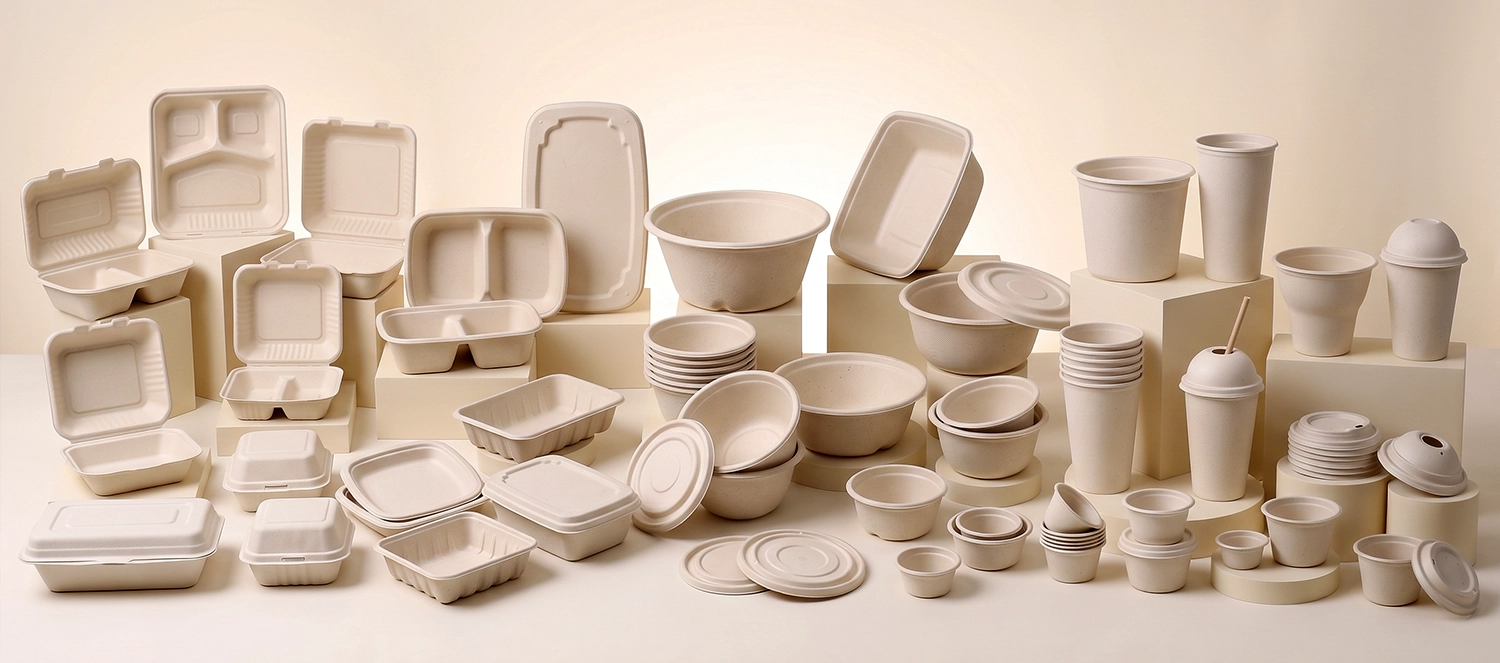
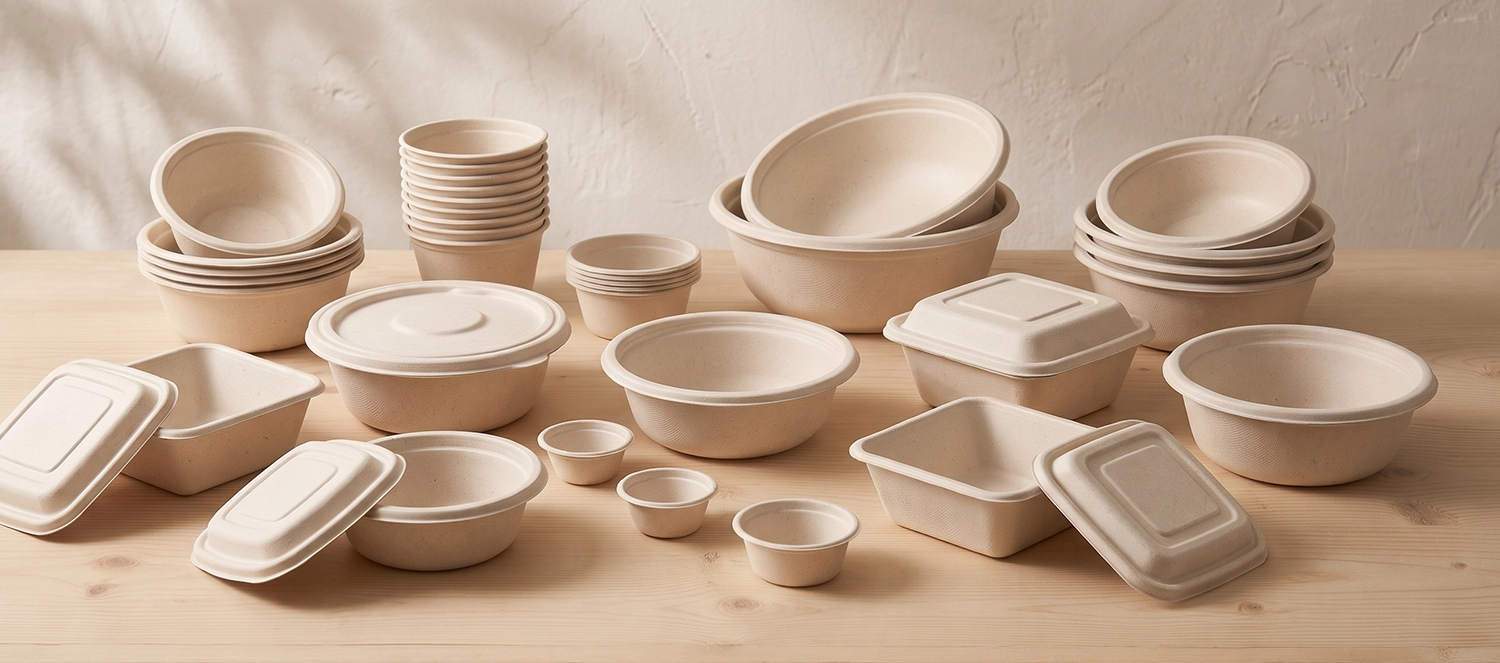
Bagasse Food Container Formats
Bagasse containers are available across a comprehensive range of formats covering the primary food categories served in restaurant, takeaway and food delivery operations.
Clamshell Containers
Hinged clamshell containers are the most widely used bagasse format in takeaway and delivery operations. Available in single and multi-compartment versions, they are suitable for full meals, burgers, sandwiches, salads and combo meal presentations. The hinged design provides secure closure without a separate lid, simplifying packaging at point of service.
Rectangular and Square Containers with Lids
Separate base and lid containers provide a premium presentation format suitable for salads, grain bowls, pasta dishes and ready meals. The flat base and secure lid combination performs well in delivery applications where presentation quality at point of receipt is important.
Round Bowls
Round bagasse bowls are used for soups, curries, noodle dishes and hot meal applications where a deeper container profile is required. Available with and without matching lids depending on service format.
Trays and Plates
Flat tray and plate formats are used for catering, event service and dine-in applications where food presentation on a flat surface is required. The natural fiber texture of bagasse trays provides a premium visual quality that works well for food-forward brand positioning.
Multi-Compartment Containers
Two and three-compartment bagasse containers allow multiple food items to be served in a single container without mixing. These are used for meal combinations, sides and sauces served alongside a main dish.
Portion and Snack Containers
Smaller bagasse containers for sides, sauces, condiments and snack portions are available in various capacities from small sauce pots through to medium sides containers.
Cost Comparison: Bagasse vs Plastic
The unit cost of bagasse containers is typically higher than equivalent plastic formats; the difference depends on container size, format and order volume, and pricing is quoted per project. However, the total cost comparison for EU market operations is significantly more nuanced than unit price alone.
Factors That Offset the Bagasse Unit Cost Premium
- Plastic-specific taxes and levies — the UK (Plastic Packaging Tax) and Spain (€0.45/kg) tax plastic packaging, Portugal charges €0.30 per single-use plastic take-away meal package, and Germany — which has no plastic packaging tax — charges producers of single-use plastic food containers through the Single-Use Plastics Fund. At relevant volumes, these levies reduce the effective cost premium of bagasse alternatives
- SUP EPR costs — extended producer responsibility under the Single-Use Plastics Directive adds clean-up and awareness costs for plastic food containers on top of the packaging EPR fees that apply to every material, bagasse included
- Regulatory risk costs — the cost of switching to compliant packaging reactively after regulatory changes is typically higher than proactive transition costs
- Brand value — in consumer-facing markets where sustainable packaging drives purchasing decisions, bagasse containers contribute measurable brand value that plastic alternatives do not
- Waste handling — in markets with food waste composting collection, compostable containers can reduce general waste handling costs
Total Cost Framework
For a realistic cost comparison, evaluate:
- Unit cost per container × monthly volume
- Plastic-specific levies and SUP EPR costs per unit applied to plastic alternatives
- Compliance and documentation cost for plastic packaging
- Brand and customer retention value differential
- Waste handling cost difference
At wholesale volumes for EU market operations, the effective cost difference between bagasse and plastic containers is typically significantly smaller than the headline unit price comparison suggests — and in markets with plastic levies, can be cost-neutral or cost-positive for bagasse.
The material name is not a specification
Two items can both be honestly described as bagasse and behave completely differently. Coatings, pulp preparation and molding conditions change the result far more than the raw material does. “Made from bagasse” tells you where the fiber came from; it tells you nothing about what the finished item will do on your service line.
Ask about the finished product, not the fiber
Three questions settle most of it: what are the temperature limits for this specific item, what are the disposal instructions, and does any compostability claim cover the finished product and name the conditions it applies under — or only the material it started as?
That last one stopped being a matter of preference. From 27 September 2026, under Directive (EU) 2024/825, displaying a sustainability label that is not based on a recognized certification scheme is a banned commercial practice.
The video follows the route from cane to finished tray in 1 minute 56 seconds.
Certifications for Bagasse Food Containers
Certification is the most important quality and compliance factor when sourcing bagasse containers for EU market supply. Without verified certification, compostability claims cannot be substantiated for regulatory compliance, B2B procurement documentation or consumer communication.
EN13432 — European Industrial Compostability
EN13432 is the primary certification standard for compostable packaging in the European market. To be certified to EN13432, a product must biodegrade by at least 90 percent within 6 months under industrial composting conditions and produce compost with no toxic residue or heavy metal contamination.
OK compost INDUSTRIAL and OK compost HOME — Two Separate Certificates
TÜV AUSTRIA issues two separate certifications: OK compost INDUSTRIAL, based on EN 13432, and OK compost HOME, which tests that a product breaks down at the lower temperatures of a home compost heap. A product can hold one, the other or both, each on its own certificate, so check which one covers the item you are buying. Ekoroll bagasse is home compostable & 100% bagasse (TÜV AUSTRIA OK compost HOME); the certificate is held by the producing mill and a copy is available on request.
FDA Food Contact Compliance
For operations supplying US and international markets, FDA food contact material compliance confirms that no harmful substances migrate from the container into food under normal use conditions. EU food contact material regulation compliance is required for European market distribution.
PFAS-Free Certification
Per- and polyfluoroalkyl substance (PFAS) contamination in food contact materials has become a significant regulatory concern in EU food safety frameworks. Since 12 August 2026, the PPWR limits PFAS in food-contact packaging (25 ppb for any single PFAS, 250 ppb for the sum of targeted PFAS, 50 ppm total PFAS). Ask for a PFAS-free declaration or test report covering the specific bagasse container, confirming that no PFAS chemicals are used in the container material or manufacturing process.
EU Regulatory Landscape for Plastic Food Containers
The EU regulatory environment for single-use plastic food containers is tightening progressively. Understanding the timeline is essential for operations planning their packaging programs beyond the immediate procurement cycle.
- 2021: the EU Single-Use Plastics Directive (EU) 2019/904 bans EPS food containers and brings other single-use plastic food containers under consumption-reduction measures and extended producer responsibility
- 2022 to 2024: national plastic measures add cost: the UK Plastic Packaging Tax (since April 2022), Portugal’s €0.30 contribution per single-use plastic take-away meal package (since July 2022), Spain’s €0.45/kg tax on non-reusable plastic packaging (since January 2023) and Germany’s Single-Use Plastics Fund, with payments based on quantities placed on the market since 2024. Germany has no plastic packaging tax; France works through eco-modulated EPR fees; Italy’s plastic tax has been postponed to 2027
- 2025 to 2026: the EU Packaging and Packaging Waste Regulation (EU) 2025/40 enters into force on 11 February 2025 and applies from 12 August 2026, including PFAS limits for food-contact packaging
- 2028 to 2030: PPWR recyclability criteria, harmonized labels and reuse targets phase in, adding compliance cost for packaging that cannot meet them
100% bagasse falls outside the SUP Directive’s plastic definition and is well positioned for the PPWR stages, and Ekoroll’s bagasse containers are home compostable & 100% bagasse (TÜV AUSTRIA OK compost HOME). Switching to bagasse alternatives now removes plastic-specific taxes and levies; general packaging EPR — for example VerpackG licensing and LUCID registration in Germany — applies to all packaging, bagasse included.
Bagasse Containers by Food Service Type
Different food service operations have different container requirements. The most effective sustainable packaging programs match container format and specification to the specific needs of each operation type.
Cafés and Bakeries
For cafés serving pastries, sandwiches and light meals, bagasse clamshell and tray formats provide the right combination of presentation quality and functional performance. Small and medium clamshells are the primary format for café food packaging.
Quick Service and Burger Restaurants
Burger clamshells and single-compartment containers are the primary format for quick service operations. Bagasse burger boxes provide the grease resistance and structural rigidity required for burger and wrap service in takeaway and delivery formats.
Asian and Noodle Restaurants
Round bowls and rectangular containers with secure lids are the primary formats for noodle, rice and curry dishes. Bagasse bowl formats suit hot, wet dishes including soups and broths; Ekoroll’s bagasse is water- and oil-resistant, and sampling the format with your liquid-heavy dishes is still good practice.
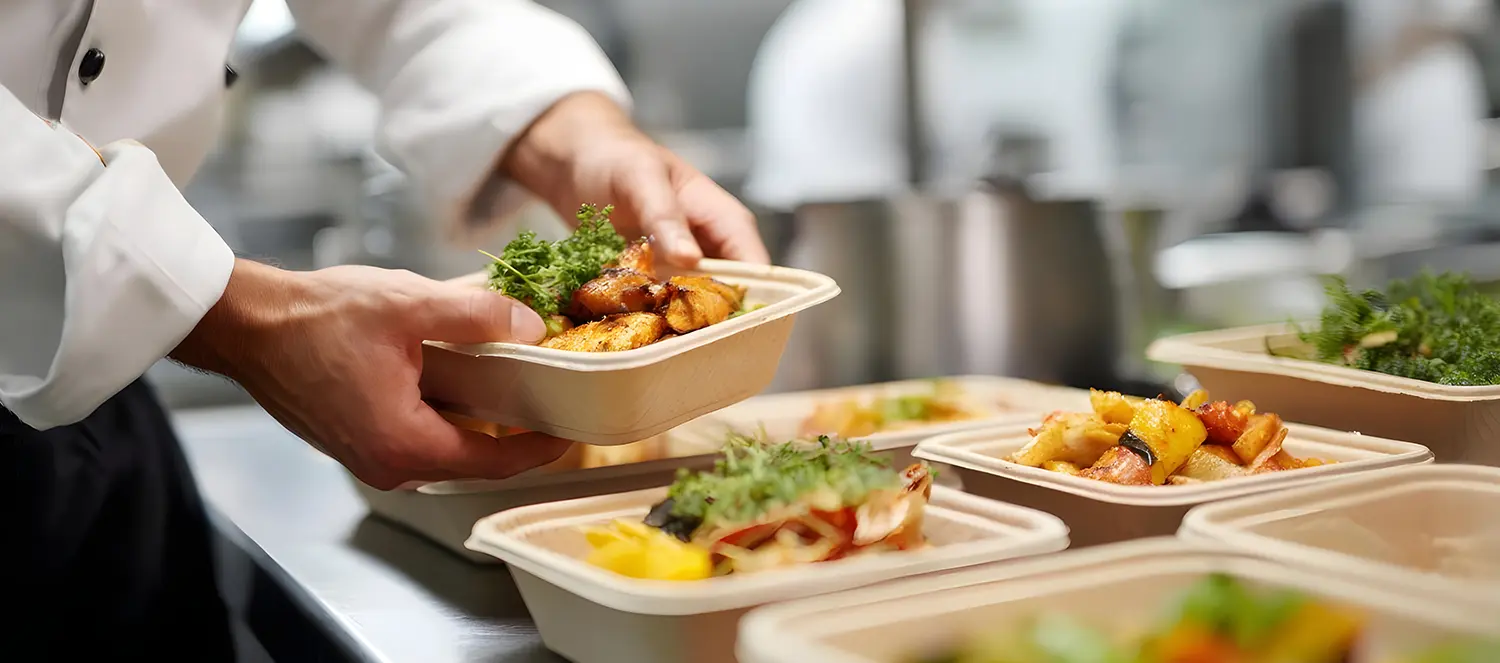
Food Delivery Operations
Food delivery requires containers that maintain food quality through transport. Bagasse containers perform well in delivery conditions due to their condensation management, structural rigidity under stacking and microwave-safe reheating at point of receipt.
Catering and Event Service
For catering and events, bagasse tray and plate formats provide premium food presentation quality that supports brand positioning. The natural fiber texture communicates the natural material visually at point of service.
How to Source Bagasse Food Containers Wholesale
For restaurants and distributors sourcing bagasse containers at wholesale volume, the key evaluation criteria are certification, format range, production consistency and logistics.
- Compostability certificate (EN 13432, OK compost HOME or OK compost INDUSTRIAL) — verify that it is current, covers the specific formats and sizes you are ordering, and who holds it
- PFAS-free confirmation — request documentation confirming absence of PFAS chemicals in the container material
- Format range — a supplier covering multiple formats allows consistent sourcing across your full container range from a single source
- Sample availability — test samples with your actual menu items under real service conditions before bulk ordering
- Production capacity — confirm that the supplier can meet your peak volume requirements consistently
- Export documentation — commercial invoice, packing list and certificate of origin for customs, plus food-contact compliance documentation for the EU importer
- Quantities: quoted per project, by format, size and print specification
Building a Complete Plastic-Reduced Packaging System
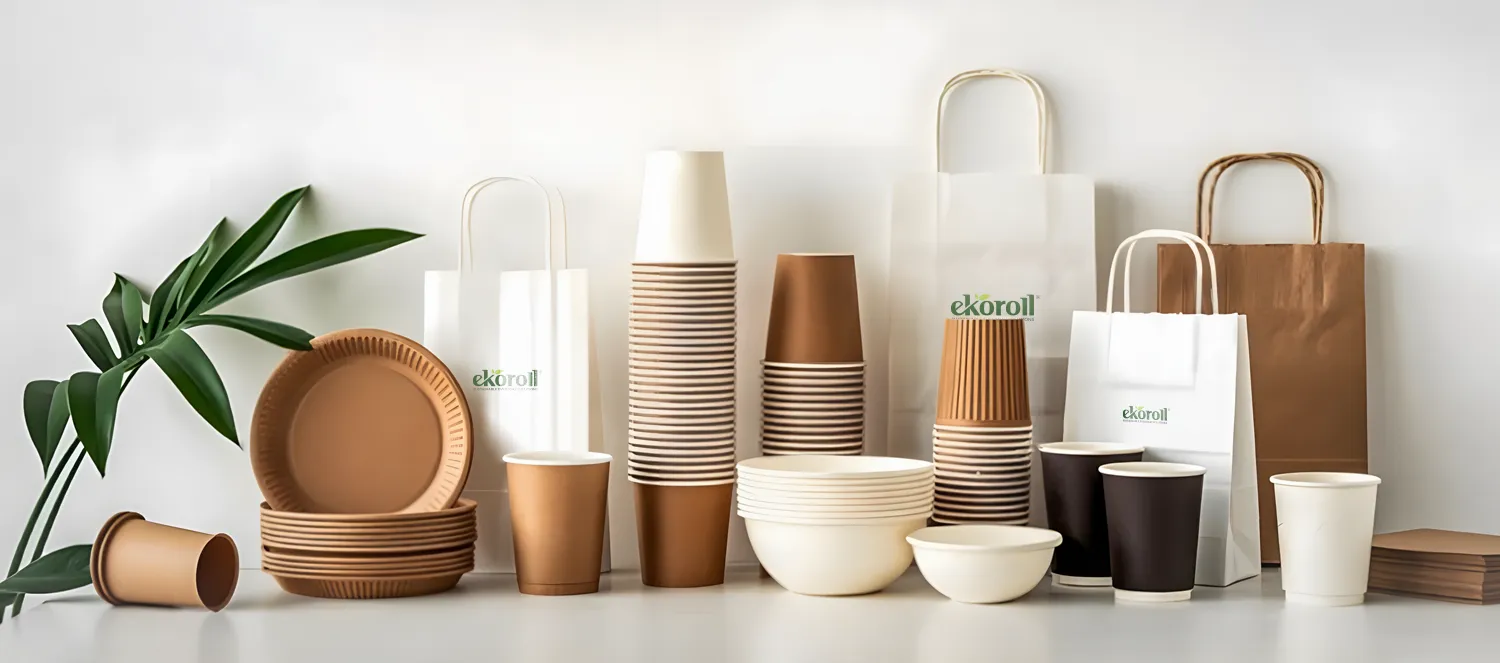
For operations building a complete plastic-reduced packaging system, bagasse food containers are typically the first and highest-volume component to switch. A complete system also addresses beverage cups, lids and cutlery.
- Bagasse food containers — for meals, takeaway food and delivery orders
- Lid-free hot paper cups — for hot beverages with no separate plastic lid
- Lid-free cold paper cups — for cold beverages and iced drinks
- Molded fiber lids — for operations keeping existing cup formats
- Wooden and bamboo cutlery — for plastic-free utensil service
- PFAS-free greaseproof paper — for wrapping and lining applications
Sourcing all components from a single wholesale supplier simplifies procurement, ensures consistent certification documentation and reduces logistics complexity for horeca operators and distributors.
Wholesale Bagasse Food Containers for Restaurants and Horeca
Ekoroll supplies bagasse food containers wholesale to restaurants, cafés, food delivery brands and horeca distributors across Europe. Direct supply from Turkey with EU-compliant documentation and samples available on request.