For restaurants, horeca distributors and food delivery operators switching from plastic cutlery, the next decision is which sustainable alternative to choose. Wooden cutlery and bamboo cutlery are the two most widely used plastic-free options in European food service, and while both eliminate plastic from the cutlery component of a takeaway system, they differ meaningfully in material properties, performance, cost and sustainability profile.
This guide provides a complete comparison of wooden cutlery vs bamboo cutlery for food service operations, covering materials, performance, certifications, cost, use cases and wholesale sourcing guidance to help you select the right option for your operation.
For wholesale supply of both formats, explore Ekoroll wooden and bamboo cutlery for horeca and takeaway operations.
Wooden Cutlery: Material and Production
Wooden disposable cutlery is manufactured primarily from birch wood, a fast-growing hardwood widely used in Northern and Eastern European forestry. Birch is the dominant wood species for disposable cutlery production due to its combination of strength, smooth grain and low moisture absorption compared to softer wood species.
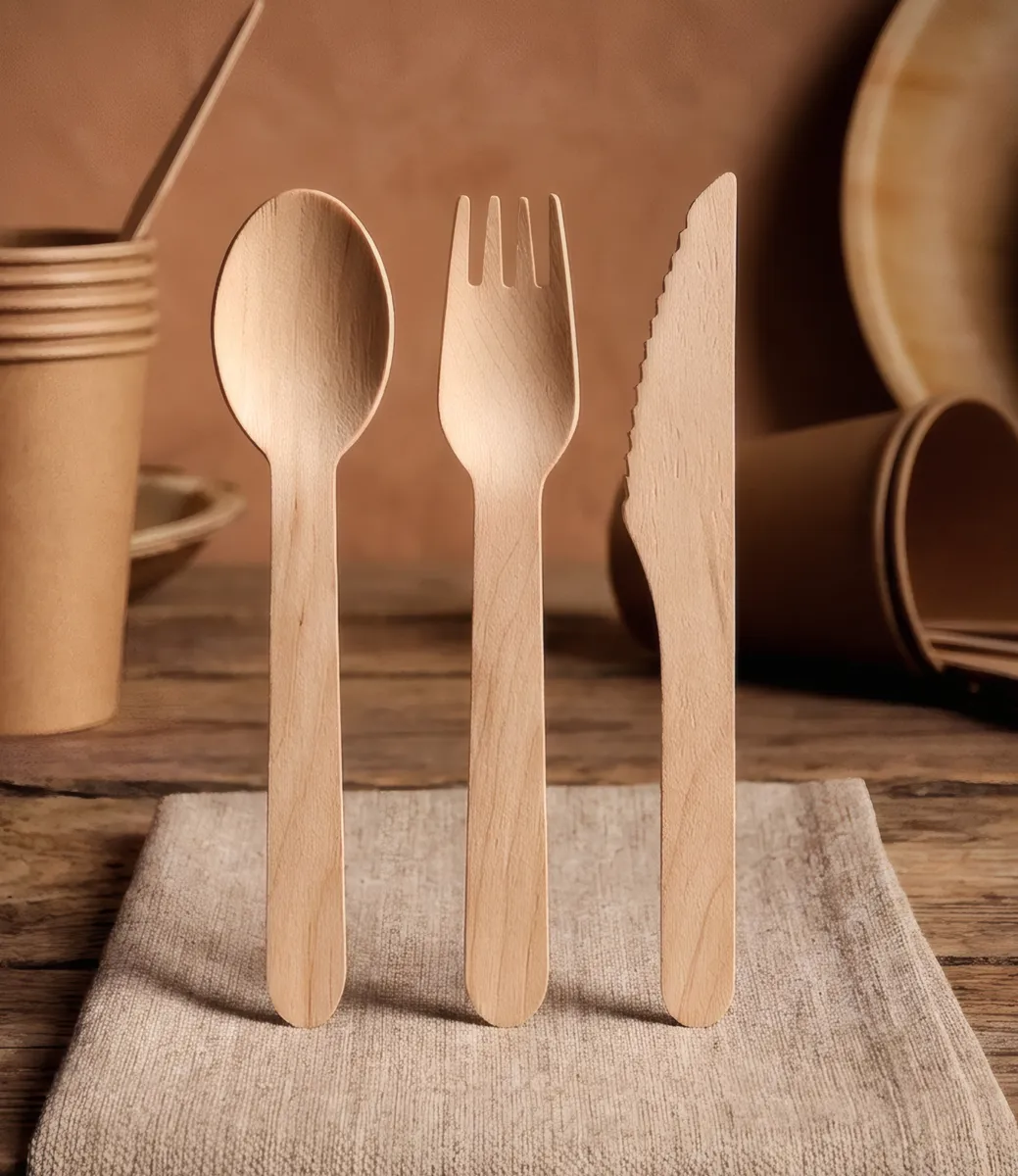
The production process involves cutting birch wood into blanks, pressing and forming under heat into the required utensil shape, sanding to a smooth food-contact surface finish, and applying food-safe treatment. The finished product is smooth, rigid and free from splinters under normal use conditions.
Key material properties of birch wooden cutlery:
- Material: birch wood from managed forestry sources
- Surface: smooth, sanded finish suitable for direct food contact
- Rigidity: high — minimal flex under normal food service use
- Heat tolerance: suitable for hot food up to approximately 80°C under normal use
- Moisture resistance: moderate — extended soaking in liquid will cause softening over time
- Weight: lightweight — approximately 2 to 4 grams per piece depending on format
- End-of-life: natural material; compostability only where the specific item is certified
Bamboo Cutlery: Material and Production
Bamboo cutlery is manufactured from bamboo fiber, either as solid bamboo strips or as pressed bamboo fiber composite. Bamboo is a grass, not a wood, and its cellular structure differs significantly from hardwood. The natural fiber structure of bamboo provides a different combination of flexibility, strength and surface characteristics compared to birch wood.
Bamboo grows extremely rapidly without requiring replanting — a bamboo plant can regenerate from its root system after harvest, unlike trees that require replanting after felling. This gives bamboo a different sustainability profile from managed forestry wood, though both are considered renewable raw material sources.
Key material properties of bamboo cutlery:
- Material: bamboo fiber or solid bamboo strip
- Surface: slightly more textured than birch — smooth finish in premium formats
- Rigidity: high with some natural flex — slightly more flexible than birch wood
- Heat tolerance: suitable for hot food, broadly similar to birch wood
- Moisture resistance: moderate to good — bamboo fiber has natural moisture resistance properties
- Weight: slightly heavier than birch wood in equivalent formats
- End-of-life: natural material; compostability only where the specific item is certified
Wooden vs Bamboo Cutlery: Full Comparison
| Feature | Wooden Cutlery (Birch) | Bamboo Cutlery |
|---|---|---|
| Raw material | Birch wood, managed forestry | Bamboo grass, self-regenerating |
| Replanting required after harvest | Yes | No — regenerates from root system |
| Growth cycle | 15 to 25 years | 3 to 5 years |
| Rigidity | High, minimal flex | High with slight natural flex |
| Surface finish | Very smooth | Smooth to slightly textured |
| Heat tolerance | Up to approx. 80°C | Up to approx. 80°C |
| Moisture resistance | Moderate | Moderate to good |
| Unit cost at wholesale | Lower | Higher (moderate premium; quoted per project) |
| Visual appearance | Natural pale wood | Natural bamboo grain, slightly warmer tone |
| Brand positioning | Practical, natural look | Premium, sustainable, high-end |
| Outside the SUP plastic cutlery ban (no plastic) | Yes | Yes |
| Natural material | Yes | Yes |
| Compostable | Only if certified | Only if certified |
| Available in sets | Yes | Yes |
| Best for | High-volume takeaway, delivery, catering | Premium restaurants, eco-brands, hotel service |
Performance Comparison for Food Service Use
Strength and Rigidity
Both birch wooden and bamboo cutlery provide sufficient strength for all standard food service applications. Neither format breaks or splinters under normal use with typical takeaway meal types including rice dishes, pasta, salads, stir-fries and similar.
Birch wood provides a stiffer, less flexible feel. Bamboo has a slight natural spring to it due to its fiber structure. For most customers, both feel comparable in use. The difference is most noticeable in knife formats, where bamboo’s slight flex can reduce the perception of cutting rigidity for dense foods.
Surface Feel and Customer Experience
Birch wood produces an extremely smooth surface after sanding and finishing. The surface is consistent and has the clean tactile feel associated with quality disposable products. Bamboo in standard formats has a slightly more textured surface that some customers associate with a more natural, premium feel. In higher-grade bamboo formats with additional finishing, surface quality approaches birch.
Hot Food Performance
Both formats perform adequately with hot food. Neither absorbs heat rapidly, which means the utensil does not become uncomfortable to hold when used with hot dishes. Extended soaking in hot liquid — for example, using a wooden fork to stir soup over several minutes — will begin to affect both materials, but under normal single-use food service conditions, both perform reliably.
Cold Food and Salad Applications
Both formats perform well with cold food, salads and room-temperature dishes. Neither material becomes brittle or changes performance characteristics at ambient or refrigerated temperatures.
Aesthetic Presentation
Wooden cutlery has the clean, pale appearance of birch wood. Bamboo cutlery has a slightly warmer tone with a visible grain pattern that most customers associate with a more distinctive natural material. For premium presentation, bamboo delivers a stronger visual signal of quality and sustainability at point of receipt.
Sustainability Comparison
Raw Material Renewability
Both birch wood and bamboo are renewable raw materials. The key difference is regeneration cycle and land use intensity.
Birch wood requires 15 to 25 years to reach harvest maturity and must be replanted after felling. Certified sustainable forestry (FSC certification) ensures that harvested trees are replaced and forest coverage is maintained.
Bamboo reaches harvest maturity in 3 to 5 years and regenerates from its root system without requiring replanting. This faster cycle and lower land use intensity gives bamboo an advantage on raw material renewability in a direct comparison.
Carbon Sequestration
Both materials sequester carbon during growth. Bamboo’s faster growth cycle means it sequesters carbon more rapidly per unit of land area. However, the carbon footprint of the finished product also depends on processing, manufacturing and transport, which can vary significantly between suppliers regardless of the base material.
End-of-Life
Wood and bamboo are natural materials. Whether a specific cutlery item may be described as compostable, and under which conditions (industrial or home), depends on its certification: compostability applies only where the specific item is certified. Ask your supplier for the certificate that covers the item you buy, and check what your local food waste collection accepts.
Neither format leaves plastic residue at end of life, which is a significant advantage over all plastic cutlery formats regardless of the wood vs bamboo distinction.
FSC and Sustainable Sourcing Certification
For both formats, ask your supplier for FSC (Forest Stewardship Council) certification or equivalent sustainable sourcing documentation. FSC certification for wooden cutlery confirms that the birch wood comes from responsibly managed forests. For bamboo, equivalent certification confirms sustainable farming and harvesting practices.
Cost Comparison
Wooden cutlery is typically lower cost than equivalent bamboo formats. At wholesale volumes, bamboo typically carries a moderate premium per piece; the difference depends on the specific format, finish quality and order volume, and pricing is quoted per project.
For high-volume operations where cutlery cost per cover is a significant factor — fast casual restaurants, food delivery platforms, large-scale catering — wooden cutlery delivers the better cost-per-cover equation while staying outside the EU ban on plastic cutlery.
For operations where the premium presentation of bamboo is commercially justified — premium restaurants, hotel food service, high-end catering — the cost premium is typically offset by the brand value delivered by the bamboo format.
Cutlery Set Formats and Cost Efficiency
Both wooden and bamboo cutlery are available in pre-packaged set formats — typically fork, knife and spoon in a single package, sometimes with a napkin included. Pre-packaged sets simplify service at point of packaging and reduce handling time for delivery operations. The cost of sets varies by format, material and whether a napkin is included.
For food delivery operations where cutlery is included in every order, pre-packaged sets provide the most efficient packaging operation and the most consistent customer experience.
When to Choose Wooden Cutlery
Wooden cutlery is the right choice when:
- Your operation is high-volume and cost-per-cover is a primary consideration
- You are building a complete sustainable packaging system and need the most cost-efficient cutlery component
- Your customers are primarily focused on functionality and sustainability rather than premium aesthetics
- You are a horeca distributor supplying a wide range of restaurant types where consistent, practical performance is the priority
- You are transitioning from plastic cutlery and want the most direct cost comparison to justify the switch internally
When to Choose Bamboo Cutlery
Bamboo cutlery is the right choice when:
- Your brand positioning is premium or explicitly sustainability-focused, and the cutlery is a visible brand signal at point of delivery or service
- Your customers are in a segment where sustainable premium matters: specialty cafés, organic food brands, farm-to-table restaurants, premium meal kit delivery
- You are supplying hotel food service, premium event catering or hospitality environments where presentation quality is part of the service standard
- You want to communicate the strongest possible sustainability credential through the cutlery format — bamboo’s faster growth cycle and no-replanting profile supports this
- The cost premium is within budget and is commercially justified by brand positioning or customer expectation
EU Regulations and Both Formats
Plastic cutlery may not be placed on the EU market under Article 5 of the Single-Use Plastics Directive (EU) 2019/904. Following the Commission’s 2021 guidelines, bio-based or biodegradable plastics such as PLA and CPLA count as plastic too. Unmodified wood and bamboo are not plastic, so the ban does not apply to them, and they are the most widely used replacements.
Because they contain no plastic, wooden and bamboo cutlery avoid plastic-specific measures such as plastic packaging taxes and SUP producer-responsibility fees for plastic items. General packaging obligations, such as EPR licensing of the packaging the cutlery is sold in (for example VerpackG in Germany), still apply.
For operations documenting their plastic-free packaging credentials for ESG reporting, supplier tenders or retail procurement requirements, both formats support full plastic-free cutlery documentation.
Wholesale Sourcing Guide
For restaurants and distributors sourcing wooden or bamboo cutlery at wholesale volume, the key evaluation criteria are the same regardless of material choice.
- FSC or equivalent certification — confirm sustainable sourcing for both wood and bamboo formats
- Food contact safety documentation — confirm EU food contact material compliance for all formats
- Format availability — fork, knife, spoon, teaspoon, chopstick and pre-packaged set formats should all be available from a single supplier
- Sample availability — test samples under your actual service conditions before bulk ordering
- Production capacity — confirm consistent supply at your peak order volumes
- MOQ: confirmed per format, size and print specification
- Export documentation — food contact documentation (a declaration under Regulation (EC) No 1935/2004) and sourcing certificates such as FSC, which EU buyers typically request during supplier approval
Sourcing both wooden and bamboo cutlery from a single wholesale supplier allows you to offer both formats to your customers while simplifying procurement and certification documentation.
Cutlery as Part of a Complete Sustainable Packaging System
Cutlery is one component of a complete sustainable takeaway packaging system. For operations building a full sustainable system, the cutlery choice should be consistent with the other packaging components in terms of material positioning and sustainability credentials.
- Bagasse food containers — plastic-free, PFAS-free fiber containers for hot and cold food; water- and oil-resistant, microwave- and freezer-safe
- Lid-free hot paper cups — beverage cups with an integrated closure and a water-based, PFAS-free, PE-free coating, no separate lid
- Lid-free cold paper cups — lid-free cold beverage cups with a water-based, PFAS-free, PE-free coating
- Molded fiber lids — plastic-free fiber lid alternative for standard cup formats
- PFAS-free greaseproof paper — plastic-free wrapping for burgers and sandwiches
Wholesale Wooden and Bamboo Cutlery for Restaurants and Horeca
Ekoroll supplies wooden and bamboo cutlery wholesale to restaurants, food delivery brands and horeca distributors across Europe. Both formats available from a single supplier, with no plastic content and so outside the EU ban on plastic cutlery. Direct supply from Turkey with food contact compliance documentation and samples available on request.