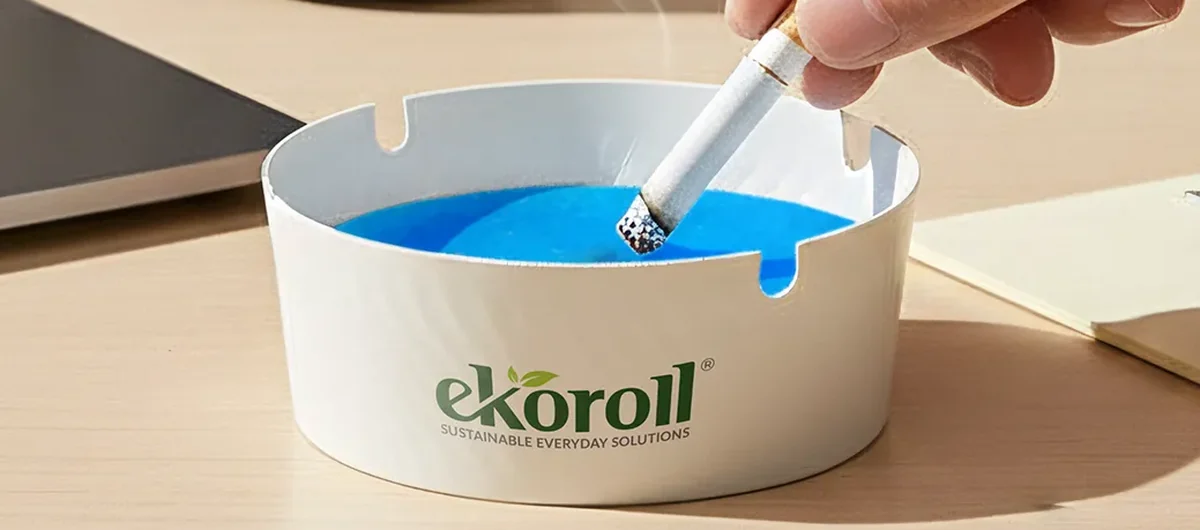

A disposable paper ashtray is a single-use ashtray made of paper that is placed on a table, terrace or smoking point and discarded with general waste when full, instead of being collected, washed and redistributed. For terraces, beach clubs, events and municipal cleanliness programs, it removes most of the labor and hygiene burden of reusable ashtrays and brings a collection point to where people actually smoke.
Cigarette butt litter is one of the most persistent and underestimated operational problems in outdoor hospitality. A single beach club terrace during a busy summer weekend can accumulate hundreds of cigarette butts across tables, planters, pavements and sand. A festival site can generate thousands. Each cigarette butt takes 10 to 12 years to decompose, contains 4,000 chemicals that leach into soil and water, and creates a hygiene and aesthetic problem that directly affects how customers perceive the venue.
The solution most venues default to — reusable plastic or glass ashtrays on every table — creates its own operational burden: washing, redistributing, monitoring for theft, replacing broken ones and managing the hygiene risks of shared surfaces in high-traffic environments. For any operation managing outdoor smoking at scale, there is a better system.
This guide covers how horeca venues, event organizers, municipalities and hospitality districts use disposable paper ashtrays to build more efficient outdoor cigarette waste management systems, with specific guidance on deployment, quantities, municipal program costs and integration into broader sustainability operations.
The Real Cost of Conventional Ashtray Systems
Before evaluating disposable paper ashtrays, it is worth calculating what conventional reusable ashtrays actually cost in a high-traffic outdoor operation — because the cost is rarely calculated fully.
Labor Cost: The Biggest Hidden Expense
A terrace with 20 tables using reusable ashtrays requires:
- Collection and emptying during service: staff collecting and emptying ashtrays at each table during and between covers
- Washing: ashtrays need washing with each table reset — at 3 to 5 minutes per ashtray including collection, washing and redistribution, 20 ashtrays represents 60 to 100 minutes of staff time per full table turnover
- Monitoring and redistribution: ashtrays moved by customers, broken, or taken require ongoing monitoring and replacement
Even at modest hourly wages, this ashtray-related labor repeats with every table turnover, every evening, for the whole season. For a 20-table terrace doing three turns per evening, ashtray management alone becomes a meaningful seasonal labor line — one that rarely appears in any budget.
Replacement and Breakage
Glass ashtrays break. Plastic ashtrays crack, stain and eventually require replacement. For a venue replacing 20 percent of its ashtray stock annually, this is an ongoing procurement cost that rarely appears in packaging budget line items but represents real operational expense.
The Hygiene Problem
Reusable ashtrays in outdoor environments accumulate residue between washes. In windy conditions, ash scatters. In rain, water mixes with ash residue and drains across table surfaces. For venues managing hygiene compliance and customer experience, these are not minor aesthetic issues — they are sources of customer complaints and negative reviews.
How Disposable Paper Ashtrays Change the Operational Model
The operational shift from reusable to disposable paper ashtrays is fundamentally a shift from a clean-and-redistribute model to a distribute-and-discard model. This change has specific implications for labor, hygiene and logistics that make the economics work differently from the simple unit cost comparison.
The New Model
- Distribution: pre-stocked paper ashtrays are placed at each table at setup. For a terrace, this is part of the table-setting process — no different from placing napkins or condiments.
- Replacement during service: when a paper ashtray is full or a table is reset, staff discard the used ashtray and place a new one. No washing, no collection to a central washing point, no redistribution. The replacement takes seconds rather than minutes.
- End-of-service: used paper ashtrays are discarded as part of general table clearing. No separate ashtray washing cycle.
The Economics
The comparison is between two different cost lines. The disposable system adds a product line: one ashtray per table per cover, so volume follows the number of covers served, with wholesale pricing quoted per project based on format, volume and print. In exchange it removes the conventional system’s washing and redistribution labor, as well as breakage and replacement costs. At terrace volumes these two lines are typically of a similar order, so the economics are broadly comparable before any operational efficiency value is applied. When labor saving is included fully, the disposable system is typically cost-neutral to cost-positive for operations running at volume.
Deployment Planning: How Many and Where
Effective deployment of disposable paper ashtrays requires thinking about the specific environment, traffic intensity and smoking patterns of your operation.
Terrace and Restaurant Outdoor Areas
- Quantity: one ashtray per table per cover, plus 20 percent buffer stock for tables with multiple smoking customers
- Placement: center of table or near the table edge, visible and accessible — placement visibility reduces butts being discarded on the ground because customers couldn’t find the ashtray
- Replacement trigger: at each table reset and whenever the ashtray is more than two-thirds full — overfilled ashtrays blow ash in wind and create hygiene problems
Beach Clubs
- Quantity: one per sun lounger in designated smoking areas, with stock at each service station for rapid replacement
- Placement challenge: sun loungers without flat surfaces require ashtrays with stable bases — the Ekoroll format’s stable footprint addresses this
- Wind management: paper ashtrays with a water-activated gel core have better wind resistance than open ashtrays — the absorbent core keeps ash contained rather than allowing it to blow
Festivals and Events
- Quantity planning: for multi-day events, estimate 2 to 4 ashtrays per designated smoking point per day based on event attendance and smoking rates. At a festival of 5,000 people with an estimated 20 percent smoking rate and 8 smoking points, estimate 1,000 smokers producing 5 cigarettes each per day = 5,000 cigarettes per day across 8 points = 625 cigarettes per point per day, requiring 3 to 5 ashtray changes per point per day
- Staffing: assign one staff member per 10 to 15 smoking points for monitoring and replacement during peak periods
- Placement: visible, accessible locations that create a natural congregation point — a visible ashtray at the edge of a smoking area dramatically reduces ground littering versus no visible collection point
Paper Ashtrays for Municipalities and Hospitality Districts
For cities, beach municipalities and tourism districts, the question is not how to equip one terrace but how to keep butts off streets, sand and drains across a whole area. The core mechanism is simple: when there is no convenient, visible disposal point within reach, cigarette butts go on the ground.
Why Conventional Approaches Fall Short
- Fixed pedestal ashtrays: they create collection points at corners and entrances, but a smoker seated at a café table 15 meters away will not walk over to use one. They help at defined points and do little for distributed outdoor seating, where much of the waste is generated.
- Awareness campaigns and fines: they can reduce littering while they run, but the effect tends to fade once activity stops, because they address motivation rather than the lack of a nearby ashtray. They work best combined with better collection infrastructure.
- Smoking bans in outdoor areas: they move the problem to the edges of the restricted zone, typically venue entrances and pavement edges, where there is often no collection point at all.
The Distribution Program Model
Effective programs treat paper ashtrays not as a replacement for fixed ashtrays but as lightweight, scalable collection infrastructure placed where smoking happens:
- Entry points: ashtrays available at the entrances of pedestrian zones, beach access points, festival gates and outdoor event areas
- Venue integration: licensed café and restaurant terraces in the district receive paper ashtrays for table placement, removing the distance barrier that makes pedestal ashtrays ineffective
- Regular replenishment: municipal or event staff restock distribution points on a fixed cycle matched to footfall, daily or twice daily in peak season
- Complement, not replace: pedestal ashtrays stay in permanent public spaces; paper ashtrays add overflow capacity in busy periods and reach places fixed units cannot. A busy event weekend can receive many times the normal distribution without any change to fixed infrastructure.
Beach and Coastal Tourism
Beach municipalities face their sharpest challenge in peak season, when filters end up in sand and near-shore water. A typical beach program places paper ashtrays at access ramps and stairs, where every beachgoer passes; at lifeguard stations and beach service points for distribution during the day; and with beach bars and lounger rental operators, one per rental position. The water-activated gel core keeps ash contained in wind, which matters on open beaches.
Events and Festivals
For large outdoor events, paper ashtrays can be handed out at ticket gates with other event materials, distributed by staff in designated smoking areas and stocked at every bar. Used ashtrays are collected with general litter, instead of requiring butts to be picked individually from grass, gravel and drains after the event. For the event-specific playbook, see the outdoor smoking solutions guide.
Cost Structure of a Municipal Program
Compare the program with what the municipality already spends, not with zero:
- Baseline: sweeping labor attributable to cigarette butts in hospitality districts and on beaches. Butts are small, scattered and lodged in pavement joints, planters and drain grates, so they take a disproportionate share of cleaning time, and that time grows with butt density.
- Program cost: paper ashtrays for distribution points and participating venues, with volume driven by footfall and venue count and pricing quoted per project based on format, volume and print; restocking time, largely absorbed into existing cleaning rounds; and a modest seasonal distribution effort.
- Net position: compared with collection labor alone, a program can look like a small additional cost. That view misses the reduction in sweeping effort as fewer butts reach the ground, the value of visibly cleaner public spaces for tourism, and less filter litter in storm drains. Municipalities that include these effects usually find the program pays for itself, particularly in tourism-dependent towns.
What EU Rules Say About Cigarette Filters
Under the Single-Use Plastics Directive (EU) 2019/904, tobacco products with filters containing plastic are single-use plastic products. Their packaging must carry a marking about the plastic in the filter, and member states must set up extended producer responsibility schemes under which producers cover, among other things, the costs of awareness-raising measures, of cleaning up the litter and of collecting these products in public collection systems, including the infrastructure. For municipalities, this is a relevant framework when planning and funding butt-collection programs; the national implementation decides how the money flows.
Integrating Hospitality Venues into a District Program
The most effective urban programs combine municipal distribution with venue participation, creating a network of collection points across the district rather than relying on municipal infrastructure alone.
A practical coordination model:
- The municipality or the district business association supplies paper ashtrays to licensed outdoor seating venues, subsidized or free of charge, in exchange for participation
- Participating venues place ashtrays on outdoor tables and replace them at each table reset as part of normal service
- Used ashtrays go out with general waste; no separate collection logistics are needed
- The program carries the district’s cleanliness branding, and participating venues display program signage
For venues, visible participation signals professionalism and supports their positioning in streets where many venues compete side by side. Custom-printed ashtrays can carry both the venue logo and the district program mark.
Integrating Paper Ashtrays into Your Sustainability Strategy
For venues that have adopted or are adopting paper-based food and beverage packaging, disposable paper ashtrays are the natural completion of the outdoor sustainability picture. A venue serving drinks in water-based coated lid-free cups and food in bagasse containers, using wooden cutlery — but with plastic ashtrays on every table — has a visible sustainability inconsistency that attentive customers notice.
The integration is straightforward: replace the plastic ashtrays at table setup with paper ashtrays as part of the same eco-friendly service proposition. The paper construction is visually consistent with the material palette of eco-friendly hospitality packaging. Custom-printed paper ashtrays — available with your venue’s logo or a sustainability message — extend the brand communication to the table level and can explicitly connect the ashtray format to your broader sustainability narrative.
Communicating the Change
For venues where regular customers are accustomed to glass or plastic ashtrays, a simple communication approach:
- Brief staff on the reason for the change and how to explain it if asked
- Ensure paper ashtrays are placed conspicuously — customers should not have to look for them
- If using custom-printed ashtrays with a sustainability message, this communicates the rationale without requiring staff explanation
For the complete sustainable outdoor operations picture, see: Outdoor Smoking Solutions Guide and Eco-Friendly Packaging for Restaurants.
Paper Ashtrays vs Conventional Alternatives: Operational Comparison
| Feature | Reusable Plastic Ashtray | Glass Ashtray | Disposable Paper Ashtray |
|---|---|---|---|
| Cleaning required | Yes — after every use | Yes — after every use | No — single use and discard |
| Labor cost | High — collection, washing, redistribution | High — collection, washing, redistribution | Low — replace at table reset |
| Breakage risk | Low | High — replacement cost | None |
| Hygiene | Cross-contamination risk between uses | Cross-contamination risk between uses | Single-use — no cross-contamination |
| Scalability for events | Limited by washing capacity | Limited by washing capacity | High — bulk distribute and discard |
| Wind performance | Ash scatters in wind | Ash scatters in wind | Absorbent core contains ash |
| Environmental impact | Plastic material — long lifecycle | Energy-intensive production | Paper-based construction |
| Custom branding | Limited | Limited | Full surface print available |
| Best for | Fixed indoor premium settings | Fixed indoor premium settings | Outdoor terraces, events, high-traffic areas |
Disposable paper ashtrays are one of the most underutilized branded touchpoints in outdoor hospitality. Every smoker on your terrace interacts with the ashtray for the duration of their time at the table — typically 30 to 90 minutes. A custom-printed ashtray with your venue logo, a campaign message or a QR code linking to your menu or loyalty program creates a direct, extended brand interaction at zero incremental cost beyond the print setup.
For distributors supplying multiple venues, private label paper ashtrays — bearing the distributor’s own brand rather than the supplier’s — provide a branded product line that strengthens customer relationships and creates procurement loyalty. MOQ is confirmed per format, size and print specification on request. For the complete private label guide: Disposable Paper Ashtray Supplier Turkey.
For a full comparison of paper versus alternative ashtray formats: Gel Ashtray vs Paper Ashtray Guide and Ashtray Types Guide.
Disposable Paper Ashtrays Wholesale: MOQ on Request
Ekoroll supplies disposable paper ashtrays wholesale to horeca operators, event companies, municipalities, tourism district programs, hospitality associations and distributors across Europe. Paper-based, with a water-activated absorbent core that turns into a gel on contact with water; an additional component stops the reaction once the gel has formed and keeps it from drying out and hardening, so the core stays active much longer than competing products: several days of active use, depending on conditions. Plain, custom-printed with venue branding or printed with program branding for municipal initiatives. Supplied from Turkey with export logistics to European ports; quantities and pricing are quoted per project. Contact us for a quote and samples.