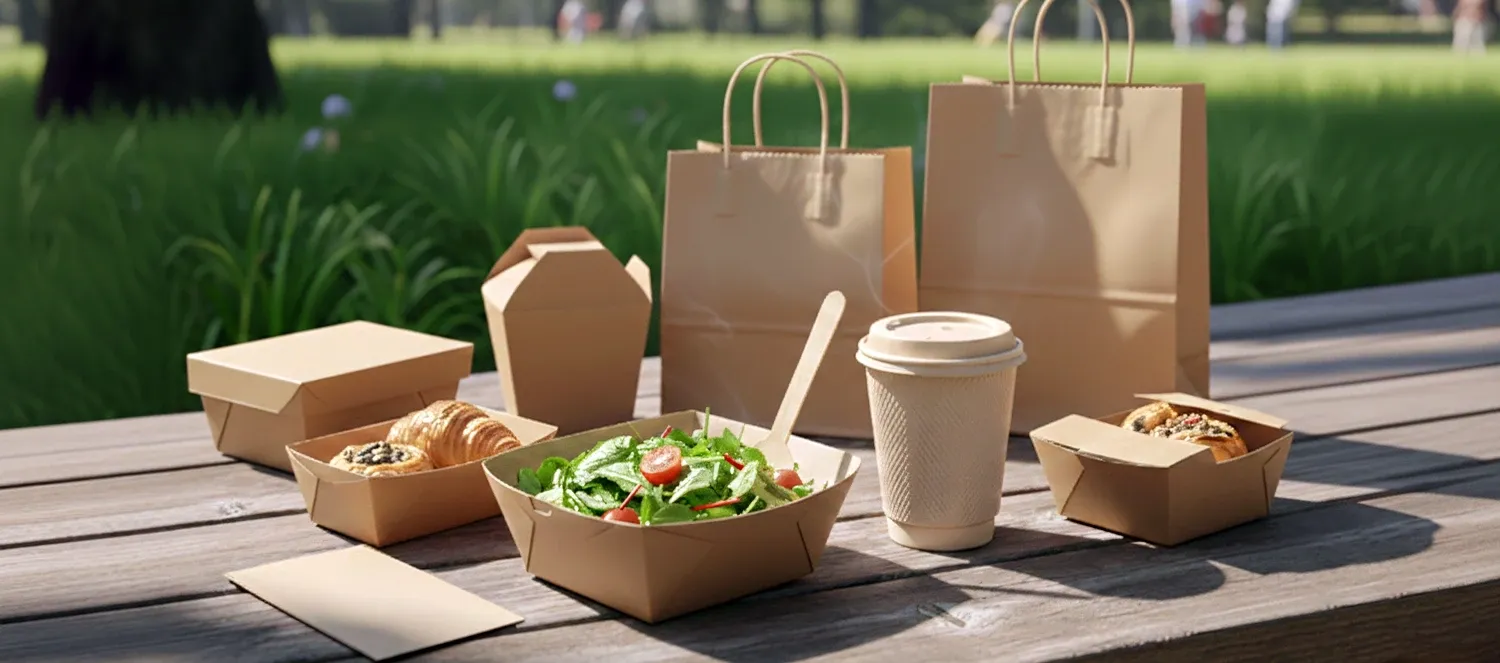
Switching to eco-friendly takeaway packaging as an independent café or restaurant is a different challenge from implementing it as a chain or being guided through it by a consultant. You are making the decision yourself, buying in volumes that don't always reach the lowest price tiers, managing the transition without a dedicated procurement team, and fielding customer questions about what changed and why.
This guide is written specifically for independent café and restaurant operators. It covers which eco-friendly takeaway packaging formats to start with, what to watch out for when evaluating suppliers and products, how to handle the transition without disrupting service, and what the realistic cost picture looks like at independent operation volumes. For the distributor perspective, see: Eco-Friendly Takeaway Packaging Guide for Horeca Distributors. For the full cost analysis, see: Sustainable Packaging Cost Analysis.
Start Here: The Two Changes That Matter Most
If you are running an independent café and have not yet made any changes to your packaging, there are two formats that produce the largest combined impact — in compliance, cost and customer perception — relative to the effort required to switch them. Start with these before addressing anything else.
Change 1: Your Cup System
Your beverage cups are your highest-visibility packaging item. They sit on customers' hands, travel through the street, appear in social media photos and represent your café to everyone who sees them. They are also the format most directly affected by current EU regulation: the tethered lid requirement (in force since July 2024) means separate snap-on plastic lids are currently non-compliant with EU law.
For an independent café, switching to lid-free cups is the most efficient resolution to the compliance issue and the most visible sustainability signal simultaneously:
- No separate lid to manage, stock or reorder — one SKU per cup size instead of two
- No plastic tax on the lid that no longer exists (in UK, Spain, Italy, Germany, France, Portugal)
- No tethered lid compliance issue — there is no separate lid to tether
- Customer-visible change: customers immediately notice and frequently comment positively on the format
The cup transition is typically the highest-ROI first move for independent cafés. The lid cost saving and plastic tax elimination in applicable markets typically covers the cup unit premium within two to three months. See: Are Lid-Free Coffee Cups Worth It. Explore: lid-free hot cups and lid-free cold cups.
Change 2: Your Food Containers
If you serve food to go — salads, hot meals, grain bowls, soups — your food containers are your second highest-impact change. Switching from plastic or PE-lined paper containers to bagasse food containers with fiber lids provides the most complete plastic-free transition for the food side of your operation:
- Bagasse handles hot food up to 95°C without structural degradation
- EN13432 certified compostable — supports substantiated "compostable packaging" claims
- No plastic in container or lid — plastic tax elimination in applicable markets
- Better delivery performance than plastic for most food types — reduces leakage complaints
Explore: bagasse food containers and molded fiber lids. For the full food container comparison: Bagasse vs Plastic Food Containers.
What to Check Before You Buy
The eco-friendly packaging market has a documentation problem: products are described as "sustainable," "compostable," "plastic-free" and "eco-friendly" in supplier marketing with varying degrees of accuracy and verification. As an independent café operator, you need to know what documentation to ask for and what it actually confirms — because from 2026, the EU Green Claims Directive means you are liable for any sustainability claims you make about your packaging that you cannot substantiate.
For Cups
- Ask for: written confirmation that the coating is water-based (not PE and not PLA). This is the single most important document for cups — it determines plastic tax status, recyclability and whether your "plastic-free" claim is accurate.
- Ask for: PFAS-free laboratory test results from an ISO 17025 accredited laboratory covering both paper substrate and coating. This is particularly important if you operate in Germany, Denmark or the Netherlands where PFAS restrictions in food contact materials are already in force.
- Ask for: EC 1935/2004 Declaration of Compliance for food contact.
- Be skeptical of: "eco-friendly" or "sustainable" cup descriptions without specific coating confirmation. Many cups described as eco-friendly use PE lining — they look identical to water-based coated cups and are not plastic-free.
For Food Containers
- Ask for: EN13432 compostability certification from TÜV Austria or DIN CERTCO — not a self-declaration, not a blanket supplier sustainability claim, but a specific product certificate from one of these two bodies.
- Ask for: EC 1935/2004 Declaration of Compliance for food contact.
- Ask for samples: test with your actual food at your actual packing temperature before ordering. A container that works for rice may not work for a high-oil curry. Test before committing to MOQ-level stock.
For Cutlery
- Note: plastic cutlery is banned under the EU SUP Directive — if you are still using conventional plastic cutlery, this is a current legal non-compliance, not a future issue.
- Ask for: FSC certification for wooden or bamboo alternatives.
- Ask for: EC 1935/2004 Declaration of Compliance for food contact.
A supplier who cannot provide these documents is not adequately qualified for EU market supply. A supplier who can provide them demonstrates the operational credibility that makes the relationship reliable long-term. See: How to Choose a Food Packaging Supplier for EU Markets.
Managing the Transition Without Disrupting Service
The packaging transition itself is where independent cafés most often create unnecessary operational problems — not from the new formats, but from poor transition timing and planning. Three common mistakes to avoid:
Mistake 1: Ordering New Formats Before Running Down Old Stock
The most common transition error. You order new lid-free cups while you still have three months of old cups and their matching lids in stock. Now you have both systems in storage simultaneously, staff switching between them, and customers receiving inconsistent formats. Run your existing stock to buffer level before the new format arrives. Calculate: how many weeks of current stock remain? Order the new format to arrive when current stock is at two to three weeks remaining — not before.
Mistake 2: Switching All Formats Simultaneously
For a small operation, switching cups, containers, cutlery and greaseproof paper simultaneously creates a training burden that produces errors during peak service. Switch one format at a time, in order of impact. Start with cups (highest visibility, fastest ROI), then containers, then cutlery (which is likely already changed if you are compliant), then greaseproof paper. Allow two to three weeks between format changes to let each one settle into service routine before adding the next.
Mistake 3: Not Briefing Staff Before Launch Day
Lid-free cups in particular require a brief staff orientation before they go into service. The folding mechanism is simple but not instinctive the first time. Five minutes of hands-on practice before the first service shift using lid-free cups prevents the slower service and inconsistent closures that create customer confusion on launch day. Show staff specifically: how to fold the closure, how to verify it is properly seated, how to hand it to the customer with the drinking opening oriented correctly.
Communicating the Change to Customers
Customers at independent cafés are more likely to notice and comment on packaging changes than those at chain operations — and more likely to ask about them directly. Being ready with a simple, confident explanation converts a potential awkward interaction into a positive brand moment.
What Works
- Brief and specific: "We've switched to fully plastic-free cups — the fold here is the drinking opening." This is more effective than a lengthy sustainability explanation that suggests you feel defensive about the change.
- Positive framing: frame the change as an improvement, not a compromise. "No separate lid to lose" is more engaging to customers than "we removed the plastic lid."
- Signage: a small A5 sign near the counter explaining the new cup format and its benefits addresses the question before it is asked, reducing the frequency of individual explanations during busy service.
Handling Initial Feedback
Expect a small percentage of customers (typically 3 to 7 percent) to express initial preference for the old format, particularly in the first two to four weeks. Distinguish between genuine usability concerns (which require a format response) and novelty friction (which resolves itself as the format becomes familiar). A customer who comments "this is different" is not requesting you to switch back — they are expressing mild surprise. Acknowledge it positively and let the format prove itself through normal service.
The Independent Café Cost Reality
Independent cafés operate at volumes where per-unit pricing is typically higher than chain operations, and where MOQ requirements can feel challenging relative to monthly consumption. The honest cost picture:
MOQ at Independent Café Volumes
Standard factory-direct MOQ is 5,000 units per format per size. An independent café using 600 cups per month of a specific size is ordering approximately 8 months of stock per order. This is not necessarily a problem — 8 months of buffer stock for a well-chosen format is acceptable inventory planning — but it means the initial cash outlay is significant relative to monthly packaging spend. Plan: order your highest-volume formats first. Your top-selling cup size likely consumes at a rate where 5,000 units is 3 to 4 months of stock, not 8 months. Size formats down the list may need to be evaluated for whether the volume justifies independent stocking or whether consolidation into an adjacent size is more practical.
The Realistic Net Cost Position
For an independent café in a EU plastic-tax market (UK, Spain, Italy, Germany, France, Portugal):
- Lid-free cup switch: typically net neutral to slightly positive once lid cost elimination and plastic tax saving are included. The cup unit premium is real but typically offset within 2 to 3 months.
- Bagasse container switch: typically 15 to 25 percent unit cost premium over equivalent plastic. This premium is not fully offset by plastic tax savings at typical independent café container volumes. Budget for it as a genuine cost increase on the container line — offset by compliance, customer perception and delivery performance improvements.
- FSC wooden cutlery switch: typically 20 to 35 percent unit cost premium over plastic. Plastic cutlery is illegal, so the comparison is moot — but plan for the cutlery line cost to increase.
For most independent cafés, the total packaging cost impact of a complete switch to eco-friendly formats is a net increase of 5 to 12 percent on total packaging spend — not zero, but significantly lower than often assumed, and partially offset in plastic-tax markets. See: Sustainable Packaging Cost Analysis and How Horeca Businesses Reduce Packaging Costs.
Beyond Food Packaging: Outdoor and Terrace Areas
For cafés with outdoor terraces and smoking areas, packaging waste management extends beyond food containers and cups. Disposable paper ashtrays are a practical solution for managing cigarette waste in outdoor café spaces — they replace conventional plastic or metal ashtrays with a single-use paper format that is handled and disposed of cleanly. For cafés building a complete plastic-free outdoor operation, they are a natural complement to the eco-friendly takeaway packaging system.
Eco-Friendly Packaging for Independent Cafés: Samples Before You Commit
Ekoroll supplies water-based coated lid-free hot cups and lid-free cold cups, EN13432 certified bagasse food containers, fiber lids and FSC-certified wooden cutlery wholesale across Europe. Full certification documentation available. Samples before bulk orders. MOQ from 5,000 units. Contact us with your cup sizes and container formats for a sample request.
Frequently Asked Questions
Start with your cup system. Cups are your highest-visibility packaging item, directly affected by current EU regulation (tethered lid requirement in force since July 2024), and the format where the cost case for switching is strongest at independent café volumes. Switching to water-based coated lid-free cups eliminates the separate plastic lid, removes plastic tax liability on the lid component in applicable EU markets, and provides an immediate, visible sustainability signal to customers. The net financial impact in plastic-tax EU markets is typically neutral to positive within two to three months when lid cost elimination and plastic tax saving are combined. After cups, switch food containers to bagasse with fiber lids. Switch cutlery if you have not already — plastic cutlery is banned under EU law. Greaseproof paper is the final piece — verify PFAS-free status with your supplier before making claims about it.
A small percentage of customers (typically 3 to 7 percent) express mild surprise or initial preference for the familiar cup-and-lid format in the first two to four weeks. This is novelty friction, not sustained dissatisfaction — it resolves as the format becomes familiar. The majority of customers respond neutrally or positively, with a meaningful segment commenting specifically and positively on the plastic-free format. The key to managing the transition well is staff confidence: staff who can demonstrate the closure mechanism clearly and frame the change positively convert potential awkwardness into positive brand interactions. Brief all staff before launch day with five minutes of hands-on practice so the explanation and demonstration come naturally during service.
The honest answer: switching to a complete eco-friendly packaging system typically increases total packaging spend by 5 to 12 percent for an independent café. This is lower than commonly assumed, and partially offset in EU plastic-tax markets where plastic taxes on conventional formats represent direct ongoing cost. The cup switch is typically the most financially neutral change — lid cost elimination and plastic tax saving offset most of the cup unit premium. The container switch carries a genuine 15 to 25 percent unit cost premium that is not fully offset. The cutlery switch is a legal requirement rather than a choice. Running the calculation for your specific formats and volumes in your specific market is more useful than any generic estimate — contact a qualified supplier for a total cost comparison using your actual consumption data.
For cups: written coating type confirmation (water-based, not PE or PLA), PFAS-free laboratory test results from an ISO 17025 accredited laboratory, and EC 1935/2004 Declaration of Compliance. For food containers: EN13432 compostability certification from TÜV Austria or DIN CERTCO, and EC 1935/2004 compliance. For wooden cutlery: FSC or PEFC certification and EC 1935/2004 compliance. For greaseproof paper: PFAS-free laboratory test results — this is the most commonly missing certification in otherwise eco-friendly systems. From 2026, the EU Green Claims Directive requires that any sustainability claim you make about your packaging (compostable, plastic-free, PFAS-free) be backed by verified documentation. Building this documentation portfolio now means you can make these claims confidently and legally as the Directive enters implementation.
Standard factory-direct MOQ is 5,000 units per format per size. For a small café using 400 to 800 cups per month of a specific size, this is 6 to 12 months of stock per order. Three practical approaches: first, order your highest-volume format first — your most popular cup size probably turns over fast enough that 5,000 units is 3 to 4 months of stock rather than 12 months. Second, request samples before placing any first order — samples allow you to verify the format works for your operation before committing to MOQ-level stock. Third, for slow-moving formats, consider whether consolidating to an adjacent size is more practical than independently stocking a low-volume SKU at MOQ. A cup format you use 200 units per month of is a 25-month stock position at 5,000 MOQ — evaluate whether that format is genuinely necessary or whether an adjacent size covers the same applications.