Eco-friendly food packaging for restaurants and cafés means replacing plastic and foam takeaway items with fiber- and paper-based alternatives: bagasse (sugarcane fiber) containers for food, paper cups with a water-based coating and no separate plastic lid for drinks, molded fiber lids, wooden cutlery, PFAS-free greaseproof paper and paper bags. To cut the most plastic waste fastest, switch the two highest-volume items first (cups in a café, food containers in a takeaway or delivery kitchen), then cutlery, wraps and bags. Every claim you make about the new packaging, such as “compostable” or “PFAS-free”, needs a certificate or test report that covers the exact product.
This guide is for restaurant and café operators, independent coffee shops and horeca distributors. It covers what to switch first, the core products and what each one replaces, priorities by type of operation, the documents to request, how to manage the changeover without disrupting service, the EU rules behind the shift, what it really costs, and how distributors build a complete eco-friendly takeaway range.
If you are already sourcing, browse our complete eco-friendly packaging range for horeca wholesale.
What Counts as Eco-Friendly Food Packaging for Restaurants?
Eco-friendly food packaging for restaurants covers every item that comes into direct contact with food or drink: containers, cups, lids, cutlery and wrapping, plus the bags that carry them. The goal is a complete plastic-reduced system in which each component meets EU food-contact rules and carries documentation for every claim made about it. Food service packaging has to perform under specific conditions: hot food, oily and acidic dishes, freezer and microwave use, and transport in delivery bags.
| Item | Conventional format | Eco-friendly alternative | What to verify |
|---|---|---|---|
| Food containers | Plastic or expanded polystyrene (EPS) foam | Bagasse containers; kraft paper bowls and boxes | Compostability certificate covering the product; food-contact declaration |
| Hot and cold cups | PE-lined paper cup plus plastic lid | Lid-free paper cup with water-based, PFAS-free, PE-free coating | Written coating confirmation; PFAS test report |
| Lids | Plastic snap-on lids | Molded fiber or bagasse lids, or a lid-free cup | Fit with your cups and containers |
| Cutlery | Plastic (banned under the SUP Directive) | Wooden or bamboo | FSC or PEFC; food-contact declaration |
| Wraps | Wax- or plastic-coated paper, PFAS-treated paper | PFAS-free greaseproof paper | PFAS laboratory test results |
| Carrier bags | Plastic bags | Paper bags | Recyclability statement with its conditions |
For sauces, dressings and condiments, single-serve sachet packaging keeps portions hygienic and reduces waste.
Why Eco-Friendly Packaging Has Become a Business Requirement
The shift to sustainable packaging is no longer only a marketing choice. For restaurants, cafés and horeca businesses operating in Europe, it is increasingly a legal and commercial necessity.
- The EU Single-Use Plastics Directive bans or restricts a wide range of single-use plastic items across member states
- Plastic taxes, levies and extended producer responsibility (EPR) schemes raise the cost of conventional packaging
- Consumer demand for sustainable takeaway packaging continues to grow
- Retailers, food chains, corporate caterers and public buyers set internal plastic-reduction targets and ask suppliers for documentation
- Packaging with documented, certified properties supports ESG reporting and specific, substantiated claims
For horeca distributors supplying restaurants, this creates a clear commercial opportunity: businesses that offer well-documented, plastic-reduced packaging are better positioned to win and keep accounts in the European market.
How Much Plastic Waste Does a Restaurant Actually Generate?
Understanding the scale of the problem is the first step to an effective packaging program. Volumes vary significantly by restaurant type and service model.
Quick Service and Takeaway Restaurants
A busy quick service restaurant serving 300 to 500 covers per day can generate between 150 and 250 kilograms of single-use packaging waste per month, of which plastic typically accounts for 40 to 60 percent by weight. The largest plastic components are food containers, beverage cups and lids, and cutlery.
Cafés and Coffee Shops
A café serving 200 to 400 takeaway cups per day generates significant plastic waste, primarily from cup lids. PE-lined paper cups, which represent the majority of the market, may also release microplastic particles into hot beverages: peer-reviewed studies have reported thousands of particles released from PE-lined cups under hot-water test conditions.
Food Delivery Operations
Food delivery typically has the highest packaging intensity per order, as every item needs its own packaging. A restaurant processing 100 delivery orders per day uses approximately 300 to 500 individual packaging items, most of them single-use plastic or plastic-containing materials.
Hotels and Catering Services
Event catering and hotel food service generate concentrated bursts of packaging waste. A single event serving 500 guests can generate over 2,000 individual packaging items. Switching to fiber-based alternatives with documented end-of-life options, and arranging separate collection at the event, keeps much of this waste out of mixed residual waste.
The Core Products in an Eco-Friendly Restaurant Packaging System
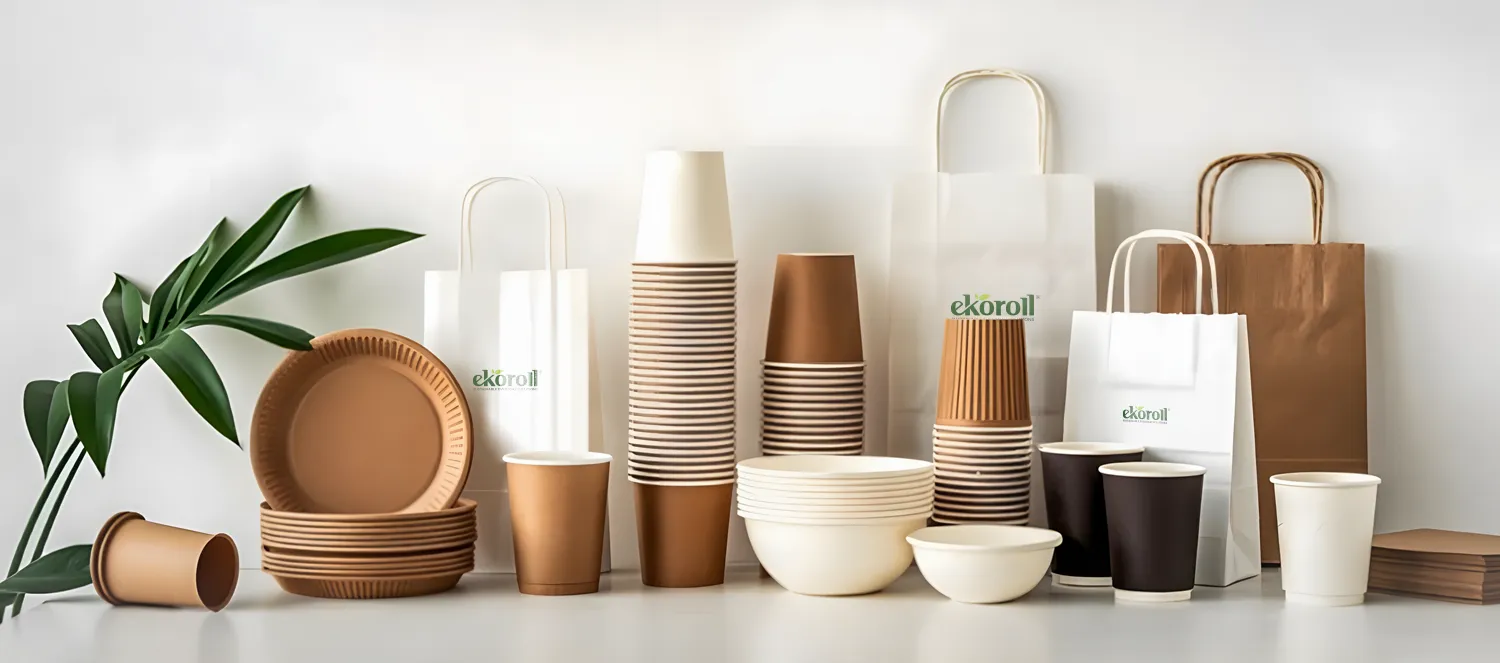
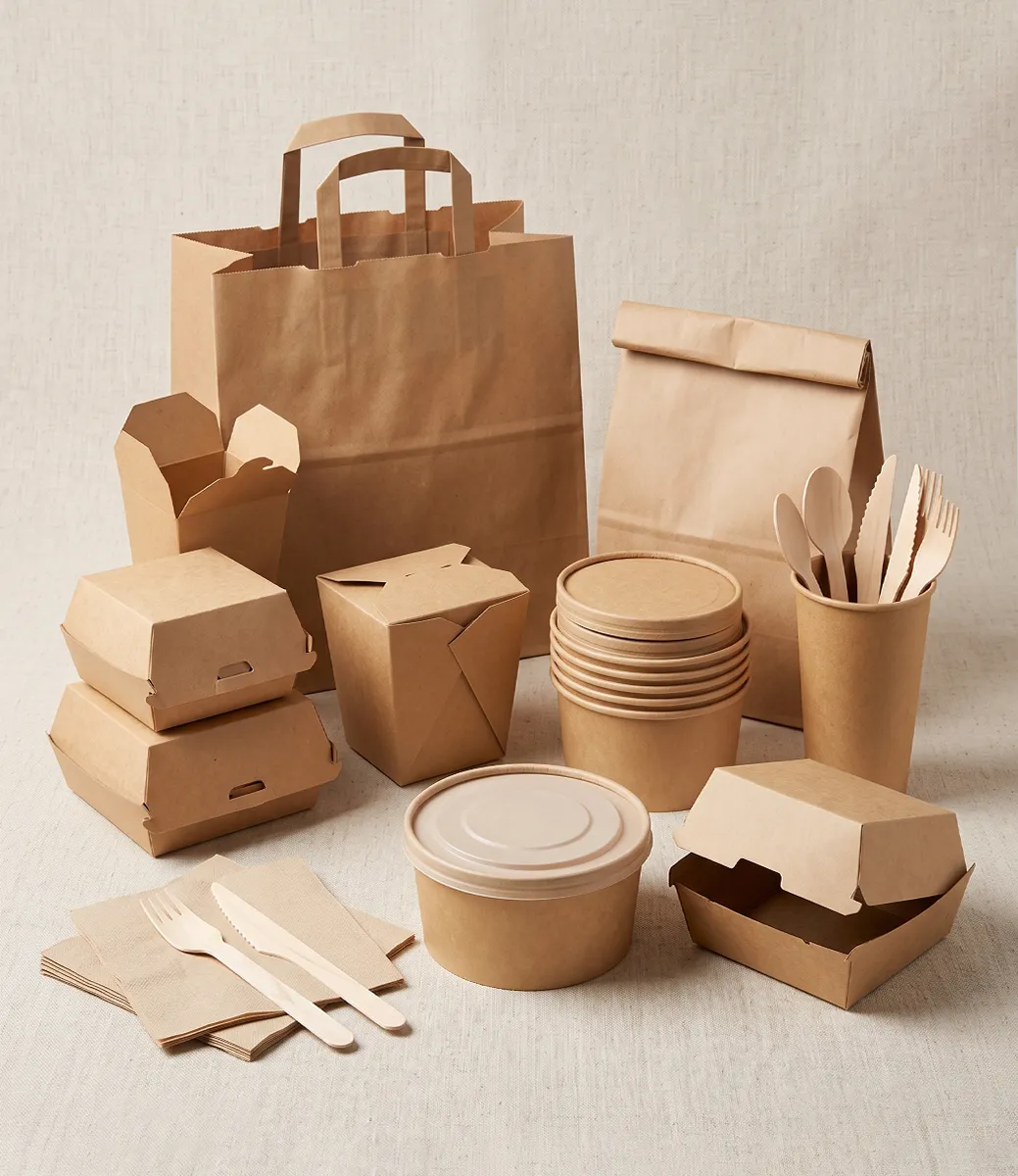
A complete sustainable packaging program typically covers food containers, beverage cups, lids, cutlery and wraps. Replacing each with a plastic-free or plastic-reduced alternative removes most single-use plastic from a food service operation.
Bagasse Food Containers
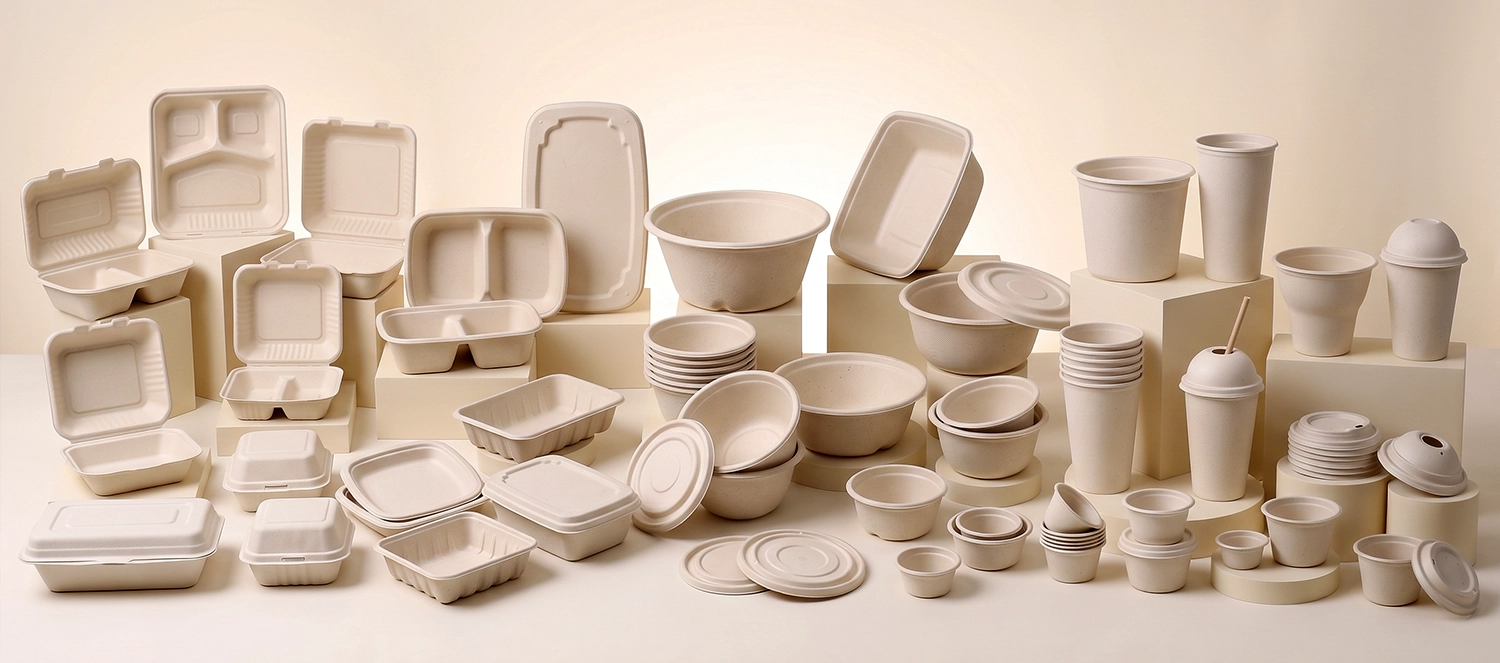
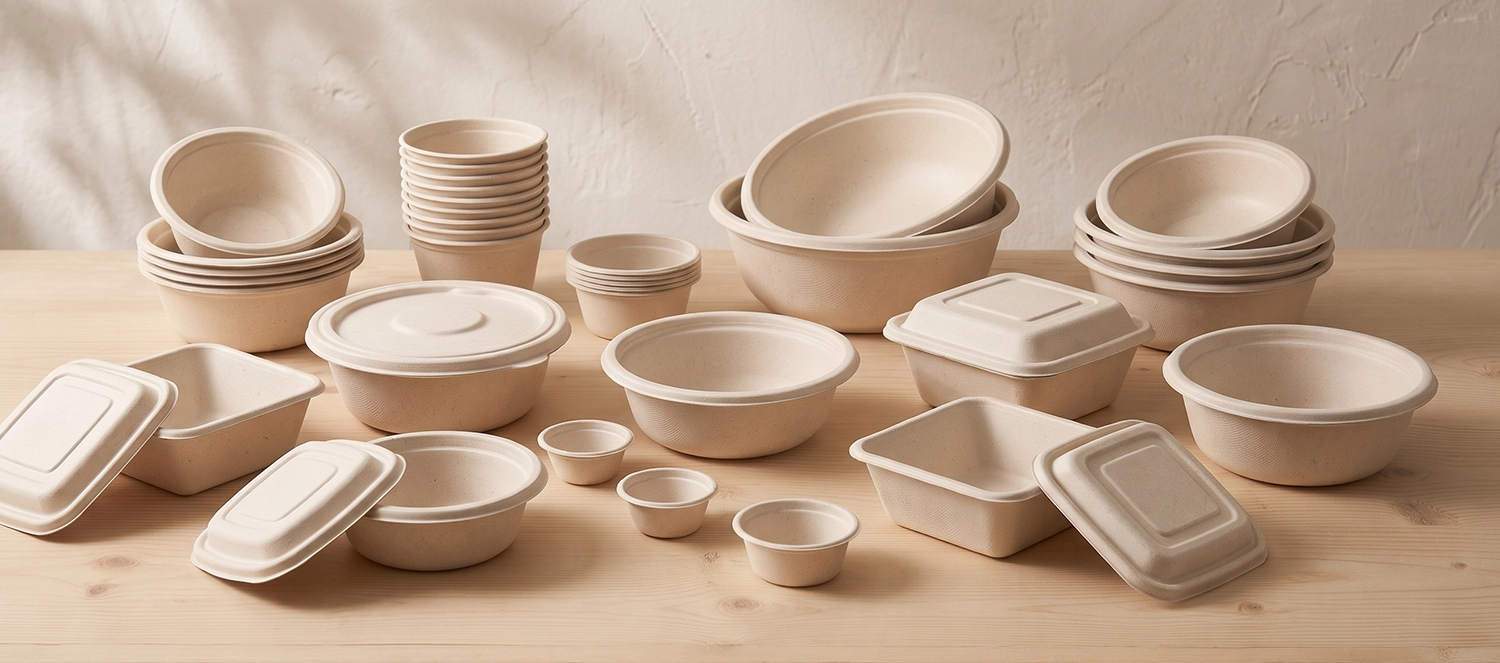
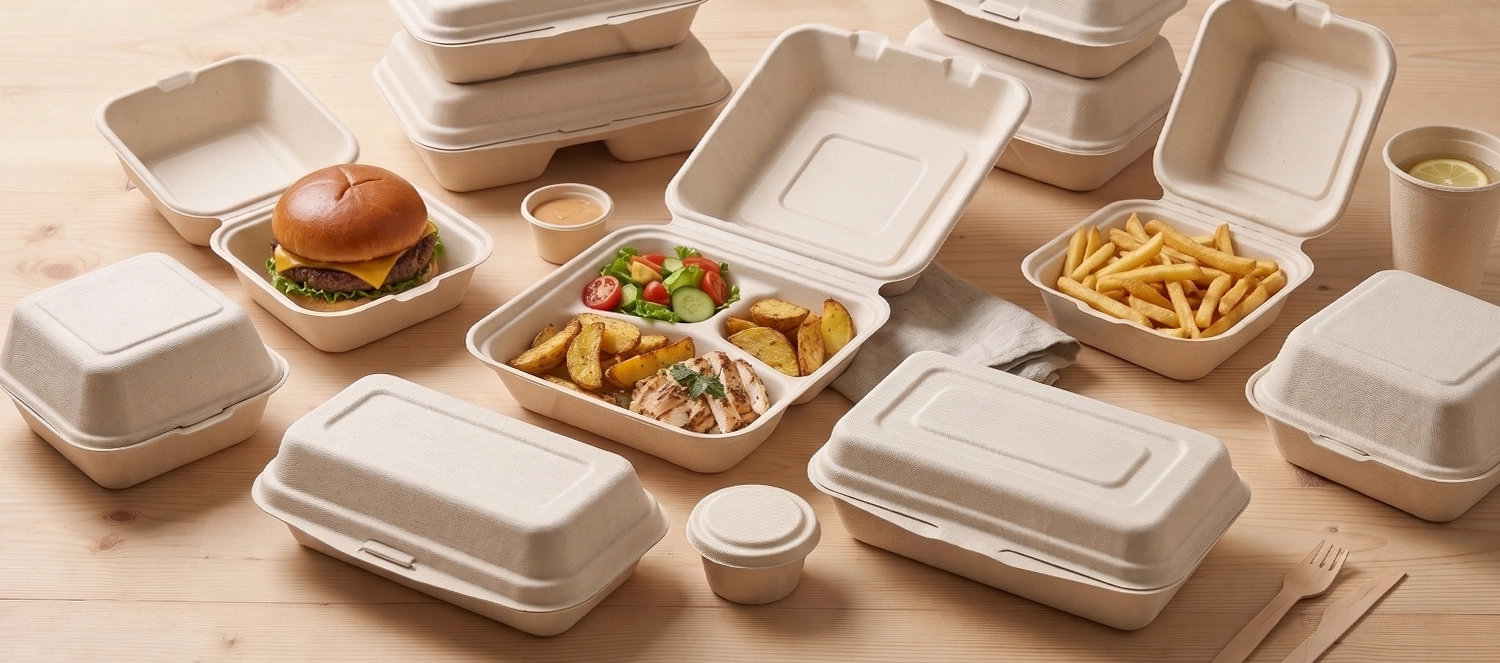
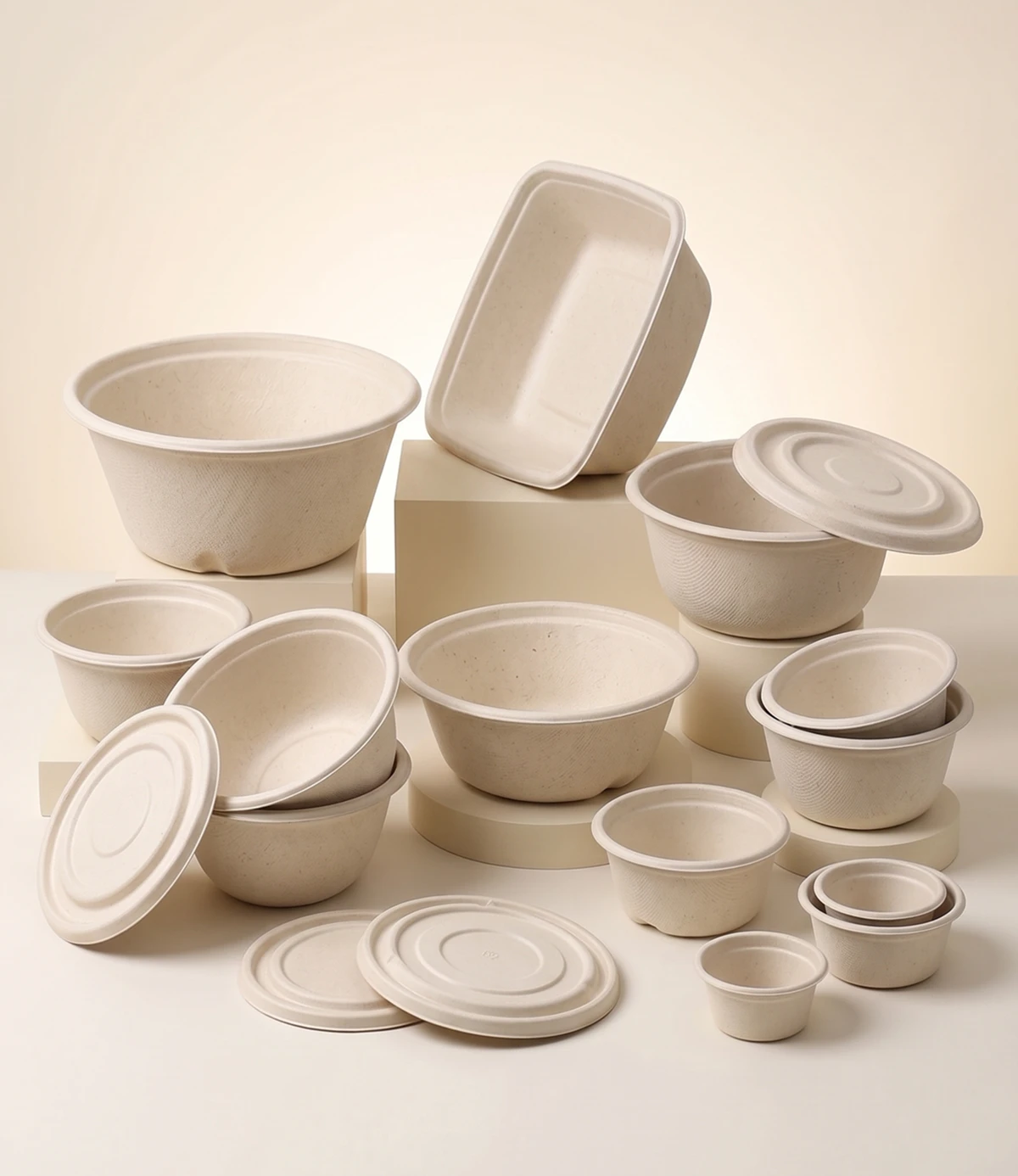
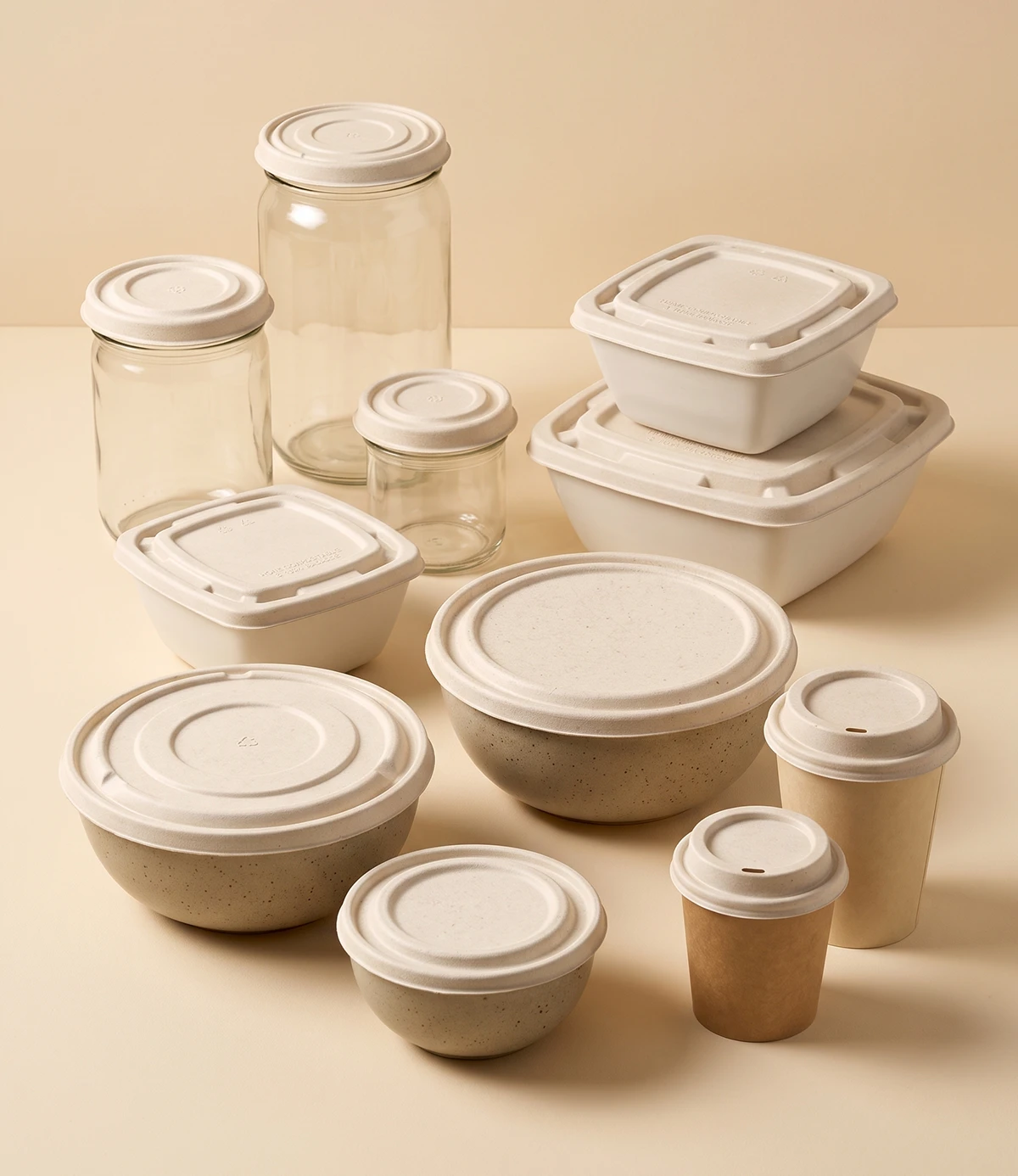
Bagasse food containers are the most widely adopted plastic-free packaging for restaurant takeaway and delivery. Made from sugarcane fiber, a natural byproduct of sugar production, they are petroleum-free and plastic-free. Ekoroll’s bagasse food containers are home compostable & 100% bagasse, certified by TÜV AUSTRIA (OK compost HOME); the certificate is held by the producing mill, copy on request.
- Suitable for hot and cold food, including hot and oily dishes
- Water- and oil-resistant for soups and sauces; PFAS-free (no added fluorinated grease barrier)
- Microwave- and freezer-safe
- Food-contact documentation according to the final product specification and production route
- Clamshell, tray, bowl, rectangle, compartment and takeout container formats
For soups, salads and hot meals that need a bowl with a lid, kraft paper bowls with lids are a durable, leak-resistant option. For branded takeaway presentation, eco-friendly packaging boxes can be customized. For wholesale sourcing, explore Ekoroll bagasse food containers, and see bagasse vs plastic food containers for a direct comparison.
Lid-Free Paper Cups

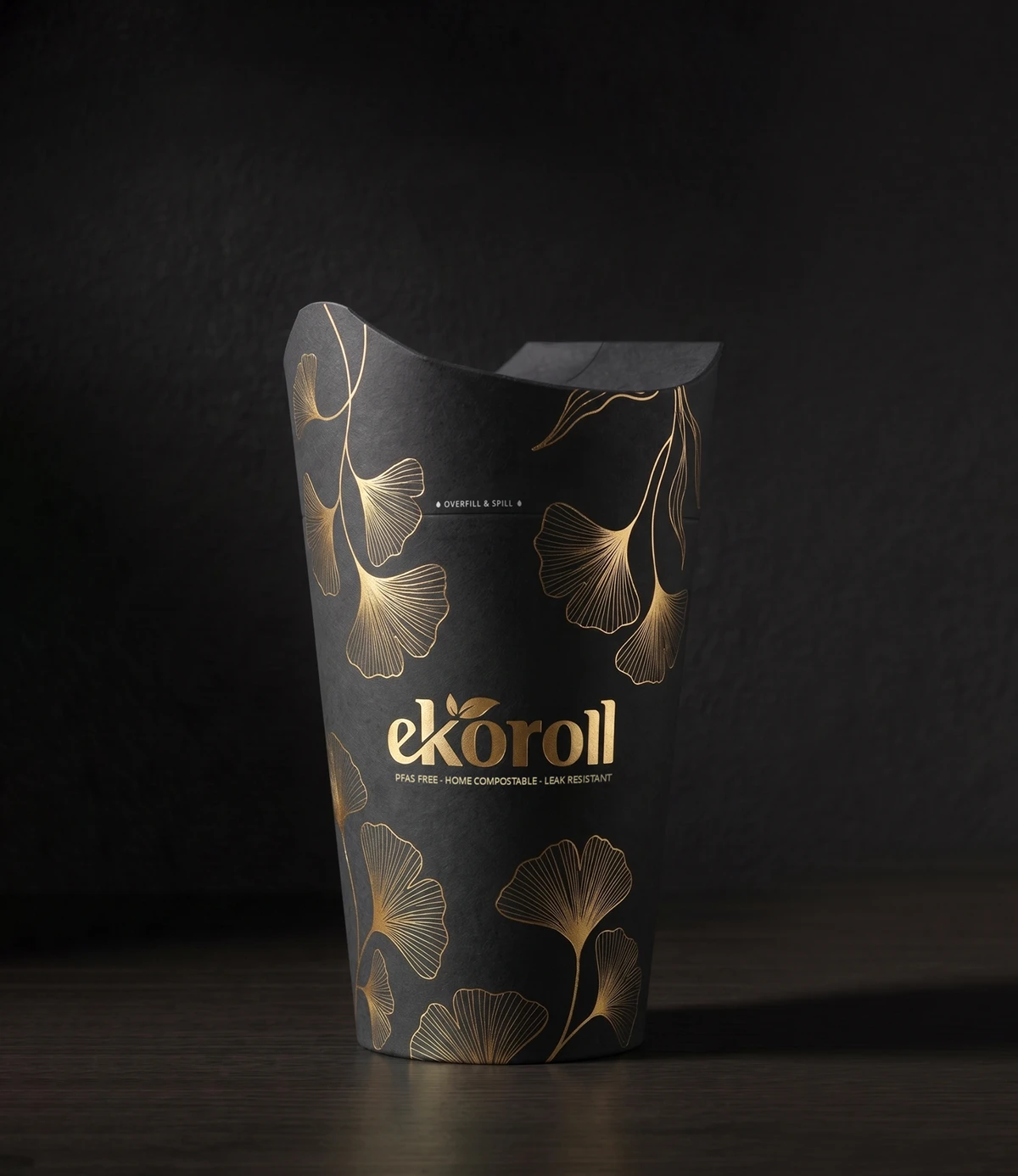
Lid-free paper cups, also called integrated lid cups or foldable paper cups, remove the separate plastic lid entirely. The closure is built into the cup wall: the top is folded to form a drinking opening. No plastic lid, no lid waste, and one item to stock per cup size instead of two.
The cups use a water-based, PFAS-free, PE-free coating instead of a PE or PLA lining, in hot and cold formats. With water-based coating, these cups carry DIN CERTCO home compostable and industrially compostable (EN 13432) certification, held by the producing partner; copies on request. A coated paper cup is still never described as “plastic-free”; the accurate description is “water-based, PFAS-free, PE-free coating”.
- Lid-Free Hot Paper Cups for espresso, lattes and hot beverages
- Lid-Free Cold Paper Cups for iced drinks and cold beverages
Molded Fiber and Bagasse Lids
Molded fiber lids replace plastic lids on standard cups and containers with a plastic-free fiber alternative. For operations not yet ready to switch to lid-free cups, they are a practical transition step. Explore molded fiber lids and the bagasse paper cup lid system for wholesale supply.
Wooden and Bamboo Cutlery
Replacing plastic cutlery with wooden or bamboo alternatives is one of the simplest and most visible steps, and in the EU it is a legal requirement: plastic cutlery, including bio-based plastics such as PLA, is banned under the SUP Directive. Wooden cutlery is sturdy and food-safe; as a natural material, it can be described as compostable only where the specific item is certified. Explore wooden and bamboo cutlery.
PFAS-Free Greaseproof Paper
PFAS-free greaseproof paper replaces wax- or plastic-coated wrapping paper for burgers, sandwiches and baked goods. PFAS have commonly been used to make paper grease-resistant, and the PPWR now limits PFAS in food-contact packaging, so greaseproof paper is often the last undocumented item in an otherwise well-documented system. Greaseproof paper should not be described as compostable unless the specific product holds a compostability certificate. Explore greaseproof paper wrap.
What Packaging Should Cafés Use to Reduce Plastic Waste?
Cafés should start with the cup system, then switch food containers, then cutlery, greaseproof paper and bags. This order follows volume and visibility: a café processing 300 takeaway cups per day uses approximately 9,000 plastic lids per month with conventional formats, and lid-free cups or fiber lids remove that entire waste stream.
First: Your Cup System
Cups are a café’s most visible packaging. They sit in customers’ hands, travel through the street and appear in social media photos. They are also the format EU and national rules focus on most.
One point first: snap-on plastic lids on coffee cups are legal. The EU tethered-cap rule, in force since July 2024, applies to caps and lids of beverage containers such as bottles and beverage cartons, not to cups. What does apply to plastic cups and their lids:
- Under the SUP Directive, member states must take measures to reduce the consumption of single-use cups including their lids (in Germany, for example, the obligation to offer a reusable option)
- Cups made partly of plastic, including PE-lined paper cups, carry a mandatory marking
- Producers of plastic cups and lids fall under extended producer responsibility and, in Germany, pay into the Single-Use Plastics Fund
- Plastic lids are taxed in the UK (Plastic Packaging Tax) and Spain (tax on non-reusable plastic packaging)
A lid-free cup takes the separate plastic lid out of all of this. There is no lid to stock or reorder, no plastic lid to count under reduction measures, EPR or the German fund, and no lid tax where lids are taxed. With a water-based coating there is no PE lining either. Whether the switch is cost-neutral for you depends on your volumes and market. See are lid-free coffee cups worth it and water-based coating vs PE paper cups.
Second: Your Food Containers
If you serve food to go (salads, hot meals, grain bowls, soups), food containers are your second highest-impact change. Bagasse containers with fiber lids remove plastic from both container and lid, so plastic-specific taxes and the SUP measures for plastic food containers do not apply to them; EPR for packaging, such as VerpackG licensing in Germany, still does.
Then: Cutlery, Pastry Wraps and Bags
Switch cutlery if you have not already, use PFAS-free greaseproof paper for pastries and sandwiches, and replace plastic carrier bags with paper bags.
Outdoor Terraces
For cafés with terraces and smoking areas, waste management extends beyond cups and containers. Disposable paper ashtrays replace plastic or metal ashtrays with a single-use paper format that is handled and disposed of cleanly, a natural complement to a plastic-reduced takeaway system.
Is Café Food Packaging Recyclable?
It depends on the material and on local collection. Paper bags, boxes and cups are generally designed for paper recycling, but whether an item is actually recycled depends on what the local system accepts and on how heavily it is soiled with food. Ask your supplier for a written recyclability statement with its conditions (for example “designed for paper recycling where local collection accepts it”) rather than a bare “recyclable” label, and avoid generic recyclability claims of your own. From 2028, the PPWR introduces EU-wide recyclability criteria for packaging.
Packaging Priorities for Other Restaurant Types
Different food service formats have different priorities. The most effective programs are built around the specific requirements of each operation.
Quick Service and Takeaway Restaurants
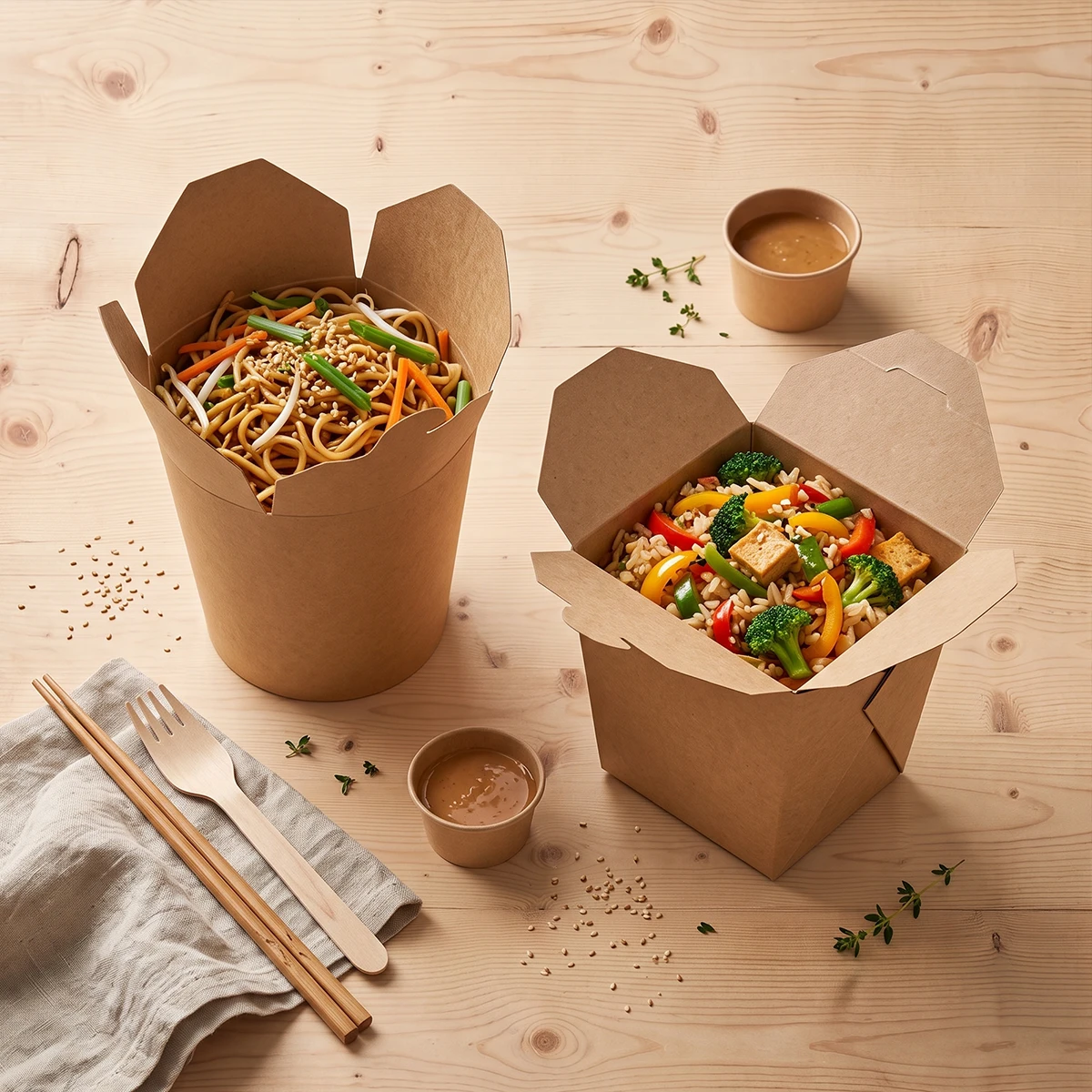
Food containers are the largest packaging volume. Switching from plastic or polystyrene foam to bagasse delivers the highest single-category impact.
- Bagasse clamshells and containers: primary food packaging replacement
- Wooden cutlery sets: replace plastic cutlery, which the SUP Directive bans
- Greaseproof paper wrap: for burgers, wraps and sandwiches
- Lid-free cups: for the beverage component of meal deals
Food Delivery Operations
Delivery packaging must keep food quality through transport. Bagasse containers perform well in delivery thanks to their structural rigidity and moisture resistance.
- Bagasse containers with secure closures: leak and spill prevention
- Kraft paper bowls with lids: soups, salads and wet dishes
- Greaseproof wrap and liners: sandwiches and burgers
- Wooden cutlery sets: included with each order
Hotels and Event Catering
Hotel and catering operations benefit from the presentation quality of bagasse and fiber formats, whose natural texture supports brand positioning alongside sustainability credentials.
- Bagasse trays and plates: buffet and catering service
- Wooden and bamboo cutlery sets: presentation for guests
- Lid-free cups: coffee and beverage stations
- Complete system supply: one supplier for all event packaging
What Documents Should You Ask For Before Buying?
The eco-friendly packaging market has a documentation problem: products are described as “sustainable”, “compostable”, “plastic-free” and “eco-friendly” in supplier marketing with varying accuracy. From 27 September 2026, Directive (EU) 2024/825 bans generic environmental claims without recognized excellent environmental performance, and national consumer law makes the business that makes a claim responsible for it, including restaurants, cafés and the distributors who resell the packaging. Ask for these documents for each product:
| Product category | Required documentation | Issued by |
|---|---|---|
| All food-contact formats | Declaration of compliance under Regulation (EC) No 1935/2004 (product-specific) | Producer |
| Containers and lids sold as compostable | Compostability certificate for the specific product (EN 13432 based industrial, or home compostable) | TÜV AUSTRIA (OK compost INDUSTRIAL / OK compost HOME) or DIN CERTCO |
| Paper cups and greaseproof paper | PFAS-free laboratory test results covering paper and coating | ISO 17025 accredited laboratory |
| Paper cups | Written confirmation of the coating type (water-based / PE / PLA) | Producer |
| Wooden and bamboo cutlery | FSC or equivalent sourcing certification | FSC or PEFC |
| Any format described as recyclable | Written recyclability statement with its conditions | Producer or third-party verification |
Three practical rules:
- Cups: the coating confirmation is the single most important document. It determines how the cup is treated under plastic-specific rules and whether a “PE-free” claim is accurate. Be skeptical of “eco-friendly” cups without it: PE-lined cups look identical to water-based coated cups.
- Containers: a self-declaration or a blanket supplier sustainability claim is not a compostability certificate. Check which certificate (home or industrial) covers which product, and who holds it.
- Samples: test with your actual food at your actual packing temperature. A container that works for rice may not work for a high-oil curry.
A supplier who cannot provide these documents is not adequately qualified for EU market supply. See how to choose a food packaging supplier for EU markets.
Step-by-Step Transition Guide for Restaurants and Cafés
A structured transition avoids the common pitfalls: switching too quickly, ordering the wrong specifications, and confusing staff during the changeover.
Step 1: Audit Your Current Packaging
List every single-use item you use, with monthly volume and unit cost. This baseline measures the impact of the transition and supports a true cost comparison.
Step 2: Prioritize by Volume and Visibility
Identify the two or three items with the highest monthly volume, which carry the greatest environmental and regulatory impact, and the most customer-visible items, which deliver the fastest brand benefit.
Step 3: Request Samples Before Ordering
Test bagasse containers with your actual menu items at serving temperature, and cup formats with your actual beverage sizes and service equipment, before committing to bulk orders.
Step 4: Time the Stock Run-Down
The most common transition error is ordering new formats while months of old cups and matching lids are still in storage: two systems on the shelf, staff switching between them, and customers receiving inconsistent formats. Calculate how many weeks of current stock remain, and time the new delivery to arrive when about two to three weeks are left.
Step 5: Switch One Format at a Time
For a small operation, switching cups, containers, cutlery and greaseproof paper at once creates a training burden that produces errors at peak service. Switch in order of impact (cups, then containers, then cutlery, then greaseproof paper) and allow two to three weeks between changes so each one settles into the service routine.
Step 6: Train Front-of-House Staff
Lid-free cups need a short orientation: the fold is simple but not instinctive the first time. Five minutes of hands-on practice before the first shift prevents slow service and inconsistent closures. Show staff how to fold the closure, how to check that it is properly seated, and how to hand the cup over with the drinking opening facing the customer.
Step 7: Communicate the Change to Customers
Customers at independent cafés are more likely to notice and ask about packaging changes than those at chains. A brief, confident answer turns a potentially awkward moment into a positive brand interaction.
- Brief and specific: “We’ve switched to a cup with a built-in closure; the fold here is the drinking opening.”
- Positive framing: “No separate lid to lose” engages customers more than “we removed the plastic lid.”
- Signage: a small A5 sign at the counter answers the question before it is asked. Keep the wording specific (“no plastic lid”, “water-based coating”) rather than generic (“eco-friendly”).
Expect a small share of customers to prefer the old format in the first weeks. Separate genuine usability concerns, which need a response, from novelty friction, which resolves on its own. A customer who says “this is different” is not asking you to switch back.
Step 8: Review and Optimize
After the first full month, review actual usage, staff feedback and customer response. Adjust order quantities to real consumption and identify the remaining conventional items for the next procurement cycle. Comparing bowl options? See kraft paper bowls vs plastic containers. For the full framework, see how to switch to plastic-free packaging.
EU Regulations Driving the Shift to Sustainable Packaging
For restaurants and distributors in European markets, the regulatory landscape is essential for long-term packaging planning.
The Single-Use Plastics Directive (EU) 2019/904, applied across member states since July 2021, bans a range of single-use plastic items and requires reduction measures, marking and producer responsibility for others, including plastic cups and their lids and plastic food containers. Bio-based plastics such as PLA count as plastic under the Directive. The Packaging and Packaging Waste Regulation (EU) 2025/40 entered into force on 11 February 2025 and applies from 12 August 2026. Food-contact materials must comply with Regulation (EC) No 1935/2004. See the EU plastic ban explained.
- July 2021: SUP Directive bans plastic cutlery, plates, straws and stirrers and EPS food containers, beverage containers and cups; marking for cups made partly of plastic
- 2022 to 2024: UK Plastic Packaging Tax (April 2022), Spain’s tax on non-reusable plastic packaging (January 2023), Germany’s Single-Use Plastics Fund (payments based on quantities from 2024); tethered caps on plastic beverage bottles and cartons (July 2024, not cups)
- 2026: PPWR applies from 12 August 2026, including PFAS limits for food-contact packaging; Directive (EU) 2024/825 on environmental claims applies from 27 September 2026
- 2028 to 2030: PPWR recyclability criteria, harmonized labels and reuse targets phase in
Key certifications when compostability is claimed:
- EN 13432: the European standard for industrial compostability of packaging
- TÜV AUSTRIA OK compost INDUSTRIAL and OK compost HOME: two separate certificates; check which one covers the specific product
- DIN CERTCO: certifies industrial and home compostability; again, check the product and the holder
Is Eco-Friendly Packaging More Expensive for Restaurants?
The unit cost of fiber-based packaging is typically higher than conventional plastic. The total cost picture is more complex, and for most operations the full business case favors switching.
Factors that offset the unit cost premium:
- Avoidance of plastic-specific taxes and levies (for example in Spain and the UK, or Germany’s Single-Use Plastics Fund); EPR fees still apply to all packaging, including paper and bagasse
- No separate plastic lid inventory with lid-free cups
- Lower compliance and documentation effort in EU-regulated markets
- Brand and customer retention value where sustainability drives purchasing decisions
- Protection against tightening rules that will raise the cost of plastic packaging further
Compare total system cost per cover, not unit price per item: unit cost, plastic-specific taxes and levies on conventional alternatives, EPR fees for all items, inventory, waste handling and compliance documentation.
The Realistic Picture for Independent Cafés
Independent cafés buy in volumes where per-unit pricing is typically higher than for chains. The honest picture by item:
- Lid-free cups: usually the closest to neutral, because a whole component (the separate lid and its costs) disappears. The cup unit premium is real; whether it is fully offset depends on your volumes and market.
- Bagasse containers: a genuine unit premium over plastic that depends on format and volume and is not fully offset at typical café container volumes. Budget it as a cost increase on the container line, balanced by regulatory simplicity, customer perception and food-contact performance.
- Wooden cutlery: costs more than plastic, but plastic cutlery is banned, so the comparison is moot.
For most independent cafés, a complete switch means a moderate net increase in total packaging spend: not zero, but often lower than assumed. See the sustainable packaging cost analysis and how horeca businesses reduce packaging costs.
Managing MOQ at Small Volumes
Ekoroll quotes MOQ per project, by format, size and print. To judge any supplier’s MOQ, divide it by your monthly use of that size: the result is how many months of stock one order represents. As an illustration only (not Ekoroll’s terms, MOQ is quoted per project): a 5,000-unit MOQ at 600 cups a month is about eight months of stock. Order your highest-volume formats first, because they turn over fastest, and for slow-moving formats consider consolidating into an adjacent size instead of stocking a separate item. See MOQ in the packaging industry.
For Distributors: Building an Eco-Friendly Takeaway Range
For horeca distributors, importers and private label buyers, the question is not “which packaging should we use” but “which packaging should we stock, document and sell”, so that customers can build complete plastic-reduced systems from one catalog.
Why a Dedicated Eco-Friendly Takeaway Line Wins Accounts
- Account qualification: corporate caterers, hotel chains, public sector food service and international delivery brands increasingly make documented, plastic-reduced packaging a supplier qualification criterion. A distributor without certified fiber containers, PFAS-tested cups and FSC-certified cutlery, each with full documentation, cannot qualify for these accounts at any price.
- Regulatory readiness: distributors with a qualified range respond to each regulatory change with existing product instead of another round of reactive sourcing.
- Consolidation: customers building plastic-reduced systems prefer one supplier for documentation, consistent quality and operational simplicity. Partial ranges force them to split procurement and open the door to competitors.
The Six Categories to Stock
| Category | Formats to stock | Documents for resale |
|---|---|---|
| Bagasse and fiber food containers | Clamshells, trays, bowls, compartment containers | Compostability certificate for each product sold as compostable; food-contact declaration |
| Beverage cups | Lid-free hot and cold cups with water-based coating; standard cups only with water-based coating | Coating confirmation; PFAS test results; food-contact declaration |
| Lids | Molded fiber lids that fit the containers and cups you stock | Food-contact declaration; PFAS documentation for barrier-treated versions |
| Cutlery | Loose wooden and bamboo pieces; wrapped sets for delivery | FSC or PEFC; food-contact declaration; splinter and migration test documentation |
| Greaseproof paper | Sheets, rolls, pre-cut burger and sandwich wraps | PFAS laboratory test results (not a supplier declaration) |
| Kraft paper packaging | Bowls with lids, takeout boxes, carrier bags | Food-contact declaration; recyclability statement with conditions |
Check dimensional compatibility: customers should never have to combine products from different suppliers to get a container and lid that fit. Related guides: bagasse meal boxes, molded fiber lids vs plastic lids, wooden and bamboo cutlery and greaseproof paper burger wrap.
Managing Documentation Across the Range
- Keep an expiry calendar for every certificate in the range, with reminders 90 days ahead for renewal requests
- Make updated documents a contractual requirement whenever a producer changes a formulation
- Build a customer-facing documentation pack per product family for your customers’ own procurement and claims
- Keep it current: an expired certificate is useless to a customer reviewing claims under Directive (EU) 2024/825 or answering a tender
Private Label
Private label eco-friendly packaging (your brand on bagasse containers, cups and wrapped cutlery sets) creates differentiation that commodity distribution cannot copy. Paper cups are the most brand-intensive item in café operations; bagasse containers carry your brand to every table and delivery; wrapped cutlery sets put it in every delivery bag. MOQ is confirmed per format, size and print specification on request, and plain formats usually start at lower quantities than printed ones. Launch with your highest-volume formats and extend as volume builds. Keep designs natural and minimal, and print only specific, documented claims (for example “PFAS-free” or “FSC certified”, and EN 13432 only where the certificate covers that exact product).
Positioning the Range
- Compliance: for chain procurement managers, lead with SUP reduction measures and levies on plastic cups and lids, the SUP ban on plastic cutlery, PPWR PFAS limits from 12 August 2026 and recyclability criteria from 2028.
- Documentation: for operators chasing corporate, hotel or public contracts, the documentation pack is the product: they can use it in tenders.
- Total cost: for cost-focused buyers, show the total system cost for their market, including plastic-specific taxes, levies and separate lid costs. The gap narrows, and for formats such as lid-free cups replacing cup-and-lid systems it can close.
Sustainability Checklist for Restaurant and Café Packaging
- Food containers switched from plastic or foam to bagasse or other certified alternatives
- Cup coating confirmed in writing as water-based, no PE or PLA lining
- Cup lids switched from plastic to molded fiber, bagasse or a lid-free format
- Cutlery switched from plastic to wooden or bamboo
- Wrapping paper confirmed PFAS-free by laboratory test
- Bags and carriers switched from plastic to paper
- Certificate, and its holder, confirmed for every item described as compostable
- Food-contact declarations on file for every item
- Staff trained on the new formats and on disposal instructions
- Customer communication in place, with specific rather than generic wording
How to Choose a Wholesale Eco-Friendly Packaging Supplier
For restaurants, cafés and distributors buying in volume, supplier selection decides how smoothly the switch goes.
- Certifications: compostability certificates (EN 13432 based, TÜV AUSTRIA OK compost INDUSTRIAL or OK compost HOME, DIN CERTCO) and food-contact declarations under Regulation (EC) No 1935/2004; check that each covers the specific product and who holds it
- Product range: one supplier for containers, cups, lids, cutlery and wraps simplifies procurement and keeps material standards consistent
- Production capacity: confirm that the supplier can meet peak order volumes reliably
- Export documentation: food-contact documentation and, for supply from Turkey, the A.TR movement certificate under the EU–Turkey customs union
- Lead times: confirm the lead time in writing with each quote; supply from Turkey benefits from short transit to European ports
- Samples policy: a reliable supplier provides samples before bulk orders
Wholesale Eco-Friendly Packaging for Restaurants, Cafés and Distributors
Ekoroll supplies bagasse food containers, lid-free hot cups and lid-free cold cups, molded fiber lids, wooden cutlery, PFAS-free greaseproof paper and kraft paper packaging wholesale to restaurants, cafés, delivery brands and horeca distributors across Europe, supplied from Turkey. Ekoroll bagasse is home compostable & 100% bagasse, certified by TÜV AUSTRIA (OK compost HOME). Product documentation is available on request, each certificate cited with its real holder. Private label printing, samples before bulk orders and MOQ quoted per project. Browse the catalog or contact us with your formats and volumes for samples and a quote.
Products in this article
Sources
- Directive (EU) 2019/904 on the reduction of the impact of certain plastic products on the environment (SUP Directive) — EUR-Lex
- Regulation (EU) 2025/40 on packaging and packaging waste (PPWR) — EUR-Lex
- Regulation (EC) No 1935/2004 on materials and articles intended to come into contact with food — EUR-Lex
- Directive (EU) 2024/825 on empowering consumers for the green transition — EUR-Lex