Greaseproof paper is one of the most widely used wrapping materials in food service, and also one of the most misunderstood. For restaurants, burger chains, bakeries and food delivery operations, it is a daily operational necessity — but choosing the wrong format, sourcing from suppliers without verified food safety certification, or using paper that contains PFAS chemicals creates both compliance risk and customer safety concerns.
This guide covers everything food service operators and horeca distributors need to know about greaseproof paper for burger wrapping and takeaway packaging: how it is made, how it performs, the critical difference between PFAS-containing and PFAS-free formats, EU regulatory requirements, available formats and wholesale sourcing guidance.
For wholesale supply, explore Ekoroll PFAS-free greaseproof paper for restaurants and horeca operations.
What Is Greaseproof Paper and How Is It Made?
Greaseproof paper is a food-contact wrapping paper specifically manufactured to resist oil and grease penetration. Unlike standard paper, which has an open fiber structure that absorbs oils rapidly, greaseproof paper undergoes an intensive mechanical refining process that creates a much denser fiber matrix. This dense structure dramatically reduces the paper’s porosity, preventing grease from soaking through the material under normal food service contact conditions.
The manufacturing process involves supercalendering — passing paper through heavy rollers under high pressure to compress and align the fibers. This process does not require plastic coatings or chemical additives to achieve oil resistance. The grease resistance comes from the physical structure of the paper itself.
This is the fundamental distinction that matters for food safety and sustainability: properly manufactured greaseproof paper achieves its oil resistance mechanically, not through PFAS chemical treatment or plastic coating. However, many lower-quality greaseproof papers on the market use PFAS chemicals as a shortcut to achieve oil resistance at lower manufacturing cost — creating a significant food safety and regulatory risk.
PFAS in Greaseproof Paper: What You Need to Know
PFAS — per- and polyfluoroalkyl substances — are a group of synthetic chemicals used in food packaging to create oil and water resistance. They are sometimes called “forever chemicals” because they persist in the environment and in the human body essentially indefinitely, accumulating over time.
PFAS contamination in food contact materials has become one of the most significant food safety and regulatory issues in European packaging. The concern is not theoretical: PFAS chemicals migrate from food packaging into food, and from food into the human body. Studies have documented PFAS migration from paper food packaging into food content, particularly with fatty foods at elevated temperatures.
How PFAS Gets Into Greaseproof Paper
Some greaseproof paper manufacturers apply PFAS-based chemical treatments to paper to create oil resistance quickly and cheaply, rather than investing in the more intensive mechanical supercalendering process. This produces paper that appears functionally similar to properly manufactured greaseproof paper but contains chemical contamination that can migrate into food.
EU Regulatory Status of PFAS in Food Packaging
The EU has been progressively restricting PFAS in food contact materials. The European Food Safety Authority has assessed PFAS exposure through food packaging as a significant contributor to overall human PFAS body burden. Denmark has banned PFAS in paper and board food contact materials since July 2020, and from 12 August 2026 the EU Packaging and Packaging Waste Regulation (EU) 2025/40 sets PFAS limits for all food-contact packaging (25 ppb for any single PFAS, 250 ppb for the sum of PFAS, 50 ppm total PFAS including polymeric PFAS).
For food service operators and distributors sourcing greaseproof paper for EU markets, PFAS-free certification is rapidly becoming a procurement requirement rather than a differentiator.
How to Verify PFAS-Free Status
Ask your supplier for explicit PFAS-free documentation. This should confirm that no per- and polyfluoroalkyl substances are present in the paper material or applied as a surface treatment. A general food contact compliance certificate is not sufficient — PFAS-free status requires specific testing and documentation. Ekoroll greaseproof paper is PFAS-free, and the supporting documentation is shared with the specification.
Greaseproof Paper vs Wax Paper vs Parchment Paper
For food service operators, understanding the differences between these three paper formats prevents specification errors that affect food quality and food safety.
Greaseproof Paper
Mechanically refined paper with dense fiber structure providing oil and grease resistance. No coating required for standard food service applications. Suitable for wrapping burgers, sandwiches, pastries and other oily foods in takeaway and delivery service. The primary paper format for burger wrapping in food service operations.
Wax Paper
Paper coated with a thin layer of wax (typically paraffin) to provide moisture resistance. Not suitable for hot food applications as the wax coating melts at elevated temperatures. Used primarily for cold food wrapping, candy making and non-heat applications. Not appropriate as a substitute for greaseproof paper in hot food service.
Parchment Paper (Baking Paper)
Silicone-coated paper designed for high-temperature oven use. Provides non-stick properties for baking. Suitable for oven temperatures but more expensive than greaseproof paper for standard wrapping applications. Not necessary for takeaway wrapping where high-temperature oven exposure is not required.
Summary for Food Service Selection
For burger wrapping, sandwich wrapping and general takeaway food packaging: greaseproof paper (PFAS-free certified) is the correct specification. Wax paper is unsuitable for hot food. Parchment paper is appropriate for oven baking applications but over-specified and more expensive for standard takeaway wrapping use.
Performance Specifications for Food Service Use
For food service operators evaluating greaseproof paper, the relevant performance dimensions are grease resistance, moisture resistance, heat tolerance, structural integrity and food contact safety.
Grease Resistance
High-quality greaseproof paper provides reliable grease barrier performance under normal food service contact conditions. This covers the full range of food service applications including burgers with oil-based sauces, fried chicken, pastries with butter content, fish and chips, and sandwiches with oily fillings. The Cobb test and KIT test are standard grease resistance measurement methods — ask your supplier for performance data on these metrics.
Moisture Resistance
The dense fiber structure of greaseproof paper also provides moderate moisture resistance, preventing steamy hot food from immediately softening the paper during wrapping and short transit periods. This is particularly important for hot burger wrapping where steam from a freshly cooked patty will attempt to penetrate the paper immediately after wrapping.
Heat Tolerance
PFAS-free greaseproof paper is suitable for contact with hot food up to approximately 200°C in short-term applications such as oven wrapping and brief warming. For standard takeaway wrapping where the paper wraps hot food but is not placed in an oven, heat tolerance is not a limiting factor under normal service conditions.
Structural Integrity
Greaseproof paper maintains structural integrity during typical food service wrapping, transport and consumption periods. It does not tear easily during manual wrapping at high service speeds, and retains its structure during delivery transport without becoming wet through from food moisture contact.
Food Contact Safety
PFAS-free greaseproof paper documented as compliant with the EU food contact framework (Regulation EC 1935/2004) confirms that no harmful substances migrate from the paper into food under normal use conditions. This is the baseline food safety requirement for any food contact wrapping material used in European food service operations.
Food Service Applications
Greaseproof paper is used across a wide range of food service wrapping applications. Understanding which format and weight suits each application helps operators specify correctly.
Burger Wrapping
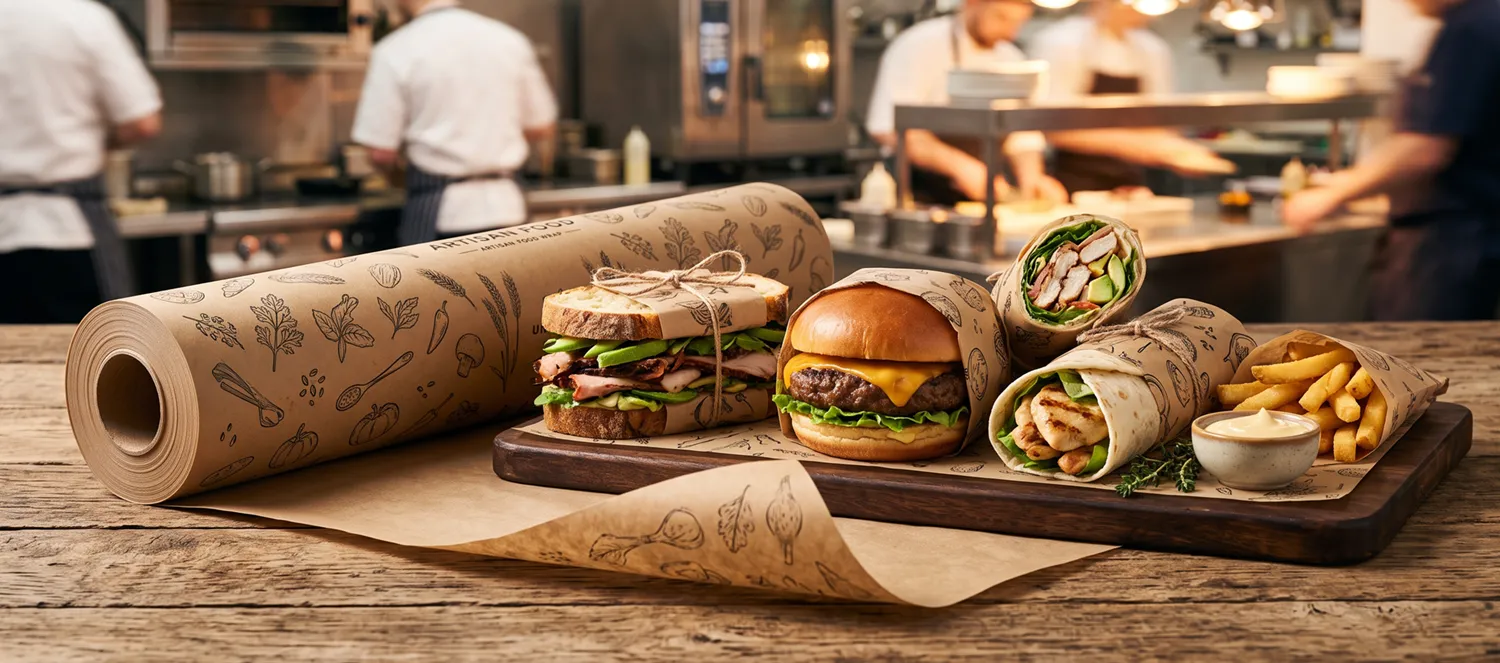
The primary application in quick service restaurants, burger chains and food delivery operations. Greaseproof paper wraps the assembled burger to contain oils, sauces and steam, maintain bun structure during transport, and provide a clean eating experience at point of consumption. For delivery operations, the wrapping also needs to maintain integrity during 20 to 45 minutes of transport time in delivery bags.
Sandwich and Wrap Packaging
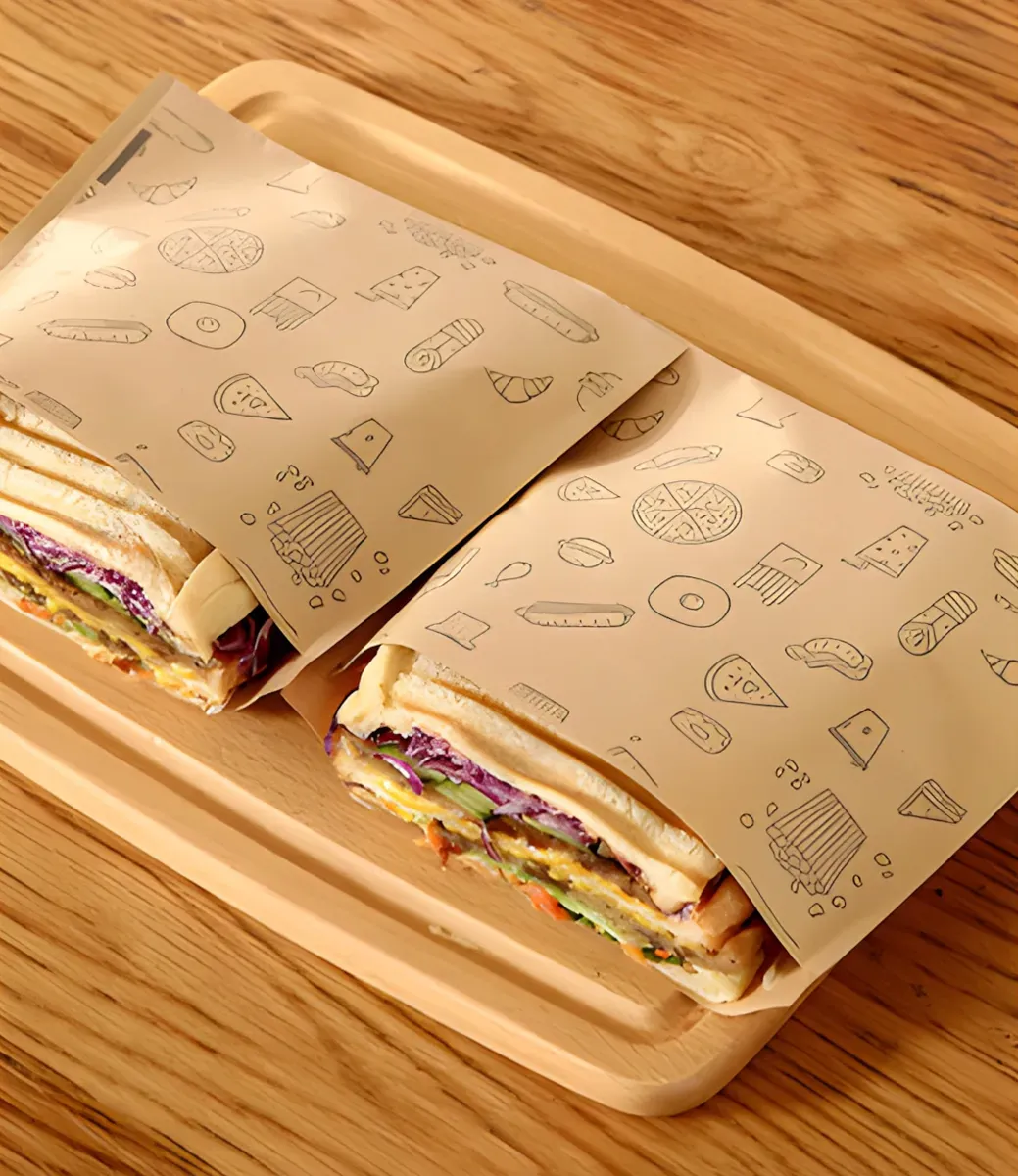
Deli-style sandwiches, submarine sandwiches and wraps are commonly packaged in greaseproof paper for both dine-in presentation and takeaway service. The paper provides oil containment for ingredients like avocado, oily meats and sauces while maintaining a clean presentation at unwrapping.
Fried Food Wrapping
Fried chicken, fish and chips, onion rings and similar high-oil fried food products require strong grease barrier performance. Greaseproof paper liners and wrapping sheets are used in boxes and bags for these applications to prevent grease soaking through outer packaging.
Bakery and Pastry Packaging
Croissants, pastries, Danish and other butter-content bakery items use greaseproof paper for individual wrapping and tray lining. The paper prevents butter from staining outer packaging while maintaining the presentation quality of the bakery product.
Tray and Box Lining
Greaseproof paper sheets are used to line food trays, takeaway boxes and serving baskets, providing a hygienic food-contact surface and grease barrier between the food and the container. This is common in fish and chip shops, burger restaurants and street food operations.
Custom Printed Wrapping
Printed greaseproof paper is used by restaurants and food brands for branded burger wrapping, sandwich paper and general food presentation. Custom printing allows logo, brand color and graphic elements to be applied to the paper, creating a branded presentation at point of service and delivery receipt.
Custom Printed Greaseproof Paper
Custom printed greaseproof paper provides food service brands with a high-visibility branding surface at the moment of food delivery or dine-in service. Unlike packaging boxes or cups, greaseproof paper wrapping is handled directly by the customer throughout the eating experience, providing sustained brand exposure.
Key considerations for custom printed greaseproof paper orders:
- Food-safe inks: confirm that printing inks are food-safe and do not contain substances that could migrate into food under heat and moisture conditions
- Print coverage: full surface print coverage, partial print and spot print options are available depending on design requirements
- Paper weight: standard weights for burger wrapping range from 30gsm to 50gsm depending on food type and wrapping style
- Sheet vs roll format: sheet format for manual wrapping stations; roll format for automated wrapping equipment
- MOQ for custom printing: Minimum order quantities depend on format, size and print and are quoted per project.
EU Regulatory Landscape
For food service operations and distributors in European markets, the regulatory requirements for greaseproof paper cover two overlapping areas: general food contact material compliance and PFAS-specific restrictions.
General Food Contact Material Requirements
All food contact materials in the EU must comply with Regulation EC 1935/2004, which requires that materials do not transfer substances to food in quantities that could endanger human health, bring about an unacceptable change in food composition, or bring about a deterioration in the organoleptic characteristics of food. Suppliers should provide a Declaration of Compliance confirming compliance with this regulation for the specific paper format supplied.
PFAS Restrictions in Food Packaging
The EU has already restricted specific PFAS compounds under its chemicals legislation. Denmark has banned PFAS in paper and board food contact materials since July 2020; Germany and the Netherlands have no comparable national ban. EU-wide, the Packaging and Packaging Waste Regulation (EU) 2025/40 limits PFAS in food-contact packaging from 12 August 2026 (25 ppb for any single PFAS, 250 ppb for the sum of PFAS, 50 ppm total PFAS), and a broader universal PFAS restriction is still being evaluated at ECHA. The EU Chemicals Strategy for Sustainability and the revision of the Food Contact Materials Regulation both include PFAS elimination as explicit policy objectives.
For EU market supply, PFAS-free certified greaseproof paper is the forward-compliant specification. Operations using PFAS-containing paper face compliance problems under the PPWR limits and market access issues in member states with stricter national measures such as Denmark.
Wrapping Without a Plastic Coating
PFAS-free greaseproof paper fits the direction of EU packaging rules. Unlike PE-coated paper or plastic-laminated wrapping materials, it has no plastic coating, is designed for paper recycling where local collection accepts it, and is a natural-fiber material. No compostability claim is made for Ekoroll greaseproof paper.
Greaseproof Paper in a Complete Plastic-Reduced Packaging System
For food service operations building a complete plastic-reduced packaging system, greaseproof paper is the wrapping component that completes the system alongside containers, cups and cutlery.
- Bagasse food containers — home compostable & 100% bagasse (TÜV AUSTRIA OK compost HOME), PFAS-free meal containers for hot and cold food; water- and oil-resistant, microwave- and freezer-safe
- Lid-free hot paper cups — water-based, PFAS-free, PE-free coated beverage cups with integrated closure and no plastic lid
- Lid-free cold paper cups — cold beverage cups with no PE lining and no plastic lid
- Molded fiber lids — for operations retaining existing cup formats
- Wooden and bamboo cutlery — natural wood and bamboo utensils for all food service formats
- PFAS-free greaseproof paper — wrapping with no plastic coating for burgers, sandwiches and bakery items
Wholesale Sourcing Guide
For restaurants and distributors sourcing greaseproof paper at wholesale volume, the key evaluation criteria are PFAS-free certification, food contact compliance documentation, grease resistance performance, available formats and logistics.
- PFAS-free certification — the most important single criterion. Request explicit documentation confirming absence of per- and polyfluoroalkyl substances. A general food contact certificate is not sufficient
- EU food contact compliance (EC 1935/2004) — Declaration of Compliance confirming compliance for the specific paper format and weight you are ordering
- Grease resistance performance data — request KIT test or Cobb test results for the specific paper specification
- Format availability — confirm sheet sizes, roll widths and paper weights suitable for your specific applications
- Custom printing capability — if branded paper is required, confirm food-safe ink specification and minimum order requirements
- MOQ plain paper: confirmed per format, size and print specification
- MOQ custom printed: confirmed per format, size and print specification
- Market documentation — EU importers need food contact compliance documentation (Declaration of Compliance) to place the paper on the market, alongside the usual commercial and origin documents for customs
Wholesale PFAS-Free Greaseproof Paper for Restaurants and Horeca
Ekoroll supplies PFAS-free greaseproof paper wholesale to burger restaurants, bakeries, food delivery brands and horeca distributors across Europe. EU food contact compliant. Plain and custom printed formats available. Direct supply from Turkey with product documentation and samples available on request.