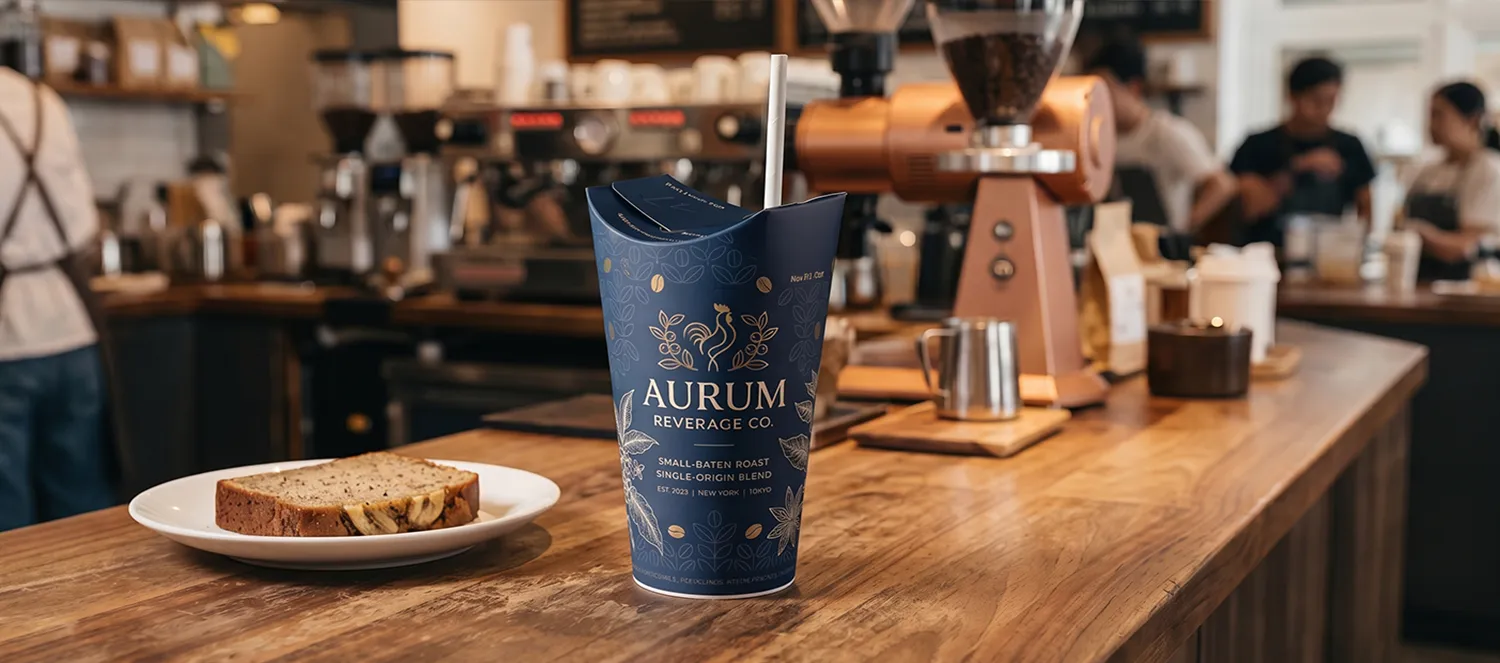
Lid-free paper cups are now one of the main alternatives to the conventional cup-and-lid system that cafés, coffee chains and food service operators across European markets are evaluating. For buyers evaluating the switch — whether from PE-lined cups with plastic lids, or from cups with compostable fiber lids — the practical questions are the same: how do they perform under real service conditions, what are the specifications to look for, how does the wholesale cost comparison work, and what does the transition actually involve operationally?
This guide provides a complete practical reference for lid-free paper cups for wholesale buyers, horeca distributors and food service operators. For the detailed engineering explanation of how the folding mechanism works, see: What Is an Integrated Lid Cup?. For the direct comparison with plastic lid systems on cost, compliance and performance, see: Lid-Free vs Plastic Lid Paper Cups.
For wholesale supply, explore Ekoroll lid-free hot cups and lid-free cold cups.
Lid-Free Cup Specifications: What to Look For
Not all lid-free paper cups are equivalent. The specification decisions that matter most for performance, compliance and wholesale procurement are coating type, paper weight, fold mechanism quality and certification documentation.
Coating Type: The Most Important Specification
The coating applied to the food-contact interior of the cup determines recyclability, food safety and plastic content. Three options exist:
- PE (polyethylene) coating: conventional plastic lining. Lid-free cup with PE coating eliminates the separate plastic lid but retains plastic in the cup body. Not recyclable in standard paper streams. Counts as a cup made partly of plastic under the EU Single-Use Plastics Directive (consumption-reduction measures, printed marking, EPR). Microplastic migration documented under hot beverage conditions. Suboptimal choice for operations that want to remove the PE lining as well as the lid.
- PLA (polylactic acid) coating: bio-based plastic from plant starch. Eliminates conventional plastic lid but retains bio-plastic in cup body. Not recyclable in standard paper streams. Counts as plastic under the Single-Use Plastics Directive (Commission guidelines 2021), so it is no exemption route. EN 13432 certificates for PLA linings cover industrial composting conditions only.
- Water-based coating: water-based polymer dispersion with no PE film. No PE, no PLA. Designed for paper recycling where local collection accepts it. Compostability documentation should be requested from the supplier, with the certificate holder clearly named. No PE-related microplastic migration. How the coating is treated under national plastic rules depends on its composition, so ask for the coating documentation. PFAS-free versions available with third-party test documentation. This is the specification for removing both the plastic lid and the PE lining.
When sourcing lid-free cups, specify “water-based coating” explicitly and request documentation. Many suppliers use “eco-friendly” or “sustainable” language without clarifying coating type. A supplier who cannot confirm water-based coating with documentation is supplying PE or PLA-lined cups regardless of marketing language.
Paper Weight and Structural Specification
Lid-free cups require a paper specification that provides both the structural rigidity for the folded closure to hold under liquid pressure and the flexibility for clean folding along the engineered score lines. This typically requires a heavier paper basis weight than standard single-wall cups. The specific GSM (grams per square meter) varies by manufacturer and construction — request a sample and test under your actual service conditions rather than relying on specification sheets.
Fold Mechanism Quality
The fold mechanism precision determines seal reliability in service. Key quality indicators:
- Score line precision — clean, consistent fold lines without delamination or surface cracking
- Panel alignment — the folded panels create a flush, even closure without gaps that could allow leakage
- Drinking aperture shape — the aperture should allow controlled liquid flow without excessive resistance or splash
- Closure retention — the folded closure should stay closed under normal handling without springing open
Test these properties under your actual service conditions with hot beverages at serving temperature and realistic handling including bag transport for delivery operations.
PFAS-Free Certification
For paper-based food contact cups, PFAS contamination is a separate issue from PE coating. A cup can be described as water-based coated but still contain PFAS if the paper substrate was treated with PFAS before coating. A complete PE-free and PFAS-free specification requires:
- Water-based coating confirmation (no PE, no PLA)
- PFAS-free certification covering both the paper substrate and the coating — from third-party laboratory testing, not self-declaration
For more on PFAS in paper cups, see: PFAS-Free Paper Cups Guide.
Performance Across Beverage Types
Lid-free paper cups are designed for both hot and cold beverage service. Performance varies by cup format and the specific application.
Hot Espresso-Based Beverages

Lattes, flat whites, cappuccinos and americanos served at standard café temperatures (70 to 85°C) are the primary application for hot lid-free cups. Water-based coated cups are designed for these drinks under normal single-use conditions. The folded closure is designed to stay closed for typical in-store to customer transit and short-distance takeaway. For food delivery applications where the cup is in a delivery bag for 20 to 40 minutes, heat retention in the folded format is comparable to conventional cup-and-lid systems.
Filter Coffee and Tea
Filter coffee and tea applications at similar temperature ranges perform equivalently. The folded closure’s drinking aperture is sized for controlled flow suitable for both espresso-based and filter beverage serving speeds.
Iced and Cold Beverages
Cold lid-free cups are designed for iced coffee, cold brew, iced tea and similar cold beverage applications. The cup construction manages condensation on the exterior without structural degradation. The fold mechanism functions effectively at cold beverage temperatures. For blended drinks with significant ice volume, confirm compatibility with your specific blended drink format with the supplier before ordering — the cup structure and fold mechanism must accommodate the viscosity and volume of your specific products.
Smoothies and Thick Beverages
Thicker beverages including smoothies and blended drinks require specific fold aperture sizing to allow adequate flow. Confirm that the drinking aperture in the specific cup format you are evaluating provides adequate flow for your thick beverage formats — aperture size varies between manufacturers and formats.
Available Sizes for Food Service Operations
Lid-free cups are available in hot and cold formats across standard food service size ranges. The specific sizes available vary by supplier — confirm your required size range with your supplier before ordering.
Hot Cup Size Range
Standard hot lid-free cup sizes for café and coffee service typically cover:
- Small (8 oz / 240ml): flat white, small latte, standard cappuccino
- Medium (12 oz / 355ml): standard latte, large cappuccino, filter coffee
- Large (16 oz / 470ml): large latte, large americano, large filter coffee
- Extra large (20 oz / 590ml): large format takeaway, travel coffee
Cold Cup Size Range
Cold lid-free cup sizes for iced beverage service typically cover:
- Medium cold (12 oz / 355ml): standard iced coffee, cold brew
- Large cold (16 oz / 470ml): large iced coffee, iced latte
- Extra large cold (20 oz / 590ml): large iced beverages, smoothies
For operations requiring specific sizes outside standard ranges or requiring custom sizing for particular beverage formats, discuss your requirements with your supplier at the sampling stage. Custom size tooling may be available for sufficient volume commitments.
Cost Comparison: Lid-Free vs Conventional Cup Systems
The cost comparison between lid-free cups and conventional cup-and-lid systems is more favorable for lid-free cups than a simple unit price comparison suggests. A complete cost analysis for EU market operations includes:
Direct Cost Components
- Cup unit cost: lid-free cups typically carry a modest unit cost premium over equivalent PE-lined conventional cups due to the more complex structural engineering. The premium varies by format, volume and print, and pricing is quoted per project.
- Lid cost eliminated: the separate lid cost is completely removed — every serve needs one purchased item instead of two. At café volumes, the monthly lid cost line disappears entirely, partially or fully offsetting the cup unit cost premium.
Regulatory Cost Components (EU and UK)
- Plastic-specific levies on the lid: where a market taxes plastic packaging, the plastic lid is in scope, and a lid-free cup removes it. Examples: the UK Plastic Packaging Tax (a UK measure, not EU; £228.82 per tonne from 1 April 2026 on plastic packaging components with less than 30% recycled plastic) and Spain’s €0.45/kg tax on non-reusable plastic packaging (since 1 January 2023). Italy’s plastic tax has been postponed and is not in force; Germany and France have no per-kg plastic packaging tax.
- Single-use plastic measures: in Germany, producers of plastic cups for beverages and their lids pay into the Single-Use Plastics Fund (Einwegkunststofffonds); across the EU, the Single-Use Plastics Directive’s extended producer responsibility (Art. 8) covers plastic cups and their lids. Removing the plastic lid takes one item out of scope. Whether a coated paper cup body is in scope depends on its coating and the national implementation, so ask your supplier for the coating documentation.
- Packaging EPR: general packaging EPR (for example VerpackG licensing in Germany or eco-modulated fees in France) applies to all packaging, including paper cups. One component instead of two can lower the fee base, but the obligation itself remains.
Operational Cost Components
- SKU reduction value: halving the cup-related SKU count from two per size to one per size reduces procurement administration, inventory management and storage cost — real operational savings that are not captured in unit price comparison
- Lid stock-out risk elimination: lid stock-outs create service disruption that has revenue cost beyond the packaging cost. Eliminating this risk has operational value that is difficult to quantify but real
For a full cost analysis framework including per-market plastic levies and EPR cost structure, see: Sustainable Packaging Cost Analysis.
Transition Planning: What the Switch Actually Involves
For operations switching from conventional cups to lid-free cups, the transition involves four practical steps.
Step 1: Sample Testing
Order samples of the specific lid-free cup formats you are evaluating — both hot and cold if applicable. Test under your actual service conditions: your specific beverages at your serving temperatures, with your packing and transport conditions if you do delivery. Evaluate seal integrity, fold mechanism quality, heat retention and drinking experience. Do not proceed to bulk ordering without sample testing.
Step 2: Staff Training
The folding mechanism requires brief training — typically two to three minutes of hands-on practice for each staff member. Build the folding motion into your standard service sequence and train all customer-facing staff before launch. Ensure consistency: all staff should fold the cup the same way to the same standard.
Step 3: Customer Communication
Prepare a brief customer explanation for the first four to six weeks after launch. A three-second demonstration at handout point is sufficient for most customers. Consider a small tabletop card or sleeve instruction for self-service contexts. Describe the switch with specific, verifiable statements (for example “no plastic lid”) rather than generic environmental claims, which Directive (EU) 2024/825 restricts from 27 September 2026.
Step 4: Stock Transition
Plan the stock transition to minimize write-off of existing conventional cup and lid inventory. A category-by-category run-down — using existing stock until depleted before introducing lid-free cups — avoids waste while transitioning smoothly. Order your first bulk quantity of lid-free cups to arrive before your existing stock runs out to avoid a gap in supply.
For a complete transition framework, see: How to Switch to Plastic-Free Packaging.
Wholesale Sourcing Checklist
For cafés, coffee chains and horeca distributors sourcing lid-free cups at wholesale volume, verify the following before placing bulk orders:
- Coating type: confirm water-based coating with documentation — not PE or PLA
- PFAS-free certification: third-party laboratory test results covering both paper substrate and coating
- EU food contact compliance: EC 1935/2004 Declaration of Compliance for the specific cup format
- Size range availability: confirm all sizes required for your operation are available in the lid-free format
- Hot and cold format availability: confirm both formats if applicable
- Sample availability: test before bulk order — non-negotiable
- MOQ: confirmed per format, size and print specification
- Lead times: standard and urgent restocking lead times for your logistics planning
- Custom printing: if branded cups are required, confirm food-safe ink specification and artwork requirements
Wholesale Lid-Free Paper Cups for Cafés and Horeca
Ekoroll supplies lid-free hot cups and lid-free cold cups wholesale to cafés, coffee chains and horeca distributors across Europe. Water-based, PFAS-free, PE-free coating. With water-based coating, these cups carry DIN CERTCO home compostable and industrially compostable (EN 13432) certification, held by the producing partner; copies on request. In Ekoroll’s internal test, water-based coated lid-free cups filled with water for more than a month showed no leakage, no softening and no water penetration. The water-based coated paperboard also passed PPWR (EU) 2025/40 tests for PFAS, total fluorine and heavy metals (lead, cadmium, mercury, hexavalent chromium); the SGS and Eurofins reports are available on request. The recommended fill temperature for the lid-free cups is up to 90 °C. No separate lid to buy, store or dispose of. Direct supply from Turkey. MOQ and pricing quoted per project. Samples and certification documentation available on request.