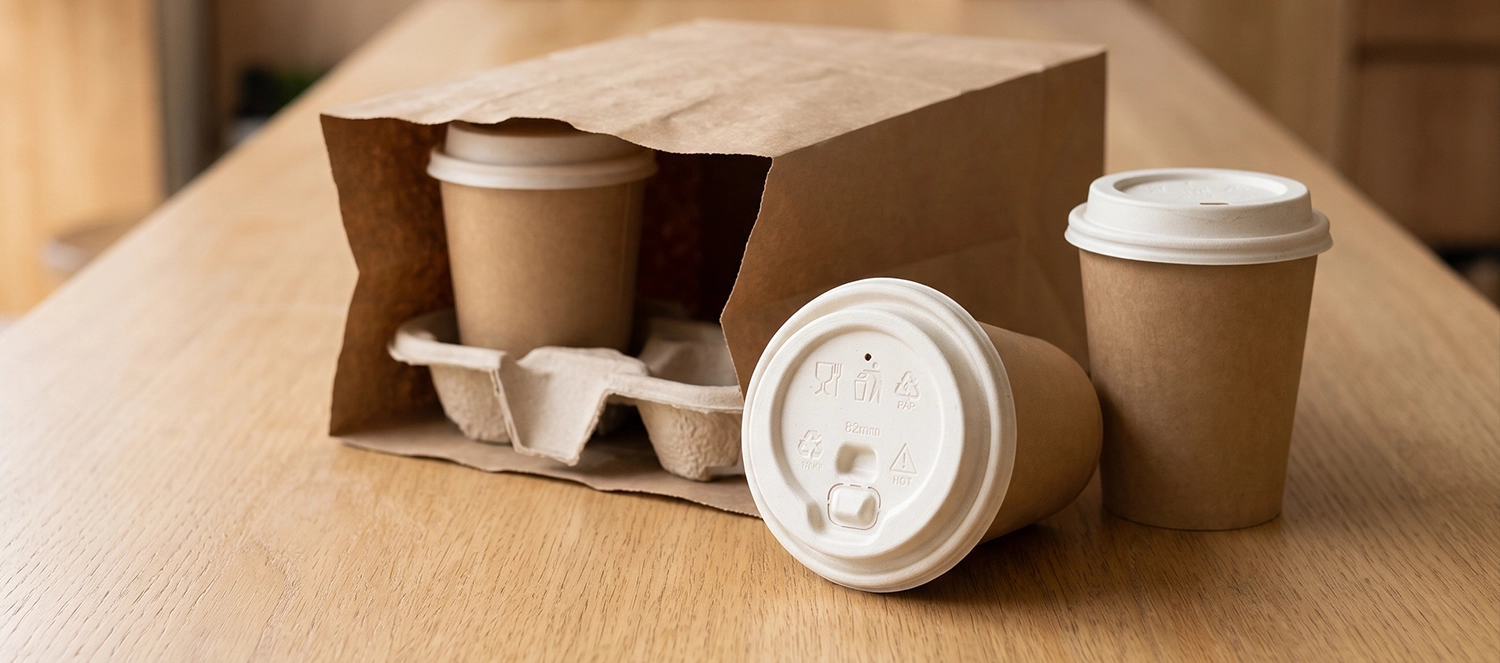
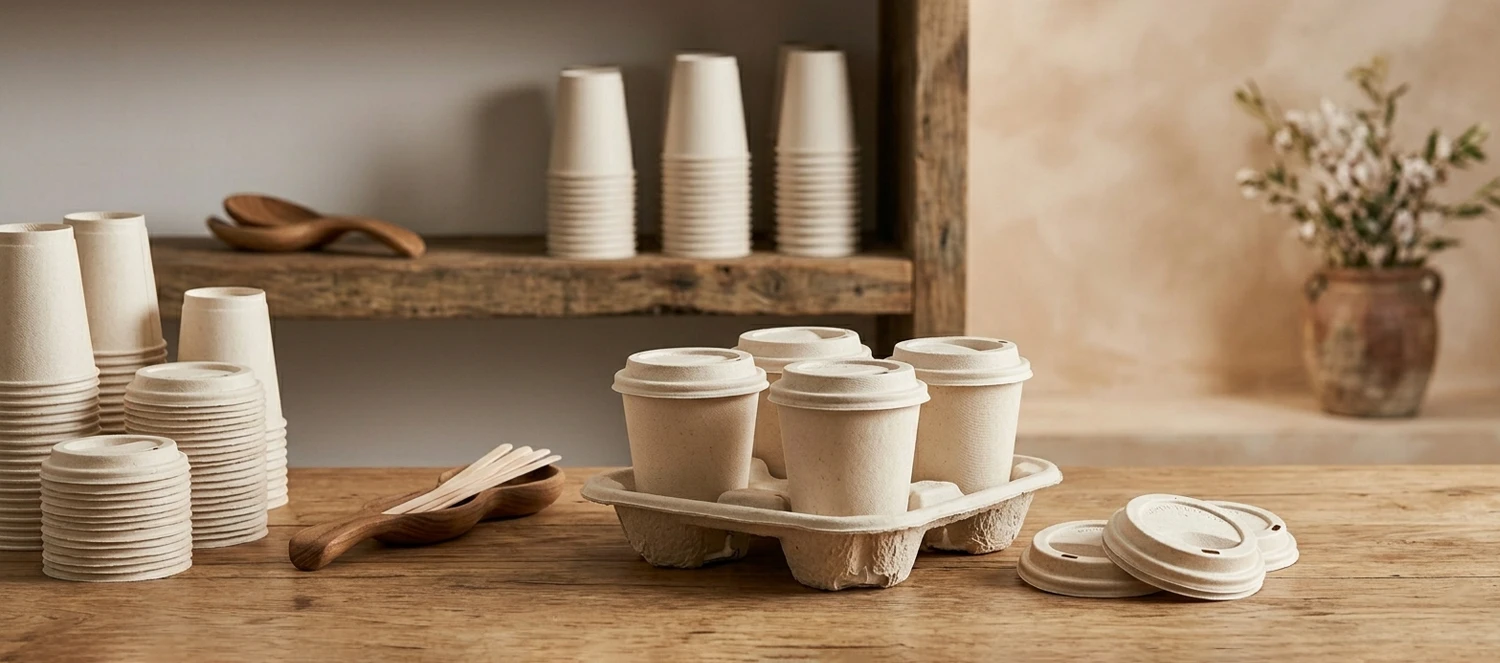
Molded fiber lids are cup and container lids pressed from plant fiber pulp, usually sugarcane bagasse, and they contain no plastic. They fit standard paper cups and food containers, cover normal hot and cold takeaway use, and remove the plastic-specific rules and charges that come with plastic lids; plastic lids keep an advantage only where you need a transparent lid or a liquid-tight seal under prolonged contact.
For cafés, coffee chains, restaurants, delivery operators and packaging distributors, switching usually needs nothing more than a supplier change. This guide covers how molded fiber lids are made, how they compare with plastic lids in a side-by-side table, how they perform in real service, what certificates to ask for, and how to source them wholesale for European and international markets.
For wholesale supply, explore Ekoroll molded fiber lids for cafés, coffee chains and horeca distributors.
What Are Molded Fiber Lids?
Molded fiber lids are cup closure lids manufactured from compressed plant-based fiber pulp — typically sugarcane bagasse, bamboo pulp, or a combination of agricultural fiber byproducts. The manufacturing process involves forming wet fiber pulp in a mold under heat and pressure, producing a rigid, shaped lid that is dimensionally consistent and structurally stable under normal food service conditions.
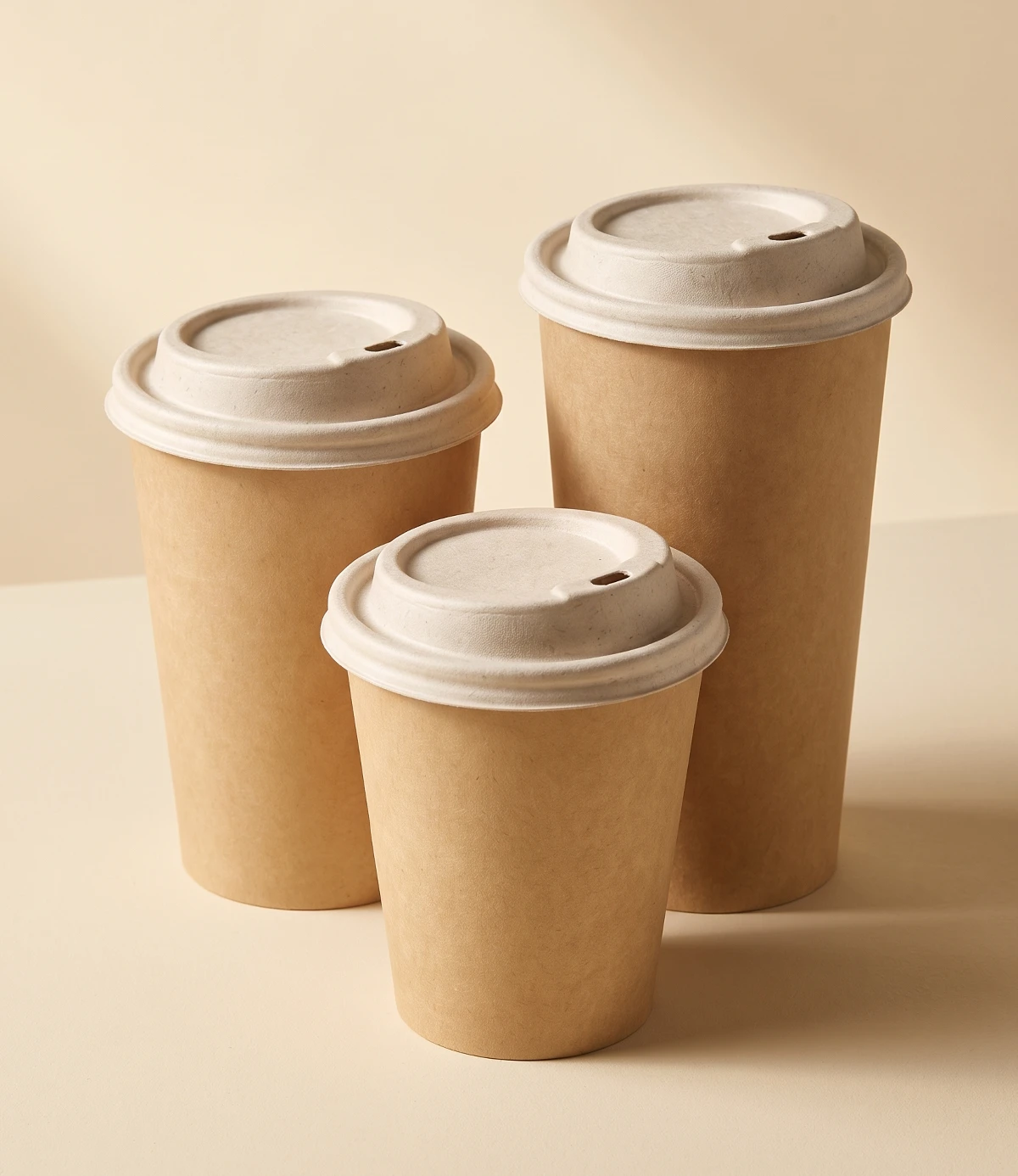
The result is a lid that functions identically to a conventional plastic lid in terms of cup closure and takeaway use, but is made of natural plant fiber with no plastic content. Where the product documentation confirms compostability for the specific format (for example an EN13432 certificate and its holder), molded fiber lids can be composted alongside food waste in industrial composting facilities.
Molded fiber lids are available in the standard rim sizes used across the European café and horeca market, making them directly compatible with existing paper cup inventories without requiring changes to cup specifications or service equipment.
How Molded Fiber Lids Are Made
The production process for molded fiber lids begins with raw agricultural fiber — most commonly sugarcane bagasse, the fibrous residue remaining after sugarcane juice extraction. This raw material is a byproduct of sugar production that would otherwise be burned or discarded, making it a genuinely circular feedstock with minimal additional environmental impact.
The fiber is processed into a wet pulp slurry, which is then formed in precision molds under heat and pressure. The molding process compresses the fiber into a dense, rigid structure that maintains its shape and structural integrity under normal service conditions including hot liquid contact, stacking and transport.
After molding, lids are dried and finished to achieve the required dimensional tolerances for cup rim compatibility. Quality control processes verify rim diameter consistency, structural integrity and surface finish across each production batch.
The finished product contains no plastic binders, no petroleum-derived coatings and no PFAS chemicals. The entire lid structure is composed of plant fiber. End-of-life suitability, including compostability, is documented according to the final product specification and production route.
Fiber Sources
- Sugarcane bagasse: the fibrous residue left after sugar extraction. A high-volume agricultural byproduct that gives strong lids with good dimensional stability for hot and cold use.
- Wheat straw: residue from the wheat harvest, an abundant byproduct with good fiber properties for molded packaging.
- Bamboo pulp: used alone or blended with bagasse.
- Recycled paper pulp: post-consumer or post-industrial fiber; it reduces virgin material use, but fiber quality varies with the source.
Surface Treatment Options
- Untreated (natural fiber surface): for drinks, dry and lightly moist food. Not intended for high-liquid or very oily food without a barrier.
- Water-based barrier: a water-based treatment on the food-contact side adds oil and moisture resistance for soups, curries and sauced dishes. Ask for documentation that the treatment is PFAS-free.
- PLA-coated: a bio-based plastic coating for liquid resistance. It may be certified for industrial composting, but PLA counts as plastic under the Single-Use Plastics Directive, so the lid is no longer a plastic-free item and it cannot go into standard paper recycling.
Molded Fiber Lids vs Plastic Lids: How Do They Compare?
Fiber and plastic lids do the same job on the counter, but they differ in material, rules, end of life and a few performance points. The table compares an untreated or water-based-treated molded fiber lid with the two plastic lids most used in food service.
| Feature | Molded fiber lids | PP plastic lids | PET plastic lids |
|---|---|---|---|
| Material | Plant fiber (bagasse, wheat straw, bamboo, recycled pulp) | Fossil-based polypropylene | Fossil-based PET |
| Plastic content | None (untreated or water-based barrier) | 100% plastic | 100% plastic |
| EU Single-Use Plastics Directive | Outside the plastic definition if 100% natural fiber without plastic coating (a PLA coating counts as plastic) | Cup lids covered by consumption-reduction measures (Art. 4) and SUP EPR (Art. 8) | Same as PP |
| Tethered-cap rule (Art. 6) | Not applicable to cups or food containers | Not applicable to cups or food containers | Not applicable to cups or food containers |
| Plastic-specific levies | None | Where they apply (UK Plastic Packaging Tax, Spain’s plastic packaging tax, Germany’s Single-Use Plastics Fund) | Same as PP |
| Packaging EPR | Applies, as to all packaging | Applies, plus plastic-specific SUP EPR | Applies, plus plastic-specific SUP EPR |
| Compostable | Only if the specific format is certified | No | No |
| Hot and cold use | Hot and cold food and drinks; varies by format | Good for hot use | Softens under sustained heat; mainly cold use |
| Grease resistance | Good with a barrier; moderate untreated | Excellent | Excellent |
| Liquid-tightness | Good; some moisture transfer under prolonged contact | Excellent | Excellent |
| Transparency | Opaque | Opaque or translucent | Clear |
| Look and feel | Natural fiber | Plastic | Plastic |
| Unit cost | Higher; quoted per project | Lower | Lower to moderate |
| Total cost where plastic levies apply | Gap narrows; packaging EPR still applies | Levies and higher EPR fees added | Levies and higher EPR fees added |
Material and Environmental Impact
Conventional plastic lids are manufactured from polypropylene (PP) or polystyrene (PS) — fossil-derived thermoplastics that persist in the environment for hundreds of years. While PP lids are technically recyclable, the recycling rate for small-format plastic lids in European waste streams is very low in practice, as they are typically too small and light to be captured effectively by standard sorting infrastructure.
Molded fiber lids are made of natural plant fiber. Whether a specific lid is certified compostable, and for which conditions, follows from its certificate; compostability and food-contact documentation follow the final product specification and production route. Where a lid format is certified to EN13432, the standard requires it to break down into compost, water and CO2 within a defined timeframe with no toxic residue — so ask for the certificate covering your exact format. They do not generate microplastic contamination at end of life.
Functional Performance
Molded fiber lids provide reliable cup closure for standard takeaway and sit-in coffee service. They perform consistently under normal handling conditions including stacking, transport in delivery bags and customer use. Current generation molded fiber lids are designed to match the snap-fit tolerance of conventional plastic lids on standard cup rim sizes.
In daily service the main points are:
- Hot food and drinks: fiber lids hold their shape on hot coffee, soups and warm dishes at normal serving temperatures. Fiber does not conduct heat the way a thin plastic lid does, so the lid is more comfortable to handle, which matters when customers and couriers hold it directly.
- Cold and chilled food: fiber does not turn brittle in the refrigerator the way some plastics can, so lids work for chilled storage after packing.
- Oily food: untreated fiber handles lightly oily food. For fried food, oil-heavy curries or fatty meat, use a barrier-treated lid and test it with your actual dishes.
- Delivery: fiber lids keep their shape under normal stacking in delivery bags and resist compression better than some thin plastic lids. Test high stacks with your own delivery setup.
- Storage: keep fiber lids in their sealed outer packaging in humid storerooms to protect dimensional stability.
- Sip and straw openings: confirm the specific format includes the opening you need; not every fiber lid has a sip hole as standard.
Where Plastic Lids Still Have the Edge
- Transparency: clear PET lids show the food. For salad bars, poke bowls and fresh food retail that can be a real sales advantage, and fiber cannot replicate it.
- Prolonged liquid contact: when liquid sits against the lid for a long time, some moisture can pass into the fiber. A barrier reduces this but does not fully match a sealed plastic lid.
For most coffee, hot meal and standard takeaway applications neither point decides the choice, so check whether either one really matters for your menu.
Cost Comparison
Molded fiber lids usually carry a unit cost premium over conventional plastic lids. How large it is depends on volume, specification and sourcing geography, and it reflects the higher material and production cost of molded fiber versus injection-molded commodity plastic. Pricing is quoted per project.
However, the relevant cost comparison includes plastic-specific charges on plastic lids, which differ by market: the UK Plastic Packaging Tax (a UK measure, not EU) on plastic packaging components with less than 30% recycled plastic, Spain’s €0.45/kg tax on non-reusable plastic packaging, and in Germany payments into the Single-Use Plastics Fund for plastic cups and their lids (Germany has no plastic packaging tax). Italy’s plastic tax is postponed and not in force, and France works through eco-modulated EPR fees. General packaging EPR applies to fiber and plastic lids alike, but fees for plastic are often higher. Together these can partially offset the unit cost premium of fiber lids at relevant volumes.
For operations at wholesale volumes, the effective cost difference between plastic and fiber lids is often noticeably smaller than the headline unit price comparison suggests, and for operators placing packaging on several markets the plastic-specific charges become a recurring cost line that disappears with a plastic-free fiber lid. For a wider view of packaging cost, see our sustainable packaging cost analysis.
Regulatory Positioning
The EU Single-Use Plastics Directive (EU) 2019/904 covers “cups for beverages, including their covers and lids”: member states must take consumption-reduction measures (Art. 4), cups made partly of plastic carry a printed marking (Art. 7), and producers of these plastic items carry extended producer responsibility (Art. 8). Plastic cup lids do not have to be tethered — the tethered-cap rule (Art. 6) applies to beverage containers such as bottles, not to cups. The Packaging and Packaging Waste Regulation (EU) 2025/40 entered into force on 11 February 2025 and applies from 12 August 2026, with PFAS limits for food-contact packaging from that date and recyclability criteria, harmonized labels and reuse targets following in stages from 2028 to 2030.
Molded fiber lids made of 100% unmodified natural fiber without a plastic coating fall outside the plastic definition of the SUP Directive (a PLA coating would count as plastic). Switching to such lids removes the plastic-specific obligations attached to plastic lids; general packaging obligations such as EPR licensing and the PPWR requirements still apply to fiber lids, as to all packaging.
Molded Fiber Lids vs Lid-Free Cups: Which Is Right for Your Operation?
Molded fiber lids and lid-free paper cups both eliminate plastic from the cup closure, but they represent different approaches with different operational implications.
Molded Fiber Lids
Molded fiber lids are the right choice when:
- Your operation uses existing cup stock that you want to continue using without changing cup specifications
- You want to remove the plastic lid immediately with the lowest operational disruption — the service process remains identical to plastic lid use
- Your customer base expects a conventional lid format and a transition period for a new format is not operationally practical
- You are a distributor supplying customers who need a lid-compatible solution for existing cup formats
Lid-Free Paper Cups
Lid-free cups are the right choice when:
- You want to eliminate the separate lid SKU entirely and simplify to a single cup product
- You want a single-component cup that removes both the plastic lid and the PE lining in one product
- Your cup body uses PE or PLA lining and you want to address both the lid and the lining in a single product transition
For many operations, the transition path is sequential: switch to molded fiber lids as an immediate step while planning the full cup transition to lid-free formats at the next procurement cycle. This approach removes the plastic lid immediately without requiring full operational change in the first phase.
Read our complete comparison: Lid-Free vs Plastic Lid Paper Cups.
Certifications and Standards for Molded Fiber Lids
Certification is the most important factor in evaluating molded fiber lids for EU market supply. Without verified certification, compostability claims cannot be substantiated for regulatory compliance, B2B procurement documentation or consumer communication.
EN13432 — European Compostability Standard
EN13432 is the primary certification standard for compostable packaging in the European market. To achieve EN13432 certification, a product must:
- Biodegrade by at least 90 percent within 6 months under industrial composting conditions
- Disintegrate so that no more than 10 percent of the original dry weight remains on a 2mm sieve after 12 weeks
- Produce compost that meets quality standards with no toxic effects on plant growth
- Contain no heavy metals or other harmful substances above defined limits
OK compost INDUSTRIAL and OK compost HOME
TÜV AUSTRIA issues two separate certificates: OK compost INDUSTRIAL (based on EN 13432, for industrial composting) and OK compost HOME (for home composting conditions). One does not cover the other. Industrial composting operates at higher temperatures than home composting, so products that meet only EN 13432 may not break down adequately in a garden compost; a home compostability claim needs the OK compost HOME certificate for the specific item.
BPI Certification — North American Markets
For operations supplying North American markets, BPI (Biodegradable Products Institute) certification is the equivalent compostability standard. Molded fiber lids intended for both EU and North American distribution should carry both EN13432 and BPI certification where possible.
FDA Food Contact Compliance
Molded fiber lids intended for food and beverage use must comply with FDA food contact material regulations for operations supplying US and international markets, in addition to EU food contact material requirements for European distribution.
Standard Sizes and Compatibility
Molded fiber lids are available in the standard rim sizes used across the European café and horeca market. Correct size matching is the most important technical consideration when switching from plastic to fiber lids, as dimensional tolerances affect snap-fit security and lid retention on the cup.
Standard Rim Sizes
- 60mm — espresso cups and small hot beverage formats (typically 2 to 4 oz)
- 80mm — standard coffee formats (typically 8 oz)
- 90mm — medium coffee and takeaway drinks (typically 12 oz)
- 98mm — large coffee and specialty beverages (typically 16 oz)
Compatibility Verification
Before ordering bulk quantities, always verify lid compatibility with your existing cup stock by testing samples. Fiber lids have slightly different dimensional tolerances than injection-molded plastic lids, and snap-fit security can vary between cup manufacturers. Request samples and test with your actual cup formats before committing to bulk orders.
For operations switching cup and lid suppliers simultaneously, confirm that the cup and lid specifications are tested together rather than assuming compatibility based on nominal rim size alone. On Ekoroll cups, the 80 mm lid fits 6 and 8 oz and the 90 mm lid fits 12, 16 and 20 oz; see Paper Cup Lids & Accessories.
Lids for Food Containers, Bowls and Jars
Molded fiber lids are not limited to cups. They are also made for:
- Bagasse food containers: a fiber lid on a fiber container gives a complete plastic-free set, the most common configuration for sustainable takeaway. See bagasse food containers.
- Paper bowls: lids matched to the rim profile of paper bowls.
- Takeaway boxes: lids for standard takeout box formats.
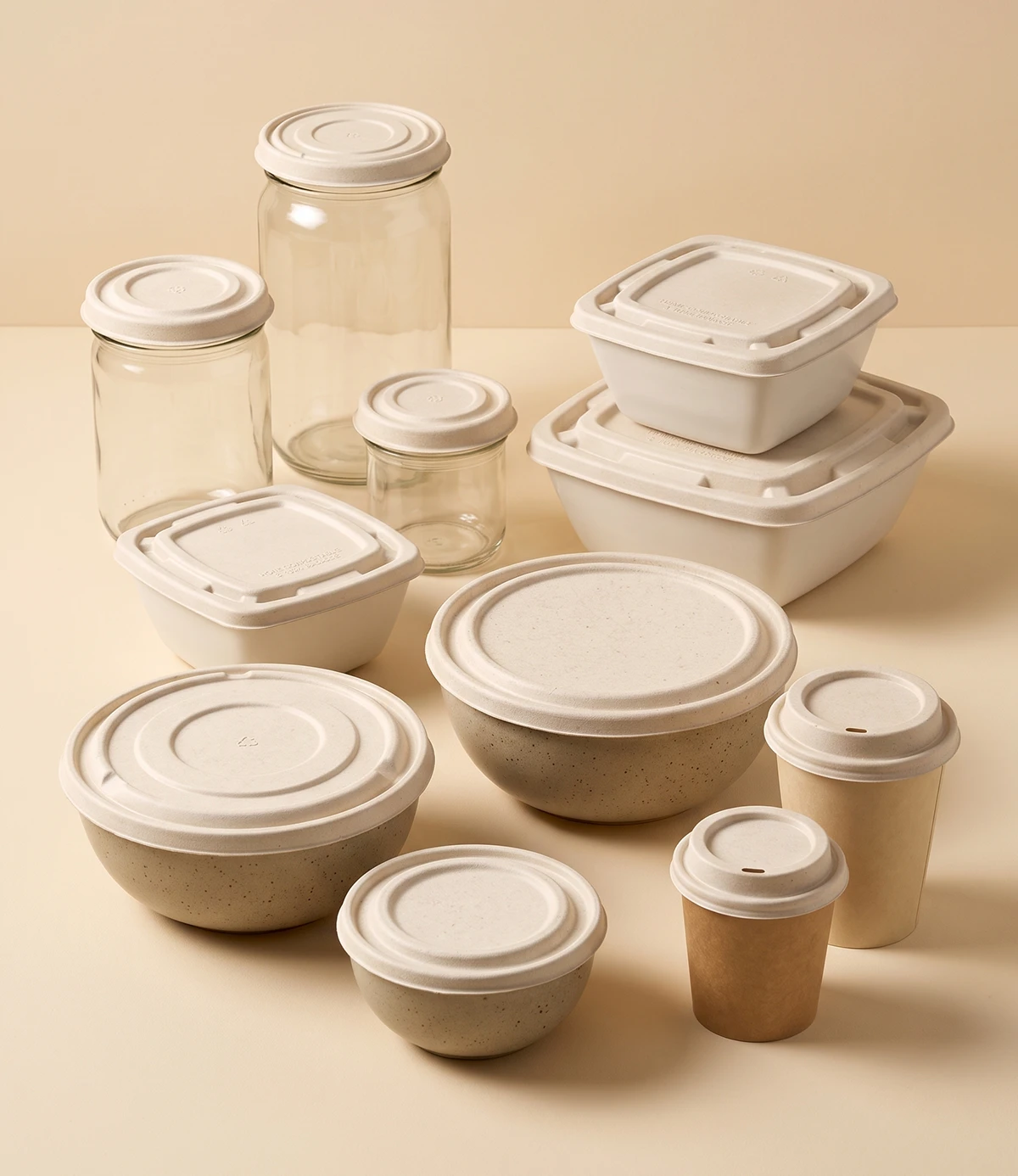
- Glass and ceramic: lids for jars, ramekins and bowls in delis and food-to-go retail.
Compatibility depends on the rim diameter and profile, not on the nominal volume: two containers with the same capacity can need different lids. Test the lid on your container with your food and delivery conditions before ordering in bulk.
How to Source Molded Fiber Lids Wholesale
For cafés, coffee chains, horeca operators and packaging distributors sourcing molded fiber lids at wholesale volume, the key evaluation criteria are certification, compatibility, production consistency and logistics.
What to Look for in a Wholesale Supplier
- EN13432 certification documentation — verify that certification is current and covers the specific lid format and size range you are ordering, not just the material category
- Dimensional consistency — request production tolerance specifications and verify against your existing cup rim measurements
- Sample availability — any reliable wholesale supplier provides samples for compatibility testing before bulk orders
- Production capacity — for high-volume accounts, confirm that the supplier can meet peak order volumes consistently across the season
- Compliance documentation — EU importers need the food contact Declaration of Compliance and, for any compostability claim, the certificate covering the exact format; from 27 September 2026, Directive (EU) 2024/825 tightens the rules on environmental claims, so claims in customer communication must be backed by documents
- PFAS-free evidence — for barrier-treated lids, ask for laboratory test results confirming the barrier contains no PFAS
- Lead times — confirm standard and expedited lead times for your market, particularly for operations with seasonal volume peaks
MOQ and Pricing Structure
Minimum order quantities depend on format, size and print, and Ekoroll quotes them per project. Custom sizes, specialty finishes or private label printing usually require higher quantities. Ask your supplier for the volume tiers at which pricing changes.
Combined Cup and Lid Supply
For operations sourcing both cups and lids, sourcing from a single wholesale supplier simplifies procurement logistics, ensures dimensional compatibility between cup and lid specifications, and consolidates certification documentation for compliance purposes. Ekoroll supplies both molded fiber lids and water-based coated paper cups wholesale from a single source.
Molded Fiber Lids in a Plastic-Reduced Cup System
Molded fiber lids address the plastic lid component of a takeaway cup system. For operations building a plastic-reduced cup solution, the lid is one of two key material decisions — the other is the cup body lining.
Most paper cups on the market, including many marketed as sustainable or eco-friendly, use PE (polyethylene) or PLA (polylactic acid) lining in the cup body to make them liquid-resistant. PE is a fossil-derived plastic. PLA is a bio-based plastic. Both prevent the cup from being recycled in standard paper streams and have been documented to release microplastic particles into hot beverages during use.
A plastic-reduced cup system needs both a plastic-free molded fiber lid (or no lid at all) and a cup body without PE or PLA lining. The two routes to achieving this are:
- Molded fiber lid + water-based coated cup body — two components: a plastic-free fiber lid and a cup body with a water-based, PFAS-free, PE-free coating, sourced together as a compatible system
- Lid-free cup with water-based coating — single component, no PE lining and no separate plastic lid required
For operations where a separate lid is operationally required or preferred, the molded fiber lid combined with a water-based coated cup body removes both the plastic lid and the PE lining. For operations ready to simplify to a single SKU, the lid-free cup eliminates the lid component entirely.
Wholesale Molded Fiber Lids for Cafés and Horeca
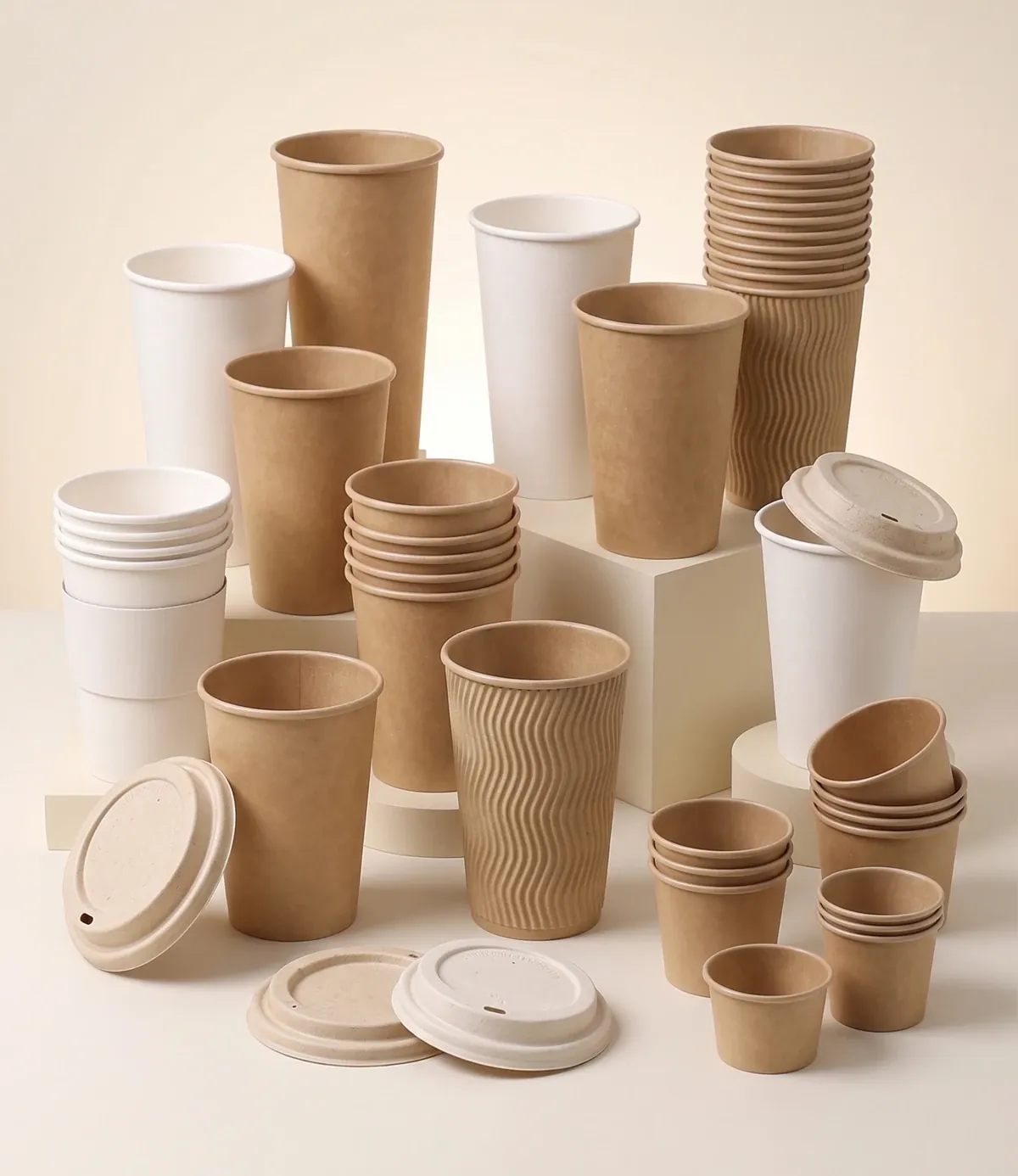
Ekoroll supplies molded fiber lids wholesale to cafés, coffee chains, restaurants, delivery operators and horeca distributors across Europe. They are plastic-free fiber lids made from 100% fiber, for paper cups, food containers and glass or ceramic jars and bowls, each matched to the rim it closes, plain or embossed. They pair with our bagasse food containers and water-based coated paper cups. Compostability and food-contact documentation according to the final product specification and production route; samples and quotes on request through our contact page.
Products in this article
Sources
- Directive (EU) 2019/904 on the reduction of the impact of certain plastic products on the environment — EUR-Lex
- Regulation (EU) 2025/40 on packaging and packaging waste (PPWR) — EUR-Lex
- Regulation (EC) No 1935/2004 on materials intended to come into contact with food — EUR-Lex
- Directive (EU) 2024/825 on empowering consumers for the green transition — EUR-Lex
- Commission Guidelines on single-use plastic products in accordance with Directive (EU) 2019/904 — EUR-Lex
- Plastic Packaging Tax — GOV.UK (HM Revenue & Customs)
- Ley 7/2022 de residuos y suelos contaminados para una economía circular — Boletín Oficial del Estado
- Einwegkunststofffondsgesetz (EWKFondsG) — Bundesministerium der Justiz