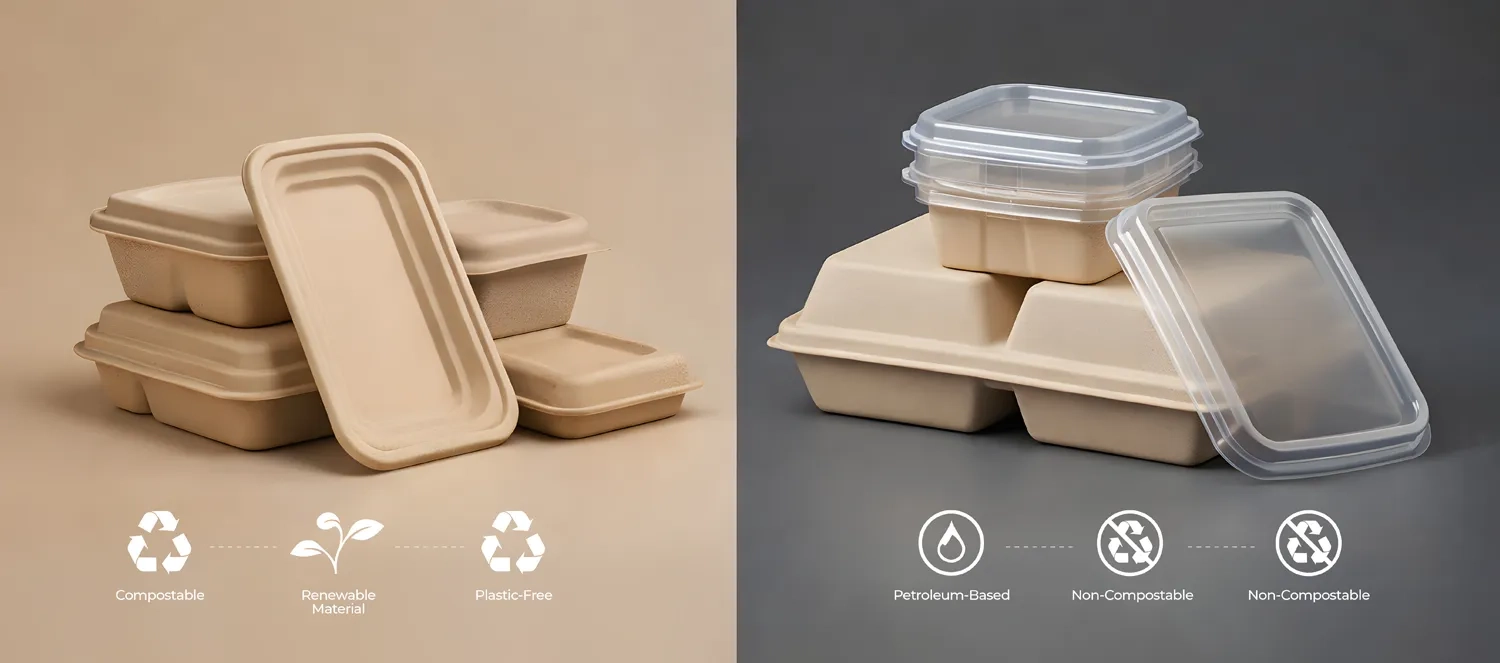
Molded fiber lids are now the primary sustainable alternative to plastic lids for food containers, takeaway boxes and beverage cups across European food service. For restaurants, horeca distributors and food delivery operations evaluating the switch, the practical questions are the same: how do they perform under real food service conditions, how do they compare on cost when regulatory factors are included, what formats and sizes are available, and what does the transition actually involve?
This guide provides a complete comparison of molded fiber lids vs plastic lids for food service procurement — covering material properties, performance, regulatory status, cost structure and sourcing guidance. For the specific comparison of plastic lid alternatives for beverage cups (including lid-free cups), see: Plastic Lid Alternatives for Coffee Cups.
For wholesale supply, explore Ekoroll molded fiber lids.
The Core Difference: Fiber vs Plastic Lids
For a full primer on what molded fiber lids are and how they're made, see our complete molded fiber lids guide. This article focuses specifically on the comparison with plastic lids for food service operations.
Molded fiber lids are food packaging components manufactured from plant fiber pulp — typically sugarcane bagasse, wheat straw, bamboo fiber or recycled paper pulp. The pulp is pressed into shape under heat and pressure, creating a rigid, form-stable lid that fits onto compatible food containers, takeaway boxes and cups.
Manufacturing Process
The molded fiber manufacturing process involves:
- Preparing the plant fiber pulp by mixing fiber material with water to create a slurry
- Forming the lid shape by pressing the slurry into a mold under heat and pressure
- Drying the formed lid to remove moisture and achieve structural rigidity
- Quality control inspection for dimensional consistency and surface integrity
No plastic is added in this process. The resulting lid is entirely plant-based, compostable and free from petroleum-derived materials.
Fiber Sources
The most common fiber sources for molded fiber lids are:
- Sugarcane bagasse: the fibrous residue remaining after sugar extraction from sugarcane. Bagasse is a high-volume agricultural byproduct that would otherwise be burned or discarded — using it for packaging avoids additional raw material extraction. Bagasse fiber produces strong, heat-resistant lids with good dimensional stability.
- Wheat straw: agricultural residue from wheat harvest. An abundant byproduct with good fiber properties for molded packaging applications.
- Recycled paper pulp: post-consumer or post-industrial paper fiber. Reduces virgin material use but may have variable fiber quality depending on source.
Surface Treatment Options
Molded fiber lids are available in untreated and surface-treated versions:
- Untreated (natural fiber surface): suitable for dry and lightly moist food applications. Not suitable for high-liquid or high-oil content applications without additional barrier treatment.
- Water-based barrier treated: a water-based coating applied to the food-contact surface provides oil and moisture resistance for demanding applications including soups, curries and sauced dishes. PFAS-free versions available — verify with supplier documentation.
- PLA-coated: a bio-based plastic coating providing liquid resistance. Still compostable under EN13432 industrial conditions but introduces bio-plastic content. Not recyclable in standard paper streams.
Molded Fiber Lids vs Plastic Lids: Full Comparison
| Feature | Molded Fiber Lids | PP Plastic Lids | PET Plastic Lids |
|---|---|---|---|
| Material source | Plant fiber (bagasse, wheat straw, recycled pulp) | Petroleum-derived PP plastic | Petroleum-derived PET plastic |
| Plastic content | None | 100% plastic | 100% plastic |
| EU SUP Directive status | Compliant — not plastic | Subject to tethered lid requirement (from July 2024) and EPR | Subject to tethered lid requirement and EPR |
| EU tethered lid requirement | Not applicable — not plastic | Must be tethered to cup (beverage cups) | Must be tethered to cup (beverage cups) |
| Plastic packaging tax | None | Applies in UK, ES, IT, DE, FR, PT | Applies in UK, ES, IT, DE, FR, PT |
| EPR obligation | None or significantly reduced | Yes — contribution levies apply | Yes — contribution levies apply |
| Compostable (EN13432) | Yes — industrial composting | No | No |
| Recyclable | Yes — via food waste / compost stream | Rarely — food contamination prevents recycling | Rarely — food contamination prevents recycling |
| Heat resistance | Good — up to approximately 90 to 95°C | Good — PP stable to 120°C | Limited — PET softens under sustained heat |
| Microwave safe | Yes — no metal, no plastic | Depends on PP grade | Generally not recommended for microwave |
| Grease resistance | Good with barrier treatment; moderate untreated | Excellent | Excellent |
| Liquid containment | Good — some moisture transfer possible under sustained contact | Excellent | Excellent (clear versions allow food visibility) |
| Food visibility | Opaque — food not visible through lid | Opaque (PP) or translucent | Clear — food visible through lid |
| Stackability | Good | Excellent | Excellent |
| Brand sustainability signal | Strong — visible natural fiber aesthetic | Negative — visible plastic | Negative — visible plastic |
| Unit cost at wholesale | Moderate — typically 20 to 40% above equivalent plastic | Lower | Lower to moderate |
| Total cost in plastic-tax EU markets | Competitive — no plastic tax, no EPR | Higher — plastic tax plus EPR | Higher — plastic tax plus EPR |
Performance Under Real Food Service Conditions
Performance is the most common concern when evaluating molded fiber lids. The honest answer is that fiber lids perform well for the large majority of food service applications — with specific limitations that are important to understand for demanding use cases.
Hot Food Applications
Molded fiber lids from bagasse or wheat straw fiber are naturally heat-resistant and handle hot food applications up to approximately 90 to 95°C without structural degradation. This covers the full range of standard hot takeaway applications: hot meals, soups and warm dishes served at normal serving temperatures. The fiber construction is inherently non-heat-conducting, which means the lid exterior does not become hot to the touch the way a plastic lid on a hot container might. This is particularly relevant for delivery conditions where customers handle lids directly.
Cold Food and Refrigerated Applications
Molded fiber lids handle cold food applications well, including refrigerated storage at normal refrigerator temperatures. Fiber is not affected by cold temperatures in the way that some plastics can become brittle at low temperatures. For applications where containers will be refrigerated after packing, molded fiber lids provide reliable performance.
Grease and Oil Resistance
Untreated molded fiber lids provide moderate grease resistance suitable for lightly oily foods. For high-oil content applications — fried food, oil-heavy curries, fatty meats — a barrier-treated fiber lid is required to prevent oil penetration through the fiber. Verify the barrier treatment specification with your supplier and test with your specific high-oil food items before bulk ordering. A barrier-treated bagasse fiber lid handles most food service grease applications reliably.
Delivery and Transit Performance
Molded fiber lids maintain structural integrity under standard delivery bag stacking conditions across typical delivery times of 20 to 40 minutes. The fiber structure resists compression deformation better than some thin plastic lids. For high-stack delivery configurations, test with your actual delivery setup before committing to bulk orders.
Where Plastic Lids Still Have Performance Advantages
Honest assessment: there are specific performance dimensions where conventional plastic lids outperform fiber alternatives:
- Transparent food visibility: clear PET lids allow customers to see the food contents through the lid. Fiber lids are opaque. For applications where food visibility is commercially important — salad bars, poke bowl operations, fresh food retail — clear PET lids have a genuine presentation advantage that fiber lids cannot replicate.
- Liquid-tight seal under prolonged contact: for high-liquid applications where the lid is in contact with liquid for extended periods (more than 30 to 45 minutes), some moisture transfer through fiber is possible. Barrier-treated fiber lids reduce this significantly but do not fully match the liquid-tightness of sealed plastic lids under prolonged contact.
Format and Size Compatibility
Molded fiber lids are available in formats compatible with standard food service container sizes. The key compatibility factors are:
Container Compatibility
Molded fiber lids are primarily designed for use with:
- Bagasse food containers: fiber-to-fiber compatibility provides a complete plastic-free container and lid system. The most common wholesale configuration for sustainable horeca packaging. Explore: bagasse food containers
- Kraft paper bowls: fiber lids compatible with kraft paper bowl rim profiles provide a complete paper and fiber system
- Takeaway boxes: fiber lids for standard takeaway box formats. Explore: takeout boxes
- Beverage cups: fiber lids for standard café cup rim sizes as a non-plastic cup lid alternative
Size Ranges
Standard molded fiber lid size ranges cover:
- Small container lids: 350ml to 500ml container formats
- Medium container lids: 500ml to 750ml container formats
- Large container lids: 750ml to 1,000ml container formats
- Beverage cup lids: 8oz, 12oz and 16oz cup formats
Confirm specific size compatibility between the lid format and your container with your supplier before ordering. Dimensional tolerance between lid rim and container rim determines snap-fit quality — test with samples before bulk ordering.
Cost Analysis: Fiber Lids vs Plastic Lids in EU Markets
The cost comparison between molded fiber lids and plastic lids in EU markets is more favorable for fiber lids than unit price comparison alone suggests.
Unit Price Comparison
Molded fiber lids carry a unit cost premium of approximately 20 to 40 percent over equivalent plastic lid formats at comparable wholesale volumes. This is the starting point — and the number that most cost comparisons stop at.
Plastic Packaging Tax Saving
In the UK, Spain, Italy, Germany, France and Portugal, plastic packaging taxes apply to plastic lids as plastic-containing packaging. At applicable rates, a standard plastic container lid weighing approximately 5 to 8 grams carries €0.002 to €0.004 in plastic tax per unit. At 10,000 lid units per month in Spain, this is approximately €15 to €30 per month in plastic tax eliminated by switching to fiber lids.
EPR Cost Saving
EPR contribution obligations for plastic lid formats in EU markets add further cost that does not apply to EN13432 certified compostable fiber alternatives. For operations placing plastic packaging on multiple EU markets, EPR savings across markets can be significant over an annual horizon.
Net Cost Position
When plastic taxes and EPR costs are properly included in the comparison, the effective cost premium of molded fiber lids over plastic lids in plastic-tax EU markets is typically 10 to 20 percent of unit cost rather than the 20 to 40 percent unit price difference. At high monthly volumes in multiple EU markets, this net premium approaches cost-neutral for many operations.
Sourcing and Certification Requirements
For professional food service procurement, molded fiber lids require specific documentation to support both compliance and sustainability claims.
- EN13432 certification: confirms industrial compostability. Must be issued by an accredited certification body (TÜV Austria or DIN CERTCO) for the specific lid format — not a blanket certification for the supplier's product range. Required for any compostability claims in customer communications, particularly under the Green Claims Directive from 2026.
- EC 1935/2004 Declaration of Compliance: confirms the lid meets EU food contact material safety requirements. Required for all food contact packaging placed on EU markets.
- PFAS-free documentation: for barrier-treated fiber lids, confirm PFAS-free status of the barrier treatment with third-party laboratory test results. Some barrier treatments historically used PFAS compounds. This is particularly important for operations making "chemical-free" or "PFAS-free" claims about their packaging.
- MOQ: 5,000 units for standard plain formats, 10,000 units for custom printed or branded formats.
Wholesale Molded Fiber Lids for Food Service Operations
Ekoroll supplies molded fiber lids wholesale to restaurants, takeaway operations and horeca distributors across Europe. EN13432 certified compostable, no plastic content, compatible with bagasse containers and standard food service formats. Factory-direct from Turkey. MOQ from 5,000 units. Full certification documentation available on request.
Frequently Asked Questions
Yes. Molded fiber lids from bagasse or wheat straw fiber handle hot food applications up to approximately 90 to 95°C without structural degradation — covering the full range of standard hot takeaway applications. For high-oil content dishes (fried food, oil-heavy curries), specify barrier-treated fiber lids and confirm the barrier treatment specification with your supplier. Test with your specific food items under your actual delivery conditions before bulk ordering. The fiber construction is naturally non-heat-conducting, so the lid exterior does not become hot to the touch during normal delivery conditions.
No. The EU tethered lid requirement (from July 2024) applies specifically to plastic cup lids — it requires that plastic lids on single-use beverage cups be physically attached to the cup rather than being separate, detachable items. Molded fiber lids are not plastic. The tethered lid requirement does not apply to them. They can continue to be used as separate, snap-on lids without any compliance modification or redesign. This is one of the most immediate practical compliance advantages of molded fiber lids for operations currently using separate plastic cup lids.
No. Molded fiber lids are opaque — food is not visible through the lid. This is a genuine difference from clear PET plastic lids, which allow customers to see food contents. For operations where food visibility through the lid is commercially important — salad bars, poke bowl concepts, fresh food retail — clear plastic lids or a clear window cut into the packaging may be needed for those specific applications. For most hot food delivery, meal box and standard takeaway applications, opacity does not affect the customer experience or purchasing decision. Assess whether food visibility through the lid is actually important for your specific menu before treating opacity as a disqualifying limitation.
Three certifications are essential for professional EU market procurement. First, EN13432 certification from TÜV Austria or DIN CERTCO for the specific lid format — this confirms industrial compostability and is required for any compostability claim in customer communications or procurement documentation. Second, EC 1935/2004 Declaration of Compliance confirming the lid meets EU food contact material safety requirements. Third, for barrier-treated fiber lids, PFAS-free laboratory test results from an ISO 17025 accredited laboratory confirming the barrier treatment does not contain PFAS compounds. A supplier unable to provide all three documents for their specific product is not adequately documented for professional EU market procurement.
Molded fiber lids are designed to be compatible with standard food service container formats including bagasse food containers, kraft paper bowls and standard takeaway boxes. Compatibility is determined by the lid rim diameter and profile matching the container rim — not all fiber lids fit all containers even when the volume size appears similar. Before ordering bulk quantities, test the specific lid format with your specific container to verify snap-fit quality, closure security and structural stability under your food type and delivery conditions. Most qualified suppliers can provide samples for compatibility testing before bulk orders are placed.