Paper cup size selection is one of the most operational decisions a café or coffee chain makes — and one of the most under-analyzed. Most cafés inherit their cup size range from their first supplier conversation and never revisit it systematically. The result is often too many sizes creating unnecessary SKU complexity, or not enough sizes creating portion and pricing compromises.
This guide covers paper cup sizes for coffee shops from an operational perspective: the standard size reference, which sizes to use for which beverages, how to build a size range that works for your specific menu and service model, and how to plan your SKU range to minimize procurement complexity without limiting your menu flexibility. For the wholesale procurement guide covering coating specifications and EU compliance, see: Disposable Paper Cups: Complete Guide for Food Service Operations.
The Standard Paper Cup Size Reference
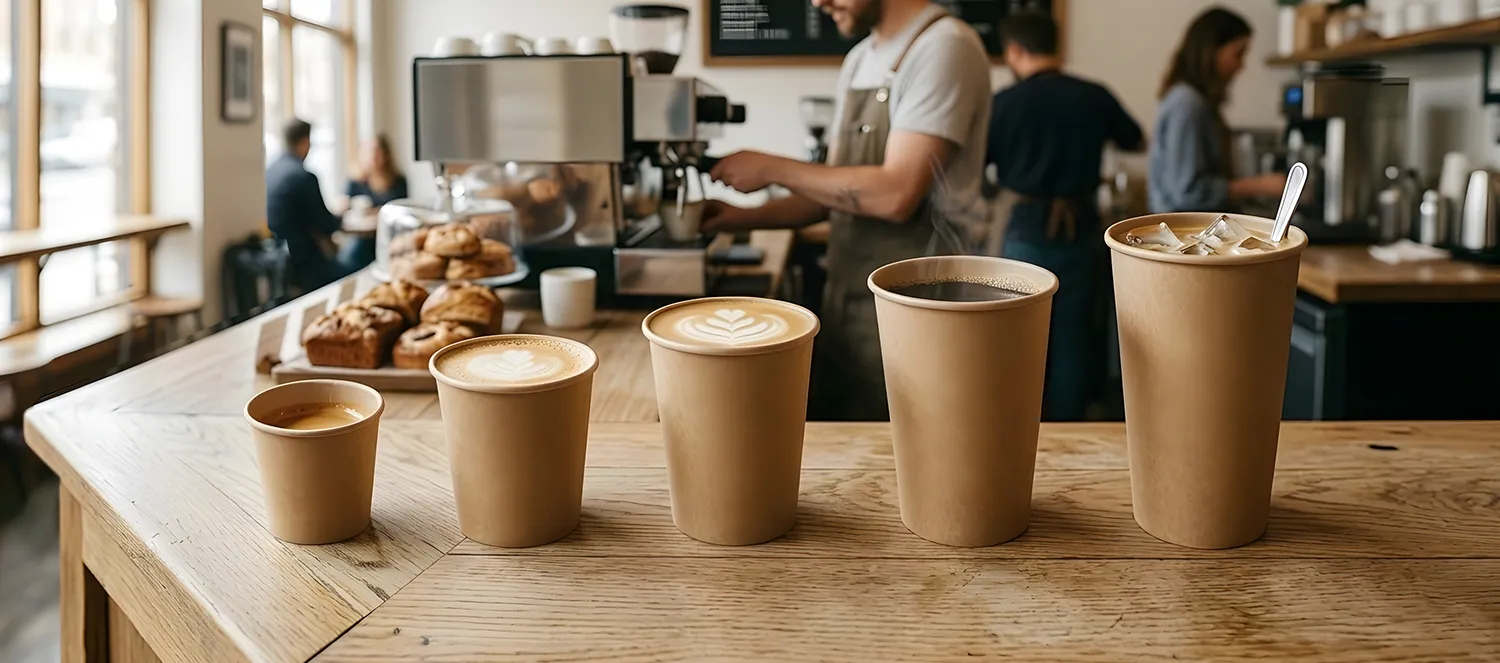
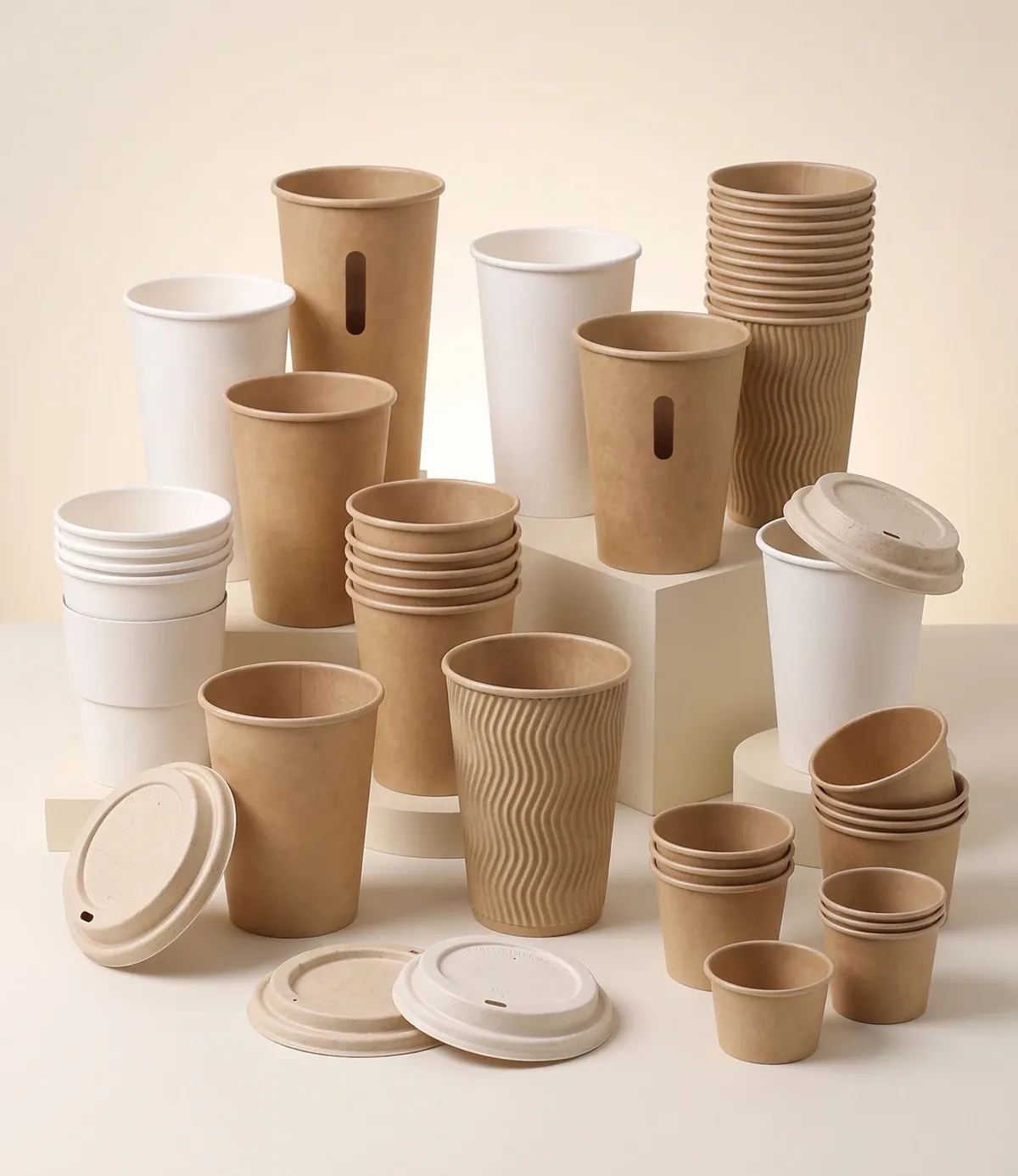
Paper cups are sized in fluid ounces (oz), with milliliter equivalents. The industry uses oz sizing universally — even in metric markets, suppliers quote oz and buyers order by oz. Understanding the oz-to-ml conversion and the typical application for each size is the starting point for cup size selection.
| Size | Volume (ml) | Typical Beverage Applications | Wall Construction |
|---|---|---|---|
| 4 oz | 118ml | Espresso, doppio, ristretto, sampling | Single wall adequate — short consumption time |
| 6 oz | 177ml | Cortado, piccolo latte, macchiato, flat white (small) | Single wall or double wall depending on serving temperature |
| 8 oz | 237ml | Flat white, cappuccino (standard), small latte, filter coffee (small) | Double wall recommended for hot beverages without sleeve |
| 10 oz | 296ml | Medium latte, americano (standard), hot chocolate | Double wall recommended |
| 12 oz | 355ml | Large latte, standard americano, standard filter coffee, medium cold brew | Double wall for hot; cold cup construction for iced beverages |
| 16 oz | 473ml | Large latte, large americano, large cold brew, standard iced coffee | Double wall for hot; cold cup for iced |
| 20 oz | 591ml | Extra large iced beverages, large smoothies, travel coffee | Cold cup or insulated format |
| 22–24 oz | 650–710ml | Large format iced drinks, blended beverages, specialty cold | Cold cup with dome lid accommodation |
Hot vs Cold Cup Construction: Why It Matters
Cup size and cup construction are two separate decisions that are made together. The same 12oz volume can be served in a hot cup or a cold cup — and these are different products requiring different specifications.
Hot Cup Construction
Hot cups are designed for beverages served at 60°C to 90°C. The key construction requirements are:
- Double wall for hand comfort without a separate sleeve — single wall cups require a sleeve for comfortable handling of beverages above approximately 55°C
- Water-based or PE coating rated for sustained hot liquid contact — the coating determines recyclability, plastic tax status and PFAS compliance as well as functional performance
- Structural integrity under sustained hot liquid contact — PE-lined cups can soften at the cup wall under prolonged contact with very hot liquids; water-based coated or bagasse alternatives maintain structure better
Cold Cup Construction
Cold cups are designed for iced beverages, cold brew, smoothies and other beverages served below approximately 10°C. The key construction requirements are:
- Condensation resistance — the exterior of a cold cup should not become wet when holding an iced beverage; look for cup constructions with exterior moisture barrier
- Structural stability with ice — cups containing ice experience temperature differential between the ice and the ambient environment; the cup wall and base need to maintain integrity under this differential
- Straw compatibility — cold beverages are often served with straws; confirm straw hole punch compatibility with the specific lid format you are using
The Lid-Free Option for Both
Lid-free cups are available in both hot and cold formats. They remove the separate plastic lid and simplify the SKU structure (one product instead of cup-plus-lid) across both hot and cold applications. See: Lid-Free Paper Cups: Wholesale Guide. Explore: lid-free hot cups and lid-free cold cups.
Building Your Size Range: The Right Number of SKUs
The most common cup size mistake in coffee shop operations is carrying too many sizes. Every additional cup size in your range is a separate procurement SKU requiring its own MOQ management, its own storage space, its own reorder cycle and its own stock-out risk. The goal is the minimum number of sizes that cover your full menu with appropriate portions — not the maximum flexibility.
The Minimum Viable Size Range by Operation Type
Espresso Bar (No Filter Coffee, No Cold Beverages)
Two sizes cover most menus: 4oz for espresso and ristretto formats, 8oz for flat whites and cappuccinos. If you serve larger milk drinks, add a 12oz. Three SKUs maximum for a well-defined espresso bar menu.
Standard Café (Espresso + Filter + Cold Beverages)
Three to four sizes: 4oz for espresso, 8oz for small milk drinks and flat whites, 12oz for standard lattes and filter coffee, 16oz cold cup for iced beverages. This covers the vast majority of standard European café menus without unnecessary size complexity.
Coffee Chain (Standardized Menu, Multiple Locations)
Three sizes mapped to your specific size naming convention (small/medium/large or equivalent). The key discipline is ruthless alignment: every menu item is assigned to one of the three sizes with no exceptions. This is operationally simpler and more scalable than multi-size systems, and it simplifies procurement significantly across multiple locations.
Takeaway-Focused Operation (Delivery + Walk-In)
Four sizes: 8oz hot, 12oz hot, 16oz cold (for standard iced beverages), 20oz cold (for large iced and blended). The larger cold cup sizes are important for delivery because iced beverages in under-sized cups have less headroom buffer and are more prone to spill during transit.
When to Add a Size
Add a cup size to your range only when a significant portion of your menu (more than 10 to 15 percent of volume) cannot be served appropriately in your existing sizes. Do not add sizes for edge cases or for infrequent menu items — the SKU complexity cost is not worth the marginal flexibility.
Cup Size and Beverage Recipe Alignment
Cup size selection must be aligned with your beverage recipes — not just with approximate volumes. This section covers the alignment principles for the most common espresso-based beverages.
Espresso-Based Hot Beverages
Flat White (standard: 150 to 180ml)
Use 6oz or 8oz. A flat white in a 12oz cup will require disproportionate milk volume to fill the cup, changing the drink ratio and flavor profile. If you only carry 8oz and 12oz, serve flat whites in 8oz with a defined milk-to-espresso ratio rather than stretching to fill a larger cup.
Cappuccino (standard: 150 to 200ml)
Use 6oz or 8oz. Traditional cappuccino is a smaller drink — serving it in a 12oz cup produces a diluted, excessively milky result that most espresso-trained customers will notice. 8oz is the standard takeaway cappuccino size across most European café operations.
Latte (standard: 250 to 350ml)
Use 8oz for small, 12oz for standard, 16oz for large. The 12oz is the industry standard takeaway latte size — it accommodates a double shot with 250 to 270ml of milk and appropriate headroom. 16oz provides room for an extra shot or larger portion without the cup looking underfilled.
Americano (standard: 200 to 350ml)
Use 8oz for small, 12oz for standard. Americanos are typically more variable in volume than milk drinks because customers specify hot water quantity preferences. 12oz provides adequate flexibility for most hot water additions without requiring an oversized cup.
Filter Coffee (standard: 250 to 350ml)
Use 12oz as the standard. Filter coffee is typically served in a single serving volume of 250 to 300ml — 12oz provides appropriate headroom. If you serve filter coffee in large format (350ml+), 16oz accommodates this without overfilling risk.
Cold Beverage Sizing
Iced Coffee (Iced Americano, Iced Latte)
Use 12oz minimum, 16oz recommended. Ice occupies approximately 30 to 40 percent of the cup volume in standard iced beverage preparation. A 12oz iced latte may contain only 200 to 250ml of actual liquid volume. Many customers associate visual fullness with value — use 16oz for standard iced beverages to ensure visual presentation is adequate.
Cold Brew (served over ice)
Use 12oz or 16oz depending on serving volume. Cold brew is typically concentrated — serving volumes of 150 to 200ml over ice in a 16oz cup provides appropriate visual presentation and room for ice without overflow.
Blended and Smoothie Beverages
Use 16oz or 20oz. Blended beverages expand in volume during blending and require headroom for the foam and blend texture. A 350ml blended smoothie served in a 12oz cup will be at or above the brim — use 16oz minimum for standard blended beverages.
Size Standardization for Multi-Location Operations
For coffee chains and multi-location operations, cup size standardization delivers compounding operational benefits that single-location analysis underestimates.
Procurement Consolidation
Every additional cup size across your location network multiplies procurement complexity. Three sizes at 20 locations means 60 SKU-location combinations to manage. Five sizes at 20 locations means 100. Reducing your range from five sizes to three — which is achievable for most menu structures — reduces procurement management by 40 percent across the network.
Inventory Homogenization
Standardized cup sizes enable inventory transfers between locations during demand spikes or stock-outs. If location A has excess 12oz stock and location B is running low, stock can be redistributed. Format differences between locations eliminate this flexibility.
Staff Training
Fewer cup sizes mean simpler staff training across every location. Staff new to a location already know the cup format from other locations. Quality control — ensuring the right drink goes in the right cup — is simpler with three sizes than with five.
Customer Consistency
Customers moving between your locations receive the same portion in the same cup format. This matters particularly for premium espresso products where the cup-to-drink ratio affects perceived quality.
Cup Size and Pricing Strategy
Cup size selection and pricing are directly connected. The price differential between sizes must justify the cost differential — including cup cost, milk volume, espresso shot count and staff time per serve.
The Standard Three-Size Pricing Structure
Most café operations use a three-size structure (small, regular, large) with price differentials of approximately €0.30 to €0.50 between sizes. This differential covers the additional milk volume and cup cost of larger sizes while providing a pricing tier that customers recognize as logical.
Size Creep and its Cost
A common operational error is introducing larger cup sizes to justify higher price points without the cost analysis to confirm the margin is maintained. Serving a 20oz cup instead of a 16oz requires roughly a quarter more milk — if the price increase does not cover this additional ingredient cost plus the higher cost of the larger cup, the larger size runs at lower margin than the smaller size despite the higher price point. Calculate the total cost per serve for each size before setting price differentials.
Practical SKU Planning for Cup Procurement
Once you have defined your size range, the procurement planning follows directly from your consumption data. For each size in your range:
- Calculate monthly consumption: count actual cups used per month per size — not theoretical based on menu pricing, but actual count from stock depletion records
- Identify your supplier’s minimum order quantity: minimums vary by supplier, format and print; Ekoroll quotes quantities per project. Each size is a separate order line.
- Calculate working order quantity: apply the formula from MOQ in the Packaging Industry to determine the right order size above MOQ for your lead time and buffer stock requirements
- Set reorder triggers: for each size, set a reorder trigger at (monthly consumption × lead time weeks / 4) + buffer stock — this is the stock level at which you place the next order to avoid stock-out before the order arrives
For operations with multiple sizes, synchronize reorder cycles where possible — ordering all sizes in the same shipment reduces logistics cost and procurement administration. See: Horeca Packaging Procurement Guide.
Paper Cups Wholesale: Lid-Free Hot and Cold Formats
Ekoroll supplies lid-free hot cups and lid-free cold cups wholesale to cafés, coffee chains and horeca distributors across Europe. Water-based, PFAS-free, PE-free coating and no separate plastic lid. Available in standard size ranges. Quantities and pricing are quoted per project. Samples available before bulk orders.