Disposable paper cups are one of the most widely procured food service packaging items in European markets — and one of the most consequential to get right. The regulatory environment around paper cups has changed more in the past few years than in the previous two decades. The coating, the lid format, the PFAS status and the recyclability of a paper cup now determine how it is treated under several regulatory frameworks at the same time.
This guide covers everything food service operators, café owners and horeca distributors need to know about disposable paper cups: the types available, how coating technology works and why it matters, the EU regulatory requirements that affect every paper cup format, how to evaluate cups for your specific operation, and what the procurement checklist looks like for professional EU market sourcing.
Types of Disposable Paper Cups
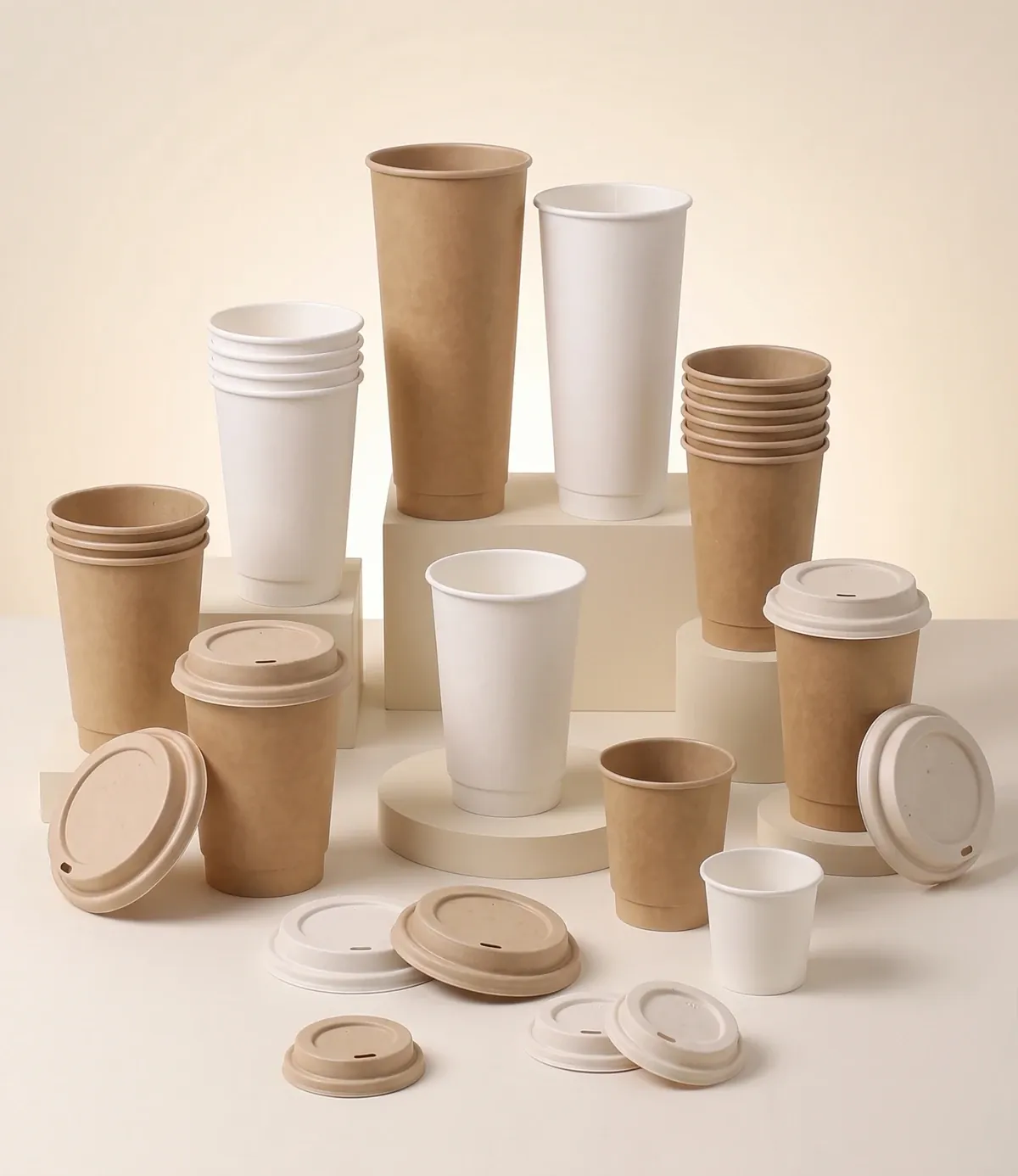
Paper cups for food service are available in several structural formats, each with different performance characteristics, use cases and regulatory implications.
Single Wall Paper Cups
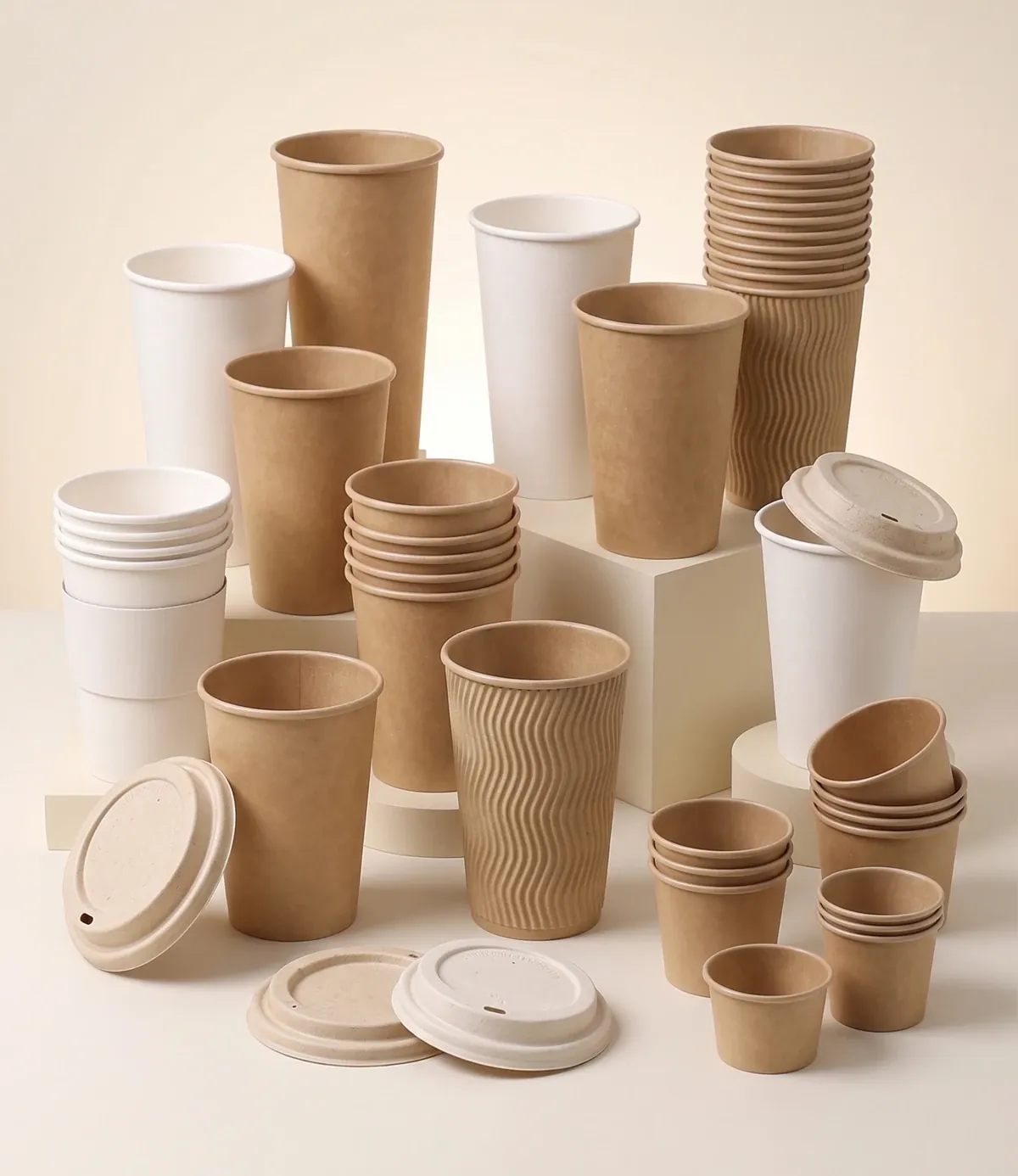
Single wall cups are made from a single layer of coated paperboard formed into a cup shape. They are the most economical cup format and are suitable for cold beverages, room temperature beverages and short-duration hot beverage consumption where heat insulation is not critical.
For hot beverage service, single wall cups typically require a separate paper sleeve to protect the customer’s hand from heat transfer — adding a component, a cost and a SKU to the service system. Without a sleeve, a single wall cup with hot liquid becomes uncomfortable to hold within seconds.
Best for: cold beverages (water, juice, soft drinks), events and high-volume environments where cost minimization is the primary criterion, vending machine applications, and hot beverage service where a sleeve is already part of the service system.
Double Wall Paper Cups
Double wall cups use two layers of paperboard with an air gap between them. The trapped air provides thermal insulation, keeping the cup exterior comfortable to hold without a sleeve even with hot beverages at full serving temperature.
The double wall construction requires more material per cup than single wall, resulting in a higher unit cost than equivalent single wall formats; the difference depends on format, volume and print, and pricing is quoted per project. For premium café operations where sleeve-free service and premium presentation are commercial priorities, double wall cups provide a genuine operational and customer experience advantage.
Best for: hot beverage service in cafés and coffee chains where sleeve-free service is standard, premium takeaway brands where cup quality is a brand signal, and any operation where handling comfort for hot beverages matters without a sleeve.
Lid-Free Cups (Integrated Lid Format)
Lid-free cups have the closure mechanism built directly into the cup wall structure — no separate lid is required. After filling, the barista folds the top of the cup along engineered score lines to create a closure with a drinking aperture. The cup is a single component that eliminates the lid SKU entirely.
Lid-free cups are available in both hot and cold formats. When specified with a water-based, PFAS-free, PE-free coating, they are the most complete low-plastic paper cup format available — no PE lining, no PLA lining, no PFAS, no separate plastic lid — and they are designed for paper recycling where local collection accepts them. With water-based coating, these lid-free cups carry DIN CERTCO home compostable and industrially compostable (EN 13432) certification, held by the producing partner; copies on request. The water-based coated paperboard also passed PPWR (EU) 2025/40 tests for PFAS, total fluorine and heavy metals (lead, cadmium, mercury, hexavalent chromium); the SGS and Eurofins reports are available on request. The recommended fill temperature for the lid-free cups is up to 90 °C.
Best for: cafés and coffee chains targeting verifiable PE-free packaging without a plastic lid, operations in markets where plastic lids carry taxes, levies or reduction measures, and operations wanting maximum SKU simplification.
Explore: lid-free hot cups and lid-free cold cups.
Ripple Wall Paper Cups
Ripple wall cups use a corrugated outer layer bonded to the cup wall to provide thermal insulation. The distinctive ridged exterior is a recognized café aesthetic and provides good hand insulation without a sleeve. Ripple wall cups are typically single-use and made from multiple paper layers including the corrugated outer sleeve bonded during production.
Best for: premium café environments where the ripple aesthetic is part of the brand identity, hot beverage service requiring good insulation without adding a separate sleeve.
Coating Technology: The Most Important Specification Decision
The coating on the food-contact interior surface of a paper cup determines its recyclability, plastic content, food safety profile and regulatory treatment. This is the most important specification decision when sourcing paper cups — more important than wall construction, size or print specification.
PE (Polyethylene) Coating
PE coating is a thin layer of polyethylene plastic bonded to the food-contact interior surface of the cup during production. It is the most widely used cup coating historically because it provides reliable liquid barrier performance and is well understood by cup producers.
PE coating creates significant problems today:
- PE-lined cups are hard to recycle in standard paper streams — the PE film has to be separated from the fiber during pulping, which many paper mills cannot do efficiently
- A PE-lined paper cup counts as a cup made partly of plastic under the EU Single-Use Plastics Directive: it carries the mandatory printed marking and falls under member-state reduction measures and extended producer responsibility for plastic cups (in Germany, also the Single-Use Plastics Fund)
- In Spain, the plastic portion of the cup is subject to the €0.45/kg tax on non-reusable plastic packaging
- Studies have reported microplastic particles released from PE-lined cups into hot water
- PE-lined cups face increasing pressure from the PPWR recyclability criteria that follow in stages from 2028 to 2030
PLA (Polylactic Acid) Coating
PLA coating uses a bio-based plastic derived from plant starch as an alternative to PE. PLA-lined cups are marketed as “compostable” because PLA can break down in industrial composting conditions — this is often the basis for EN 13432 compostability certification for PLA-coated cups.
PLA coating has significant limitations:
- PLA softens at relatively low temperatures (often cited at around 55°C), which can limit PLA-lined cups for very hot beverage service
- Under the European Commission’s 2021 guidelines, bio-based and biodegradable plastics such as PLA count as plastic under the Single-Use Plastics Directive, so PLA-coated cups are treated like other cups made partly of plastic — marking, reduction measures and EPR apply
- PLA-coated cups are hard to recycle in standard paper streams and need industrial composting infrastructure to break down
- PLA requires industrial composting temperatures (typically above 58°C) to break down within the EN 13432 timeframe — home composting is typically insufficient
Water-Based Coating
Water-based coating is a barrier applied to the food-contact surface as a water-based dispersion instead of a laminated PE film. It provides liquid barrier performance comparable to PE for standard hot and cold beverage applications without a PE film.
Water-based coated cups:
- Have no PE film in the cup body
- Are designed for paper recycling where local collection accepts them — the thin coating is processed with the fiber in the pulping step
- Can carry compostability certification for the specific product (the lid-free cups in this guide carry DIN CERTCO home compostable and industrially compostable (EN 13432) certification, held by the producing partner; copies on request)
- Are described as “water-based, PFAS-free, PE-free” — not as plastic-free
- Are available in PFAS-free versions (verify with supplier test documentation)
How a specific water-based coating is treated under the Single-Use Plastics Directive and national plastic taxes depends on its composition, so ask your supplier for written documentation of the coating type. Combined with a lid-free format, water-based coating removes the two most visible plastic components of a conventional cup system — the PE lining and the plastic lid — and gives you specific, documentable claims under Directive (EU) 2024/825.
For a complete technical comparison of coating types, see: Water-Based Coating vs PE Paper Cups.
The PFAS Issue in Paper Cups
PFAS (per- and polyfluoroalkyl substances) in paper cups are a separate issue from the PE vs water-based coating question — and one that is increasingly important for professional procurement.
PFAS have been used historically as a treatment on the paper substrate to provide oil and moisture resistance. A cup can be described as “water-based coated” and still contain PFAS if the paper substrate was PFAS-treated. This means that verifying coating type alone is insufficient — PFAS-free status requires specific laboratory testing of both the paper substrate and the coating.
The regulatory picture: from 12 August 2026, the EU Packaging and Packaging Waste Regulation (PPWR) limits PFAS in food-contact packaging — 25 ppb for any single PFAS (targeted analysis), 250 ppb for the sum of PFAS (targeted analysis) and 50 ppm for total PFAS including polymeric PFAS. Denmark has banned PFAS in paper and board food-contact materials since July 2020. A separate universal PFAS restriction proposal is still being evaluated at the European Chemicals Agency (ECHA), with no adoption date set.
For professional procurement, PFAS-free status requires third-party laboratory test results covering both paper substrate and coating — not a general food contact Declaration of Compliance, which does not address PFAS status. For full detail, see: PFAS-Free Paper Cups Guide.
EU Regulatory Requirements for Paper Cups
Paper cups in European markets are affected by five distinct regulatory frameworks at the same time. Understanding all five is essential for compliant and forward-looking procurement.
1. EU Food Contact Materials (EC 1935/2004)
All food contact packaging including paper cups must meet EU food contact material safety requirements. The supplier must provide an EC 1935/2004 Declaration of Compliance for the specific cup format. This is the baseline legal requirement — a cup without this documentation should not be used for food contact in EU markets.
2. EU Single-Use Plastics Directive (EU) 2019/904
Paper cups that are lined or coated with plastic (including PE and PLA) count as cups made partly of plastic. For these cups and their plastic lids, the Directive requires member-state consumption-reduction measures (Article 4), a mandatory printed marking on the cup (Article 7) and extended producer responsibility (Article 8). Cups made of expanded polystyrene (EPS) are banned (Article 5).
The tethered-cap rule (Article 6, in force since 3 July 2024) is often misapplied to cups. It covers caps and lids of beverage containers up to 3 liters, such as bottles and beverage cartons — not cups. A snap-on plastic lid on a coffee cup does not need to be tethered and is not illegal. The lid does, however, fall under the reduction measures and EPR for plastic cups and lids, which is one reason operators move to lid-free cups or molded fiber lids.
3. Plastic Taxes and Levies
There is no EU-wide plastic tax on companies (the EU plastic own resource of €0.80/kg of non-recycled plastic packaging waste is paid by member states). National measures that matter for cups:
- United Kingdom (not EU): Plastic Packaging Tax since 1 April 2022 on plastic packaging components with less than 30% recycled plastic — £223.69 per tonne from 1 April 2025, £228.82 per tonne from 1 April 2026. It applies to predominantly plastic components such as plastic lids; a paper cup is usually outside it.
- Spain: €0.45/kg tax on non-reusable plastic packaging since 1 January 2023, including the plastic portion of a PE-lined cup and plastic lids.
- Germany: no plastic packaging tax, but producers of plastic cups for beverages and their lids pay into the Single-Use Plastics Fund (Einwegkunststofffonds), based on quantities placed on the market since 2024. Separately, VerpackG licensing fees and LUCID registration apply to all packaging, including paper cups.
- Italy: a €0.45/kg plastic tax has been repeatedly postponed, now to 2027; it is not in force.
- France: no per-kg plastic packaging tax; EPR fees are eco-modulated under the AGEC law.
4. PPWR (EU) 2025/40
The EU Packaging and Packaging Waste Regulation entered into force on 11 February 2025 and applies from 12 August 2026, starting with the PFAS limits for food-contact packaging. Recyclability criteria, harmonized labels and reuse targets follow in stages from 2028 to 2030. PE-lined cups that are hard to recycle at scale face increasing pressure; water-based coated cups are designed for paper recycling where local collection accepts them.
5. Environmental Claims: Directive (EU) 2024/825
From 27 September 2026, Directive (EU) 2024/825 bans generic environmental claims such as “eco-friendly” without recognized excellent environmental performance, product “climate neutral” claims based on offsetting, and sustainability labels not based on certification schemes or set by public authorities. Specific claims need specific evidence: coating-type documentation, PFAS test results and, where compostability is claimed, a certificate covering the specific product. (The separately proposed Green Claims Directive was not adopted.)
Paper Cup Sizes: Standard Reference for Food Service
Paper cups for food service follow standard size conventions measured in fluid ounces (oz) and milliliters (ml). The industry standard sizes cover the full range of beverage service from espresso to large takeaway formats. Milliliter values are approximate (1 US fl oz ≈ 29.6 ml).
| Size | Volume (approx.) | Primary Application | Notes |
|---|---|---|---|
| 4 oz | 120 ml | Espresso, small hot drinks | Sampling, espresso service |
| 6 oz | 180 ml | Small flat white, cortado | Specialty coffee formats |
| 8 oz | 240 ml | Small latte, cappuccino, filter coffee | Most common small café size |
| 12 oz | 355 ml | Medium latte, americano, standard filter | Most common café size overall |
| 16 oz | 470 ml | Large latte, large americano, large cold brew | Standard large size across most chains |
| 20 oz | 590 ml | Extra large takeaway, travel coffee | US-origin sizing, increasingly common in EU |
| 22 oz+ | 650 ml+ | Large iced drinks, smoothies, cold beverages | Cold cup formats primarily |
For a complete café-specific size selection guide, see: Paper Cup Sizes Guide for Coffee Shops.
Comparing Paper Cup Formats: Which Is Right for Your Operation?
| Cup Type | Best For | Coating to Specify | Plastic-specific exposure | Recycling |
|---|---|---|---|---|
| Single wall | Cold drinks, events, budget operations | Water-based for PE-free | PE lining: SUP marking, EPR, Spanish tax; water-based: per coating documentation | Designed for paper recycling if water-based coated |
| Double wall | Hot beverages, premium cafés | Water-based for PE-free | As single wall, plus any plastic lid | Designed for paper recycling if water-based coated |
| Lid-free (integrated lid) | PE-free systems without a plastic lid, SKU simplification | Water-based (built in) | No PE lining, no plastic lid | Designed for paper recycling where local collection accepts it |
| Ripple wall | Premium hot beverage, café aesthetics | Water-based for PE-free | As single wall, plus any plastic lid | Depends on construction |
Wholesale Procurement Checklist
For cafés, coffee chains and horeca distributors sourcing paper cups at wholesale volume, use this checklist to verify supplier qualification before placing bulk orders.
- EC 1935/2004 Declaration of Compliance: for the specific cup format — not a blanket supplier declaration
- Coating type documentation: written confirmation whether coating is water-based, PE or PLA — not marketing language
- PFAS test results: third-party laboratory test results covering both the paper substrate and the coating from an ISO 17025 accredited laboratory, against the PPWR PFAS limits
- Lid format: decide between plastic lids (legal, but subject to SUP reduction measures, EPR and national levies), molded fiber lids or a lid-free format
- SUP marking: for cups lined or coated with plastic, confirm the cup carries the mandatory marking for the markets you sell in
- Recycling statement: for water-based coated cups, a written statement on paper recycling and its conditions
- Compostability certificate: if compostability claims are made — from TÜV AUSTRIA or DIN CERTCO, covering the specific format
- Size range confirmation: confirm all required sizes are available in the specified format and coating
- Sample testing: test with your actual beverages at your serving temperatures before bulk ordering
- MOQ: confirmed per format, size and print specification
Wholesale Disposable Paper Cups: Water-Based Coated, PFAS-Free
Ekoroll supplies disposable paper cups wholesale to cafés, coffee chains and horeca distributors across Europe. Lid-free hot cups and lid-free cold cups with a water-based, PFAS-free, PE-free coating and no separate plastic lid. Supplied from Turkey. MOQ quoted per project. Product documentation available on request.