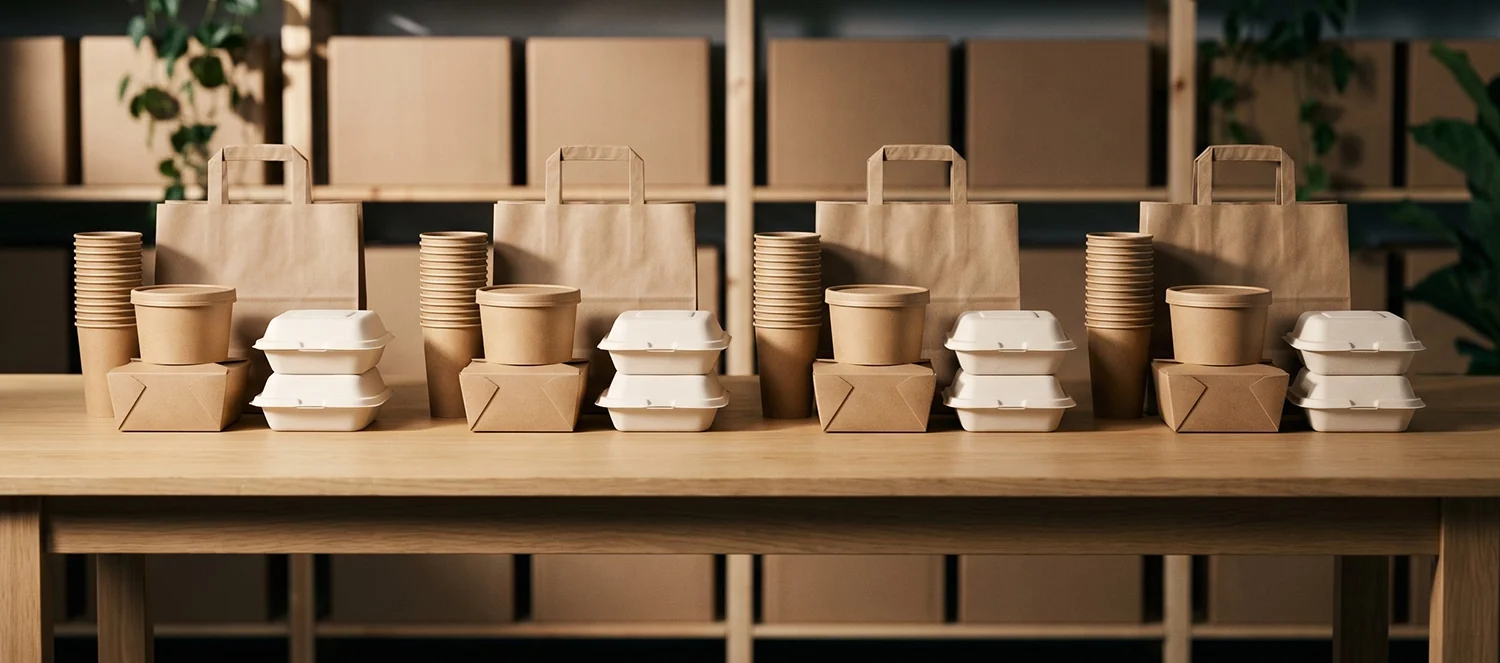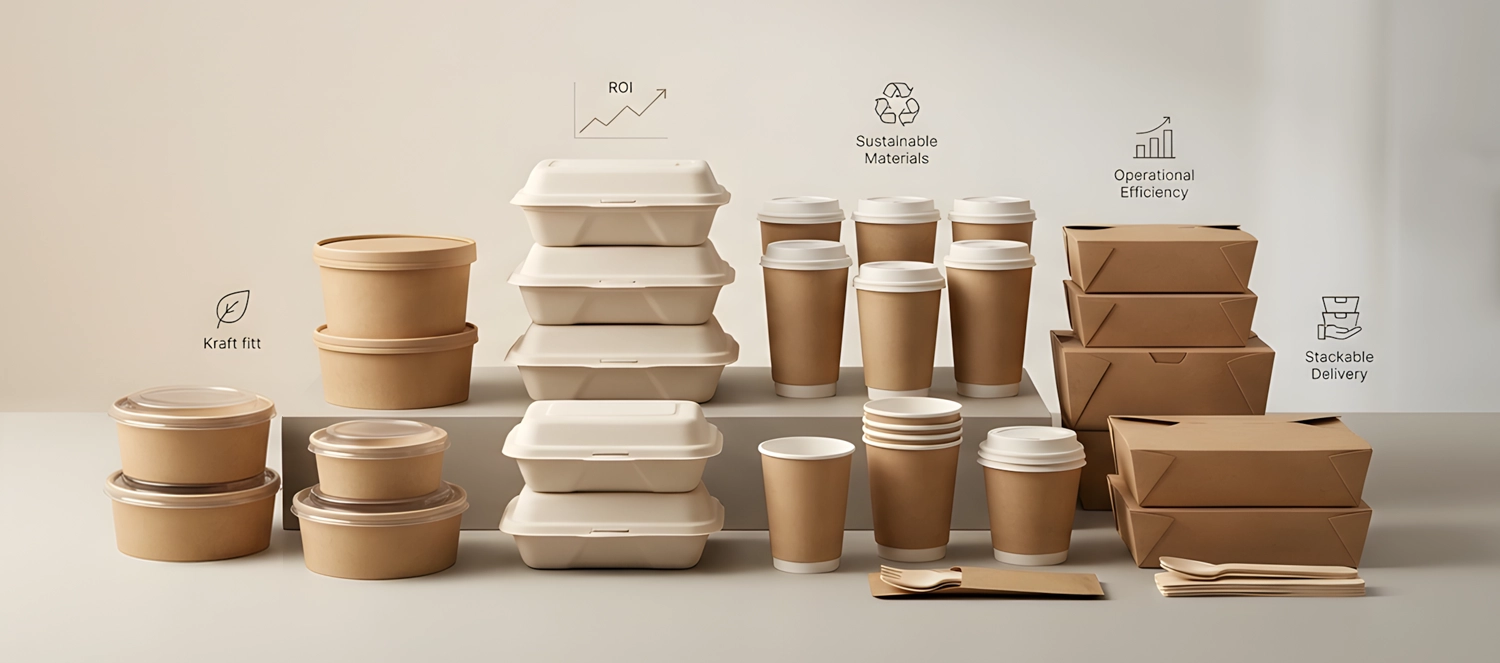

Packaging procurement for horeca operations is one of the most consequential and least systematized purchasing decisions in food service. For restaurant groups, hotel chains, catering operators and horeca distributors, packaging touches every customer interaction, every delivery, every compliance audit and every sustainability communication. Yet most operations still manage packaging procurement the way they managed it in 2015: on price, from familiar suppliers, with minimal documentation, and with no framework for evaluating total operational cost.
The European regulatory environment has fundamentally changed what packaging procurement requires. The EU Single-Use Plastics Directive, national plastic taxes, EPR schemes, the Packaging and Packaging Waste Regulation and the new EU rules on green claims (Directive (EU) 2024/825) have together created a procurement landscape where the wrong purchasing decision is not just suboptimal — it carries legal exposure, compliance cost, brand risk and supply chain vulnerability.
This guide provides a complete, professional framework for horeca packaging procurement: how to structure supplier evaluation, what certifications to require, how to build a cost model that includes all regulatory costs, how to manage multi-market compliance, when to consolidate to a single supplier, and how to future-proof procurement decisions against the EU regulatory timeline through 2030.
For wholesale packaging supply to European horeca operations, explore the Ekoroll packaging range.
What Horeca Packaging Buyers Need to Know
Horeca packaging covers the complete range of food and beverage packaging used across hotels, restaurants and cafés — containers, cups, lids, cutlery and wrapping paper. For buyers sourcing horeca packaging in European markets, the decision has shifted from simple price comparison to a multi-dimensional evaluation covering performance, regulatory compliance, certification and total cost of ownership. This guide provides the complete framework for professional horeca packaging procurement.
The Changed Landscape of Horeca Packaging Procurement
Three structural changes in the past five years have made packaging procurement significantly more complex for European horeca operations — and significantly more consequential to get right.
Regulatory Proliferation
A horeca distributor or multi-location restaurant group operating across five European markets today is navigating a packaging compliance environment that includes the EU SUP Directive (in force since 2021), national EPR schemes in each market (each with separate registration, reporting and contribution requirements, covering all packaging materials), plastic-specific taxes and levies that differ by country (the UK Plastic Packaging Tax, Spain’s plastic packaging tax, Portugal’s per-package contribution, Germany’s Single-Use Plastics Fund), the PPWR (in force since 11 February 2025 and applicable from 12 August 2026), and the green-claims rules of Directive (EU) 2024/825 (applicable from 27 September 2026). Each regulation has a different scope, different compliance timeline and different documentation requirement.
In 2015, packaging compliance for a European horeca operator was primarily a food safety question: does the packaging meet EC 1935/2004 food contact requirements? Today, it is a multi-regulation, multi-market compliance challenge that affects procurement cost, supplier qualification, documentation management and customer communication simultaneously.
Supplier Differentiation
The sustainable packaging market has matured rapidly. Five years ago, the choice between conventional plastic and sustainable alternatives was primarily a cost and availability question. Today, the sustainable packaging supplier landscape ranges from manufacturers with full EN13432 certification, PFAS-free documentation, FSC-certified material sourcing and multi-market EPR compliance expertise, to distributors who have simply relabeled conventional packaging with sustainability marketing language and cannot provide any underlying certification documentation.
For professional procurement, the difference between these two supplier types is not a sustainability question — it is a legal compliance and brand risk question. Procuring packaging described as compostable or recyclable from a supplier who cannot provide EN13432 certification or PFAS-free test results creates direct exposure under the green-claims rules of Directive (EU) 2024/825 from 27 September 2026, and risks incorrect EPR declarations in markets where fees are modulated by material and recyclability.
Procurement Complexity at Scale
As horeca operations scale — multi-location restaurant groups, franchise systems, hotel chains, catering operators supplying corporate accounts — packaging procurement complexity compounds. Fragmented supplier relationships, inconsistent certification documentation, SKU proliferation across locations and incompatible format specifications create procurement administration cost, operational inconsistency and compliance documentation gaps that are invisible at small scale but materially significant at 20, 50 or 100 locations.
Restaurants transitioning to compliant materials can follow our detailed eco-friendly packaging guide for restaurants for a step-by-step framework.
Managing many locations? See packaging standardization for multi-location horeca.
Packaging Procurement Framework: The Five Dimensions
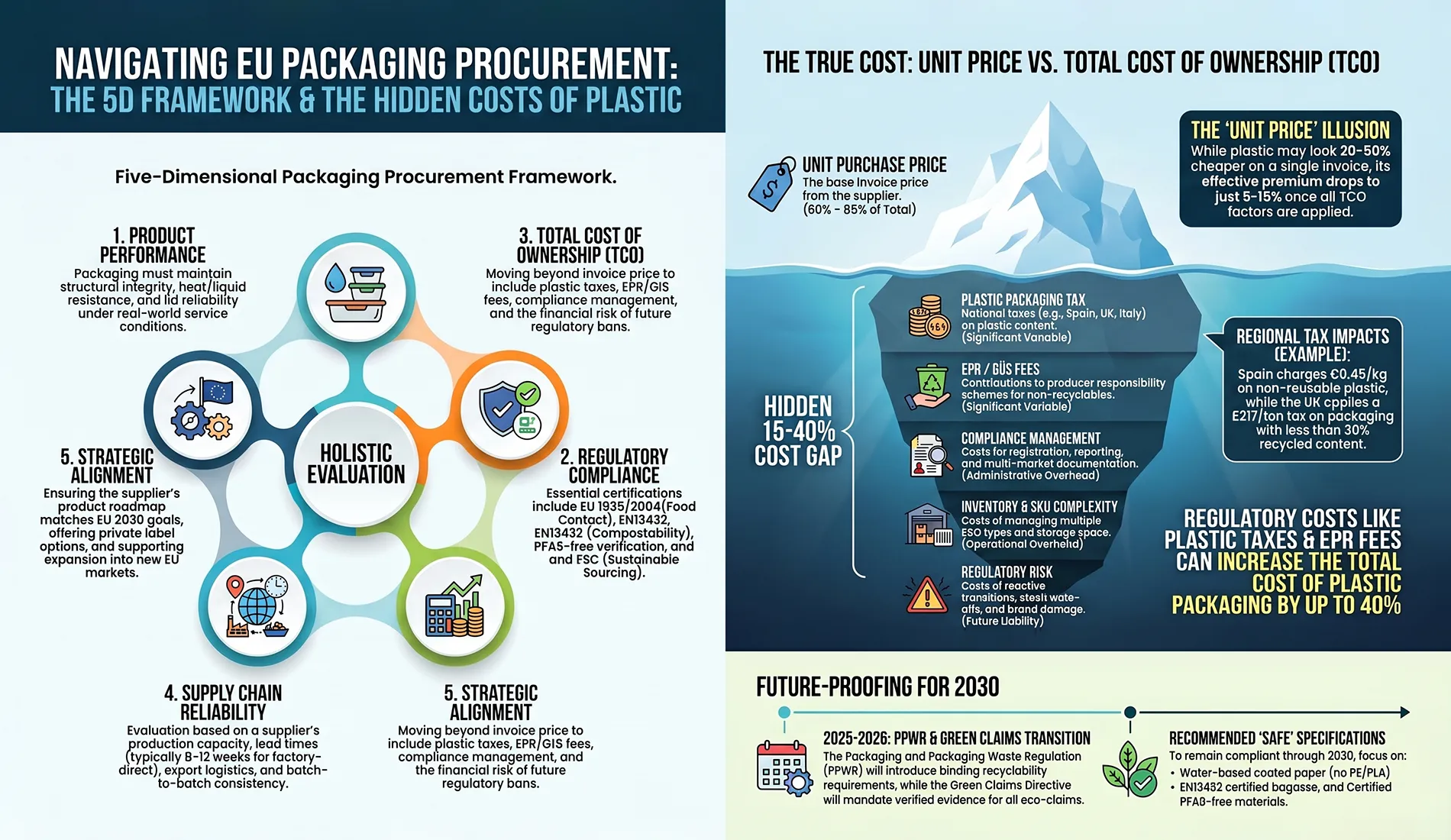
Professional horeca packaging procurement requires evaluation across five dimensions simultaneously. Most operations evaluate on only one or two. The five-dimension framework ensures procurement decisions are robust across all the factors that determine total value.
Dimension 1: Product Performance
The packaging must perform under your actual service conditions — not under ideal conditions or the conditions described in a supplier product sheet. Performance evaluation covers:
- Heat resistance: the temperature range the packaging maintains structural and barrier integrity across, for your specific food types and serving temperatures
- Liquid and grease resistance: barrier performance under your specific menu — high-oil dishes, soups, sauces — for the duration of your longest delivery time or service period
- Structural integrity under stacking: whether the container maintains its shape under realistic delivery bag stacking conditions across your standard delivery distance
- Seal and closure reliability: lid snap-fit reliability, container closure leak prevention, pre-packaged cutlery set seal integrity
- Dimensional consistency: whether the same format from consecutive production batches has the same dimensions, which matters for automated packing stations and standardized bag configurations
Performance evaluation must be conducted with samples under your actual conditions. Supplier performance claims, product datasheets and certification documents describe materials under standard test conditions — not your service conditions. A bagasse container that performs perfectly with rice dishes may behave differently with high-acid tomato-based sauces. A molded fiber lid that snap-fits one manufacturer’s cups may not fit another manufacturer’s nominally identical cup rim size.
Dimension 2: Regulatory Compliance
Regulatory compliance documentation is not a checklist item — it is a continuous obligation that changes as regulations evolve and as your market footprint changes. At minimum, professional horeca packaging procurement requires:
- EU food contact material compliance (EC 1935/2004): a Declaration of Compliance for each specific packaging format in your portfolio. This is the baseline food safety requirement. A supplier who cannot provide this for any format they supply should not be supplying food contact packaging.
- EN13432 certification for compostable claims: if any packaging is described as compostable in your procurement documentation, customer communications or sustainability reporting, the underlying EN13432 certification from an accredited body (TÜV Austria, DIN CERTCO or equivalent) is required. Without it, the claim has no verified substantiation and creates exposure under Directive (EU) 2024/825 from 27 September 2026.
- PFAS-free documentation: for all paper-based food contact packaging — cups, bowls, greaseproof paper, food containers. A general food contact Declaration of Compliance does not confirm PFAS-free status. Specific third-party laboratory test results covering total fluorine screening and targeted PFAS compound analysis of both the paper substrate and any coating are required.
- FSC or equivalent sustainable sourcing certification: for wooden and bamboo cutlery and paper-based packaging where sustainable sourcing claims are made.
- EPR registration documentation: in markets where you are the operator placing packaging on the market, EPR registration documentation confirms you are meeting your legal producer responsibility obligations. EPR covers all packaging, including paper and bagasse (in Germany, for example, VerpackG system participation and LUCID registration); plastic items carry additional SUP-specific obligations.
Dimension 3: Total Cost of Ownership
The total cost of packaging procurement for EU market operations includes six cost elements, of which only one — unit purchase price — is typically included in standard procurement comparison. A professional procurement model includes all six:
- Unit purchase cost: the invoice price per unit at your order volume from your supplier
- Plastic-specific taxes and levies: where they apply in the markets you supply — the UK Plastic Packaging Tax (per tonne), Spain’s per-kilogram tax on non-reusable plastic packaging, Portugal’s per-package contribution on single-use plastic and aluminium meal packaging, Germany’s Single-Use Plastics Fund payments. Italy’s plastic tax is postponed to 2027 and France uses eco-modulated EPR fees instead of a plastic tax
- EPR contribution levies: financial contributions to producer responsibility organizations in each market, based on packaging type and volume placed on the market — higher for non-recyclable formats
- Compliance administration cost: registration, reporting, documentation management and professional advice costs for multi-market EPR compliance — particularly relevant for operations supplying five or more EU markets
- Inventory management cost: SKU complexity cost — the procurement administration, storage space, stock management and reordering cost associated with each additional packaging SKU in your portfolio
- Regulatory risk cost: the expected cost of reactive transition if a packaging format faces future restriction — including stock write-off, premium urgent sourcing and operational disruption during unplanned transition
For operations supplying multiple EU markets, the regulatory cost elements (plastic taxes, EPR levies, compliance administration) can represent a substantial share of the total cost of plastic-containing packaging when properly calculated. This is the cost that most unit-price comparisons miss entirely.
Dimension 4: Supply Chain Reliability
For multi-location operations where packaging is a daily operational necessity, supply chain reliability is a procurement dimension that determines operational risk. Evaluation criteria for supply chain reliability include:
- Production capacity: can the supplier fulfill your peak volume requirements without lead time extension or allocation constraints? Ask for evidence of production capacity for your specific formats at 150 percent of your current volume to allow for growth.
- Lead times: standard lead times for repeat orders, and the lead time for urgent restocking in case of unexpected demand. Understand whether lead times are from production or from stock — and what buffer stock the supplier maintains.
- Export logistics: for suppliers outside your market, export documentation reliability, customs clearance capability and logistics partner stability. A supplier who cannot reliably clear customs in your market is not a reliable supplier regardless of product quality.
- Format consistency across batches: particularly important for operators with automated packing equipment or standardized bag configurations. Dimensional variation between batches creates operational disruption.
- Communication and responsiveness: how the supplier responds to quality issues, urgent requirements and specification changes. This is only evaluable through reference contacts — ask for customer references from operations at comparable scale to your own.
Dimension 5: Strategic Alignment
For multi-location operations with long procurement planning horizons, strategic alignment between your packaging supplier and your business direction matters. Evaluate:
- Whether the supplier’s product development roadmap is aligned with EU regulatory direction — are they actively expanding certified compostable formats, PFAS-free lines and plastic-reduced alternatives?
- Whether the supplier can support your growth into additional EU markets from a single supply relationship
- Whether the supplier offers private label and custom printing capability at the volumes relevant to your scale
- Whether the supplier can provide the compliance documentation your B2B accounts will require — hotel chains, corporate catering accounts, public sector food service tenders
For condiment, sauce and single-serve formats, see our sachet packaging guide.
The Certification Verification Process
Certification claims in sustainable packaging procurement are common. Verified certification is significantly less common. The gap between claimed and verified certification is where green-claims risk, EPR compliance risk and brand exposure accumulate.
How to Verify EN13432 Certification
EN13432 certification must be issued by an accredited third-party certification body — not self-declared by the manufacturer. The primary accredited bodies issuing EN13432 certification in Europe are TÜV Austria (issuing OK COMPOST certification) and DIN CERTCO. The certification document should identify:
- The specific product(s) covered by the certification (by product name, item code or description)
- The certification body and certificate number
- The validity period of the certification
- Which certificate it is: TÜV AUSTRIA OK compost INDUSTRIAL and OK compost HOME are two separate certificates — a product may hold one, the other, or both as separate certificates
Verify that the certification covers the specific format you are procuring — not a similar format or a parent material. Certification is product-specific, not manufacturer-wide.
How to Verify PFAS-Free Status
PFAS-free status requires specific laboratory testing — it is not confirmed by EN13432 certification, FSC certification, or EC 1935/2004 Declaration of Compliance. Verification requires:
- Third-party laboratory test results using total fluorine screening (TOF) and targeted PFAS compound analysis (LC-MS/MS)
- Test results covering both the paper substrate and the coating or lining material separately
- The testing laboratory should be accredited under ISO 17025
- Test results should be product-specific and recent — PFAS-free status should be verified periodically as formulations can change
How to Verify FSC Certification
FSC certification for wooden and bamboo cutlery and paper-based packaging can be verified through the FSC certificate database at info.fsc.org. The supplier’s FSC certificate number can be checked against the public database to confirm validity, scope and the specific products covered.
Creating a Certification Tracker
For multi-format procurement portfolios, maintain a certification tracker spreadsheet covering every packaging format in your portfolio with:
- Format name and supplier item code
- Certifications held and certificate numbers
- Certification validity expiry dates
- Date last verified
- Markets where the format is used
- Any certification gaps requiring follow-up
Review this tracker at each procurement cycle and before renewing supplier agreements. Expired certifications that have not been renewed are a compliance and brand risk equivalent to no certification.
Single Supplier vs Multi-Supplier Strategy
One of the most consequential structural decisions in horeca packaging procurement is whether to consolidate to a single supplier for your core packaging range or maintain separate supplier relationships for different packaging categories.
The Case for Single-Supplier Consolidation
For most multi-location horeca operations, the operational and compliance advantages of single-supplier consolidation outweigh the risk diversification benefits of multi-supplier procurement.
- Certification consolidation: a single supplier providing EN13432, PFAS-free and FSC certification across all formats means a single certification management relationship, a single documentation archive and a single contact for certification renewal. Across four to six separate suppliers, this becomes four to six separate relationships, documentation sets and renewal timelines.
- EPR documentation simplification: in markets where EPR reporting requires supplier-provided documentation of packaging composition and weight, a single supplier relationship produces one consolidated set of EPR documentation per period rather than four to six separate submissions.
- Volume-based pricing: consolidating total packaging volume with a single supplier typically unlocks better pricing than splitting equivalent volume across multiple suppliers. The size of the saving depends on total volume and supplier relationship structure.
- Operational consistency: when all packaging comes from a single supplier with consistent manufacturing standards, dimensional consistency across formats and batch-to-batch quality consistency are easier to maintain than when sourcing the same functional formats from different manufacturers with different production specifications.
- Relationship-based problem solving: when a quality issue, a supply disruption or a specification change occurs, a single trusted supplier relationship with volume significance is significantly more responsive than a peripheral relationship in a multi-supplier portfolio.
When Multi-Supplier Procurement Is Appropriate
Multi-supplier procurement is appropriate when:
- No single supplier can provide the full range of formats required at the required quality and certification level
- A specific format category requires specialist expertise that a general packaging supplier cannot provide
- Supply chain risk diversification is required for mission-critical formats — maintaining a qualified second supplier for your highest-volume item as backup is prudent risk management
- Geographic supply constraints require regional sourcing for specific markets
The Hybrid Approach for Scale Operations
For large-scale horeca operations, a hybrid approach is often optimal: one primary supplier for 80 to 90 percent of packaging volume covering all core formats, with one or two specialist suppliers for specific categories where the primary supplier cannot meet requirements. This captures most of the consolidation benefits while maintaining supplier diversity for specific needs.
MOQ, Lead Times and Inventory Planning
Minimum order quantities and lead times are procurement parameters that many operators accept at face value from suppliers without understanding how to optimize them. Professional procurement treats MOQ and lead time as negotiable parameters within a supplier relationship framework.
Standard MOQ Structure for Horeca Packaging
Across the industry, MOQ structures for direct wholesale supply of sustainable packaging follow a common pattern; Ekoroll confirms MOQ per format, size and print specification, quoted per project:
- Plain unprinted formats: the lowest MOQs — this applies to bagasse food containers, kraft paper bowls, wooden cutlery sets, plain greaseproof paper, plain cups and similar
- Custom printed formats: higher MOQs — the setup cost of custom printing tooling requires minimum volume to be economically viable for both supplier and buyer
- Private label formats: typically the highest MOQs, depending on the complexity of the private label specification
How to Think About MOQ at Different Scales
MOQ planning should be based on your actual consumption rate and desired inventory cover, not on a desire to minimize individual order size. The relevant calculation is:
- Monthly consumption rate for the format
- Desired inventory cover in weeks (typically 8 to 12 weeks for imported formats to allow for transit time and buffer)
- Reorder point: when stock falls to the number of weeks of consumption equal to your supplier’s lead time plus safety buffer
As a purely hypothetical illustration (the figures are assumptions, not Ekoroll’s terms, which are quoted per project): for an operation using 2,000 containers per month, an assumed MOQ of 5,000 units represents 2.5 months of consumption — a sensible starting inventory for a new format. With an assumed 6-week lead time, the reorder point would sit at approximately 3,000 units (6 weeks of consumption) to ensure continuous availability.
Lead Time Management for Multi-Market Supply
Direct supply from Türkiye or other origins to European distribution centers involves several weeks of sea-freight transit plus customs clearance; Ekoroll confirms lead time per project. Air freight shortens transit to 3 to 5 days at significantly higher cost and is appropriate only for urgent replenishment of high-value or time-sensitive formats.
Operational planning should build 8 to 12 weeks of buffer stock for core formats to absorb supply chain variability without operational disruption. This buffer stock investment is often resisted as working capital cost — but a packaging stock-out in a food service operation creates revenue loss and customer experience damage that exceeds the working capital cost of the buffer by a significant multiple.
Private Label and Custom Printing: A Procurement Decision Framework
For restaurant groups, hotel chains and food delivery brands with established visual identities, custom printed packaging is a brand investment rather than a procurement cost. The decision framework for private label and custom packaging procurement involves four considerations.
When Custom Printing Is Worth the Investment
Custom printed packaging generates measurable brand value when:
- The operation has a recognizable visual identity that customers associate with quality and consistency
- Packaging is a high-visibility customer touchpoint — particularly takeaway cups, food delivery containers and greaseproof wrapping paper that customers handle directly throughout the meal experience
- The operation is building sustainability credentials and wants to communicate specific verified claims (PFAS-free, EN13432 certified compostable, recyclable) directly on the packaging
- The operation is supplying corporate accounts or hotel guests where packaging presentation is part of the service standard
Custom Printing Technical Requirements
For EU food contact compliance, custom printing on food contact packaging must use food-safe inks that comply with EU food contact material requirements. Printing applied to the exterior surface of packaging (not the food-contact surface) is subject to migration requirements — inks must not transfer to food through the packaging material at unsafe levels.
When briefing a custom printing order, provide:
- Print-ready artwork files in vector format (AI or PDF) at actual print size
- Pantone color references for exact color matching
- Confirmation of which surfaces will be printed (exterior only, or wrap-around)
- Whether text includes specific certification claims (EN13432, PFAS-free) — these require underlying certification documentation to support
MOQ and Lead Time for Custom Orders
Custom printed orders carry higher MOQs and longer lead times than plain stock, because print tooling setup, production and transit all follow artwork approval; Ekoroll confirms both per project. Plan custom print orders well in advance of transition dates to avoid gaps where plain stock must be used as a bridge.
Private Label Strategy
For horeca distributors supplying restaurant accounts, private label packaging — packaging manufactured to your brand specification — creates a product range that is exclusively yours in your market. Private label differentiation prevents direct price comparison by your accounts, builds distributor brand loyalty and creates a sustainable competitive position that commodity packaging distribution cannot provide.
What is the curl on a paper cup?
The curl is the rolled edge at the top of the cup and the rolled seam at the base. It holds the construction together, it is what a lid seats against, and it is the first place a badly made cup gives way.
Why a weak curl costs money
Under-curling is the most common defect in paper cups and it is the hardest to see, because it sits underneath. Follow the lower edge past the side seam: the seam is the hardest area to curl cleanly, so that is where the fault usually shows. A thin curl at the seam gives an unstable ring — lids that pop off in transit, cups that go out of round in the stack, and complaints that reach the café before they reach you.
The 54-second video shows the check on a real cup.
Multi-Market Procurement: Managing EU Compliance Across Multiple Countries
For horeca distributors and restaurant groups supplying multiple EU markets, packaging procurement must be managed as a multi-market compliance system rather than a single procurement decision replicated across markets.
What Varies by Market
- EPR registration requirements: each EU member state has its own EPR authority, registration process, reporting format and contribution rate structure. A distributor supplying Germany, France, Spain, Italy and the Netherlands requires five separate EPR registrations and manages five separate reporting obligations
- Plastic packaging tax rates and scope: each market with plastic packaging taxes applies them at different rates per kilogram with different exemptions and different applicability criteria. Spain’s tax applies to non-reusable plastic packaging at €0.45/kg; the UK (outside the EU) applies its Plastic Packaging Tax to plastic packaging components with less than 30% recycled plastic at £228.82/tonne from 1 April 2026; Portugal charges €0.30 per single-use plastic or aluminium take-away meal package; Germany has no plastic tax but runs the Single-Use Plastics Fund — different rates, different scope, different compliance requirements
- National PFAS restrictions: Denmark has banned PFAS in paper and board food contact materials since July 2020, ahead of the EU-wide PPWR limits that apply from 12 August 2026. Operations supplying Denmark have faced stricter PFAS requirements than other markets; from August 2026 the PPWR limits apply in every EU market
- Waste infrastructure and composting programs: which certified compostable packaging can be disposed of through food waste composting collection varies by country and by municipality — affecting the end-of-life claims that can be made about packaging in specific markets
Procurement Documentation for Multi-Market Operations
For operations managing packaging compliance across multiple EU markets, the documentation management requirement is significant. A professional documentation system for multi-market packaging compliance should maintain:
- Current food contact Declarations of Compliance for all formats in all markets
- EN13432 certification documents with validity dates for all certified compostable formats
- PFAS-free test results with testing dates for all paper-based food contact formats
- EPR registration certificates for each market where EPR obligations apply
- Plastic packaging tax calculation records and payment documentation for each applicable market
- Substantiation for every environmental claim made in customer communications in each market (Directive (EU) 2024/825 applies from 27 September 2026)
This documentation system needs to be reviewed and updated at each procurement cycle — typically quarterly for high-volume operations. Outdated certification or expired registrations create immediate compliance exposure that is disproportionate to the administrative cost of maintaining current documentation.
The EU Regulatory Timeline: Procurement Planning to 2030
Professional packaging procurement for EU market operations requires a planning horizon that extends beyond the current procurement cycle. The EU regulatory timeline through 2030 creates a series of decision points that affect which packaging formats are worth investing in today.
2021 — Already in Force
EU SUP Directive bans: single-use plastic cutlery, plates, straws and stirrers, and food containers, beverage containers and cups made of expanded polystyrene (EPS). Bio-based plastics such as PLA count as plastic under these rules. Any operation still using these formats is in active violation. The same directive requires member states to reduce consumption of plastic cups (including their lids) and food containers, requires a printed marking on cups made partly of plastic, and introduces extended producer responsibility for these items.
2024 — Already in Force
Tethered caps: since 3 July 2024, plastic caps and lids of beverage containers up to 3 liters — bottles and composite beverage cartons — must stay attached to the container. This rule does not apply to cups: snap-on plastic lids on coffee cups remain legal and do not have to be tethered. In Germany, producers of certain single-use plastic products (including cups and their lids) pay into the Single-Use Plastics Fund, based on quantities placed on the market since 2024.
2025 to 2026 — PPWR and Green Claims Rules
The PPWR, Regulation (EU) 2025/40, entered into force on 11 February 2025 and applies from 12 August 2026. From that date it limits PFAS in food-contact packaging (25 ppb for any single PFAS, 250 ppb for the sum of PFAS, 50 ppm total PFAS including polymeric PFAS) and continues the 100 mg/kg limit for heavy metals in packaging.
Directive (EU) 2024/825 (Empowering Consumers for the Green Transition) applies from 27 September 2026. It bans generic environmental claims such as “eco-friendly” without recognized excellent environmental performance, product “climate neutral” claims based on offsetting, and sustainability labels not based on a certification scheme or set by public authorities. The separately proposed Green Claims Directive was not adopted: in June 2025 the Commission announced its intention to withdraw it.
2028 to 2030 — PPWR Stages
PPWR recyclability criteria, harmonized labels and reuse targets phase in from 2028 to 2030. PE-lined cups that are hard to recycle in paper streams face increasing pressure; water-based coated alternatives designed for paper recycling are the forward-looking specification. A universal PFAS restriction is still being evaluated at ECHA, with no adoption date. Packaging formats that are already PFAS-free are well positioned; formats containing PFAS face replacement.
Procurement Implication
For procurement decisions made today, the forward-compliant specification is: water-based coated paper cups (water-based, PFAS-free, PE-free coating; designed for paper recycling where local collection accepts it), bagasse food containers (home compostable & 100% bagasse, TÜV AUSTRIA OK compost HOME; no plastic), PFAS-free greaseproof paper, wooden or bamboo cutlery. Every format in this specification meets the rules in force today and is well positioned for the PPWR stages through 2030. Choosing these formats now avoids reactive transition costs at each future regulatory step. For a full regulatory overview, see: EU Plastic Ban Explained. For a restaurant-specific transition framework, see our eco-friendly packaging guide for restaurants.
For a focused overview of the 2026 rules, see our EU packaging regulations guide for horeca.
Professional Packaging Procurement Support for Horeca Operations
Ekoroll supplies complete PFAS-free, water-based packaging systems — including paper food boxes — to restaurants, food delivery brands and horeca distributors across Europe: bagasse containers, water-based coated lid-free cups, molded fiber lids, PFAS-free greaseproof paper and wooden cutlery — all from a single wholesale supplier with product documentation. Direct supply from Türkiye; MOQ and lead times quoted per project. Explore our complete packaging range or contact us for a procurement consultation and a quotation.