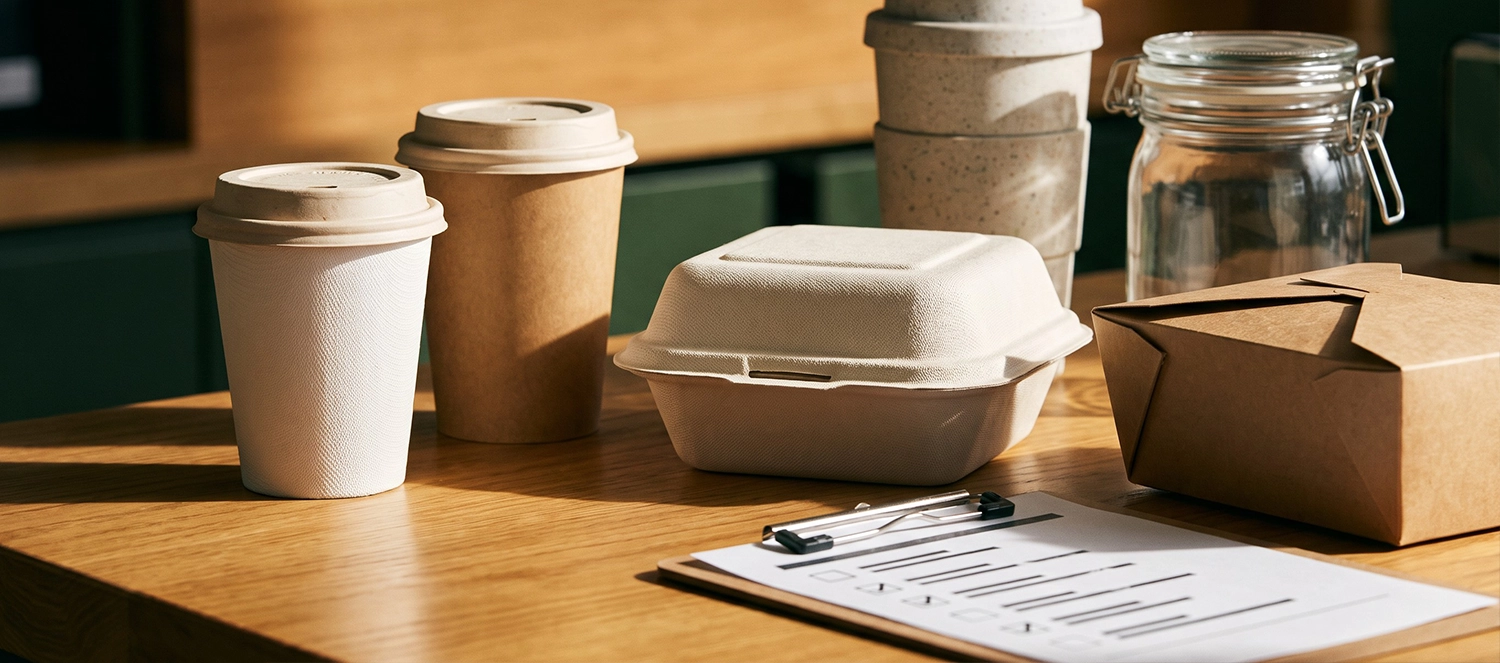
The 12 August 2026 PPWR deadline has turned PFAS-free food packaging from a sustainability preference into a market-access requirement. From that date, the EU Packaging and Packaging Waste Regulation — Regulation (EU) 2025/40 — bans PFAS in food-contact packaging placed on the EU market, and applies directly and identically across all 27 member states with no national transposition.
For food service operators and packaging buyers, this raises one practical question: which packaging is actually PPWR-compliant, and how do you prove it? This guide explains what PPWR requires from the August deadline, why PFAS-free and recyclable formats are the ones that stay on the market, and what documentation to demand from suppliers before you commit to an order. For the full PPWR timeline beyond PFAS, from takeaway obligations to the 2030 recyclability and format rules, see PPWR explained.
What PPWR 2026 Requires for Food Packaging
PPWR 2026 is the EU Packaging and Packaging Waste Regulation (Regulation (EU) 2025/40), applicable from 12 August 2026. It replaces the thirty-year-old Packaging Directive (94/62/EC). Because it is a Regulation rather than a Directive, one identical rulebook applies across the entire EU with no country-by-country variation.
PPWR applies to every operator placing packaging on the EU market — manufacturers, importers, distributors and online sellers — regardless of where they are based. A supplier in Turkey, China or any non-EU country placing packaging into EU markets is subject to PPWR at the point of market entry. For food service buyers, three requirements from the August 2026 deadline matter most.
PPWR Compliance Timeline
Key deadlines under EU Regulation 2025/40 — a phased rollout, not a single date
12 August 2026
The first hard deadline
PFAS ban in food-contact packaging · Declaration of Conformity required · substance restrictions · no grace period
12 August 2026
August 2028
Harmonized material-composition labeling for correct consumer sorting
February 2029
Reusable Packaging Labeling
Reusable-packaging labels with QR codes
February 2029
2030
Recyclability grades (A–C required) · recycled-content targets · packaging minimization (Article 10)
1. PFAS-Free Food-Contact Packaging Is Mandatory
This is the single most consequential change. From 12 August 2026, food-contact packaging placed on the EU market must not contain PFAS (per- and polyfluoroalkyl substances) at or above the specified limits. Based on the regulation and the European Commission’s March 2026 guidance, these are 25 ppb for any individual PFAS by targeted analysis, 250 ppb for the sum of targeted PFAS, and 50 ppm for total PFAS including polymeric PFAS.
The Commission has confirmed there is no transitional period and no inventory sell-off allowance for the PFAS restriction. Packaging that does not meet the limits cannot legally be placed on the EU market from the application date. The most exposed items are high-volume food-contact formats: beverage cups and lids, coated paper containers, molded fiber clamshells, trays, sauce cups and multi-component delivery packaging. For buyers, PFAS-free evidence per packaging type is now a baseline supplier qualification requirement.
2. A Declaration of Conformity for Every Packaging Type
From the August deadline, before packaging can be placed on the EU market, the manufacturer must assess conformity against the applicable PPWR articles following the procedure in Annex VII, and hold a Declaration of Conformity backed by technical documentation for each unique packaging type. The Commission has clarified that the manufacturer retains legal responsibility for compliance even where testing is carried out by third parties.
3. Recyclability as the Direction of Travel
PPWR establishes recyclability as a core design requirement, assessed through a graded system whose detailed performance grades phase in over the following years. The direction is unambiguous: packaging that cannot be recycled in standard material streams faces escalating compliance pressure. Conventional PE-lined paper cups sit on the wrong side of this trajectory, because the plastic lining prevents recycling in standard paper streams.
What are the PPWR PFAS limits?
Three numbers, and they are not interchangeable: 25 ppb for any single targeted PFAS, 250 ppb for the sum of targeted PFAS, and 50 ppm for PFAS including polymeric PFAS.
Concentration, not migration
The limits apply to how much PFAS is in the packaging, not to how much transfers into the food. That is a stricter test than the migration limits most buyers are used to quoting, and a declaration written against migration does not answer it.
The 59-second video covers what to ask a supplier before the order is placed rather than after the container has shipped.
Why PFAS-Free Paper Cups Are the PPWR-Compliant Choice
The PFAS restriction is where most food service packaging portfolios have a hidden problem. Many conventional cups and containers rely on fluorochemical or plastic barrier treatments to resist grease and moisture — exactly the substances PPWR now restricts or pushes out of the recycling stream.
The barrier technology matters more than the label. A cup marketed as “paper” can still fail PPWR on two fronts: PFAS content in the barrier treatment, and a PE plastic lining that blocks recyclability. The formats that stay comfortably on the EU market are those built on a genuinely PFAS-free, PE-free barrier.
This is why water-based coated paper cups are increasingly the default PPWR-compliant choice for food service. A water-based coating provides grease and moisture resistance through a water-based (aqueous) barrier rather than a fluorochemical treatment or a PE film. The result is a cup that is PFAS-free, PE-free and designed for paper recycling where local collection accepts it — addressing both the PFAS restriction and the recyclability direction of PPWR in a single material choice.
| Cup type | PFAS risk | Recyclable in paper stream | PPWR position |
|---|---|---|---|
| Fluorochemical-treated paper cup | High — barrier may contain PFAS | Often no | Exposed to PFAS restriction |
| PE-lined paper cup | Lower, but plastic lining | No — lining blocks pulping | Exposed on recyclability |
| PLA-lined paper cup | Lower, but still a bioplastic | Needs industrial composting | Recyclability limitations |
| Water-based coated paper cup | PFAS-free barrier | Designed for paper recycling where local collection accepts it | Well positioned on both |
For the full technical comparison between water-based and PE coatings, see our guide: PE Coating on Paper Cups and the Water-Based Alternative.
How PPWR 2026 Interacts with Existing Rules
PPWR does not arrive in isolation. It sits alongside regulations food service buyers may already be managing, and understanding how they fit together prevents duplicated or missed compliance work.
| Regulation | What it covers | Relationship to PPWR 2026 |
|---|---|---|
| EU Single-Use Plastics Directive (2019/904) | Bans on specific single-use plastic items (including EPS cups); consumption reduction, marking and EPR for plastic cups and lids; tethered caps on beverage containers up to 3 L (not on cups) | Remains in force alongside PPWR; PPWR adds broader packaging-wide obligations |
| National plastic taxes and levies | UK Plastic Packaging Tax (not EU); Spain €0.45/kg on non-reusable plastic packaging; Germany’s Single-Use Plastics Fund levy on certain single-use plastic items (not a packaging tax); Italy’s plastic tax postponed to 2027 | Independent economic measures; continue to apply to plastic-containing formats |
| Directive (EU) 2024/825 (Empowering Consumers for the Green Transition) | From 27 September 2026, bans generic environmental claims without recognized excellent environmental performance, offset-based “climate neutral” product claims and uncertified sustainability labels | Complements PPWR; both push toward specific, documented claims over marketing language (the separate Green Claims Directive proposal was not adopted) |
| Extended Producer Responsibility (EPR) | Producer contributions to end-of-life packaging management, registered per member state | Continues under PPWR; obligations remain country-specific for waste management |
For a broader view of the full regulatory landscape affecting food service packaging, see our guide: EU Plastic Ban Explained.
A PPWR Compliance Checklist for Packaging Buyers
The businesses best positioned for PPWR 2026 are not the ones scrambling in August. They are the ones that audited their packaging early, requested proper supplier documentation, and approved PFAS-free, recyclable alternatives before inventory pressure began. Here is a practical sequence.
STEP 01
Audit Your Food-Contact Packaging
List every food-contact packaging item you place on the EU market, by format. Cups, lids, containers, trays, sauce cups, wraps and cutlery each need to be assessed individually. This inventory is the foundation for everything that follows.
STEP 02
Request PFAS Test Evidence Per Item
For each food-contact item, request a laboratory PFAS test report from your supplier demonstrating compliance with the PPWR limit values — not a general marketing statement. Where a supplier cannot provide this, treat it as a compliance gap and a reason to switch.
STEP 03
Identify Recyclability Weak Points
Flag formats that cannot be recycled in standard material streams. Conventional PE-lined paper cups are the most common example in food service. These are the formats most exposed as recyclability requirements tighten, and the first candidates to replace with water-based coated or fiber alternatives.
STEP 04
Confirm Documentation and Labeling
Confirm that each packaging type has, or can obtain, a Declaration of Conformity and supporting technical documentation. Review print artwork against emerging harmonized labeling requirements so redesigns are planned rather than rushed.
STEP 05
Clarify EPR Responsibility in Contracts
EPR registration and contributions remain country-specific and typically fall to the EU importer or distributor rather than a non-EU manufacturer. Make sure your supply contracts state clearly which party is responsible for EPR registration in each market.
PPWR-Compliant Packaging from Ekoroll
Ekoroll’s packaging range was developed around the same principles PPWR 2026 now makes mandatory, which positions our products well on the requirements that matter most to food service buyers.
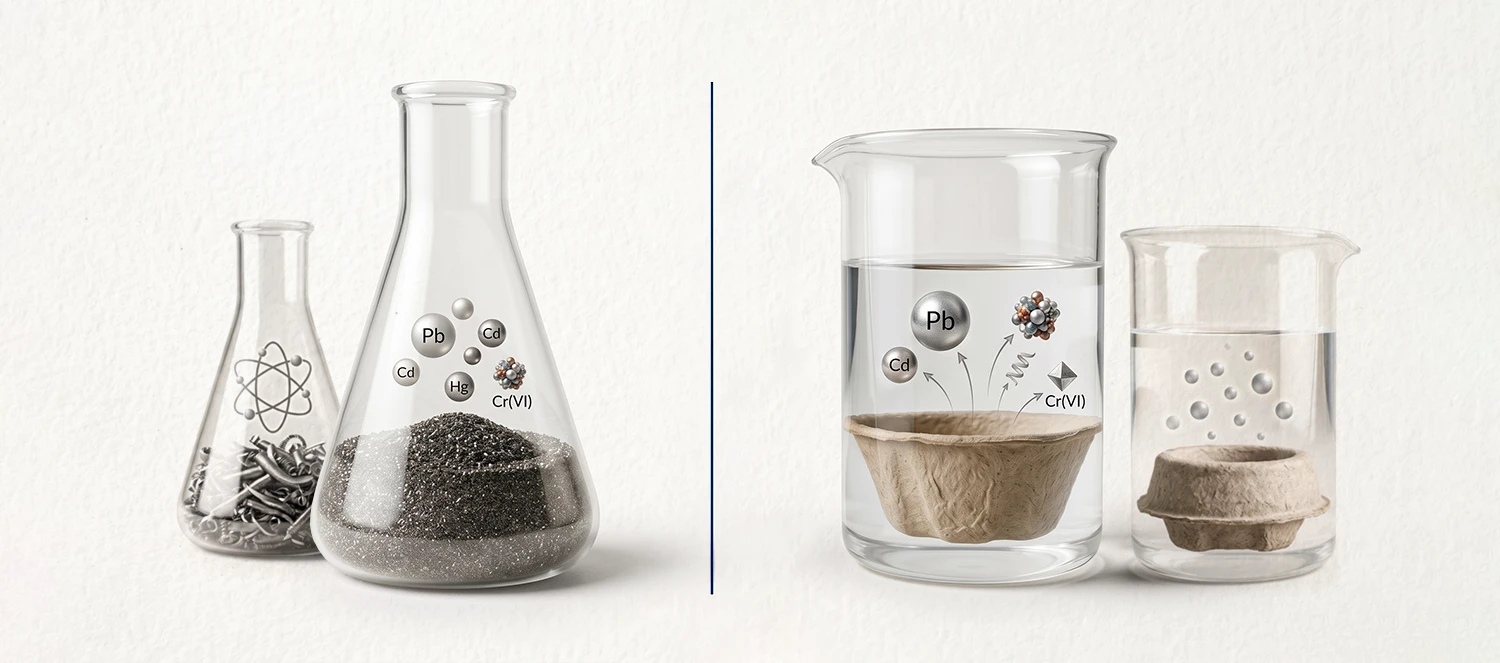
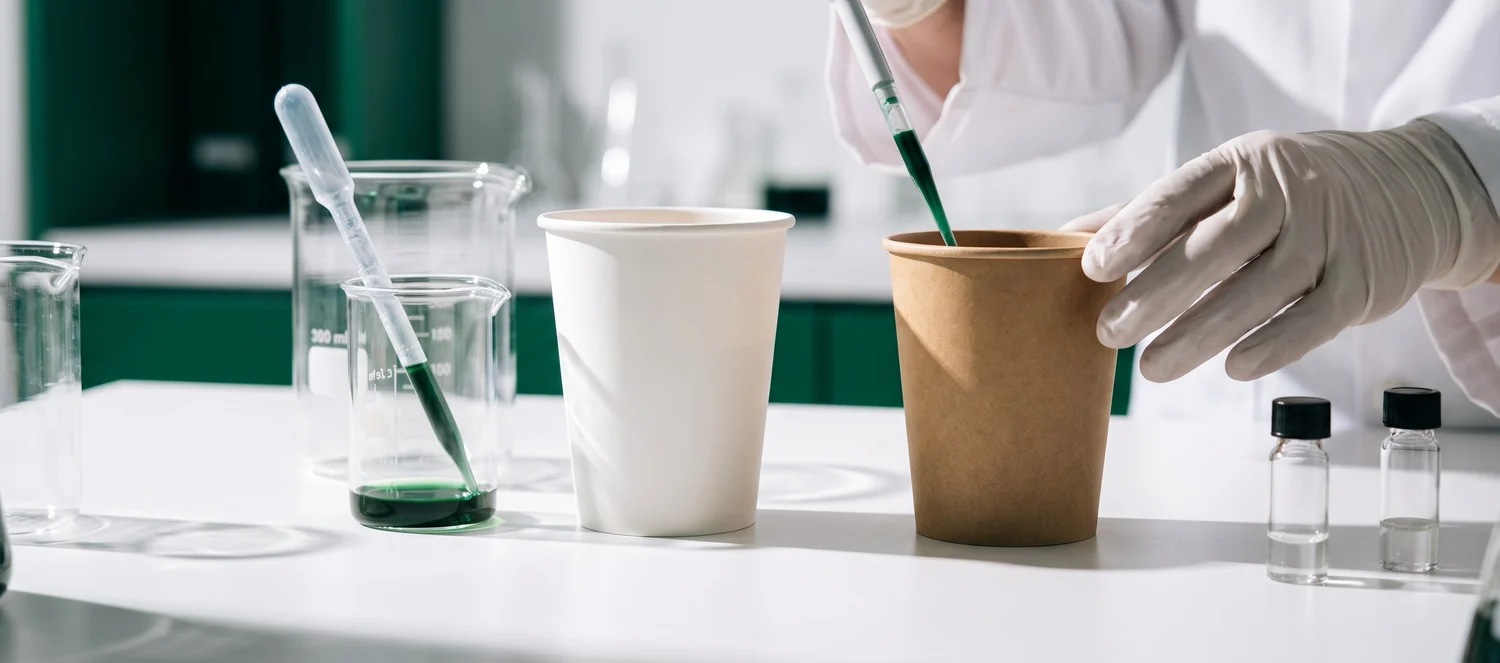
On the PFAS restriction — the most consequential August 2026 change — Ekoroll’s food-contact products are supported by SGS testing showing PFAS results below detectable levels, well within the PPWR limit values. In SGS (June 2026) and Eurofins (July 2026) reports, the water-based coated paperboard and paper containers passed the PPWR (EU) 2025/40 tests for PFAS, total fluorine and heavy metals (lead, cadmium, mercury, hexavalent chromium); the reports are available on request. Because we build barrier performance on a water-based coating that is PFAS-free and PE-free rather than fluorochemical or fossil-plastic linings, our cups avoid both the substance and recyclability weak points that expose conventional formats. Water-based coated paper cups are designed for paper recycling where local collection accepts them, positioning them well as PPWR recyclability requirements tighten.
We describe our coating accurately and deliberately: water-based, PFAS-free and PE-free, with no PE lining and, for lid-free cups, no plastic lid. With the water-based coating, the cups carry DIN CERTCO home compostable and industrially compostable (EN 13432) certification, and the paper food containers carry DIN CERTCO home compostable and industrially compostable (EN 13432) certification; both are held by the producing partner, copies on request. In a regulatory environment built specifically to eliminate greenwashing, precise and substantiated claims are not just compliant — they are commercially safer than the exaggerated language that PPWR and Directive (EU) 2024/825 are designed to stop.
For the definitive compliance position on any specific format, a PPWR assessment by an accredited laboratory or compliance specialist remains the authoritative source. What Ekoroll provides is a PFAS-free product range and the supporting documentation designed to make that assessment straightforward rather than a scramble.
PFAS-Free, PPWR-Ready Packaging Wholesale
Ekoroll supplies PFAS-free, water-based coated packaging wholesale to restaurants, cafés, food delivery brands and horeca distributors across Europe — with the SGS and Eurofins test reports and supporting documentation PPWR 2026 buyers need. Explore our complete packaging range or contact us for wholesale quotes and compliance documentation for your specific formats.