
Choosing a food packaging supplier for EU market operations is a decision that affects regulatory compliance, operational efficiency, brand credibility and total procurement cost simultaneously. For restaurants, horeca distributors and food service operators, it is one of the most consequential and least systematized procurement decisions in the business.
Most operations choose their packaging supplier the way they chose their first one: on price, on familiarity, or on a salesperson relationship. This works acceptably in stable regulatory environments. It does not work well in the current EU food packaging environment, where the regulatory requirements, certification obligations and documentation demands on packaging suppliers have changed more in the past three years than in the previous two decades.
This guide provides a complete framework for evaluating and selecting a food packaging supplier for EU food service operations — covering what criteria matter, how to verify them, what documentation to require, what questions expose unqualified suppliers, and how to structure the ongoing supplier relationship to reduce compliance and operational risk over time. For the specific framework for integrated lid cup suppliers, see: Integrated Lid Paper Cup Supplier Guide. For the complete procurement framework for horeca operators, see: Horeca Packaging Procurement Guide.
What Has Changed in EU Packaging Supplier Requirements
Before building a supplier evaluation framework, it is worth understanding what has changed in EU food packaging requirements since 2021 — because these changes directly affect which supplier attributes matter and which have become insufficient.
Before 2021: Compliance Was Primarily a Food Safety Question
Before the EU Single-Use Plastics Directive entered force in July 2021, food packaging supplier compliance for European horeca operations was primarily a food safety question: does the packaging meet EC 1935/2004 food contact material requirements? A supplier with a valid Declaration of Compliance for their products was adequately documented for most European procurement requirements.
2021 to 2026: A Layered Regulatory Environment
Since 2021, supplier compliance requirements have become significantly more complex:
- SUP Directive compliance: certain formats (EPS containers, plastic cutlery, plastic straws) became illegal for EU market supply. Suppliers must demonstrate that their products comply with the specific prohibited and restricted formats under the SUP Directive
- Plastic cups and lids under the SUP Directive: cups for beverages including their lids are subject to national consumption-reduction measures and extended producer responsibility, and cups made partly of plastic must carry a printed marking. Snap-on cup lids do not have to be tethered — the tethered-cap rule (since July 2024) applies to beverage bottles and composite beverage cartons, not to cups
- EPR documentation: suppliers must be able to provide packaging composition and weight documentation for buyer EPR reporting obligations in multiple EU markets
- PFAS-specific documentation: EN13432 and EC 1935/2004 certification do not confirm PFAS-free status — separate third-party laboratory test results are required for PFAS-free claims
- PPWR (applicable from 12 August 2026): Regulation (EU) 2025/40 limits PFAS in food-contact packaging from that date, with recyclability criteria and labeling following from 2028 to 2030
- Green claims (from 27 September 2026): under Directive (EU) 2024/825, suppliers must be able to provide specific, verified certification documentation to support the environmental claims buyers make about their packaging in customer communications
A supplier who was adequately documented in 2020 may be insufficiently documented today. The supplier evaluation framework must account for the current full documentation requirements, not the requirements from previous procurement cycles.
The Seven-Criterion Supplier Evaluation Framework
Evaluate potential food packaging suppliers across these seven criteria. They are ordered from most to least important for EU market horeca operations — stop evaluation when a supplier fails a mandatory criterion rather than continuing to assess optional criteria.
Criterion 1: Food Contact Safety Documentation
Non-negotiable baseline. Every food contact packaging item supplied for EU markets must be covered by an EC 1935/2004 Declaration of Compliance for that specific product. This document confirms that the packaging material meets EU food contact safety requirements under the specific use conditions described (food types, temperatures, contact duration).
What to request: EC 1935/2004 Declaration of Compliance for every specific product format you are evaluating, not a blanket declaration for the supplier’s product range. The declaration must be product-specific.
Red flag: a supplier who provides a single Declaration of Compliance covering all their products, or who provides a test report from a food contact laboratory but not a Declaration of Compliance signed by the manufacturer. These are not equivalent.
Criterion 2: Format-Specific Regulatory Compliance
Beyond food contact safety, EU packaging regulation has format-specific requirements that vary by material and format. Verify compliance for each format category in your procurement portfolio:
- Paper cups: confirm coating type (water-based vs PE vs PLA) with documentation — affects recyclability, plastic tax status and EPR obligations. Confirm PFAS-free status with laboratory test results if making PFAS-free claims
- Compostable containers (bagasse, fiber): confirm EN13432 certification from TÜV Austria or DIN CERTCO for compostability claims. Self-declared compostability without certification is unverifiable and creates exposure under Directive (EU) 2024/825
- Wooden and bamboo cutlery: confirm FSC or equivalent sustainable sourcing certification. Confirm food contact compliance with splinter and chemical migration testing documentation
- Greaseproof paper: confirm PFAS-free status with laboratory testing. PFAS have been commonly used in greaseproof paper and continued presence is a specific food safety risk for this format
- Any plastic-containing format: confirm compliance with the SUP Directive (not a banned format), the printed marking for cups made partly of plastic, and the tethered-cap requirement where it applies (beverage bottles and cartons). Confirm EPR registration and documentation capability for each market you supply
Criterion 3: Product Performance Under Real Conditions
Certification documents confirm compliance with standards. They do not confirm performance under your specific service conditions. Request samples of every format you are evaluating and test under your actual conditions — not the supplier’s demonstration conditions.
The most common performance failures in food packaging procurement are:
- Container seal failure under your specific food types (high-oil dishes, soups) for delivery distances and times typical of your operation
- Cup coating failure under your specific serving temperatures and contact times
- Cutlery mechanical failure under your specific food types (dense foods, stirring hot liquids)
- Greaseproof paper barrier failure with your specific food items and oil levels
The sample testing protocol should use your actual food products under your actual service conditions. A bagasse container that performs perfectly with rice dishes may behave differently with a high-fat curry. Test for both and do not generalize from one food type to another.
Criterion 4: Production Consistency and Quality Control
Sample quality from a single batch is insufficient for long-term wholesale sourcing. Production consistency — the ability to deliver the same quality across batches and over time — requires separate verification:
- Request samples from two separate production batches (not the same production run split into two packages) and test both batches against the same performance criteria
- Ask for the supplier’s documented quality control specifications — dimensional tolerances, material weight ranges, coating weight tolerances. A supplier with documented QC specifications is operating with process discipline
- Request the supplier’s quality complaint procedure and ask for an example of how a quality complaint was resolved. A supplier without a documented complaint procedure or who responds defensively to quality questions is a risk
- Check references specifically about batch-to-batch consistency and response to quality issues — not just about general satisfaction
Criterion 5: Supply Chain Reliability
Supply chain reliability for food service packaging is more critical than in many other procurement categories because packaging stock-outs directly disrupt service operations. Evaluate:
- Lead times: standard lead time for repeat orders and urgent restocking lead time, in writing. Get the worst-case lead time (during supplier peak production periods) as well as the standard lead time
- Buffer stock policy: does the supplier maintain finished goods stock of your specific formats, or is every order a production run? Stock availability significantly reduces your effective restocking lead time and operational risk
- Production capacity headroom: can the supplier fulfill your requirements at 150 percent of current volume to allow for growth? Ask for evidence of capacity, not just a verbal commitment
- Geographic risk: direct supply from Turkey, China or other manufacturing origins requires understanding the supply chain risks — port disruptions, customs delays, transit damage rates. Ask for specific data on past delivery reliability
- Single source vs backup supplier: for your highest-volume items, consider qualifying a backup supplier as insurance against your primary supplier disruption. This is particularly important for formats where a stock-out would immediately halt service
Criterion 6: Commercial Terms and Total Cost Structure
For EU market operations, total cost analysis of food packaging procurement must include all cost components — not just unit purchase price. The relevant cost components are:
- Unit purchase cost at your order volume from the supplier
- Plastic-specific taxes and levies where they apply — for example the UK Plastic Packaging Tax, Spain’s €0.45/kg tax on non-reusable plastic packaging, Portugal’s €0.30 contribution per single-use plastic or aluminium take-away meal package, and Germany’s Single-Use Plastics Fund (Italy’s plastic tax is postponed to 2027; France uses eco-modulated EPR fees)
- EPR contribution levies per unit in each market — EPR applies to all packaging, including paper and bagasse, with additional SUP-specific fees for plastic items
- Compliance documentation cost — the supplier’s ability to provide EPR composition documentation reduces your internal compliance administration cost
- Shipping, customs and logistics cost for the specific supply chain from supplier to your operation
- Inventory holding cost for the buffer stock level required to cover the supplier’s lead time
A supplier with a lower unit purchase price but higher plastic tax exposure, inadequate EPR documentation and longer lead times requiring higher buffer stock may have a higher effective total cost than a more expensive supplier on unit price alone. Run the complete cost calculation before comparing supplier options. For the full cost analysis framework see: Sustainable Packaging Cost Analysis.
Criterion 7: Strategic Alignment and Long-Term Capability
For suppliers you expect to work with over a multi-year horizon, strategic alignment matters as much as current capability. Evaluate:
- Product development direction: is the supplier actively developing formats that are forward-compliant with EU regulatory direction (water-based coated cups, EN13432 certified compostables, PFAS-free greaseproof paper)? Or are they primarily focused on conventional formats facing increasing regulatory pressure?
- Documentation investment: is the supplier investing in certification and documentation capability? A supplier who added EN13432 certification and PFAS-free testing in the last 12 months is building toward the documentation requirements of the next three years. A supplier with the same certifications they had in 2020 is not
- Market coverage: can the supplier support your growth into additional EU markets from a single supply relationship? Multi-market supply simplification is a commercial value of single-supplier consolidation
- Private label and customization: can the supplier produce custom printed or private label formats at volumes relevant to your scale? Private label capability builds product differentiation that commodity packaging distribution cannot provide
The Supplier Request for Information
Send this structured information request to all potential suppliers simultaneously to enable direct comparison. Do not begin commercial negotiations until you have received and reviewed responses.
Documentation Package
- EC 1935/2004 Declaration of Compliance for each specific format being evaluated
- EN13432 certification (TÜV Austria or DIN CERTCO) for any compostable formats
- PFAS-free laboratory test results (ISO 17025 accredited laboratory) covering paper substrate and coating for all paper-based food contact formats
- FSC or equivalent certification for wooden and bamboo cutlery
- Coating type specification with technical documentation for all cups (water-based / PE / PLA)
- SUP Directive compliance statement for all formats
- Quality control specifications document with dimensional tolerances and material weight ranges
Commercial Information
- Unit pricing at your estimated order volumes per format (provide three volume tiers)
- MOQ per format for plain and custom printed versions
- Standard lead time for repeat orders and urgent restocking lead time
- Buffer stock availability policy for your formats
- Shipping terms (ex-works, FOB, CIF) and standard logistics configuration
- Custom printing capability: methods, colors, Pantone matching, lead time from approval
- Private label capability and MOQ
References
- Two current wholesale customer references at comparable volume with contact details and permission to contact
Red Flags That Should End the Evaluation
The following responses to standard supplier evaluation questions indicate disqualifying issues. These are systemic problems, not correctable through the buyer-supplier relationship — eliminate the supplier rather than seeking to address the issue.
- No EC 1935/2004 Declaration of Compliance for specific products: the supplier is not selling verified food-safe products for EU markets. This is a legal compliance issue, not a documentation administrative issue
- Blanket certification claims without product-specific documentation: “all our products are food-safe certified” without product-specific Declarations of Compliance means the claim is unverified at the product level
- EN13432 certification claimed but cannot produce the certificate: EN13432 certification is product-specific and issued by accredited bodies. A supplier who claims certification but cannot produce the certificate number and issuing body is not certified
- PFAS-free claim without laboratory test documentation: self-declared PFAS-free status without third-party laboratory test results is an unverified marketing claim. This creates direct legal exposure for buyers making PFAS-free claims about their packaging
- Cannot specify coating type for paper cups: describing cup coating as “eco-friendly,” “natural” or “plant-based” without specifying whether it is water-based, PE or PLA is a red flag. A supplier confident in their product specification can answer this immediately with documentation
- No customer references at comparable volume: a supplier without verifiable references from operations at comparable scale has not demonstrated the ability to perform reliably at your volume
- Sample performance failure: if a product sample fails the basic performance test for your application (seal failure, structural failure, coating failure under standard conditions), the product is not suitable regardless of other supplier attributes. Do not proceed on the expectation that production quality will be better than samples
- Defensive response to quality questions: a supplier who responds defensively or dismissively to standard quality questions — about documentation, complaint procedures or batch consistency — will not be a constructive partner when actual quality issues arise
Managing the Supplier Relationship Over Time
Selecting the right supplier is the beginning, not the end, of the procurement management process. The following practices reduce compliance and operational risk over the duration of the supplier relationship.
Annual Certification Review
Certifications expire. EC 1935/2004 Declarations of Compliance should be reviewed when the supplier changes their product formulation. EN13432 certifications have defined validity periods. PFAS-free test results should be refreshed periodically as paper and coating formulations can change even with the same supplier. Build an annual certification review into your procurement calendar — do not rely on the supplier to notify you of certification changes.
Periodic Performance Testing
Run periodic performance testing of production samples (not special demonstration samples) against your original test protocol. This catches production standard drift before it becomes a customer complaint issue. For high-volume formats, run a production sample test at least annually.
Regulatory Monitoring
The EU regulatory environment affecting food packaging is continuing to develop through 2030. Share relevant regulatory developments with your supplier and ask how their product development roadmap addresses upcoming requirements. A supplier who is not aware of the PPWR timeline (applicable from 12 August 2026, recyclability criteria from 2028) or the green-claims rules of Directive (EU) 2024/825 is not managing their product development to the market direction.
Volume and Pricing Review
Review volume and pricing annually. Significant volume growth gives you pricing leverage. Regulatory cost changes (new plastic taxes, new EPR contribution rates) in applicable markets should be reflected in your total cost analysis at each annual review. Do not let the convenience of an existing supplier relationship prevent you from running a competitive evaluation every two to three years.
Food Packaging Wholesale: Complete Range and Documentation
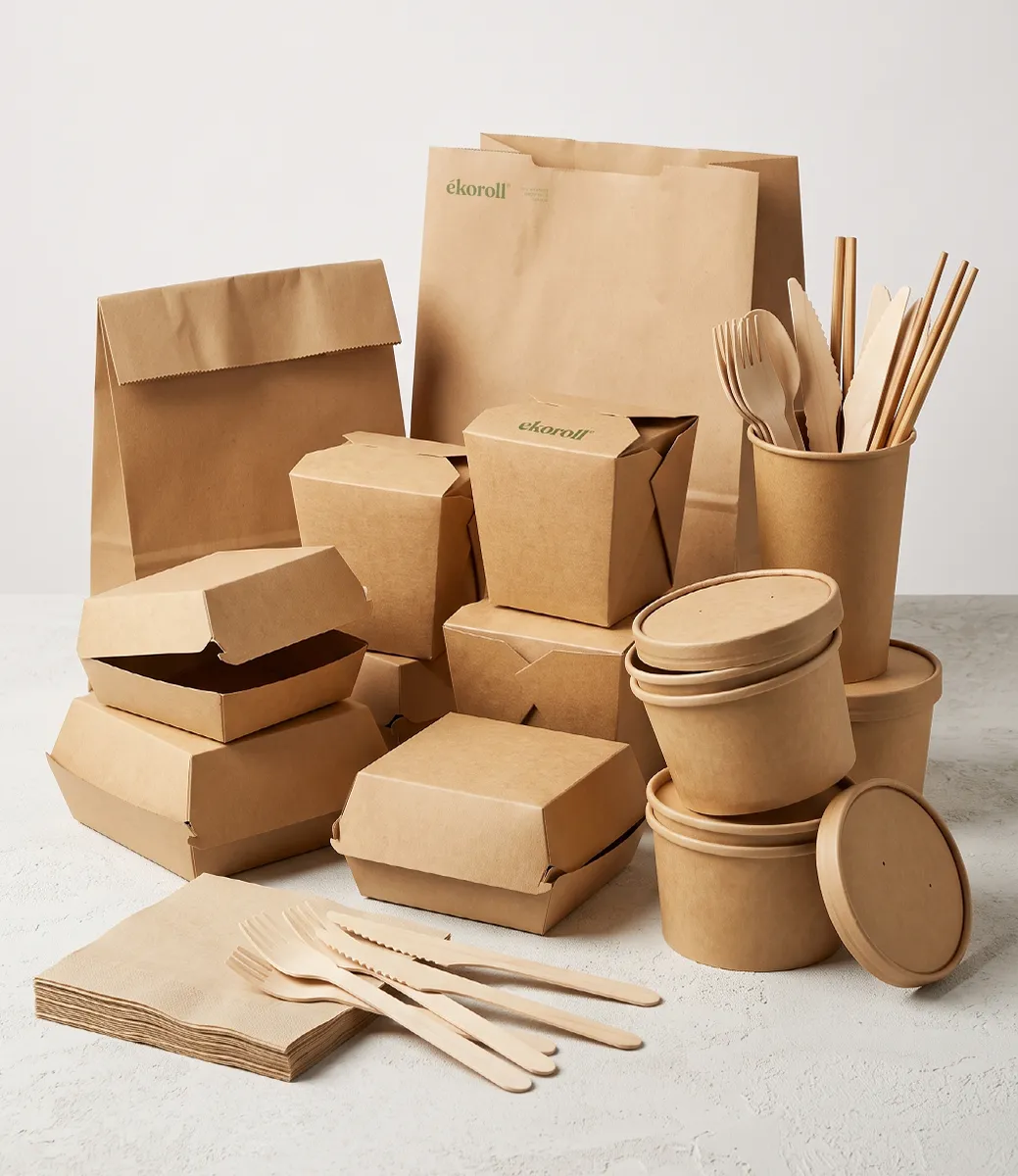
Ekoroll supplies complete food packaging systems wholesale to restaurants, cafés, food delivery brands and horeca distributors across Europe. Bagasse containers, lid-free cups, molded fiber lids, wooden cutlery and PFAS-free greaseproof paper — all from a single wholesale supplier with product documentation. Supplied from Türkiye. MOQ and lead times quoted per project.