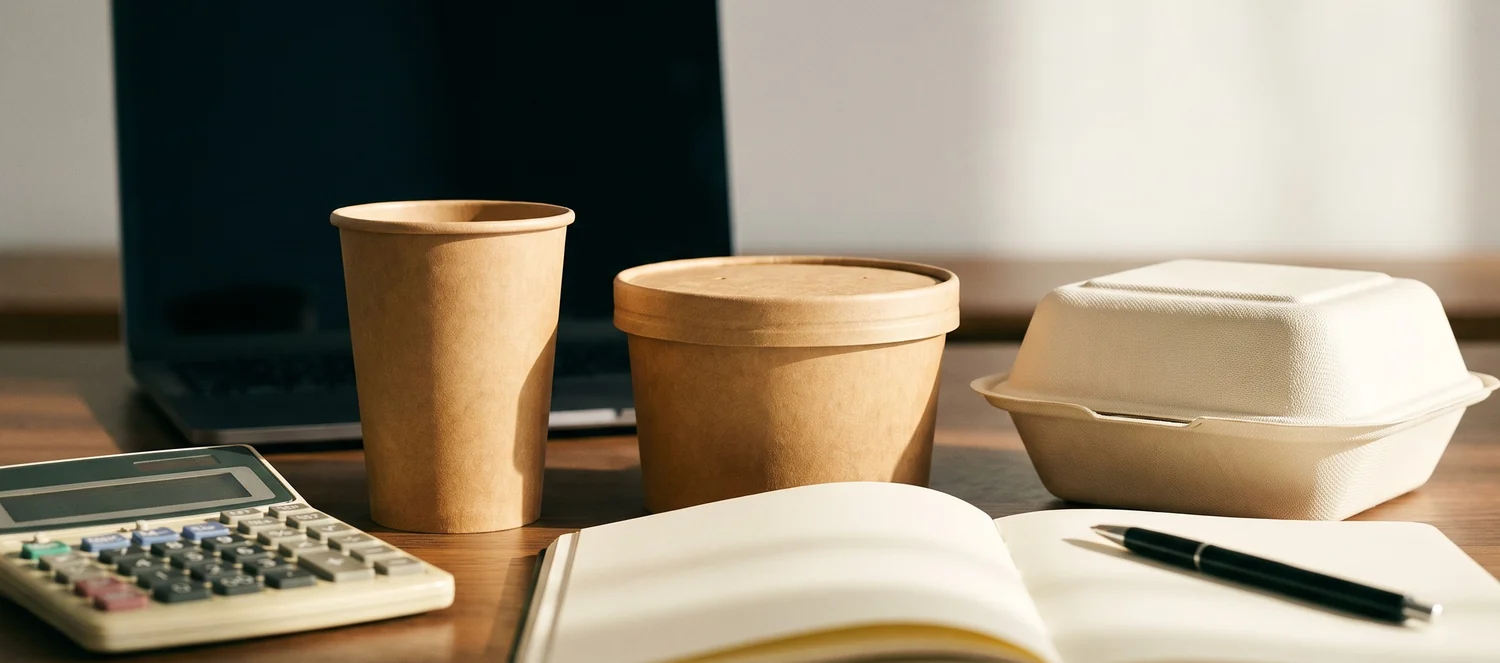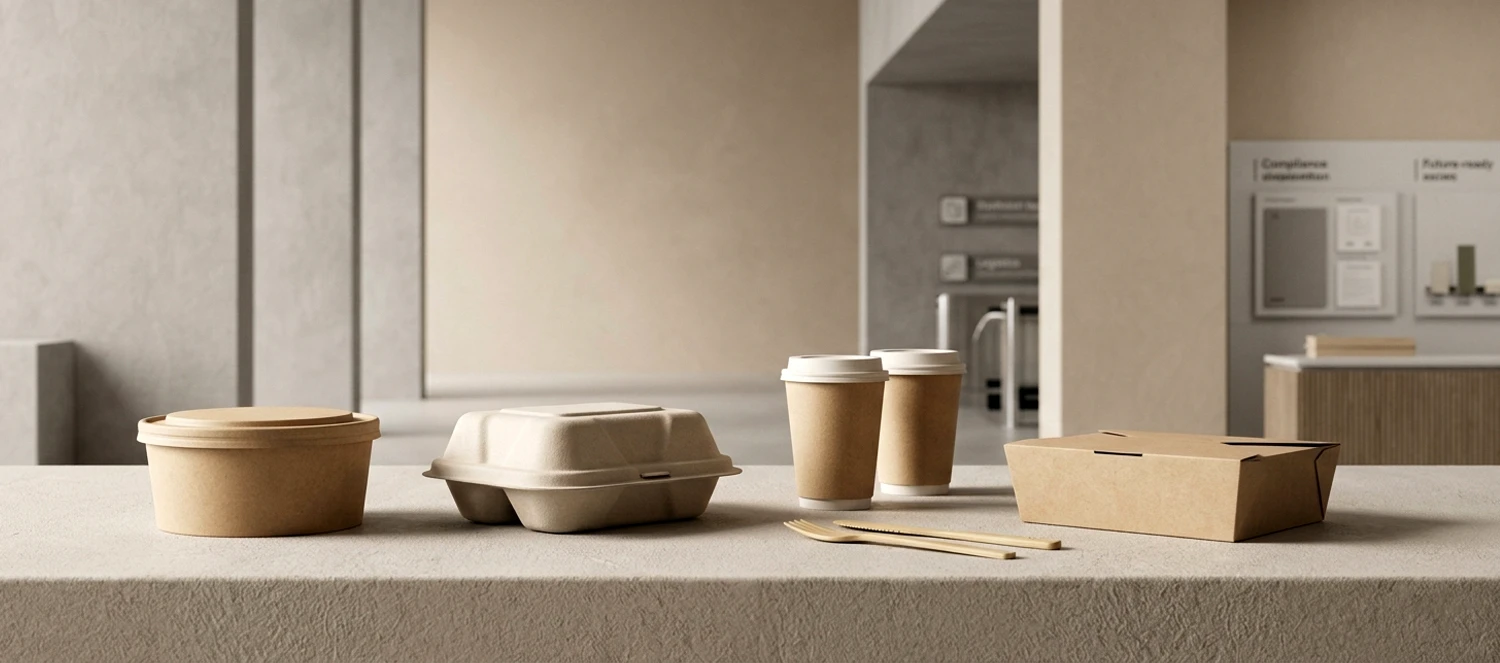
Switching to plastic-free packaging is no longer just an environmental decision. For restaurants, cafés, food delivery brands and horeca distributors operating in European markets, it is a strategic business decision that affects regulatory compliance, cost structure, brand positioning and operational efficiency. Done correctly, the transition reduces regulatory exposure, can narrow the total packaging cost gap over time and improves positioning with customers and B2B accounts. Done poorly — or based on unverified “plastic-free” claims — it creates operational disruption, quality problems, hidden costs and legal exposure that undermine the entire business case.
This guide provides a complete, practical framework for switching to plastic-free packaging — covering the audit process, replacement priorities, supplier evaluation, cost analysis, team training, and the single most important thing most operators overlook: how to tell a genuine plastic-free claim from a marketing one.
For wholesale supply of PE-free, PFAS-free paper and fiber packaging, explore the Ekoroll food packaging range for restaurants, cafés and horeca distributors.
First, a Warning: “Plastic-Free” Is the Most Abused Claim in Packaging
Before any transition plan, one thing has to be understood clearly, because it determines whether your transition succeeds or exposes you to legal risk: the term “plastic-free” has no single legal definition, and it is used loosely across the packaging industry. Many products marketed as “plastic-free” are not, in any technical sense, free of polymers.
This matters enormously for a buyer, because under EU consumer law — tightened by Directive (EU) 2024/825, applicable from 27 September 2026 — an unsubstantiated “plastic-free” claim is not a marketing choice; it is a compliance liability. And the liability can sit with the business that passes the claim on to its own customers, not only with the manufacturer who made it.
The Three Things “Plastic-Free” Often Hides
- Dispersion-coated paper marketed as plastic-free: many “plastic-free” paper cups and containers use a water-based dispersion barrier that still contains polymers. It is a major improvement over PE lining — far less plastic, designed for paper recycling where local collection accepts it, no PE film to shed microplastics — but it is more accurately described as plastic-reduced or PE-free, not plastic-free.
- PLA-lined products marketed as plastic-free: PLA is a bioplastic. It is bio-based and can be certified for industrial composting, but it is still a plastic — the European Commission’s 2021 guidelines on the Single-Use Plastics Directive treat it as plastic. Products lined with PLA are frequently sold as “plastic-free” when they are not.
- Claims with no test evidence at all: the most common case — a supplier simply prints or states “plastic-free” with no laboratory documentation to support it.
What This Means for Your Transition
The practical takeaway is not to abandon the goal — reducing and eliminating plastic in packaging is exactly the right direction. The takeaway is to stop trusting the words and start requiring the evidence. A credible claim is specific and documented: “PE-free, verified by supplier declaration,” “PFAS-free, verified by third-party laboratory test,” “designed for paper recycling where local collection accepts it.” A non-credible claim is a single vague word — “plastic-free” — with nothing behind it.
The rest of this guide is built on that principle. Everywhere it refers to plastic-free packaging, it means packaging whose specific, testable properties you have verified — not packaging that simply carries the label.
Why the Switch Is Now Commercially Necessary
The business case for switching to plastic-free packaging in European food service operations has shifted from optional to necessary over the past three years. Three converging pressures make this clear.
EU Regulatory Requirements
The EU Single-Use Plastics Directive (EU) 2019/904 has banned single-use plastic cutlery, plates, straws and stirrers, as well as expanded polystyrene (EPS) food containers, beverage containers and cups, since 3 July 2021. Plastic cups and their lids and plastic food containers are not banned but face consumption-reduction measures, marking rules (for cups) and extended producer responsibility. Plastic-specific charges add direct cost in several markets: the UK Plastic Packaging Tax (a UK measure, not EU), Spain’s €0.45/kg tax on non-reusable plastic packaging, Germany’s Single-Use Plastics Fund (Germany has no plastic packaging tax) and Portugal’s €0.30 contribution per single-use plastic or aluminum take-away meal package; Italy’s plastic tax is postponed and not in force. General packaging EPR applies to all packaging, paper and fiber included. The EU Packaging and Packaging Waste Regulation (EU) 2025/40 entered into force on 11 February 2025 and applies from 12 August 2026, starting with PFAS limits for food-contact packaging; recyclability criteria, harmonized labels and reuse targets follow in stages from 2028 to 2030. Operations still using banned plastic formats face legal exposure, and those using plastic formats that are still allowed face rising compliance costs.
B2B Procurement Requirements
Corporate food service accounts, hotel chains, airline catering and retail food brands increasingly require documented low-plastic packaging as a procurement condition for supplier qualification. Horeca distributors supplying these accounts need verifiable certification to maintain and grow their account base. From 27 September 2026, Directive (EU) 2024/825 bans generic environmental claims without recognized excellent environmental performance, product “climate neutral” claims based on offsetting, and sustainability labels not based on a certification scheme or set by public authorities. Together with existing rules against misleading claims, this makes an unverified “plastic-free” claim a legal compliance risk rather than a marketing decision.
Commercial Opportunity
Restaurants and food brands that have completed the transition consistently report positive customer feedback, improved brand perception and — in most cases — a smaller cost differential than initially anticipated once plastic-specific levies are factored into the full cost comparison. The operations that transitioned early, with verifiable claims rather than vague ones, are now using their credentials as a genuine competitive differentiator in market positioning.
Step 1: Audit Your Current Packaging System
A complete packaging audit is the essential starting point for any transition. Without knowing exactly what you are replacing, in what volumes and at what cost, you cannot accurately plan the transition or build a credible business case for the investment.
What to Audit
List every single-use packaging item your operation currently uses. For each item, capture:
- Item description: what it is and what food or beverage it is used for
- Material: what it is made from — plastic type (PP, PS, PET, EPS), PE-coated paper, plain paper, other
- Monthly volume: how many units you use per month at current service levels
- Unit cost: current cost per unit from your supplier
- Total monthly cost: volume × unit cost for each item
- Supplier: who you currently source from and what the MOQ and lead time is
Categorize by Plastic Content
Once you have the full list, categorize each item:
- Plastic-containing: items made from or coated with plastic that need to be replaced
- Already plastic-reduced or PE-free: items that are already paper, fiber or water-based coated materials
- Unknown: items where the material composition is unclear — follow up with your supplier for confirmation, and treat any “plastic-free” label without documentation as unknown until verified
Calculate Your Plastic Baseline
Add up the total monthly volume and cost of all plastic-containing items. This is your transition baseline — the number you will measure improvement against and use to build the cost comparison with plastic-free alternatives.
Identify Regulatory Risk Items
Cross-reference your plastic-containing items against the EU SUP Directive’s restricted and banned list. Any items that are currently banned or restricted are immediate compliance priorities regardless of cost or convenience. These include single-use plastic cutlery, plastic straws, plastic stirrers and EPS food containers.
Step 2: Prioritize by Impact and Volume
Once the audit is complete, prioritize replacement items using two criteria: regulatory urgency and volume impact.
Regulatory Priority (Immediate)
Any items that are banned or restricted under the EU SUP Directive require immediate replacement regardless of other considerations. These are not business decisions — they are compliance requirements. Single-use plastic cutlery and EPS food containers fall into this category for EU market operations.
Volume Priority (Highest Impact)
After regulatory items, prioritize by monthly volume. The highest-volume plastic items in your operation deliver the greatest environmental impact reduction and the most significant cost differential when switched. For most food service operations, this means:
- Food containers: the highest volume plastic item for most restaurants — bagasse containers are the primary replacement
- Beverage cup lids: plastic snap-on lids represent high volume for cafés — molded fiber lids or lid-free cups eliminate this entire category
- Cutlery: single-use plastic cutlery is banned under the EU SUP Directive — wooden or bamboo cutlery is the common replacement
- Wrapping materials: PE-coated wrapping paper — PFAS-free greaseproof paper replacement
- Beverage cups (PE-lined): switching to water-based coated cups addresses both recyclability and microplastic concerns
Visibility Priority (Brand Impact)
For brand-positioned operations, also consider which packaging items are most visible to customers at point of receipt or service. Cutlery and cup lids are highly visible and signal sustainability positioning clearly. Prioritizing these alongside volume items accelerates customer-facing brand benefit from the transition.
Step 3: Select Verified Plastic-Free Alternatives
For each plastic-containing item identified in your audit, select the appropriate alternative based on performance requirements, format compatibility and — critically — verifiable claims. For each alternative below, note the honest, documented claim rather than the loose marketing one.
Food Containers: Plastic and EPS to Bagasse
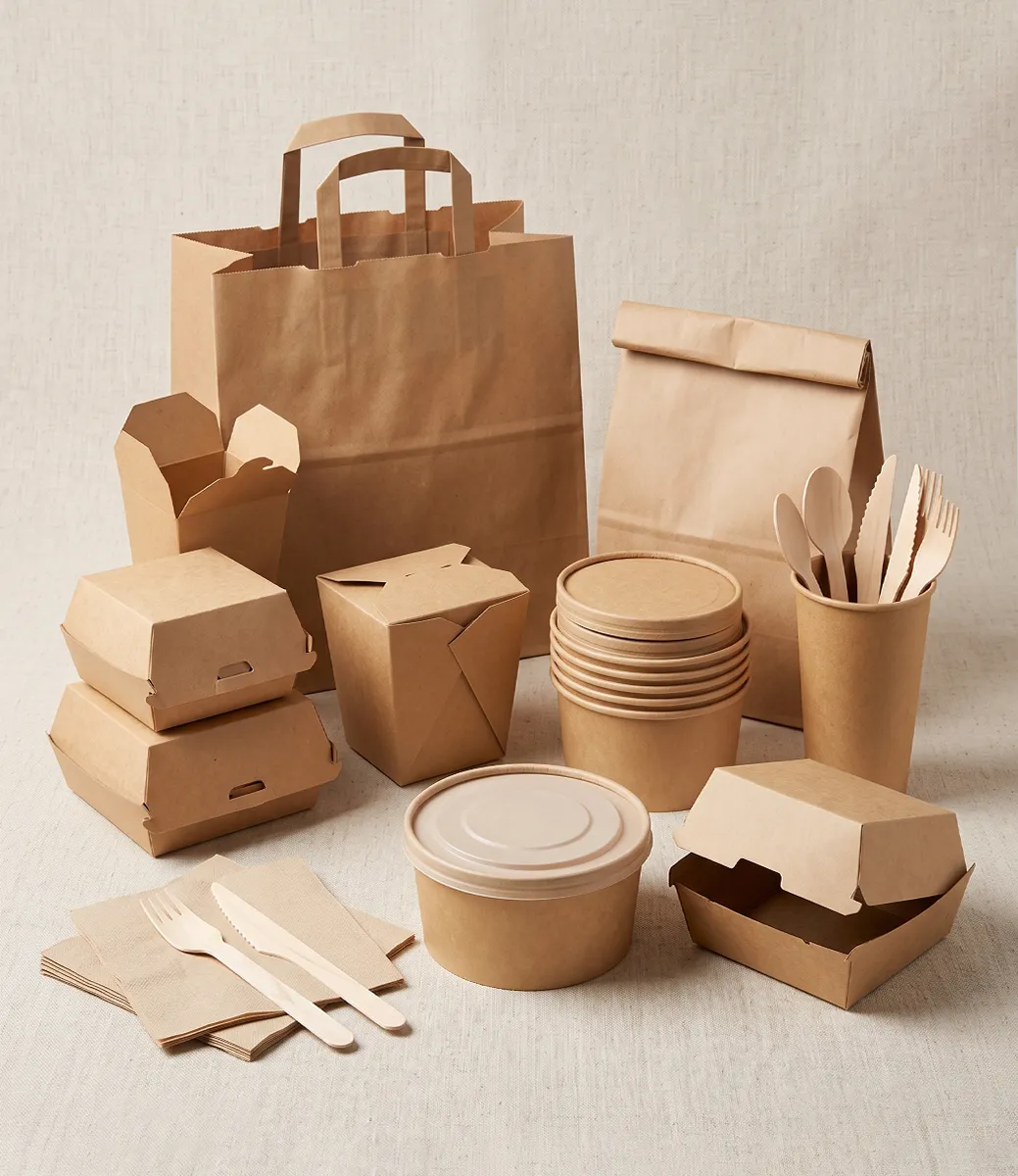
Bagasse food containers are the primary replacement for plastic and EPS food containers in takeaway and food delivery operations. Bagasse handles hot and cold food without any plastic coating; Ekoroll’s bagasse is water- and oil-resistant, PFAS-free, and microwave- and freezer-safe. Ekoroll’s bagasse containers are home compostable & 100% bagasse, certified by TÜV AUSTRIA (OK compost HOME); food-contact documentation is provided according to the final product specification and production route. This is one of the few genuinely plastic-free formats — a molded fiber substrate with no polymer coating at all.
Explore: bagasse food containers
Beverage Cups: PE-Lined to Water-Based Coated
Standard paper cups with PE lining cannot be recycled in standard paper streams and can release microplastic particles into hot beverages. Water-based coated paper cups provide the same liquid resistance with dramatically reduced plastic content and are designed for paper recycling where local collection accepts it. The accurate claim here is water-based, PFAS-free, PE-free coating — a major improvement over PE-lined cups, verified by documentation rather than a blanket “plastic-free” label. For a complete solution that eliminates the separate lid entirely, lid-free cups integrate the closure into the cup wall.
Explore: lid-free hot cups and lid-free cold cups
Cup Lids: Plastic to Molded Fiber
For operations that want to retain their existing cup format while switching lids, molded fiber lids provide a direct plastic lid replacement compatible with standard cup rim sizes. For operations ready to eliminate the separate lid entirely, lid-free cups are the more complete solution.
Explore: molded fiber lids
Cutlery: Plastic to Wooden or Bamboo
Wooden birch cutlery is the most cost-efficient plastic-free cutlery replacement for high-volume operations — and genuinely plastic-free, with no coating. Bamboo cutlery provides a premium alternative for upmarket positioning. Uncoated wood and bamboo are natural materials outside the plastic definition of the EU SUP Directive; compostability applies only where the specific item is certified. Pre-packaged cutlery sets simplify delivery packing and ensure hygiene compliance.
Explore: wooden and bamboo cutlery
Wrapping Paper: PE-Coated to PFAS-Free Greaseproof
Conventional greaseproof paper often uses PFAS chemical treatment for oil resistance. PFAS-free greaseproof paper achieves oil resistance through mechanical fiber compression instead — ask for the third-party PFAS test report. Make no compostability claim for greaseproof paper unless the specific item carries a valid certificate. Essential for burger wrapping, sandwich packaging and bakery applications.
Explore: PFAS-free greaseproof paper
Step 4: Build a System, Not a List of Replacements
The single most important strategic decision in a plastic-free packaging transition is whether to approach it as a list of individual item replacements or as a complete system change. Operations that take the system approach consistently achieve better outcomes across cost, compliance and operations.
Why System Thinking Matters
When packaging items are sourced from multiple different suppliers with different certification standards, different material specifications and different lead time structures, the operational complexity multiplies. Documentation for B2B procurement or ESG reporting requires certification from every supplier. Quality inconsistencies between materials from different sources create customer experience variability. Lead time mismatches between suppliers create stock-out risks.
What a Complete System Looks Like
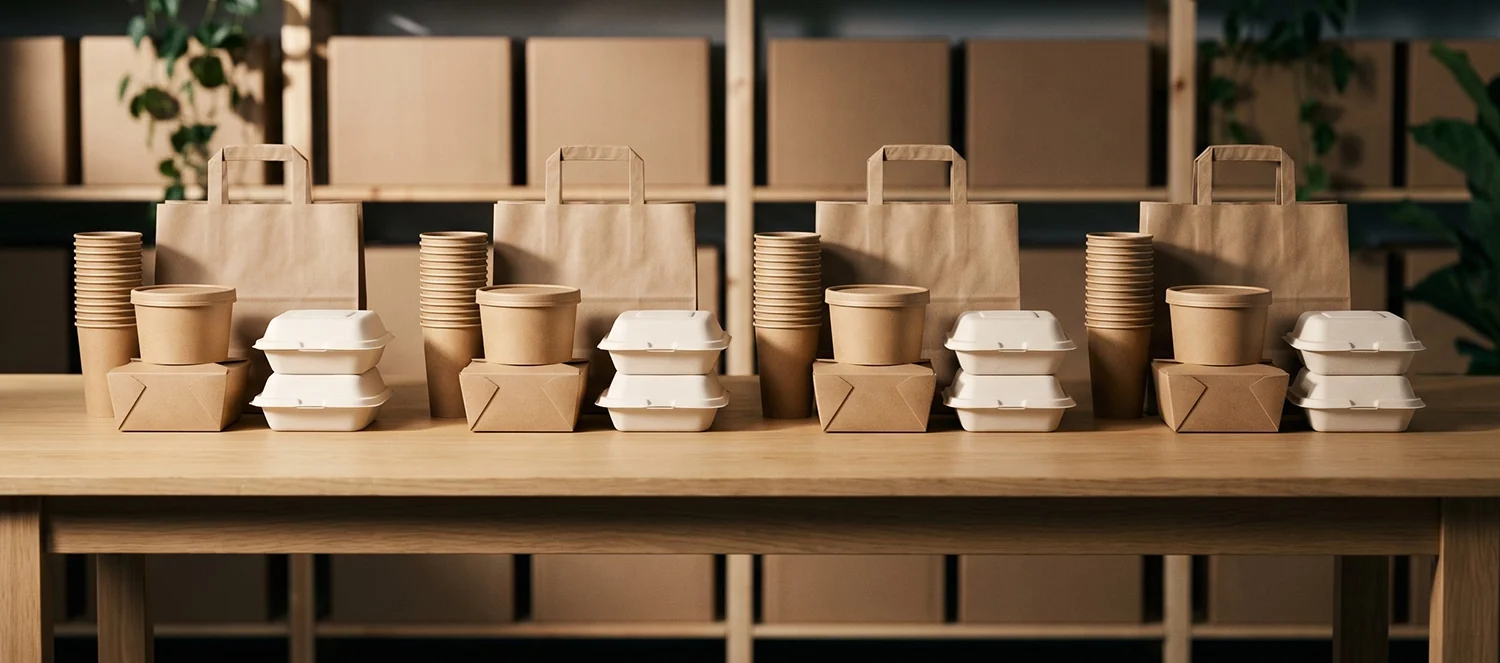
A complete plastic-free packaging system for a food service operation typically covers:
- Food containers — bagasse clamshells, bowls and rectangular containers for all meal types
- Beverage cups — lid-free hot and cold cups or water-based coated cups with fiber lids
- Cutlery — wooden or bamboo sets in pre-packaged sealed formats for delivery
- Wrapping — PFAS-free greaseproof paper for burgers, sandwiches and bakery
- Bags and carriers — paper alternatives for plastic carrier bags (if applicable)
Single-Supplier Advantage
Sourcing all plastic-free packaging components from a single wholesale supplier simplifies procurement, consolidates certification documentation, reduces logistics complexity and provides a single point of contact for compliance queries. For B2B procurement documentation, a single supplier providing compostability documentation and PFAS test results across all items is significantly more efficient than managing certification across five or six separate suppliers.
Step 5: Build the Cost Case
The cost comparison between plastic and plastic-free packaging is more nuanced than unit price alone. A complete cost analysis for EU market operations includes factors that significantly reduce the apparent cost premium of plastic-free alternatives.
Total Cost Framework
For each plastic item being replaced, the relevant cost comparison includes:
- Unit cost differential: the price difference per unit between plastic and plastic-free alternatives at your order volume
- Plastic-specific levies: charges that apply only to plastic items in your target market — for example the UK Plastic Packaging Tax, Spain’s plastic packaging tax, Germany’s Single-Use Plastics Fund or Portugal’s per-package contribution on plastic take-away meal containers
- Inventory simplification: switching to lid-free cups eliminates the separate lid SKU entirely, reducing inventory management cost and storage space
- Compliance cost: reporting and fees under plastic-specific producer responsibility (SUP Directive EPR, Germany’s Single-Use Plastics Fund); general packaging EPR applies to paper and fiber as well, so count it on both sides
- Brand value: quantify where verified low-plastic credentials contribute to B2B account retention or consumer acquisition in your specific market
What the Numbers Typically Show
At wholesale volumes for EU market operations, the effective cost difference between plastic and plastic-free packaging is typically significantly smaller than the headline unit price comparison suggests. In markets with plastic-specific levies, the effective cost difference can be close to neutral for some high-volume items. For plastic items covered by single-use plastic producer responsibility (plastic cups, lids and food containers), the saving on those plastic-specific obligations further reduces the net cost premium.
Step 6: Request Samples and Test Under Real Conditions
Testing packaging under real service conditions before bulk ordering is not optional — it is the step that prevents the most common and costly transition mistakes. Any reliable wholesale supplier provides samples before bulk orders. If a supplier will not provide samples, that is a significant supplier reliability warning.
What to Test
- Food containers: fill with your actual menu items at serving temperature and hold for the duration of your longest typical delivery time. Check for grease penetration, structural integrity under stacking, and moisture performance
- Cups: test with your actual beverage formulations at serving temperature. For lid-free cups, test the fold mechanism with your serving staff under real service speed conditions
- Cutlery: test with your actual menu items, particularly any dishes requiring cutting or serving dense food
- Lids: test snap-fit with your actual cup stock — dimensional tolerance between fiber and plastic lids can vary between manufacturers
- Greaseproof paper: test with your highest-oil food items and longest transport times
Ask for the Documentation, Not Just the Sample
Alongside physical samples, request the paperwork that substantiates every environmental claim: the compostability certificate for compostable items (EN 13432 or OK compost INDUSTRIAL for industrial composting, OK compost HOME for home composting), third-party PFAS-free laboratory test results for paper-based items, and a clear material declaration for any product marketed as plastic-free. If a supplier can send a sample but cannot send the documentation, treat the claim as unverified. Keep brief written records of both the sample test outcomes and the documentation received for each item.
Step 7: Plan the Stock Transition
How you manage the transition from existing plastic stock to new plastic-free stock affects both cost and operational disruption.
Run-Down vs Clean Break
Two approaches are available: run down existing plastic stock before introducing plastic-free alternatives, or make a clean break by transitioning on a set date regardless of existing stock levels. Run-down minimizes waste of existing inventory but extends the transition period. A clean break creates a clear before/after point but may result in some plastic stock being written off.
For most food service operations, a category-by-category run-down is the most practical approach: transition each packaging category as existing stock depletes, starting with the highest-volume and highest-regulatory-risk items first.
Buffer Stock During Transition
Maintain buffer stock of the new plastic-free items during the transition period. Supply chain disruptions during the transition are more operationally damaging than in steady-state, as staff are still learning the new formats and processes. Build a minimum of four weeks of buffer stock for each new item before retiring the plastic alternative.
Step 8: Train Your Team
Staff training is consistently underestimated in packaging transitions. The operational performance of new packaging formats depends significantly on correct handling, and customer-facing formats (particularly lid-free cups) require brief customer explanation at handover.
What to Cover in Staff Briefing
- What is changing and why: a brief explanation of the sustainability and regulatory drivers — staff who understand the reason engage better with the change
- How each new format works: particularly lid-free cup folding, cutlery set placement in delivery bags, and any differences in container closure methods
- Storage and handling: any differences in storage conditions for new materials, particularly fiber products that may require dry storage
- Customer communication: brief script for explaining lid-free cups to customers at handover — a 10-second explanation eliminates the majority of customer confusion
- Accurate claims: brief customer-facing staff on how to describe the packaging honestly — “PFAS-free,” “no PE lining,” “no plastic lid,” “designed for paper recycling where local collection accepts it” — rather than overclaiming “plastic-free” where it is not strictly accurate
- Waste disposal: if compostable packaging is being disposed of in food waste composting streams, brief staff on correct disposal procedures
Common Mistakes That Derail Plastic-Free Transitions
Understanding the most common failure modes helps avoid them in your transition planning.
Trusting the “Plastic-Free” Label Without Evidence
The single most consequential mistake is accepting a “plastic-free” claim at face value. As covered at the start of this guide, the term is used loosely and often covers dispersion-coated or PLA-lined products that still contain polymers. Always ask what the barrier material actually is, and request the material declaration or test result. A supplier who cannot explain their own barrier chemistry, or provide documentation for it, is a supplier whose claims you cannot pass on to your own B2B accounts safely.
Switching Without Testing
The most common operational mistake is ordering bulk quantities of a new format based on supplier claims or product descriptions without testing under your actual service conditions. Bagasse containers that perform perfectly with rice dishes may perform differently with highly acidic sauces. Fiber lids that snap-fit one cup brand may not fit another manufacturer’s cups at the same nominal rim size. Testing eliminates these surprises before they affect service quality or customer experience.
Choosing Certified Biodegradable Instead of Certified Compostable
Many packaging products are marketed as “biodegradable” or “eco-friendly” without carrying EN13432 certification. These products may not meet the requirements of composting programs, B2B procurement documentation or the EU rules on environmental claims (Directive (EU) 2024/825). Always verify the compostability certificate (industrial or home, as claimed) for any material claimed to be compostable, and ask for the certification document (not just the claim on the packaging).
Managing Too Many Suppliers at Once
Transitioning to five different suppliers simultaneously for different packaging components multiplies procurement complexity, certification management burden and lead time risk. Where possible, consolidate to a single wholesale supplier covering your complete plastic-free packaging range.
Underestimating Lead Times
Custom printed packaging and pre-packaged cutlery sets typically have longer lead times than plain stock items. Plan your custom printing orders well in advance of the transition date to avoid gaps where you would need to revert to plain or plastic formats.
Skipping the Cost Analysis
Operations that switch to plastic-free packaging without building a proper cost case often experience sticker shock from the first invoices and reverse the decision. A complete cost analysis including plastic-specific levies, EPR fees, inventory simplification and compliance cost savings typically shows a significantly smaller net cost premium than unit price comparison alone — and in some categories, cost neutrality or advantage for plastic-reduced formats at relevant volumes.
Complete Plastic-Free Packaging Checklist
- Full packaging audit completed with material, volume and cost for every item
- Regulatory risk items (EU SUP banned formats) identified and flagged for immediate replacement
- Replacement alternatives selected for every plastic-containing item
- Every “plastic-free” claim challenged and verified with a material declaration or test result
- Compostability certificate (industrial or home, as claimed) verified for all compostable items
- PFAS-free confirmation obtained by third-party test for greaseproof paper and coated items
- Samples tested under real service conditions for all new formats
- Complete cost analysis built including plastic-specific levies and EPR fees
- Single wholesale supplier confirmed for as many items as possible
- Stock transition plan confirmed — run-down schedule or clean break date
- Buffer stock ordered for all new items before plastic stock is retired
- Staff briefing completed on new formats, handling, accurate claims and customer communication
- Customer communication prepared (table cards, social media, menu notes)
- Review date set for one month post-transition to assess performance and adjust
Wholesale Low-Plastic Packaging for Restaurants and Horeca
Ekoroll supplies complete PFAS-free paper and fiber packaging systems wholesale to restaurants, cafés, food delivery brands and horeca distributors across Europe. Bagasse food containers, lid-free cups, molded fiber lids, wooden cutlery and PFAS-free greaseproof paper — all available from a single wholesale supplier, with documentation according to each product’s final specification and production route. Ekoroll’s bagasse is home compostable & 100% bagasse, certified by TÜV AUSTRIA (OK compost HOME); the certificate is held by the producing mill, copy on request. Paper cups and other paper items with water-based coating (water-based, PFAS-free, PE-free) carry DIN CERTCO home compostable and industrially compostable (EN 13432) certification, held by the producing partner; copies on request. We describe every product by its verified properties, not by vague labels. Explore our complete packaging range or contact us for a quote and samples.