Wooden and bamboo cutlery are now the standard plastic-free alternative to conventional plastic utensils across European food service. For restaurants, cafés, food delivery operations and horeca distributors, making the switch from plastic cutlery is both a regulatory requirement and a commercial opportunity — but choosing the right format, sourcing reliably at wholesale volumes and building a consistent plastic-free system requires a complete understanding of both materials.
This guide covers everything you need to know about wooden and bamboo cutlery for food service: material properties, performance under real service conditions, EU regulatory requirements, certifications, available formats, how to choose between wood and bamboo, and how to source wholesale.
For wholesale supply, explore Ekoroll wooden and bamboo cutlery for restaurants, cafés and horeca distributors.
Why Restaurants Are Replacing Plastic Cutlery
Plastic cutlery — forks, knives, spoons and chopsticks manufactured from polypropylene or polystyrene — has been the default option in food service for decades due to its low unit cost and wide availability. However, three converging pressures have made plastic cutlery commercially and operationally problematic for European food service operations.
EU Regulatory Prohibition
The EU Single-Use Plastics Directive, which came into force across member states from 2021, prohibits single-use plastic cutlery across the European market. This is not a tax or a restriction — it is a ban. Plastic forks, knives, spoons and chopsticks cannot be placed on the EU market as single-use items. Any restaurant, distributor or operator supplying plastic cutlery in EU markets is in direct violation of current regulation.
Customer Expectation
Consumer awareness of plastic packaging waste has increased significantly across European markets. Customers receiving takeaway meals with plastic cutlery increasingly associate the brand with environmental irresponsibility. For food delivery operations and premium restaurant brands, the cutlery is one of the most visible packaging elements at point of receipt — making it a high-impact signal of brand sustainability positioning.
ESG and Procurement Requirements
Corporate food service accounts, hotel chains, airline catering and retail food brands increasingly require documented plastic-free packaging including cutlery as a procurement condition. Horeca distributors supplying these accounts need documented plastic-free cutlery (material specification and food-contact declaration) to maintain and grow these relationships.
Wooden Cutlery: Material, Production and Properties
Wooden disposable cutlery is manufactured primarily from birch wood, a fast-growing hardwood widely used across Northern and Eastern European forestry. Birch is selected for disposable cutlery production because of its combination of strength, smooth grain, low natural resin content and relatively low moisture absorption compared to softer wood species.
The production process involves cutting birch timber into blanks, pressing and heat-forming into the required utensil profile, sanding to a smooth food-contact surface finish, and applying food-safe treatment. The finished product is smooth, rigid and splinter-free under normal single-use food service conditions.
Key Material Properties
- Raw material: birch wood from managed forestry — ask for sourcing documentation (such as FSC) for the specific format
- Surface finish: smooth and comfortable for direct food contact
- Rigidity: high — minimal flex under normal food service use including cutting and scooping
- Heat tolerance: suitable for hot food up to approximately 80°C under normal use conditions
- Moisture resistance: moderate — performs well during a single meal; extended soaking in liquid will cause softening
- Weight: lightweight — typically 2 to 4 grams per piece depending on utensil type and size
- Taste neutrality: minimal taste transfer to food under normal use — birch is a low-resin wood
- End-of-life: natural material; compostability only where the specific item is certified
Available Wooden Cutlery Formats
- Wooden fork — standard fork for meals, salads and pasta dishes
- Wooden knife — table knife profile for cutting food at point of consumption
- Wooden spoon — for soups, desserts and rice dishes
- Wooden teaspoon — for hot beverages, desserts and condiments
- Wooden chopsticks — for Asian cuisine and noodle dishes
- Pre-packaged cutlery sets — fork, knife and spoon in a single hygienically sealed package, with or without napkin
Bamboo Cutlery: Material, Production and Properties
Bamboo cutlery is manufactured from solid bamboo strip or from bamboo fiber. Check that fiber-based items do not use a melamine or PLA binder: a plastic binder makes the item plastic under the SUP Directive. Bamboo is a grass, not a hardwood, and its cellular fiber structure gives it different performance characteristics compared to birch wood. The natural fiber alignment in bamboo provides a combination of strength, slight natural flex and a distinctive visual appearance that many customers associate with premium sustainable products.
Bamboo grows to harvest maturity in 3 to 5 years and regenerates from its root system after cutting without requiring replanting. This gives bamboo a different raw material sustainability profile compared to managed forestry wood, where trees require 15 to 25 years to reach maturity and replanting is required after harvest.
Key Material Properties
- Raw material: solid bamboo strip or bamboo fiber without a plastic binder — ask for the material specification and sourcing documentation for the specific format
- Surface finish: smooth to slightly textured — premium formats approach birch surface quality
- Rigidity: high with slight natural flex — bamboo fiber structure provides some spring
- Heat tolerance: suitable for hot food, broadly similar performance to birch wood
- Moisture resistance: moderate to good — bamboo has natural moisture resistance properties
- Weight: slightly heavier than birch in equivalent formats
- Visual appearance: distinctive natural bamboo grain with warmer tone than pale birch
- End-of-life: natural material; compostability only where the specific item is certified
Available Bamboo Cutlery Formats
- Bamboo fork — for meals, salads and food service applications
- Bamboo knife — for cutting and food preparation at point of consumption
- Bamboo spoon — for soups, desserts and rice dishes
- Bamboo teaspoon — for hot beverages and condiments
- Pre-packaged bamboo sets — fork, knife and spoon in hygienically sealed packaging
Performance Under Real Food Service Conditions
The most common concern when switching from plastic to wooden or bamboo cutlery is performance — specifically whether natural material cutlery is strong enough for the food types and service conditions in a real food service operation. The answer for both formats is yes, with some practical context.
Strength and Cutting Performance
Both birch wooden and bamboo cutlery provide sufficient strength for all standard takeaway and delivery meal types. Neither breaks or splinters under normal single-use conditions when used with rice dishes, pasta, salads, stir-fries, curries, grilled protein or similar. The performance difference versus plastic is minimal in practice for the overwhelming majority of food service applications.
For dense foods that require more cutting force — thick meats, hard vegetables — birch wood’s higher rigidity provides a more reliable cutting feel than bamboo’s slight flex. For all other applications, both formats perform equivalently.
Hot Food Performance
Both formats perform adequately with hot food under normal single-use conditions. Neither absorbs heat rapidly, so the utensil does not become uncomfortable to hold. Extended contact with hot liquid — stirring soup for several minutes — will eventually affect both materials, but this is not a realistic single-use scenario.
Cold Food and Salad Applications
Both formats perform well with cold food, salads and room-temperature dishes. Neither becomes brittle or changes performance at ambient or refrigerated food temperatures.
Moisture Exposure During Delivery
For pre-packaged cutlery included in delivery orders, the cutlery is typically in a sealed package and does not come into contact with food until the customer opens it. Moisture exposure is therefore not a performance concern for delivery applications where sets are provided in sealed packaging rather than loose in the meal container.
Customer Experience and Perception
Customer feedback on wooden and bamboo cutlery is generally positive in food service operations that have made the switch. Customers tend to associate the natural material feel with quality. Customers rarely report preference for plastic over wood or bamboo in post-switch feedback.
Wood vs Bamboo: Choosing the Right Format
Both are natural materials outside the SUP Directive’s plastic definition, provided bamboo items have no plastic binder; compostability applies only where the specific item is certified. The choice between them comes down to four practical factors: cost, visual positioning, specific menu requirements and customer segment.
| Factor | Wooden Cutlery (Birch) | Bamboo Cutlery |
|---|---|---|
| Unit cost at wholesale | Lower | Moderately higher; quoted per project |
| Surface finish | Very smooth | Smooth to slightly textured |
| Visual positioning | Natural, light-toned | Premium, distinctive, warmer tone |
| Rigidity | Higher, less flex | Slightly more flex |
| Raw material renewability | 15 to 25 year growth cycle | 3 to 5 year cycle, no replanting |
| Best for | High-volume QSR, delivery, catering | Premium restaurants, hotels, eco brands |
| Outside the SUP plastic definition | Yes (no plastic coating) | Yes (solid bamboo, or fiber without a plastic binder) |
| Compostable | Only if certified | Only if certified |
For a detailed comparison of the two formats, see: Wooden Cutlery vs Bamboo Cutlery: Complete Comparison.

EU Regulations: What You Need to Know
The EU Single-Use Plastics Directive is the primary regulatory driver for cutlery switching across European food service markets. Understanding the scope of the regulation helps clarify both the obligation and the opportunity.
What Is Banned
Single-use plastic cutlery including forks, knives, spoons and chopsticks made from plastic (PP, PS, PLA or other plastic materials) cannot be placed on the EU market. This applies to all operators supplying food service in EU member states — restaurants, caterers, distributors and importers alike.
What Is Compliant
Cutlery made of wood, or of bamboo without a plastic coating or binder, is not plastic within the Directive’s definition, so the ban does not cover it. Bamboo fiber composites bound with melamine or PLA count as plastic, and so do bio-based plastics, so ask for the material specification. As non-plastic items, wooden and bamboo cutlery are also outside plastic-specific taxes and single-use plastic levies.
Documentation for B2B Supply
For horeca distributors supplying restaurants and catering operations, maintaining documentation of cutlery compliance is increasingly a standard procurement requirement. Suppliers should be able to provide EU food contact material compliance documentation for all cutlery formats supplied, plus sourcing documentation (such as FSC) wherever you make a sourcing claim.
Timeline and Enforcement
The ban on single-use plastic cutlery has been in force across EU member states since July 2021. Enforcement varies by member state, but the rule is clear: single-use plastic cutlery may not be placed on the EU market, and operations still using it face legal and commercial risk.
Certifications for Wooden and Bamboo Cutlery
For EU market supply, verify the following certifications with your supplier before placing bulk orders.
FSC Certification (Wooden Cutlery)
Forest Stewardship Council certification confirms that the birch wood used in wooden cutlery production comes from responsibly managed forests where replanting, biodiversity and community impact are actively managed. FSC certification is the primary sustainable sourcing credential for wooden cutlery in B2B procurement.
Sustainable Sourcing Certification (Bamboo Cutlery)
Equivalent sustainable sourcing certification for bamboo confirms responsible farming and harvesting practices. Ask your supplier for documentation of the bamboo sourcing region, farming practices and any third-party certification applicable to their supply chain.
EU Food Contact Material Compliance
All cutlery in food service use must comply with EU food contact material regulations (Regulation EC 1935/2004 and related specific measures). This confirms that no harmful substances migrate from the cutlery material into food under normal use conditions. Request a Declaration of Compliance from your supplier covering the specific formats you are ordering.
Compostability Certification
Wood and bamboo are natural materials, but compostability is a claim that needs a certificate for the specific item. For waste management documentation or customer communication, ask for the certificate that covers the exact format, either EN 13432 for industrial composting or a home composting certificate such as TÜV AUSTRIA OK compost HOME, and check who holds it. Without such a certificate, describe the cutlery as natural wood or bamboo and do not call it compostable.
Cutlery Sets: Pre-Packaged vs Loose
For food delivery and takeaway operations, the choice between loose cutlery and pre-packaged sets affects both operational efficiency and customer experience.
Pre-Packaged Cutlery Sets
Pre-packaged sets include fork, knife and spoon in a single hygienically sealed package. Some sets also include a napkin. Pre-packaged sets provide several operational advantages for delivery and takeaway:
- Hygiene assurance — cutlery is sealed until point of use, with no contamination risk during packing
- Speed — one item to pack per order rather than three separate pieces
- Consistency — every order receives the same cutlery set without staff decisions about what to include
- Customer experience — sealed packaging signals hygiene care at point of receipt
Loose Cutlery
Loose cutlery is suitable for dine-in service where cutlery is placed on tables or provided at a service counter. Loose formats are typically lower cost per piece than pre-packaged sets. For delivery applications, loose cutlery requires individual piece selection during packing, increasing packing time and potential for inconsistency.
Which to Choose
For delivery and takeaway operations: pre-packaged sets. For dine-in and cafeteria service: loose formats. For catering and events: both formats are used depending on the service style — pre-packaged for buffet and outdoor events, loose for sit-down service where cutlery is set at the table.
Wooden and Bamboo Cutlery in a Complete Sustainable Packaging System
Cutlery is one component of a complete sustainable takeaway and delivery packaging system. For operations transitioning fully away from plastic, the cutlery switch is typically one of the easiest and most visible changes — and is often the first step that customers notice and respond to positively.
A complete sustainable packaging system for restaurant and delivery operations typically includes:
- Bagasse food containers — plastic-free fiber containers for hot and cold food
- Lid-free hot paper cups — beverage cups with an integrated closure and a water-based, PFAS-free, PE-free coating, no separate lid required
- Lid-free cold paper cups — lid-free cold beverage cups with a water-based, PFAS-free, PE-free coating
- Molded fiber lids — plastic-free fiber lids for operations retaining existing cup formats
- PFAS-free greaseproof paper — PFAS-free wrapping for burgers, sandwiches and baked goods
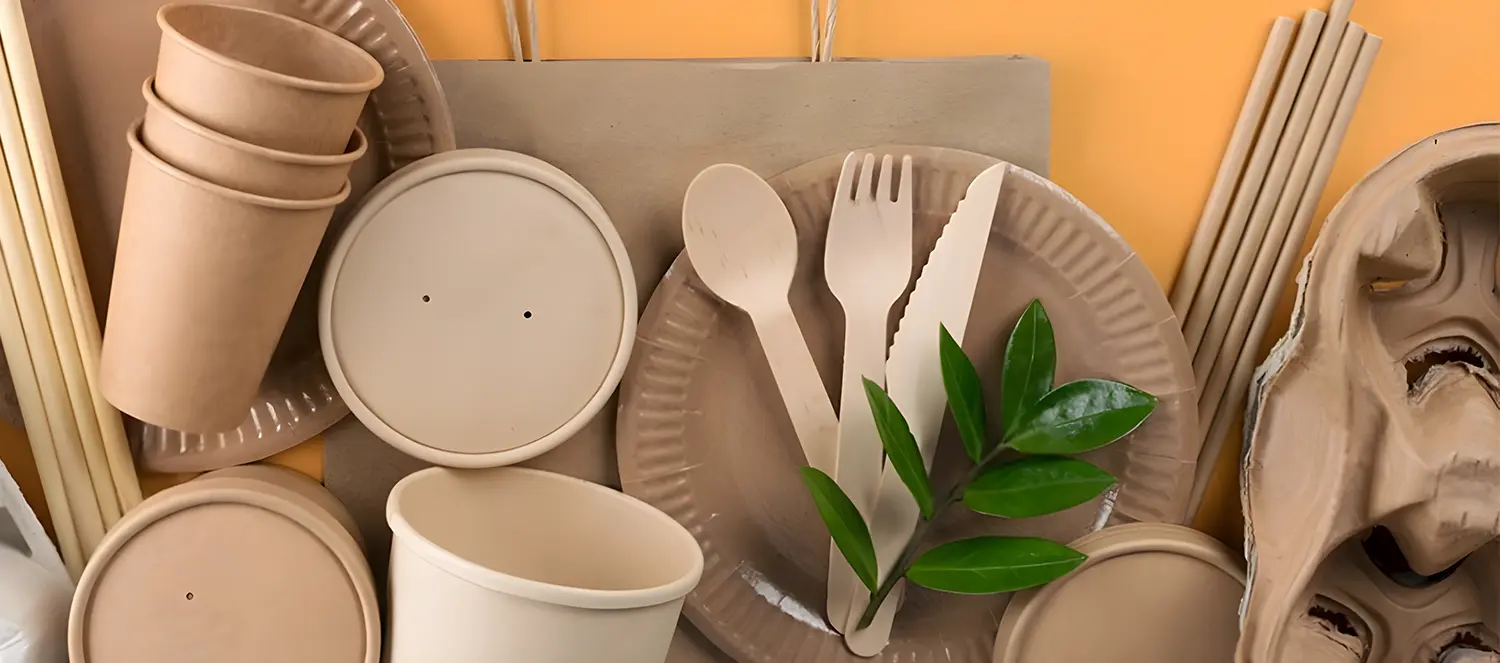
- Wooden or bamboo cutlery sets — for all food service formats
Sourcing all components from a single wholesale supplier simplifies procurement logistics, ensures consistent compliance documentation and provides a single point of contact for EU compliance requirements.
Wholesale Sourcing Guide
For restaurants and horeca distributors sourcing wooden or bamboo cutlery at wholesale volume, the key criteria are certification, format availability, production consistency, lead times and logistics.
- FSC or equivalent certification — confirm sustainable sourcing for your specific format and origin
- EU food contact compliance documentation — Declaration of Compliance for all formats
- Format availability — fork, knife, spoon, teaspoon, chopstick and pre-packaged set formats from a single supplier
- Sample availability — test under your real service conditions before bulk orders
- Production consistency — confirm dimensional consistency across batches, particularly for pre-packaged sets
- Lead times — standard and express options for your market, with buffer stock recommendations for seasonal peaks
- Minimum quantities: quoted per format, size and print specification
- Import documentation — commercial invoice, packing list and transport documents (with an A.TR movement certificate for goods from Türkiye), plus the food-contact declaration of compliance for your product files. Sustainability certificates are not a customs requirement; keep them for the claims you make
Wholesale Wooden and Bamboo Cutlery for Restaurants and Horeca
Ekoroll supplies wooden and bamboo cutlery wholesale to restaurants, food delivery operations and horeca distributors across Europe. Birch wood and bamboo formats available, with the material specification for each item. Pre-packaged sets and loose formats. Direct supply from Türkiye with food contact compliance documentation and samples available on request.