The plastic coffee cup lid is one of the most commonly used single-use plastic items in European food service, and one of the most visible. It is also widely misunderstood: snap-on plastic lids on coffee cups are not banned, and EU law does not require them to be tethered. What is changing is the cost and the perception around them. National measures to reduce single-use plastic cups and lids, plastic taxes and levies in several markets, extended producer responsibility, the new EU Packaging and Packaging Waste Regulation (PPWR) and stricter rules on environmental claims are together making the conventional plastic lid a growing cost and brand question for cafés, coffee chains and horeca distributors.
The good news is that the alternatives are now mature, well tested and available at wholesale volumes. This guide covers every practical plastic lid alternative for coffee cups: what each option is, how it performs, what it costs, what the regulatory status is, and which type of operation each suits best. The goal is a decision framework, not a product catalog.
Why Plastic Lids Are Being Replaced: The Four Drivers
Understanding what is actually driving plastic lid replacement helps evaluate alternatives against the right criteria. Four drivers are operating at the same time.
Driver 1: Single-Use Plastics Directive Measures on Cups and Lids
The Single-Use Plastics (SUP) Directive (EU) 2019/904 lists “cups for beverages, including their covers and lids” among the items whose consumption member states must measurably reduce (Article 4). Countries do this in different ways: mandatory reusable options for takeaway, charges on single-use cups, or targets for food service. Cups made wholly or partly of plastic must carry the printed SUP marking (Article 7), and producers of plastic cups and lids pay into extended producer responsibility schemes (Article 8). Expanded polystyrene cups are banned outright (Article 5).
A common misreading is worth correcting: the tethered-cap rule (Article 6, since 3 July 2024) applies to caps and lids of beverage containers up to 3 liters, such as bottles and composite beverage cartons, not to cups. Snap-on plastic lids on coffee cups are legal and do not have to be tethered. The pressure on plastic lids comes from consumption-reduction measures, costs and customer perception, not from a tethering obligation.
Driver 2: Plastic Taxes and Levies
Several markets put a direct cost on plastic packaging, including cup lids:
- UK (not EU): Plastic Packaging Tax on plastic packaging components with less than 30% recycled plastic, £223.69 per metric ton from 1 April 2025 and £228.82 per metric ton from 1 April 2026.
- Spain: €0.45 per kilogram of non-reusable plastic packaging since 1 January 2023.
- Germany: no plastic packaging tax, but producers of certain single-use plastic products, including beverage cups and their lids, pay into the Single-Use Plastics Fund (Einwegkunststofffonds), based on quantities placed on the market since 2024.
- Italy: a plastic tax has been legislated but repeatedly postponed (now to 2027); it is not in force.
At typical lid weights of 3 to 6 grams per unit, these charges add a small but direct cost to every plastic lid, and that cost scales with volume. A lid without plastic avoids them.
Driver 3: EPR and the PPWR
Extended producer responsibility applies to all packaging, including paper and fiber: in Germany, for example, every packaging item needs VerpackG system participation and LUCID registration. Plastic items carry additional plastic-specific obligations on top (SUP EPR for plastic cups and lids, eco-modulated fees that are usually higher for plastic). The Packaging and Packaging Waste Regulation (EU) 2025/40 applies from 12 August 2026; its PFAS limits for food-contact packaging apply from that date, and recyclability criteria, harmonized labels and reuse targets follow in stages from 2028 to 2030.
Driver 4: Customer Perception and Claims Rules
The plastic lid is one of the most visible single-use plastic items in daily life, and customers notice it. Removing it is a tangible signal at the point of service. At the same time, the rules on what you can say about packaging have tightened: Directive (EU) 2024/825 (Empowering Consumers for the Green Transition) applies from 27 September 2026 and bans generic environmental claims such as “eco-friendly” without recognized excellent environmental performance, “climate neutral” product claims based on offsetting, and sustainability labels not based on a certification scheme. Specific, verifiable statements such as “no plastic lid” or “PE-free coating” are the safe way to communicate the change.
The Four Plastic Lid Alternatives: Complete Comparison
Four distinct alternatives to conventional plastic snap-on lids are available for food service operations. Each has different performance characteristics, cost implications, regulatory status and operational fit.
Alternative 1: Lid-Free Cups (Integrated Lid Format)
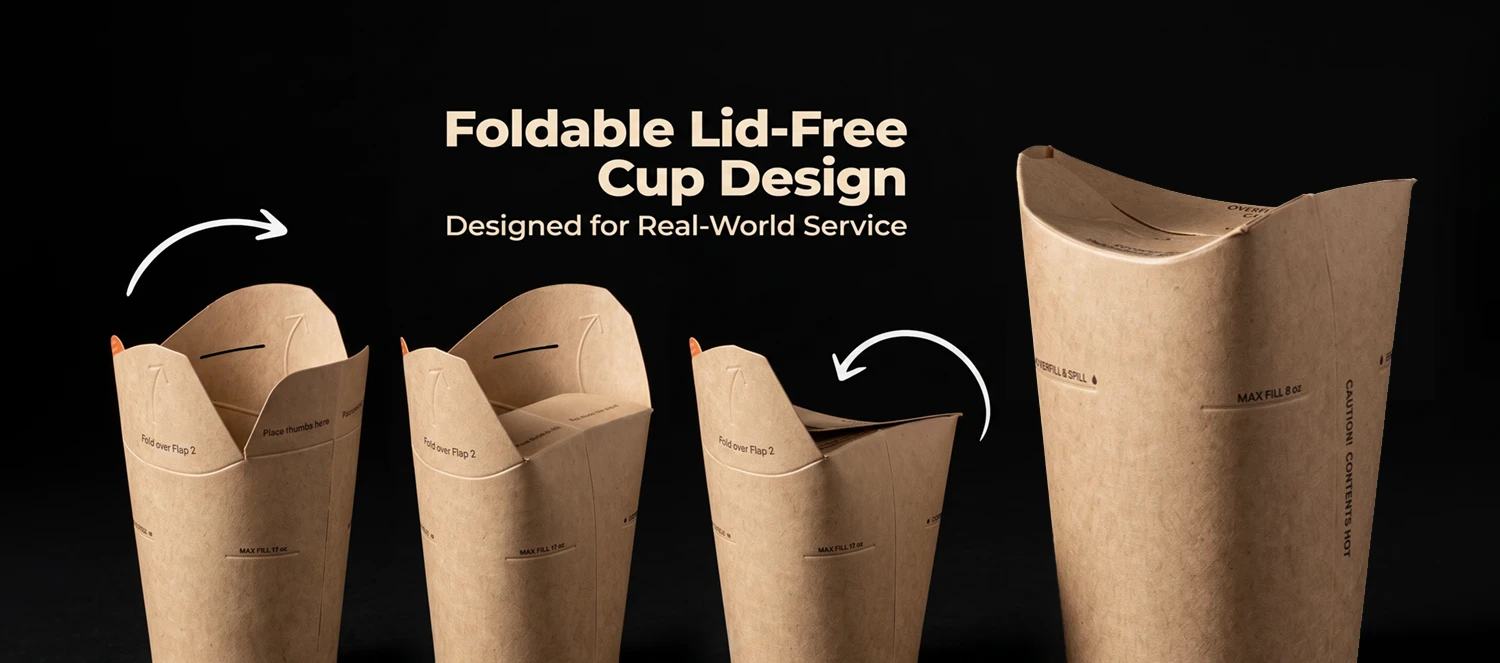
Lid-free cups, also called integrated lid cups or foldable paper cups, have the closure built directly into the cup wall. No separate lid exists. After filling, the barista folds the top of the cup along engineered score lines to create a closure with a drinking aperture. The cup is a single component.
Performance: equivalent to a conventional cup and lid for standard hot and cold beverage service. Seal integrity under normal handling and delivery is comparable to snap-on lids when the folding mechanism is properly engineered. Heat retention is comparable for typical café-to-customer transit times.
Regulatory status: with a water-based, PFAS-free, PE-free coating there is no PE lining and no plastic lid, so the lid-related plastic taxes, SUP fees and SUP marking question disappear with the lid. Confirm how your national rules classify the coated cup itself. Packaging EPR (for example VerpackG licensing) still applies to the cup, as it does to all packaging.
Cost: the cup carries a moderate unit cost premium over equivalent PE-lined cups; the difference depends on format, volume and print, and pricing is quoted per project. Lid cost is eliminated entirely, and so are the plastic charges on the lid. In markets with plastic charges, net total system cost is often comparable to a conventional cup-and-lid system.
Best for: cafés and coffee chains with consistent cup size ranges, operations wanting maximum SKU simplification, operations building PE-free, lid-free brand positioning.
Explore: lid-free hot cups and lid-free cold cups. For the complete wholesale guide see: Lid-Free Paper Cups: Wholesale Guide.
Alternative 2: Molded Fiber Lids
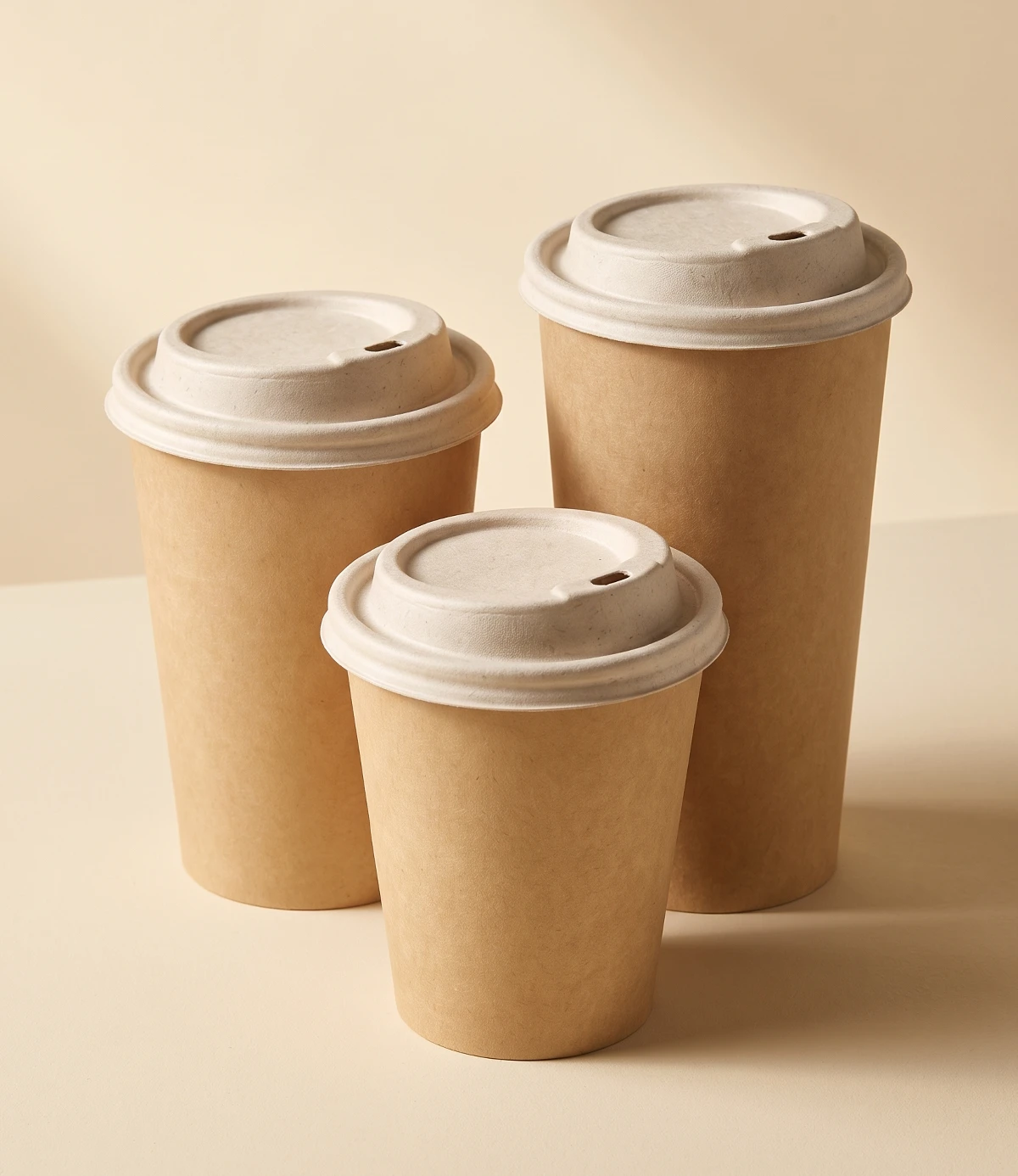
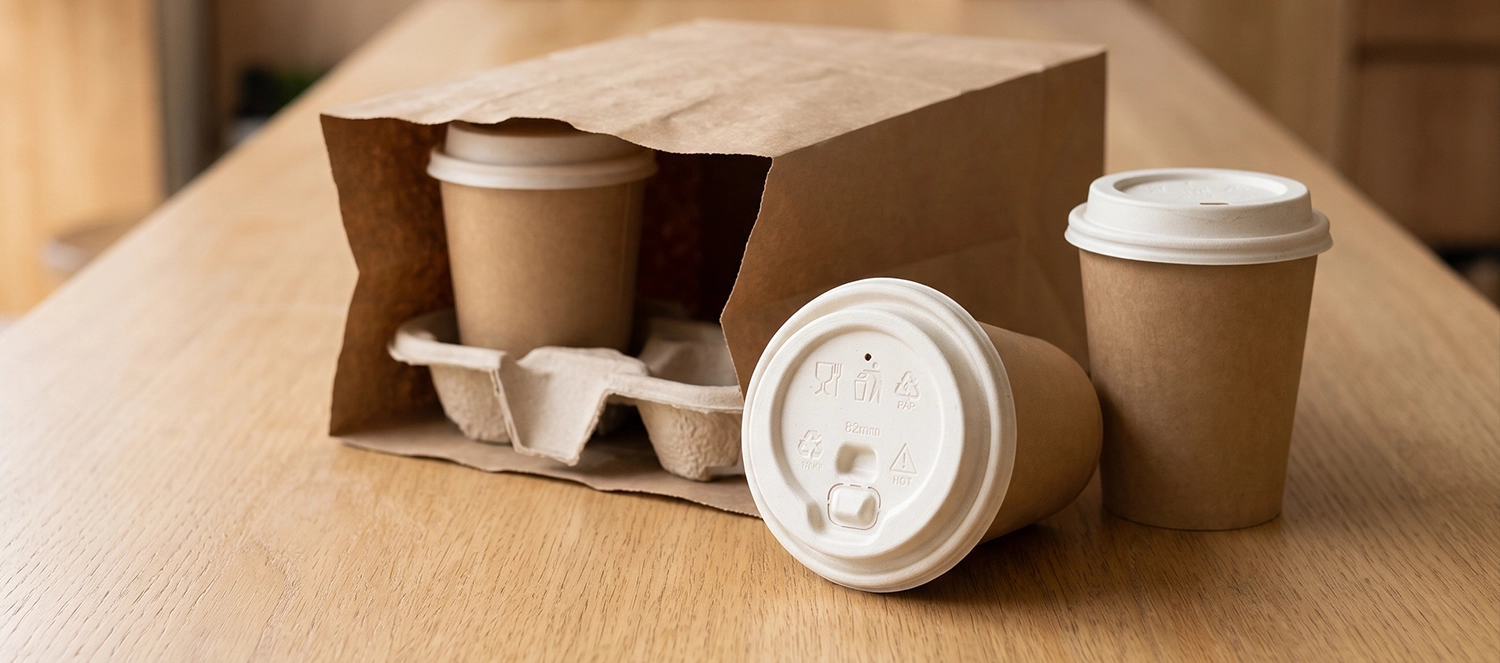
Molded fiber lids are made from pressed plant fiber pulp, typically sugarcane bagasse or other plant fibers. They fit onto conventional cup rims the same way plastic snap-on lids do, giving a familiar two-component cup-and-lid system with a fiber lid.
Performance: molded fiber lids provide adequate liquid containment for standard hot and cold beverage service. They are not as watertight as plastic lids: some moisture transfer through the fiber can occur during extended transit. For in-café service and short-distance delivery, performance is generally satisfactory. For long-distance delivery in humid conditions, test under your specific conditions before bulk ordering.
Regulatory status: a molded fiber lid without plastic content is outside the EU plastic definition, so SUP measures for plastic items, plastic taxes and the German Single-Use Plastics Fund levy do not apply to it. Packaging EPR still applies. Compostability and food-contact documentation are provided according to the final product specification and production route.
Cost: molded fiber lids typically cost more per unit than plastic snap-on lids. The difference depends on format and volume, and pricing is quoted per project. In markets with plastic charges, this premium is partly offset because those charges fall away.
Best for: operations keeping existing cup stock and replacing only the lid, operations where customers strongly prefer the familiar cup-and-lid format, and operations moving away from plastic lids as a first step before a possible switch to lid-free cups.
Explore: molded fiber lids. For a complete comparison see: Molded Fiber Lids Complete Guide.
Alternative 3: Redesigned Plastic Lids (Hinged, Recycled-Content)
Some suppliers offer redesigned plastic lids: hinged or tethered designs that stay attached to the cup after opening, lids with recycled content, or lighter designs. These are voluntary design choices, not a legal requirement for cups. They can reduce lid litter or plastic weight while keeping a plastic lid format.
Performance: comparable to conventional plastic lids for liquid containment and heat retention. A hinged design may change the drinking experience; some customers find a flapping lid less convenient than a removable one.
Regulatory status: still a plastic item: SUP consumption-reduction measures, SUP EPR and plastic taxes or levies continue to apply. Recycled content can reduce the UK Plastic Packaging Tax (the tax applies below 30% recycled plastic) but not the other charges. Does not support a “no plastic lid” claim.
Cost: redesigned plastic lids usually cost more than standard plastic lids, and the plastic-specific charges remain.
Best for: operations with a specific reason to keep a plastic lid format. Given the direction of consumption-reduction measures and plastic charges, this is usually a transitional choice.
Alternative 4: PLA or Paper Lids
PLA lids use a bio-based plastic made from plant starch. Paper lids use a layered paper construction. Both are offered as a step away from conventional PP or PS plastic lids.
Performance: PLA lids have heat sensitivity limitations — PLA softens at temperatures above approximately 55°C, which limits its use for very hot beverage service in warm environments. Paper lids have structural limits for liquid-tight applications. Neither format consistently matches plastic or molded fiber lids for hot beverage containment.
Regulatory status: PLA is plastic. Under the Commission’s 2021 SUP guidelines, bio-based and biodegradable plastics count as plastic, so PLA lids are subject to SUP measures, plastic taxes and plastic-specific EPR in the same way as conventional plastic lids. PLA is never “SUP-compliant” or “SUP-exempt” by virtue of being bio-based. Paper lids with a plastic coating or component are treated as plastic-containing items.
Best for: limited applications where the specific properties of PLA or paper fit the use case. Not recommended as a primary long-term replacement.
Full Comparison Table
| Feature | Lid-Free Cup | Molded Fiber Lid | Redesigned Plastic Lid | PLA Lid |
|---|---|---|---|---|
| Plastic content | No PE lining, no plastic lid (water-based, PFAS-free, PE-free coating) | None, if specified without plastic | Yes — PP, PS or PET | Yes — bio-based plastic |
| SUP Directive status | No plastic lid; check national classification of the coated cup | Outside the plastic definition (no plastic content) | Plastic item: SUP measures, marking, EPR | Plastic item: SUP measures, marking, EPR |
| Plastic taxes and levies (UK, Spain, Germany fund) | None on the lid | None | Yes | Yes (bio-plastic is still plastic) |
| Packaging EPR | Yes, as for all packaging | Yes, as for all packaging | Yes, plus plastic-specific fees | Yes, plus plastic-specific fees |
| Compostability | The water-based coated cup carries DIN CERTCO home compostable and industrially compostable (EN 13432) certification, held by the producing partner; copies on request | Only if certified | No | Industrial only, if certified |
| End of life | Designed for paper recycling where local collection accepts it | Depends on local collection and certification | Rarely recycled when food-contaminated | Not accepted in standard recycling streams |
| Liquid containment | Good — folded seal | Good — some moisture transfer possible | Excellent | Limited — heat sensitive |
| Hot drinks | Good — recommended fill up to 90 °C | Good — hot beverages | Suitable | Limited — softens above 55°C |
| SKUs per cup size | 1 (cup only) | 2 (cup plus lid) | 2 (cup plus lid) | 2 (cup plus lid) |
| Customer familiarity | Novel — brief explanation needed | Familiar | Familiar | Familiar |
| Supportable specific claim | PE-free coating, no plastic lid | Fiber lid, no plastic lid | No | No |
| Total system cost (markets with plastic charges) | Competitive — no lid cost, no lid charges | Higher lid unit cost, no plastic charges | Plastic lid cost plus charges | Higher — plus charges |
Which Alternative Is Right for Your Operation?
The best plastic lid alternative depends on four factors: your service environment, your current cup stock, your customer base and the markets you sell in.
Choose Lid-Free Cups If:
- You are sourcing new cups anyway and want to make one transition rather than two
- You operate in markets with plastic charges (UK, Spain, Germany’s Single-Use Plastics Fund) or national cup and lid reduction measures, where removing both the PE lining and the plastic lid has the most effect
- You want the simplest system: one SKU per cup size, no separate lid management, no lid stock-out risk
- You want a specific, verifiable statement about your cup packaging (“PE-free coating, no plastic lid”) that holds up under the claims rules applying from 27 September 2026
- Your menu is mainly standard hot and cold drinks (lattes, americanos, cold brew, iced coffee), where lid-free performance matches conventional systems
Choose Molded Fiber Lids If:
- You have existing cup stock you want to use and want to remove the plastic lid now
- Your customers strongly prefer the familiar cup-and-lid format and you want to transition gradually
- You serve blended or thick drinks that you have not yet tested in a lid-free cup
- You need a drop-in lid replacement that does not change cup stock, service procedures or staff training beyond the lid itself
Keep Plastic Lids Only If:
- You have a specific reason to keep a plastic lid format that fiber or lid-free alternatives cannot meet. It is legal, but the plastic-specific charges and reduction measures remain, so treat it as a transitional choice.
Transitioning: Practical Steps
Whichever alternative you choose, the transition from conventional plastic lids follows the same sequence.
- Request samples of the format you are evaluating and test under your actual service conditions: your drinks, your serving temperatures, your delivery conditions if applicable
- Verify documentation: compostability and food-contact documentation for molded fiber lids according to the final product specification and production route, water-based coating confirmation and PFAS-free test results for lid-free cups, and an EU food-contact Declaration of Compliance for all formats
- Plan stock transition: run down existing plastic lid stock before introducing the alternative to minimize write-off, and order new stock to arrive before the old stock runs out
- Brief staff: for molded fiber lids the training need is minimal (different lid, same process). For lid-free cups, allow two to three minutes of hands-on practice per staff member
- Communicate to customers: frame the change positively and specifically. For lid-free cups, a short demonstration at handout during the first four weeks greatly reduces first-encounter friction
For the complete transition framework, see: How to Switch to Plastic-Free Packaging.
Plastic Lid Alternatives Wholesale: Lid-Free Cups and Molded Fiber Lids
Ekoroll supplies both primary plastic lid alternatives wholesale to cafés, coffee chains and horeca distributors across Europe: lid-free hot cups and lid-free cold cups with a water-based, PFAS-free, PE-free coating, and molded fiber lids. Supplied from Turkey. Quantities and pricing are quoted per project. Full documentation available.