
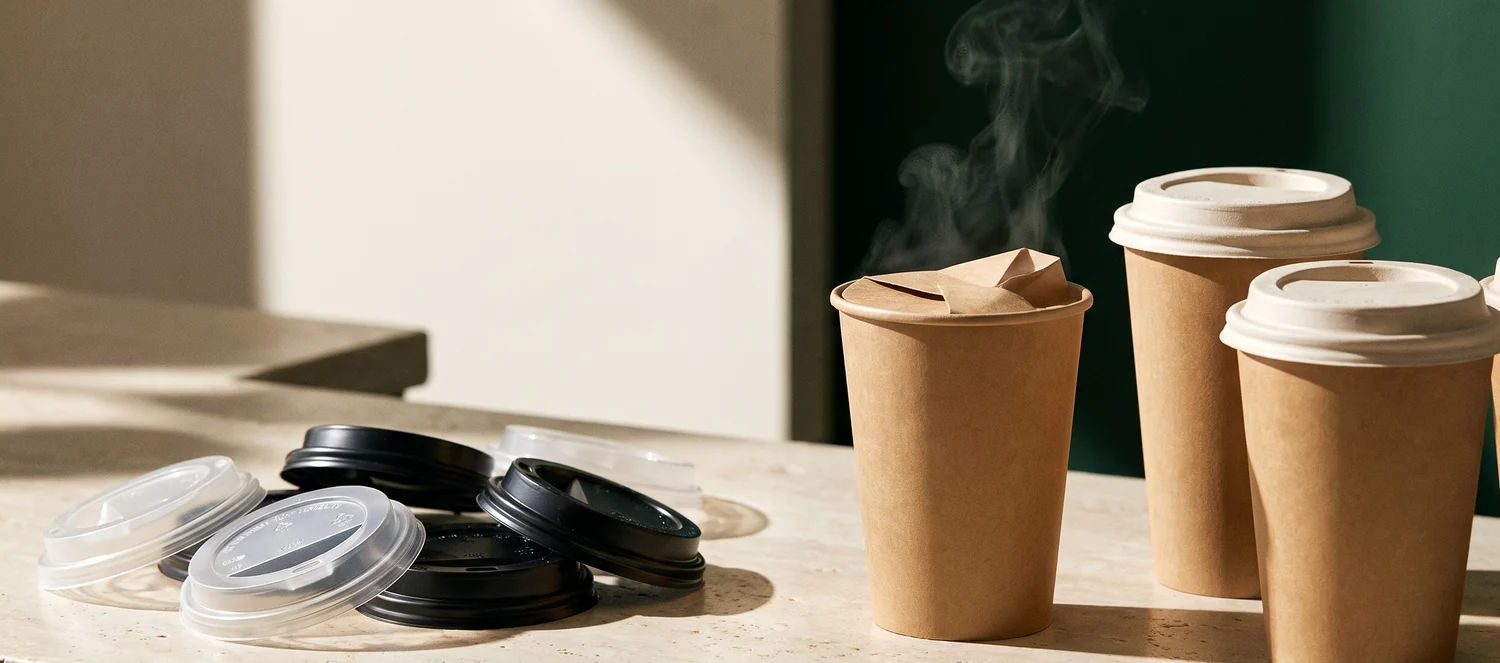
Plastic lids are being replaced across European food service, not because of a single ban, but because a set of regulatory, financial and market forces makes them more expensive and less attractive than the alternatives. It is worth being precise about what the law actually says: snap-on plastic lids on coffee cups are legal and do not have to be tethered. The pressure comes from consumption-reduction measures, plastic taxes and levies, extended producer responsibility, the new Packaging and Packaging Waste Regulation (PPWR) and tighter rules on environmental claims. Understanding these forces, and their pace, is essential for operations making sourcing decisions through 2030.
This article covers the complete picture of plastic lid replacement in Europe: the regulations that apply, the financial mechanisms reinforcing them, how adoption differs by market, and what operations at different stages should do next. For the practical guide to available alternatives, see: Plastic Lid Alternatives for Coffee Cups. For the cost analysis, see: Are Lid-Free Coffee Cups Worth It.
The Regulatory Timeline: What Has Already Happened and What Is Coming
The EU framework around single-use plastic cups and lids is a current reality, with requirements already in force and further measures phasing in through 2030.
July 2021: EU Single-Use Plastics Directive Applies
The Single-Use Plastics (SUP) Directive (EU) 2019/904 applied across EU member states from July 2021. For plastic cups and their lids it set out four things: member states must achieve a measurable reduction in the consumption of “cups for beverages, including their covers and lids” (Article 4); cups made wholly or partly of plastic must carry a printed marking (Article 7); producers of plastic cups and lids fall under extended producer responsibility (Article 8); and cups made of expanded polystyrene are banned (Article 5). Under the Commission’s 2021 guidelines, bio-based and biodegradable plastics such as PLA count as plastic, so they are not an exemption route.
2022 to 2024: EPR Schemes Expand
Extended producer responsibility for packaging applies to all packaging, including paper, fiber and bagasse. In Germany, for example, every packaging item placed on the market needs VerpackG system participation and LUCID registration. On top of general packaging EPR, the SUP Directive adds plastic-specific EPR for plastic cups and lids, and many schemes use eco-modulated fees that are higher for plastic. A separate plastic lid is a separate plastic item in this reporting; a fiber lid without plastic or a lid-free cup removes it, but packaging EPR for the cup and any fiber lid remains.
2022 to 2024: Plastic Taxes and Levies Take Effect in Some Markets
Only some markets put a direct charge on plastic packaging such as cup lids:
- United Kingdom (not EU): Plastic Packaging Tax since 1 April 2022 on plastic packaging components with less than 30% recycled plastic; £223.69 per metric ton from 1 April 2025 and £228.82 per metric ton from 1 April 2026
- Spain: tax of €0.45 per kilogram of non-reusable plastic packaging since 1 January 2023
- Germany: no plastic packaging tax; producers of certain single-use plastic products, including beverage cups and their lids, pay into the Single-Use Plastics Fund (Einwegkunststofffonds), based on quantities placed on the market since 2024
- Italy: a plastic tax of €0.45 per kilogram has been legislated but repeatedly postponed, now to 2027; it is not in force
- France: no per-kilogram plastic packaging tax; eco-modulated EPR fees under the AGEC law
- Portugal: a €0.30 contribution per single-use plastic or aluminium take-away or delivery meal package; a per-package levy on meal containers, not a per-kilogram packaging tax
The EU’s “plastic own resource” (€0.80 per kilogram of non-recycled plastic packaging waste) is paid by member states to the EU budget; it is not a tax on companies, although it gives governments a reason to reduce plastic packaging.
A standard plastic snap-on lid weighing 4 to 6 grams carries these charges on every lid in the markets where they apply, and at café or chain volumes that becomes a recurring cost on lids alone. A fiber lid without plastic, or a lid-free cup with no plastic lid, avoids them.
July 2024: Tethered Caps for Beverage Containers (Not Cups)
From 3 July 2024, Article 6 of the SUP Directive requires plastic caps and lids on beverage containers of up to 3 liters, such as plastic bottles and composite beverage cartons, to stay attached to the container during use. This rule is often wrongly applied to coffee cups. It does not cover cups: cups are a separate category in the Directive, handled through consumption reduction, marking and EPR. Separate snap-on plastic lids on coffee cups remain legal, and no cup or cup lid needs to be “tethered-lid compliant”.
12 August 2026 Onward: PPWR Applies
The Packaging and Packaging Waste Regulation (EU) 2025/40 entered into force on 11 February 2025 and applies from 12 August 2026. From that date its PFAS limits for food-contact packaging apply (25 ppb for any single PFAS and 250 ppb for the sum of PFAS by targeted analysis, 50 ppm for total PFAS including polymeric PFAS). Recyclability criteria, harmonized labels and reuse targets follow in stages from 2028 to 2030. Most plastic cup lids are rarely recycled after food contact, so recyclability design rules add longer-term pressure on conventional lid formats.
27 September 2026: Rules on Environmental Claims
Directive (EU) 2024/825 (Empowering Consumers for the Green Transition) applies from 27 September 2026. It bans generic environmental claims such as “eco-friendly” or “sustainable” without recognized excellent environmental performance, product “climate neutral” claims based on offsetting, and sustainability labels not based on a certification scheme or set by public authorities. The separately proposed Green Claims Directive was not adopted; in June 2025 the Commission announced its intention to withdraw it. For cafés, the practical effect is that vague claims on cups are risky, while specific, verifiable statements (“no plastic lid”, “PE-free coating”) remain usable when documented.
The Financial Mechanics: Why Plastic Lids Are Getting More Expensive
Beyond the legal framework, plastic lid use is becoming more expensive through several mechanisms.
Plastic Tax and Levy Trajectory
Plastic charges are not static. The UK Plastic Packaging Tax rate is raised each April. Spain’s tax is in force, Italy’s is postponed but legislated, and Germany’s Single-Use Plastics Fund levy is charged annually. Every market that adds or raises a plastic charge increases the cost of conventional plastic lids for a multi-market operation.
EPR Contribution Trajectory
EPR fees for plastic packaging in major EU markets have generally risen since schemes were introduced, and eco-modulation makes poorly recyclable plastic more expensive than recyclable materials. Fiber and paper packaging also pay EPR fees, so the saving is the plastic-specific difference, not the whole fee.
PPWR Transition Cost
Operations using lid formats that will not meet PPWR recyclability criteria face a transition in the 2028 to 2030 period. Planned transitions cost less than rushed ones, so operations that move early avoid both the ongoing plastic charges and the cost of a late, reactive change.
The Compounding Effect
An operation using plastic lids in Spain pays plastic tax on every lid it places on the market, every year; in Germany, the Single-Use Plastics Fund levy applies to the cups and lids placed on the market. As rates and fees rise, each year of delay adds to the cumulative cost compared with switching now. The same logic applies in each market with plastic charges that an operation serves.
Market Adoption: Where European Food Service Is in the Transition
Plastic lid replacement across European food service is not uniform; adoption differs by market and by operation type.
Most Advanced Markets
The UK, the Netherlands and the Nordic countries are among the most advanced markets. In the UK, the Plastic Packaging Tax created a direct financial incentive from 2022. The Netherlands and the Nordic markets combine high consumer awareness with active national measures on single-use cups. In these markets, lid-free cups and fiber lids are now common offerings from café packaging suppliers.
Rapidly Transitioning Markets
Germany, France, Spain and Italy are in active transition. Spain’s plastic tax, Germany’s Single-Use Plastics Fund levy and national reusable-option rules, and France’s AGEC framework push chains and corporate caterers first, driven by procurement policies and sustainability reporting. Independent cafés are moving more gradually, often prompted by suppliers or customers.
Early Transition Markets
Central and Eastern European markets are at earlier stages. EU obligations apply equally, but national measures have been slower and consumer pressure is less developed. The PPWR, which applies in all member states, will narrow these differences from 2026 onward.
Operation Type Differences
Within any market, the stage of transition varies by operation type:
- International coffee chains: most advanced, driven by corporate commitments and procurement standardization across markets
- National café chains: transitioning actively, driven by sustainability reporting and competitive positioning
- Independent cafés: variable; some early adopters, many still considering, mainly driven by customer feedback and supplier recommendations
- Horeca distributors: adjusting product portfolios in response to demand from the segments above
- Corporate and institutional catering: transitioning quickly, driven by client requirements in tenders and contracts
The Three Drivers Behind Individual Business Transitions
Businesses that have moved away from conventional plastic lids usually name one of three primary drivers, and most cite a combination.
Driver 1: Regulatory Pressure
The concrete triggers are national consumption-reduction measures for single-use cups (charges, mandatory reusable options), plastic-specific EPR and levies, and the PPWR timeline. Operations that manage compliance actively use these as the moment to evaluate alternatives. A tethering obligation is not among them: it does not apply to cups.
Driver 2: Cost Optimization
Finance-driven transitions usually start when someone runs a full system cost comparison including plastic taxes and levies, EPR fees and lid cost against lid-free or fiber lid alternatives. In markets with plastic charges, the total system cost of lid-free cups is often comparable to a conventional cup-and-lid system, which turns lid replacement from a sustainability cost into a cost-neutral operational change. See: Sustainable Packaging Cost Analysis.
Driver 3: Brand and Commercial Positioning
Commercial transitions are triggered by competitive pressure, customer feedback or a brand initiative. In markets with high consumer awareness, a visible “no plastic lid” change is a differentiator. Corporate and institutional food service accounts increasingly ask suppliers for specific packaging credentials, which makes lid replacement a revenue-qualification issue as well as a cost question.
What Operations at Different Stages Should Do
Not Yet Started: Immediate Priority Actions
- Check the rules that actually apply to your cups in each market: national single-use cup measures, SUP marking for plastic-containing cups, EPR registration (for all packaging) and any plastic tax or levy
- Calculate the plastic-specific charges on your cup lids in each market; this is a direct ongoing cost that quantifies the financial case for switching
- Request samples of lid-free cups and fiber lids for testing under your specific service conditions; do not commit to formats you have not tested
In Evaluation: Moving to Decision
- Run a full total system cost comparison including plastic charges, EPR fees and logistics, not just unit price
- Verify supplier documentation: EC 1935/2004 food-contact compliance, PFAS-free test results (PPWR limits apply from 12 August 2026) and compostability certificates where you plan to mention them. These documents determine which specific claims you can make
- Plan the stock transition: run down existing plastic lid stock before introducing alternatives, and order new stock to arrive before the old stock runs out
In Transition: Managing the Change
- Train all customer-facing staff before launch day; consistency at handout is the most important factor in customer experience during the transition
- Frame the change positively, not “we no longer have plastic lids” but “we have moved to a cup with a built-in closure”
- Monitor customer feedback in the first four to six weeks and separate one-time novelty comments from structural complaints that need a response
Completed Transition: Optimizing the Position
- Build your claims documentation now: compile the certificates and test results behind each specific packaging statement, in line with the rules applying from 27 September 2026
- Use the transition as a commercial story in B2B contexts; corporate and institutional buyers value demonstrable, specific credentials such as no plastic lid, PE-free coating and fiber lids
- Review annually: certificates expire, supplier formulations change and rules evolve, so an annual review keeps your documentation current
Molded fiber lids are the leading drop-in replacement; see our complete guide to molded fiber lids for formats and compatibility.
Plastic Lid Alternatives: Wholesale Supply for European Markets
Ekoroll supplies the two primary plastic lid alternatives wholesale to cafés, coffee chains and horeca distributors across Europe: lid-free hot cups and lid-free cold cups with a water-based, PFAS-free, PE-free coating and no plastic lid, and molded fiber lids. Supplied from Turkey. Quantities and pricing are quoted per project. Product documentation available on request.