Custom paper bags, usually custom printed paper bags, are kraft or white paper bags printed with your logo and brand colors, used to carry takeaway, delivery and retail orders. The right bag depends on three choices: the construction (flat-bottom without handles, twisted handles, flat handles or die-cut handles), the size of the largest item it must carry flat, and the paper and print method that show your design well. For bags that touch food, the paper and the inks must also meet EU food-contact rules.
This guide compares the main bag types, explains how to size a bag to your order, shows how kraft and white paper change the print, summarizes the EU rules that apply, and ends with a checklist for briefing a supplier of custom paper bags.
What Types of Paper Bags Are Used for Takeaway and Retail?
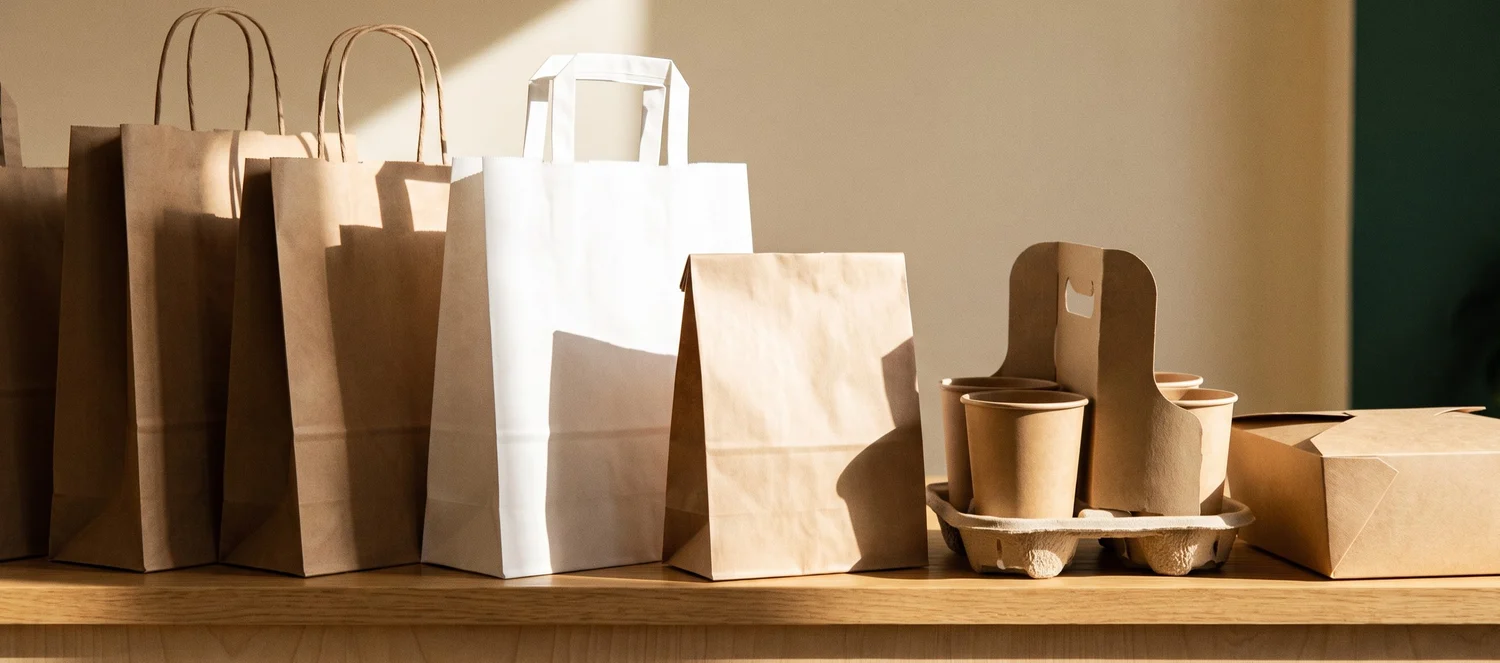
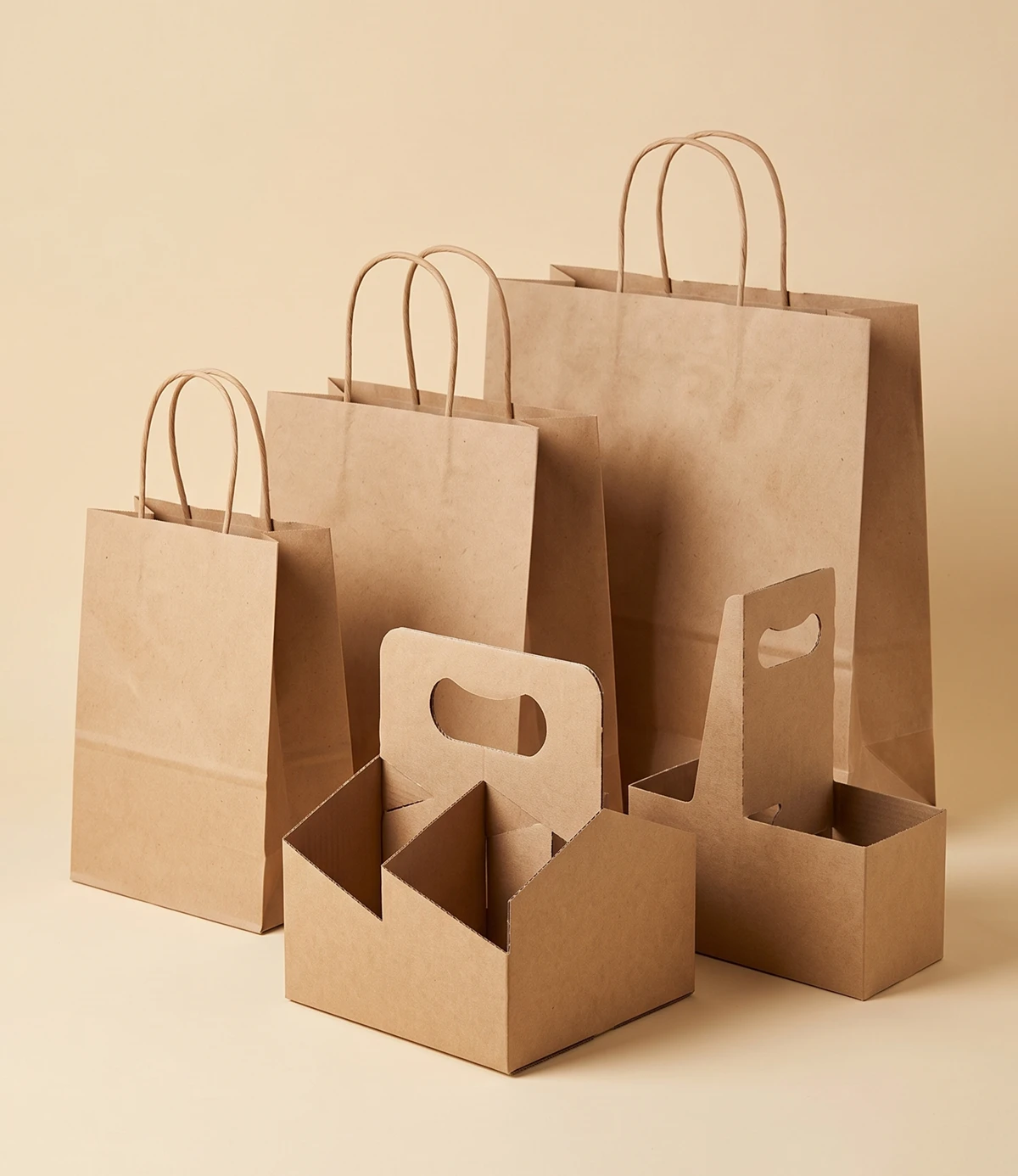
Paper bags differ mainly in how they are carried and how they stand. Four constructions cover most food-service and retail needs:
- Flat-bottom bags without handles. A flat rectangular base lets the bag stand open on the counter while it is filled. Used for single meals, bakery orders, grocery items and as an inner bag in delivery.
- Carrier bags with twisted paper handles. A twisted paper cord is glued inside the top edge. Comfortable to hold, suitable for heavier orders, and often chosen for retail and premium takeaway.
- Carrier bags with flat paper handles. A flat paper strip is glued inside the top edge. The common choice for quick-service and delivery orders, where many bags are packed quickly.
- Bags with die-cut handles. The handle is a hole punched through a reinforced top. A clean shape for boutiques and gift retail, usually for lighter contents.
Small flat or V-bottom bags, with or without a window, are a separate group: they hold croissants, sandwiches, pastries and snacks in direct contact with the food.
How Do the Bag Types Compare?
| Bag type | Typical use | Load comfort | Print area | Relative cost |
|---|---|---|---|---|
| Flat-bottom, no handle | Single meals, bakery, inner bag for delivery | Carried in the hand or arm; best for light orders | Front, back and gussets | Lower; quoted per project |
| Twisted paper handles | Retail, premium takeaway, heavier orders | Good for heavier loads; comfortable grip | Front, back and gussets | Higher; quoted per project |
| Flat paper handles | Quick-service, delivery, family orders | Good for everyday meal orders | Front, back and gussets | Moderate; quoted per project |
| Die-cut handles | Boutiques, gifts, light retail items | Best for light contents | Front and back, around the handle | Depends on paper and finish; quoted per project |
| Flat or V-bottom food bags | Bakery, sandwiches, snacks | Not for carrying heavy orders | Front and back | Lower; quoted per project |
The paper weight, the bag size and the number of print colors change the cost more than the handle type alone, so compare quotes on the same specification.
What Size Paper Bag Do You Need?
Start from the order, not from a size chart:
- Measure the largest item that must sit flat. Usually a takeaway box, a bowl or a cup carrier. The bag’s base (width × gusset) must take it without tilting, so sauces and drinks stay level.
- Check the height. Leave enough room above the tallest item to fold or close the top, or to keep the handles free.
- Cover your orders with two or three sizes. A small bag for a single meal and one or two larger bags for family orders keep stock simple. Bags in many sizes take more storage space and complicate reorders.
- Test with real orders. Pack a busy-hour order, carry it, and check that the bottom stays firm and nothing is crushed.
The food trays, cup carriers and paper bags page lists reference bag sizes, from 140 × 220 × 80 mm for a small order to 260 × 360 × 120 mm for a large one, next to the matching trays and carriers.
Kraft or White Paper: How Does the Print Change?
The paper is the background of your design:
- Brown kraft paper absorbs more ink. Colors print darker and warmer, and light colors such as pale yellow lose contrast. One- or two-color logos in black, dark green or white ink look clean and natural on kraft.
- White paper keeps colors bright and close to your brand colors. It suits detailed artwork, full-color designs and photos.
Common print methods are flexographic printing, used for most bag runs from one color upward, and full-color printing for detailed designs. Gusset print and a printed handle area are options to discuss with the supplier. Inside print is only for bags whose inside does not touch unpacked food, such as carrier bags for boxed orders, because the EU GMP rules do not allow printed surfaces in direct contact with food. Always approve a digital proof and, for a first order or a new color, a printed sample on the actual paper. Our guide to private label food packaging explains the artwork, proof and sample steps in detail.
Which EU Rules Apply to Paper Bags?
Food contact
A bag that touches food is a food-contact material under Regulation (EC) No 1935/2004: it must not transfer its constituents to food in quantities that could endanger human health, bring about an unacceptable change in the composition of the food, or make its taste, smell or texture worse. The good manufacturing practice rules in Regulation (EC) No 2023/2006 add a specific requirement for printing: inks on the outside of a bag must be formulated and applied so that substances from the print do not pass to the food-contact side, either through the paper or by set-off when printed bags are stacked or reeled, in amounts that would breach Article 3 of Regulation (EC) No 1935/2004. Printed bags must also be handled and stored so that this does not happen. The European Printing Ink Association’s guideline explains how ink makers and printers share this work.
For paper made with recycled fiber, ask about mineral oil residues. The German Federal Institute for Risk Assessment (BfR) notes that mineral oil from printing inks in the recycled feedstock can migrate into food, and that fresh-fiber board, mineral-oil-free inks or a functional barrier reduce the risk. For bakery and sandwich bags in direct contact, ask which fiber is used and request the declaration of compliance.
Plastic carrier bag rules
Since Directive (EU) 2015/720, EU countries have had to cut the use of lightweight plastic carrier bags, for example by capping consumption at 40 bags per person a year or by not handing them out free of charge, and the PPWR keeps this obligation. These rules target plastic bags, not paper bags. National rules can add charges or bans for other bag types too, so check the rules in each country you sell in.
Packaging and Packaging Waste Regulation (PPWR)
The PPWR has applied since 12 August 2026 and covers paper bags as packaging. Two dates matter for bags you order now:
- Labeling. Packaging must carry a harmonized, pictogram-based label on its material composition from 12 August 2028 or 24 months after the Commission’s implementing act, whichever is later. Plan the space for this label in future print artwork.
- Recyclability. From 1 January 2030 (or 24 months after the delegated acts, whichever is later), packaging may only be placed on the market if it meets recyclability grade A, B or C. Ask your supplier how the paper, glue, handles and any window or coating affect recyclability.
Since 12 August 2026, the PPWR has not allowed food-contact packaging containing PFAS above set limits, which matters for grease-resistant food bags. See PPWR explained for the full timeline.
Claims printed on the bag
Since 27 September 2026, national rules implementing Directive (EU) 2024/825 ban generic environmental claims such as “eco-friendly” or “green” on products sold to consumers in the EU unless the trader can show recognized excellent environmental performance, and specific claims must be backed by evidence. Print a claim such as “recyclable” or “compostable” only if it is true for the bag as supplied and you hold the documents.
Buyer Checklist for Custom Printed Paper Bags
Send your supplier these points with the inquiry:
- Use: takeaway, delivery, bakery or retail; direct food contact or only carrying packed food.
- Largest item: dimensions of the box, bowl or carrier that must sit flat.
- Construction: flat-bottom without handles, twisted handles, flat handles or die-cut handles.
- Paper: brown kraft or white; fresh fiber or recycled; paper weight for the load.
- Print: number of colors, brand color references, print on gussets, inside print only if the inside does not touch unpacked food, artwork file.
- Quantities: per size and per design, and how often you reorder.
- Documents: declaration of compliance for food contact, ink information, and the material details you need for PPWR labeling and your EPR reporting.
- Sample: a printed pre-production sample on the actual paper, tested with a real order.
- Packing and delivery: how bags are packed, delivery address and whether bags ship with your boxes and cups.
Ekoroll Paper Bags for Takeaway and Retail
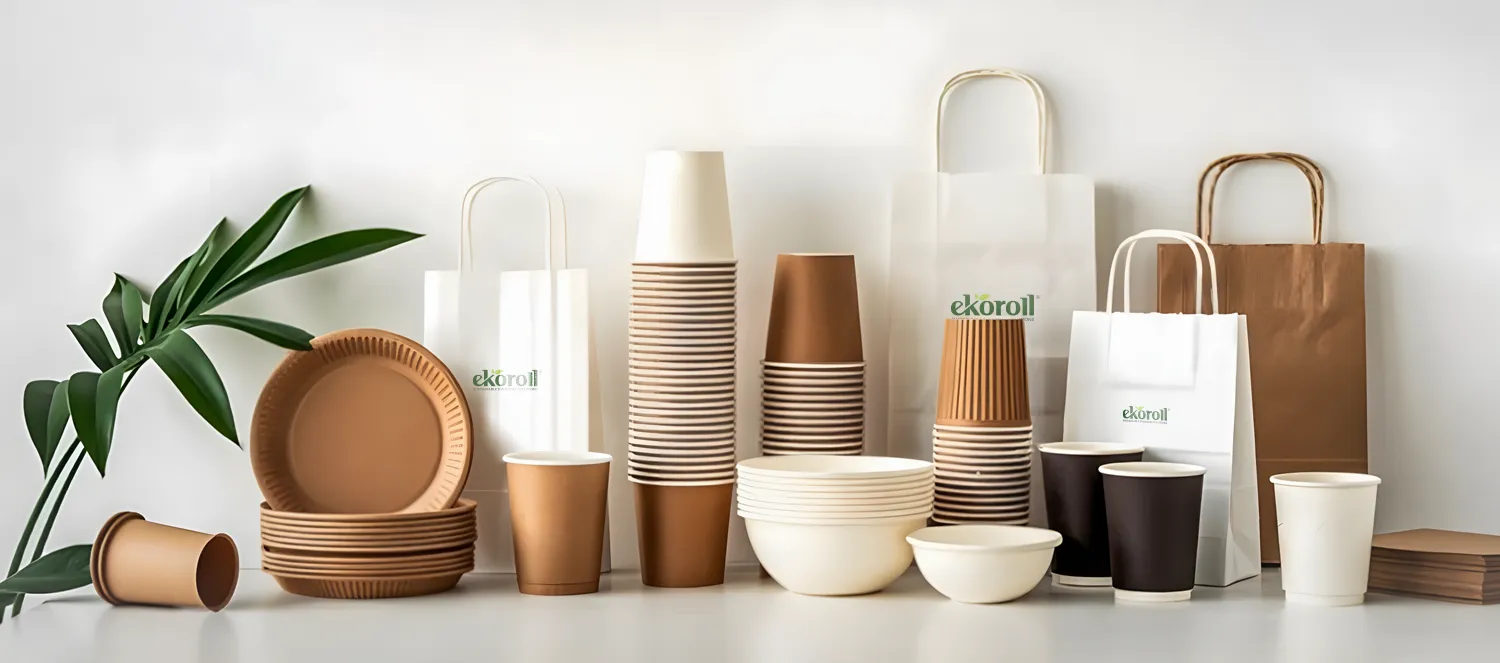
Ekoroll is a manufacturer-direct supply partner for food-service packaging. We supply wholesale kraft and white paper bags: carrier bags with twisted handles, flat handles or die-cut handles, flat-bottom bags without handles and bakery bags with a window, plain or custom printed, together with matching trays, cup carriers, boxes and cups so the whole order carries one brand look. Our design team prepares the print-ready artwork and the proof, and other bag sizes can be developed on request through our custom packaging development.
Prices, minimum order quantities and lead times are quoted per project, depending on the size, paper, print and quantity. Food-contact documentation is provided according to the final product specification and production route. Send us your order sizes and artwork through the contact form, or browse the catalog. For the wider picture of materials for food service, see our guide to eco-friendly packaging for restaurants and the article on food delivery packaging mistakes.
Products in this article
Sources
- Regulation (EU) 2025/40 on packaging and packaging waste (PPWR) — EUR-Lex
- PPWR Article 12: labeling of packaging (German text) — lxgesetze.de
- PPWR Article 6: recyclable packaging (German text) — lxgesetze.de
- PPWR Recital 100: lightweight plastic carrier bags (German text) — lxgesetze.de
- Regulation (EC) No 1935/2004 on materials and articles intended to come into contact with food — EUR-Lex
- Regulation (EC) No 2023/2006 on good manufacturing practice for food-contact materials, Annex (printing inks) — legislation.gov.uk (EU text as at 31 December 2020)
- EuPIA Guideline on Printing Inks applied to Food Contact Materials (2023) — European Printing Ink Association (EuPIA)
- New EFSA risk assessment: some mineral oil residues in food remain a health concern (Communication 35/2023) — German Federal Institute for Risk Assessment (BfR), 2023-07-27
- Plastic bags — European Commission, Directorate-General for Environment
- Directive (EU) 2024/825 on empowering consumers for the green transition — EUR-Lex