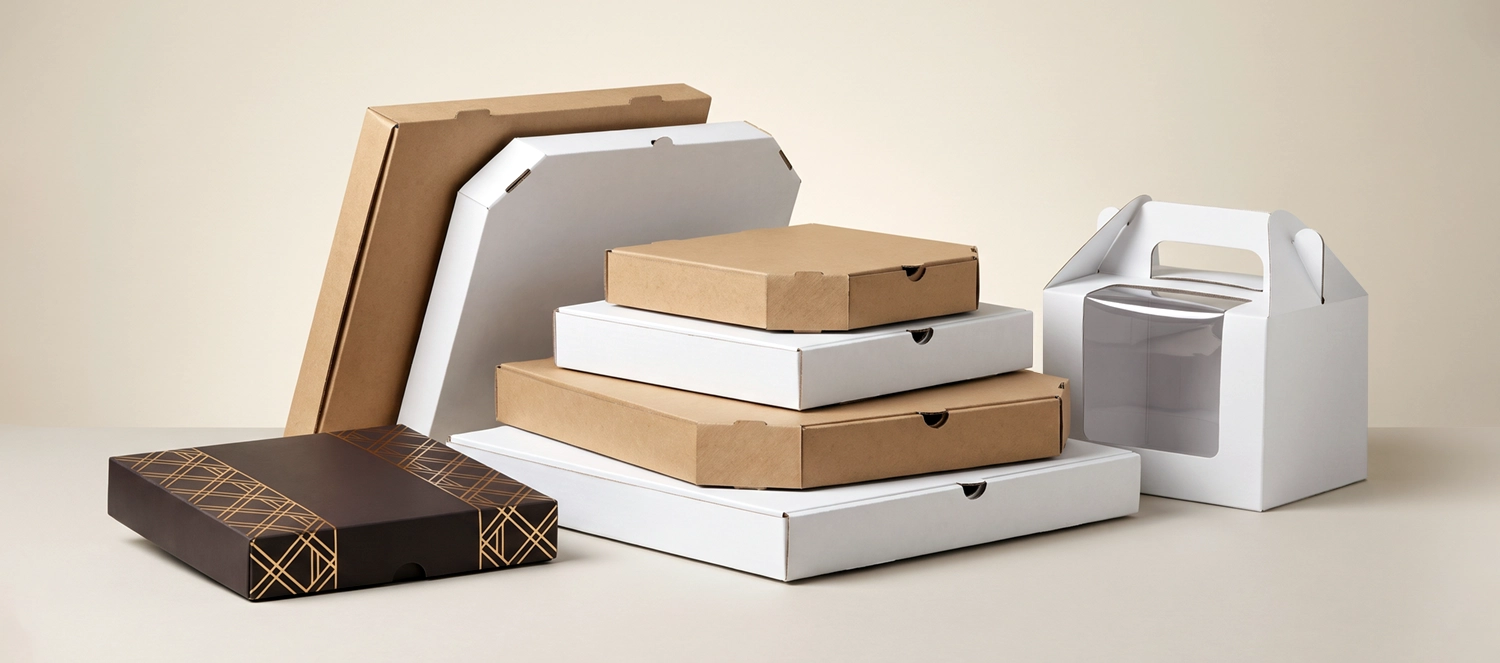
Standard pizza boxes come in 7, 9, 10, 12, 14 and 16 inches, which is about 180 × 180 mm up to 406 × 406 mm, usually 45 to 50 mm deep. Most are made of E-flute corrugated board in brown kraft or white. Cake, pastry and baklava boxes are a different product: folding boxboard, often with a window, handle or insert, built around the product they carry.
This guide gives the size chart for pizza boxes, explains flute and board in plain terms, covers cake, bakery and baklava boxes, and lists what to check before you order printed boxes.
What Are the Standard Pizza Box Sizes?
A pizza box is named after the pizza, not the box. The inside of the box is the pizza’s diameter plus a little clearance, so the crust does not press against the walls. The table shows the standard range.
| Pizza size | Pizza diameter (approx.) | Box size, folded (mm) | Typical use |
|---|---|---|---|
| 7” | 18 cm | 180 × 180 × 45–50 | Personal, kids’ menu, side pizza |
| 9” | 23 cm | 230 × 230 × 45–50 | Small, single portion |
| 10” | 25 cm | 255 × 255 × 45–50 | Small to medium |
| 12” | 30 cm | 305 × 305 × 50 | Medium, the most common delivery size |
| 14” | 36 cm | 356 × 356 × 50 | Large |
| 16” | 41 cm | 406 × 406 × 50 | Family, sharing |
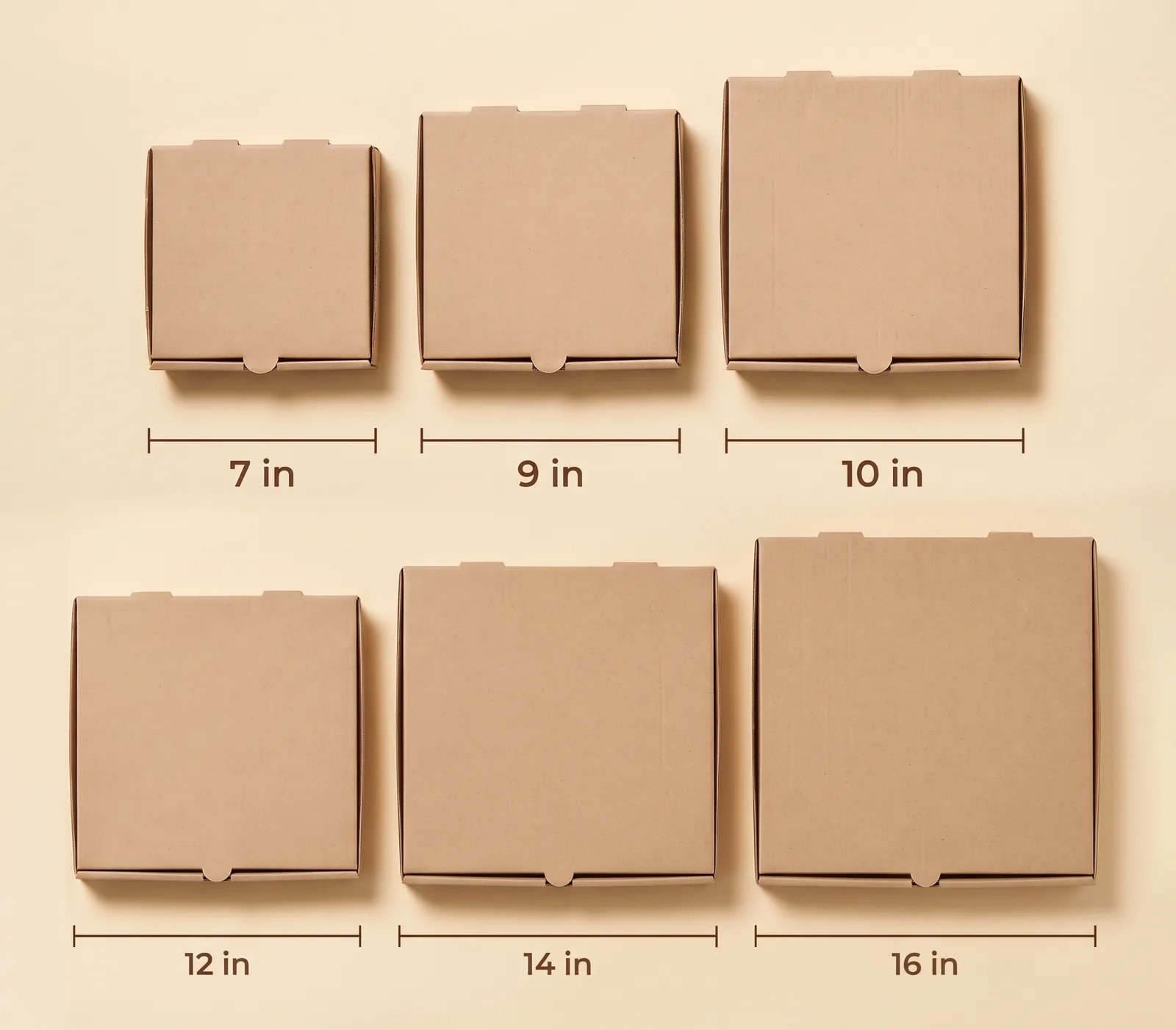
How to use it:
- Measure the baked pizza, not the dough ball. A pizza spreads in the oven. Measure five finished pizzas and take the largest.
- Depth follows the topping. 45 mm suits a thin Neapolitan or Turkish-style pide pizza; 50 mm or more suits thick crust and heavy toppings, so the lid does not touch the cheese.
- Keep the range short. Three sizes, for example 10, 12 and 16 inches, cover most menus and keep stock and print plates simple.
- Calzone, pide and lahmacun do not need round-pizza boxes: rectangular boxes or flat sleeves fit them better and use less board.
What Is the Difference Between E-Flute and B-Flute?
Corrugated board is three layers: an outer liner, a wavy middle layer called the fluting, and an inner liner. The size of the waves is the flute type. It decides how thick, strong and printable the board is.
| Flute | Thickness (approx.) | Strength and insulation | Print surface | Best for |
|---|---|---|---|---|
| F (micro) | 0.8 mm | Lower | Very smooth | Small, light boxes, premium retail |
| E | 1.6 mm | Good for most pizzas, holds heat well for its weight | Smooth, prints well | Standard takeaway pizza boxes 7–16” |
| B | 3 mm | Higher stacking strength, better insulation | Rougher, wave can show through | Very large or heavy pizzas, long stacks, catering |
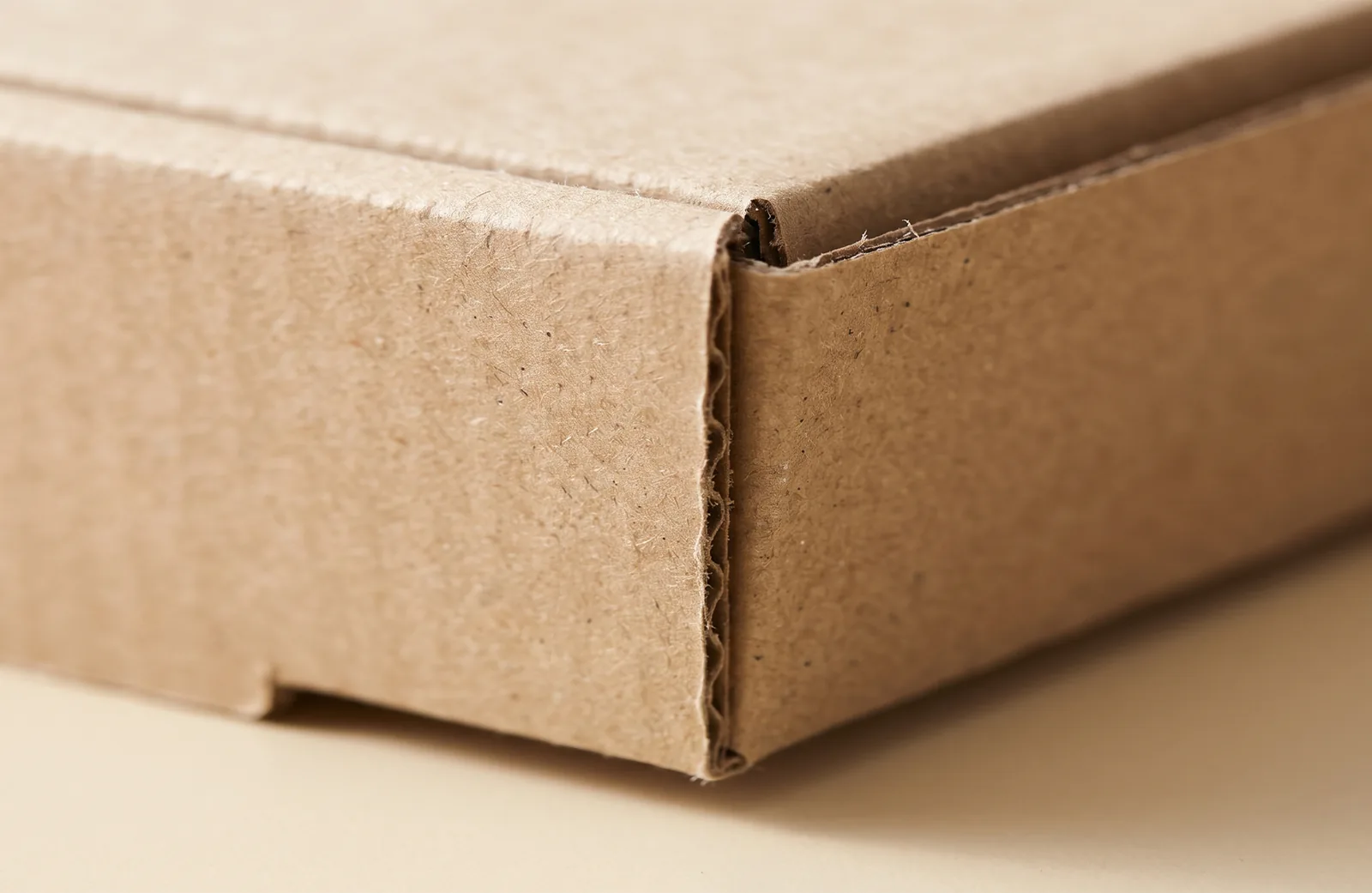
Thickness values are typical industry figures; the exact value depends on the board mill.
For most pizzerias, E-flute is the right choice: it is light, folds cleanly, keeps the pizza warm for normal delivery times and gives a good surface for your logo. Move to B-flute if your pizzas are heavier than usual, if boxes stand in tall stacks for a long time, or if you print only a simple one-color logo and want maximum stiffness.
What do board grades like “80 / 112 / 100” mean?
Suppliers describe the board as the weight of each layer in grams per square meter. A brown pizza box might be 80 g testliner outside, 112 g fluting and 100 g kraftliner inside; a white box might use 110 g white-top liner on both sides. Heavier liners make the box stiffer and more resistant to moisture from the pizza. When you compare quotes, compare these numbers and the flute type. The color alone tells you nothing about strength.
Kraft or white?
- Kraft (brown) looks natural, hides grease marks and suits one- or two-color logos.
- White shows colors truer and suits full-color designs and photos.
Both can be printed. The choice is about how the brand should look.
How Do Cake, Pastry and Baklava Boxes Differ?
Bakery boxes carry products that are fragile, sticky or sold by weight, and they are often gifts. They are usually made of folding boxboard (a single, stiff board) rather than corrugated board, because it is smoother, prints better and folds into neat shapes.
| Box | Usual board | Common features | What to decide |
|---|---|---|---|
| Cake box | Folding boxboard; corrugated for large or tiered cakes | Window, carry handle, tall lid for cream decoration | Base size and height of the tallest cake, window or not |
| Pastry and dessert box | Folding boxboard | Window, insert for single pieces, handle | Number of pieces, insert layout |
| Baklava and Turkish dessert box | Folding boxboard with a barrier inside | Tray and lid or sleeve, gold or printed finish, sizes by weight | Weight per box (for example 250 g, 500 g, 1 kg), syrup barrier |
| Cupcake and doughnut box | Folding boxboard | Insert with holes, window | Number of pieces and piece diameter |
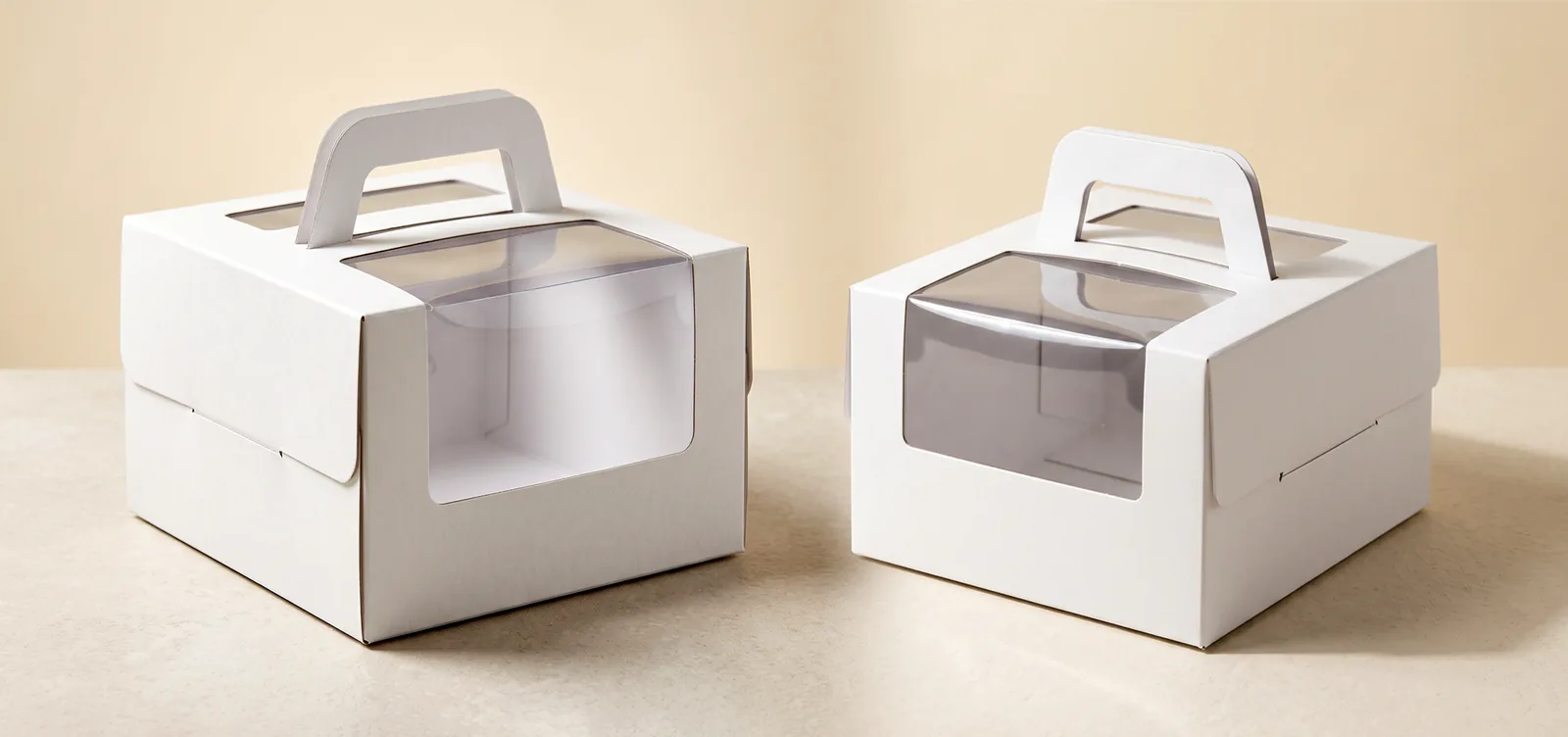
What are the standard cake box sizes?
Cake boxes are sized by the cake’s diameter: the base is about 5 cm (2”) wider than the cake, so it can be lifted out without touching the sides, and the height leaves room for cream and decoration.
| Cake diameter | Box base (approx.) | Box height (typical) | Serves (approx.) |
|---|---|---|---|
| 6” / 15–16 cm | 203 × 203 mm (8 × 8”) | 127–152 mm | 4–6 |
| 8” / 20 cm | 254 × 254 mm (10 × 10”) | 127–203 mm | 8–12 |
| 10” / 25 cm | 305 × 305 mm (12 × 12”) | 152–203 mm | 12–20 |
| 12” / 30 cm | 356 × 356 mm (14 × 14”) | 152–305 mm | 20–30 |
| Tiered cakes | to the base tier + 5 cm | 254–356 mm | — |
What are the standard pastry, cupcake and baklava box sizes?
| Box | Typical size | Note |
|---|---|---|
| 4 cupcakes or pieces | about 170 × 170 × 100 mm | Insert with 4 holes |
| 6 cupcakes or pieces | about 240 × 165 × 100 mm | Insert with 6 holes |
| 12 cupcakes or pieces | about 355 × 255 × 100 mm | Insert with 12 holes |
| Baklava, 1 kg | about 220–256 × 120–181 × 40 mm | Size depends on the cut and how many rows the shop places |
| Baklava, 250 g / 500 g / 2 kg | same height, base scaled to the weight | Made to the shop’s own layout |
These are typical market sizes, not fixed standards: cake heights, cupcake diameters and baklava cuts differ from shop to shop. Measure your largest product and confirm the inside size of the box before you print.
Three details matter most:
- Window. A window sells the product from the counter. It is a film glued behind a cut-out. Agree the film material with the supplier, since it affects how the box is sorted after use.
- Barrier. Baklava, syrupy desserts and butter pastry need a barrier inside the box so oil and syrup do not soak through. Ask for the barrier type in writing (water-based, PE or PLA) and the food-contact declaration of the finished box.
- Size by product, not by catalog. Bakery products vary more than pizzas. Send the supplier the outer size and weight of your largest product and let them propose the box.
What Should You Check Before Ordering Printed Boxes?
- Size chart from your own products. Measured pizzas or cakes, with the deepest topping or tallest decoration.
- Board specification in writing. Flute type, liner and fluting grades, kraft or white.
- Barrier and food contact. Whether there is a barrier, what it is made of, and a declaration of compliance for the finished box under Regulation (EC) No 1935/2004.
- Print method and colors. Flexo for simple one- to two-color logos on corrugated board, offset or full color for photographic designs on bakery boxes.
- Sample before production. Fold the box, fill it, close it, stack it and carry it. A box that cracks at the corner or opens in the bag fails in the street, not in the office.
- Claims on the print. Since 27 September 2026, Directive (EU) 2024/825 limits generic environmental claims such as “eco-friendly” on products sold to consumers in the EU. Print only claims you can document.
- Packing and delivery. How boxes are packed (flat, in shrink-wrapped bundles), the carton or pallet quantity and the delivery terms.
Pizza boxes stained with grease are a known problem for paper recycling, and the rules on what goes into the paper bin differ between countries and municipalities. If you sell into the EU, the PPWR (Regulation (EU) 2025/40) will add recyclability requirements for all packaging in the coming years; keep the design simple, with no unnecessary plastic parts, so the box stays easy to recycle.
Pizza, Cake and Bakery Boxes from Ekoroll
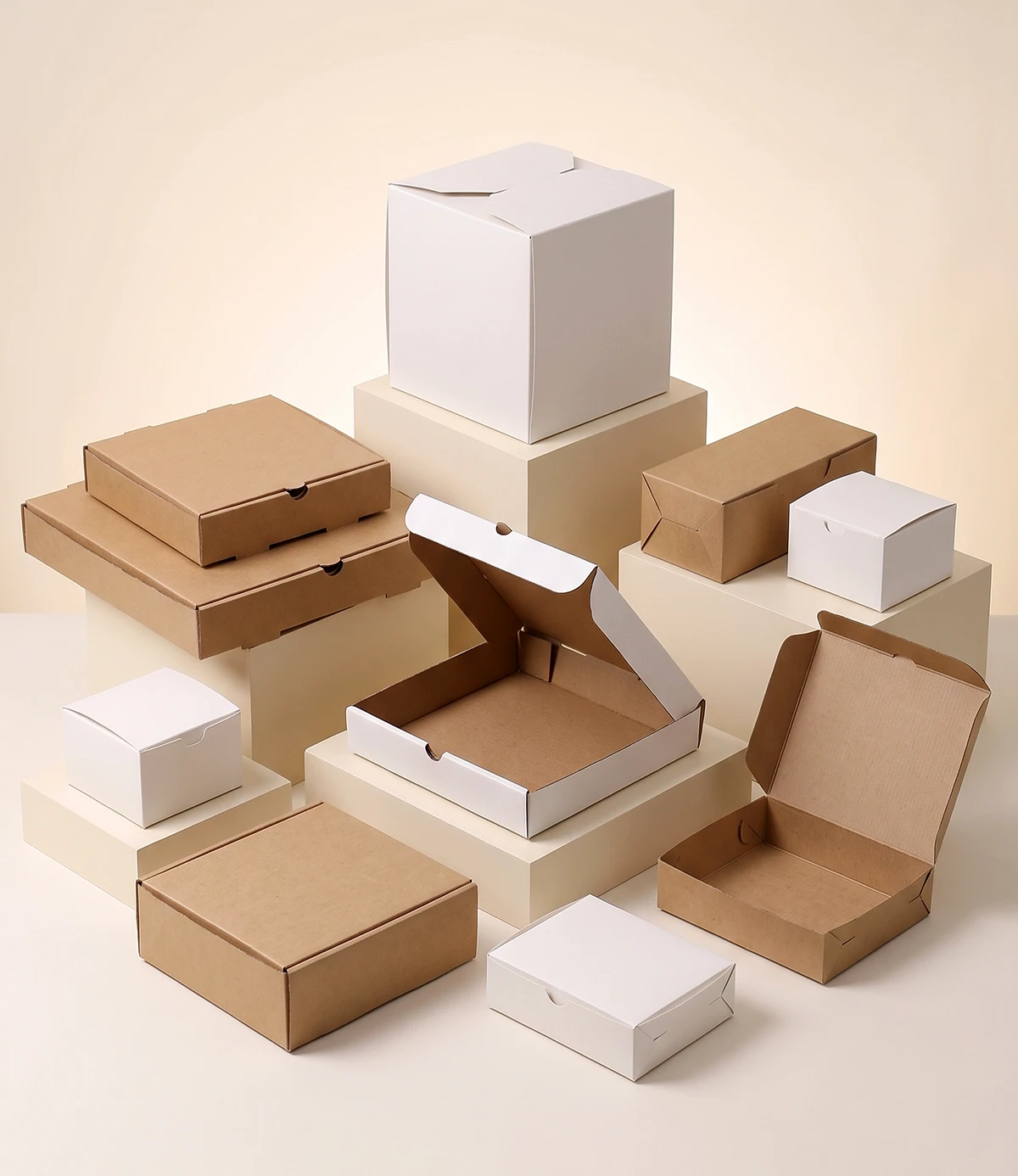
Ekoroll supplies pizza, cake and bakery boxes manufacturer-direct: E-flute corrugated pizza boxes from 7 to 16 inches in brown kraft or white, plain or printed, and cake, pastry, dessert and baklava boxes in kraft or white board, with or without a window, handle or insert. Because the boxes are made to your specification, sizes and shapes outside the standard range are possible.
Printed boxes start from 10,000 pieces per design with about 2 to 3 weeks of production, and Ekoroll quotes per project on the exact format, board and print. Graphic design support is free, and you approve a digital proof before production. For other printed formats, see custom printed boxes and the guide to private label food packaging; for burger, noodle and meal boxes, see paper takeaway boxes wholesale.
Request a quote with your sizes and quantities, or ask for samples.
Products in this article

Sources
- Corrugated fiberboard: flute sizes — Wikipedia
- Cake box sizes guide — Packaging Vista
- Regulation (EC) No 1935/2004 on materials and articles intended to come into contact with food — EUR-Lex
- Regulation (EU) 2025/40 on packaging and packaging waste (PPWR) — EUR-Lex
- Directive (EU) 2024/825 on empowering consumers for the green transition — EUR-Lex