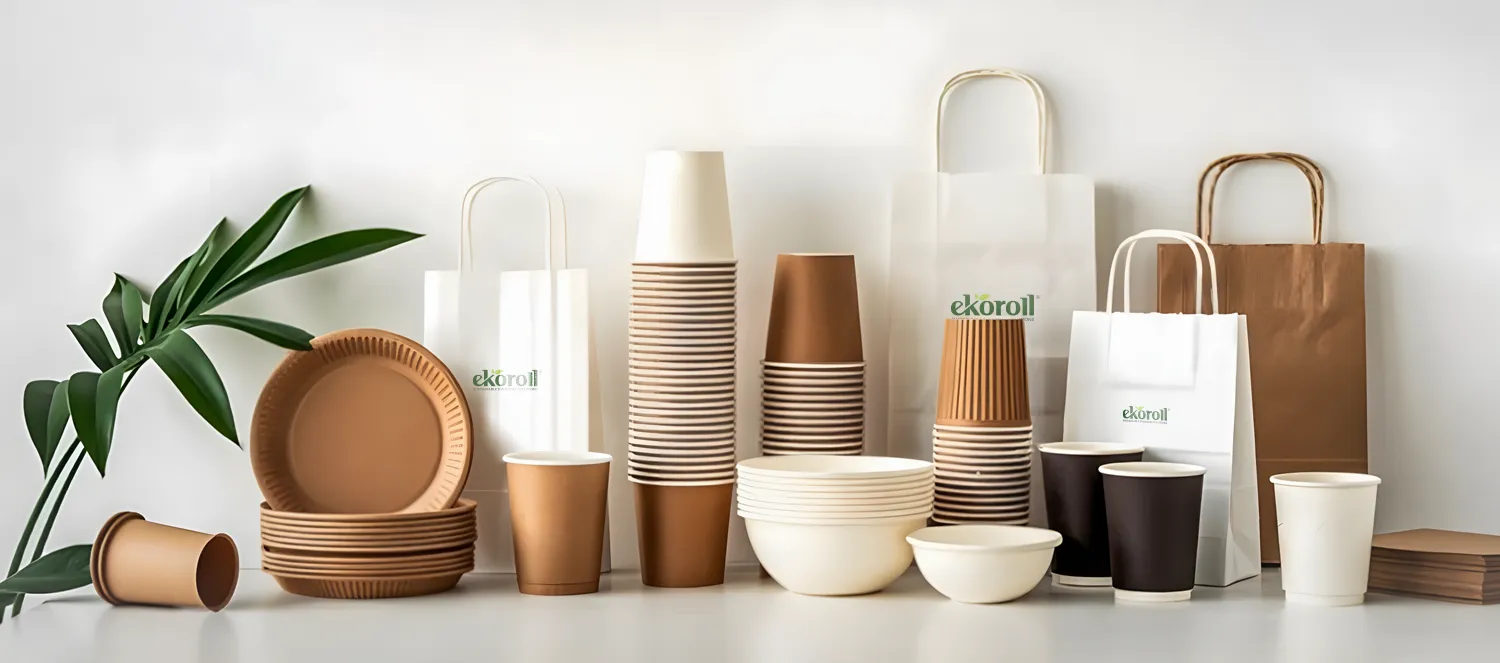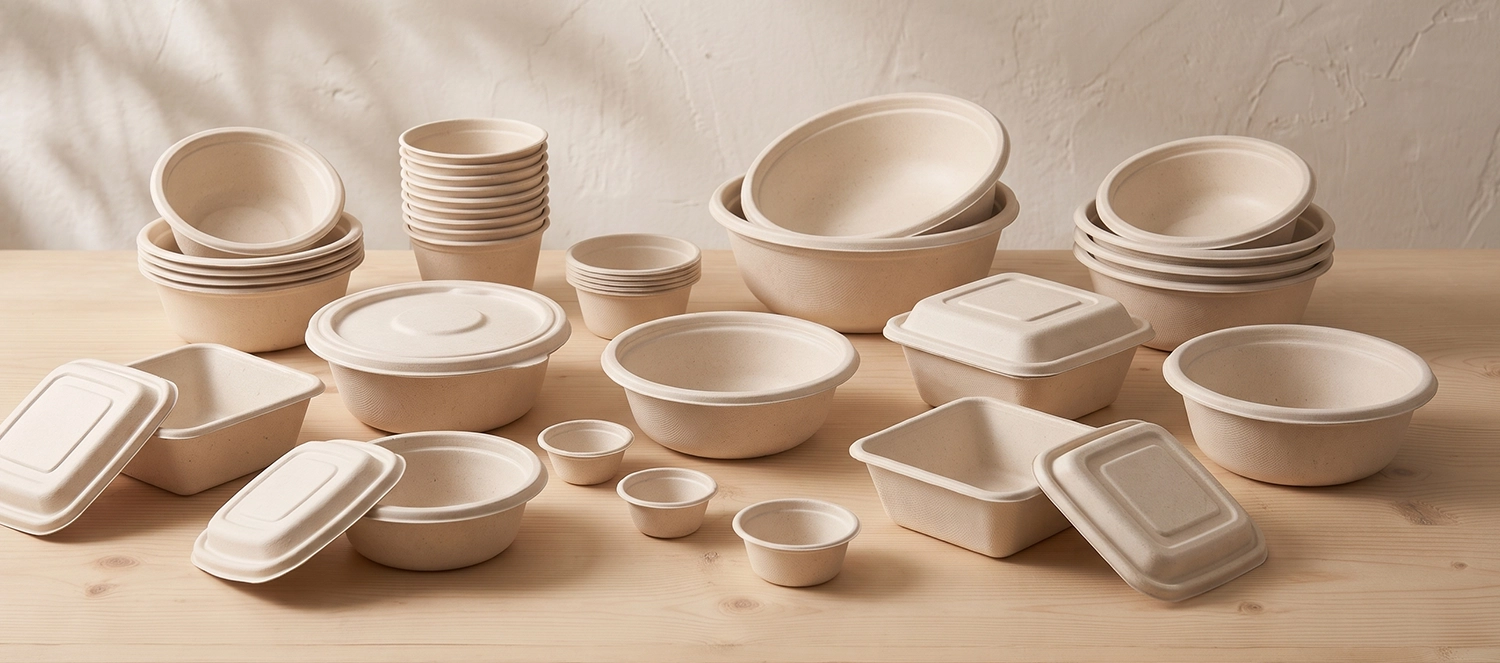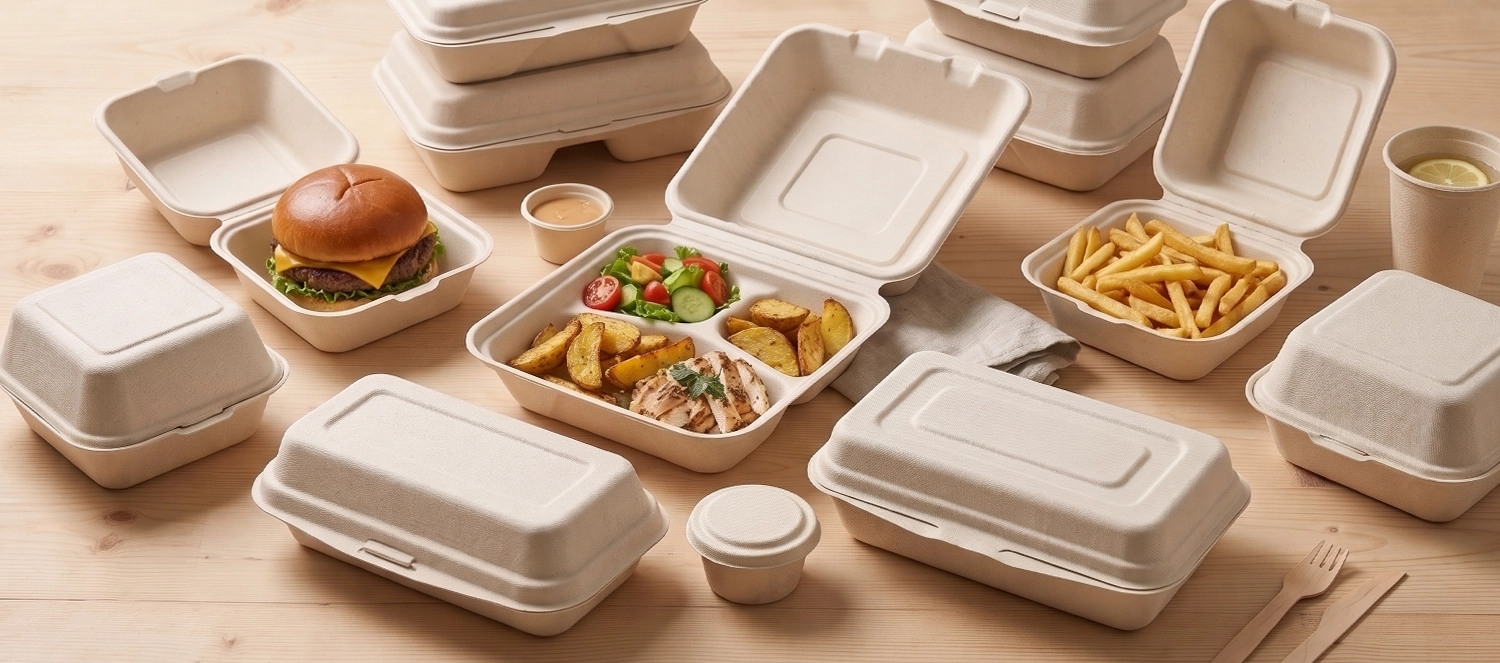
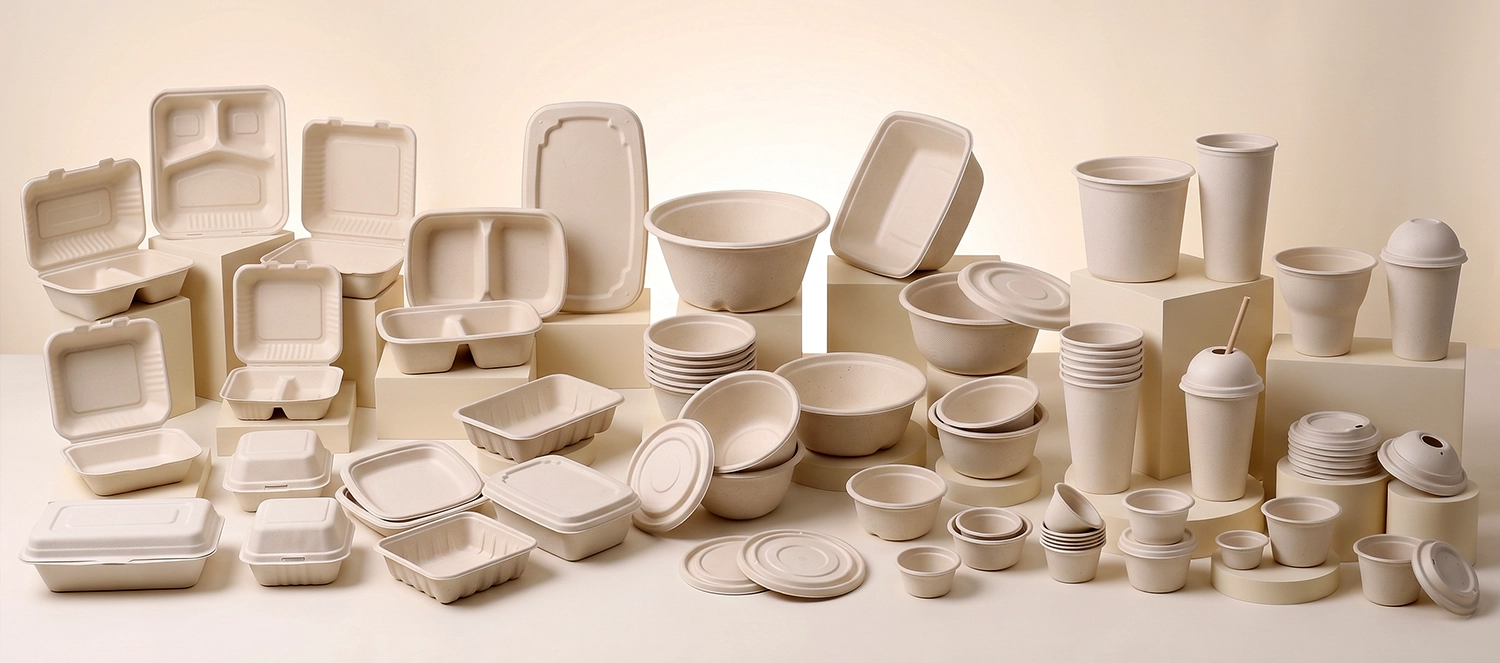
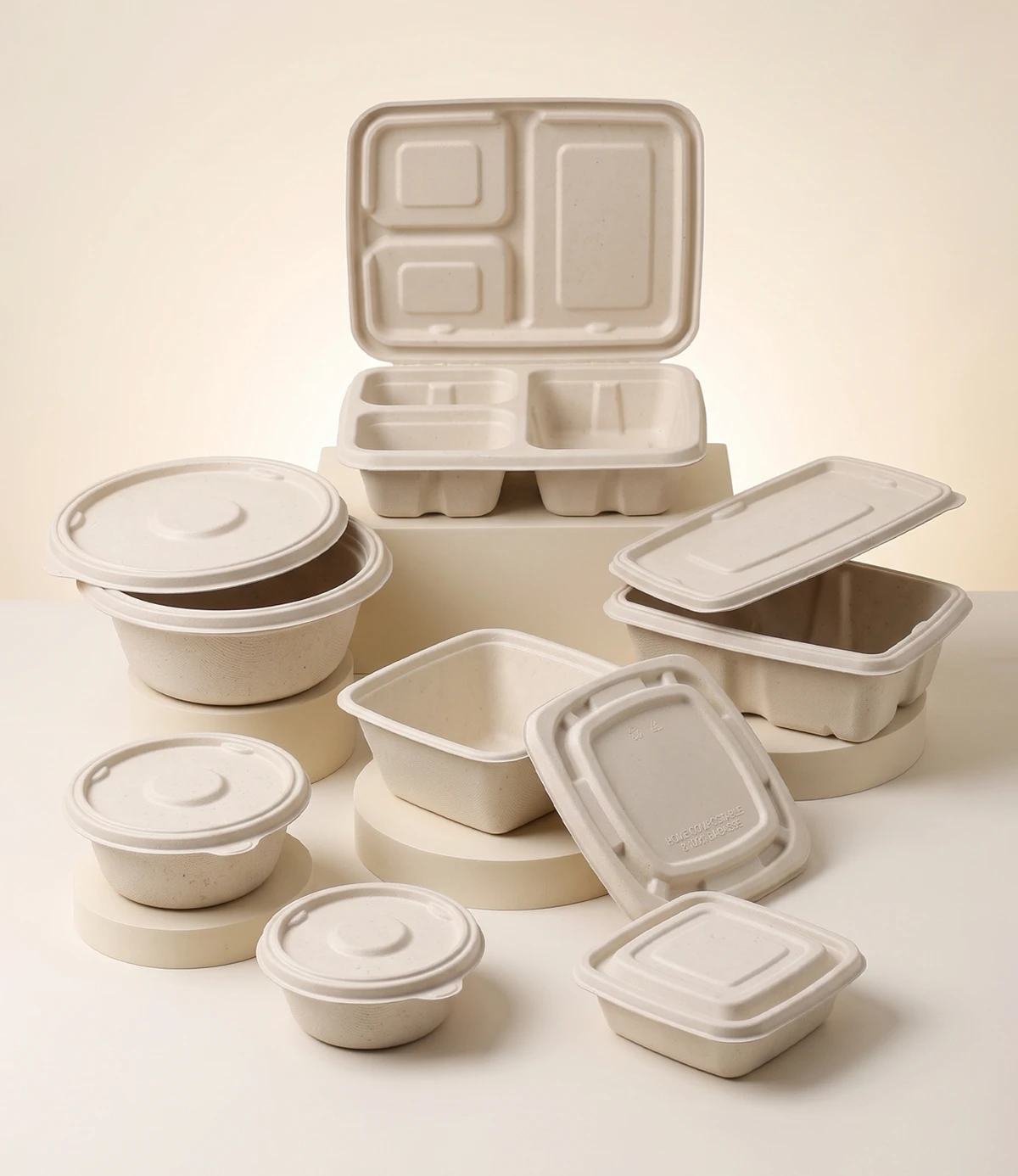
Bagasse packaging is food packaging molded from sugarcane fiber, the residue left after sugarcane is crushed for sugar. It is rigid, plastic-free when made of 100% bagasse fiber, and works for hot and cold food in clamshells, bowls, plates, meal trays, containers with lids and cups. This guide explains how bagasse containers are made, how they perform, how compostability claims work, which EU rules apply and what to ask a bagasse packaging supplier before you buy wholesale.
It is written for buyers at restaurant groups, delivery kitchens, caterers and packaging distributors who are replacing foam or plastic takeaway containers and want to compare options on facts.
What is bagasse?
Bagasse is the fibrous material left after sugarcane stalks are crushed to extract their juice. The juice goes on to become sugar; the fiber stays behind at the sugar mill in large volumes every harvest season.
That fiber is mostly cellulose, the same structural material found in wood and paper. Because it is a by-product of an existing crop, using it for packaging needs no land, water or harvest of its own. The sugar mill already collects it at one site, which makes it a practical raw material for molded fiber products.
In packaging, “bagasse” and “sugarcane fiber” mean the same thing. You will also see the broader term “molded fiber” (or “molded pulp”), which covers products made from bagasse, bamboo, wheat straw or wood pulp. This guide is about bagasse specifically.
How is bagasse packaging made?
Bagasse containers are made by wet molding, a form of fiber thermoforming. The general process is the same across the industry:
- Pulping. Bagasse from the sugar mill is cleaned and broken down in water into a fiber pulp. Some producers use bleached pulp for a white finish; others keep the natural, light-beige color.
- Additives where needed. Depending on the product, the producer adds food-safe agents to improve water and oil resistance. This step decides how the finished item behaves with sauces and grease, and whether it is free of PFAS.
- Forming. A mesh mold picks up a layer of wet pulp by suction, then the pulp is pressed between heated tools. Heat and pressure drive out the water and fuse the fibers into a rigid shape.
- Trimming. The formed items are trimmed to their final outline, so rims are clean and lids close properly.
- Inspection and packing. Items are checked for shape, thickness and defects, then counted and packed in sleeves and cartons.
The tooling, the pulp recipe and the pressing conditions are what separate a container that holds a curry through a delivery run from one that softens. That is why samples and the producing mill’s documentation matter more than the material name on a quote.
From sugar mill to packaging: how does the sugarcane value chain work?
Bagasse packaging is one use of the fiber; energy is another, and the two sit side by side.
Sugar mills have long burned bagasse in their own boilers. In modern mills this is done in combined heat and power (CHP), or cogeneration, plants: the steam runs the mill’s processes and the turbines generate electricity. The International Sugar Organization describes bagasse cogeneration as the norm in cane sugar production, powering entire mill operations, with modern mills selling surplus electricity to the national grid. Its 2023 review covers Brazil, India and Mauritius among the producing countries. In Mauritius and Réunion, sugar factories have integrated sugar and electricity production for decades, and IRENA reports that bagasse combustion in Brazil’s large sugar cane industry accounted for around 4.4 GW of grid-connected power capacity in 2010.
What this means for a packaging buyer:
- Bagasse is a genuine by-product. The mill exists to make sugar; the fiber is what remains after the juice is extracted.
- Fiber has competing uses. Part of it is burned for heat and power, part goes to packaging, paper or other products. Packaging is a higher-value use of fiber that would otherwise be burned.
- Supply follows the harvest. Fiber availability depends on the cane crop and the region. A capable supplier plans pulp supply across the year so your orders do not depend on one season.
How does bagasse packaging perform?
Bagasse makes stiff, lightweight containers that keep their shape with hot, wet and greasy food. In daily service, buyers look at five things: heat, cold, grease, liquid and the lid fit.
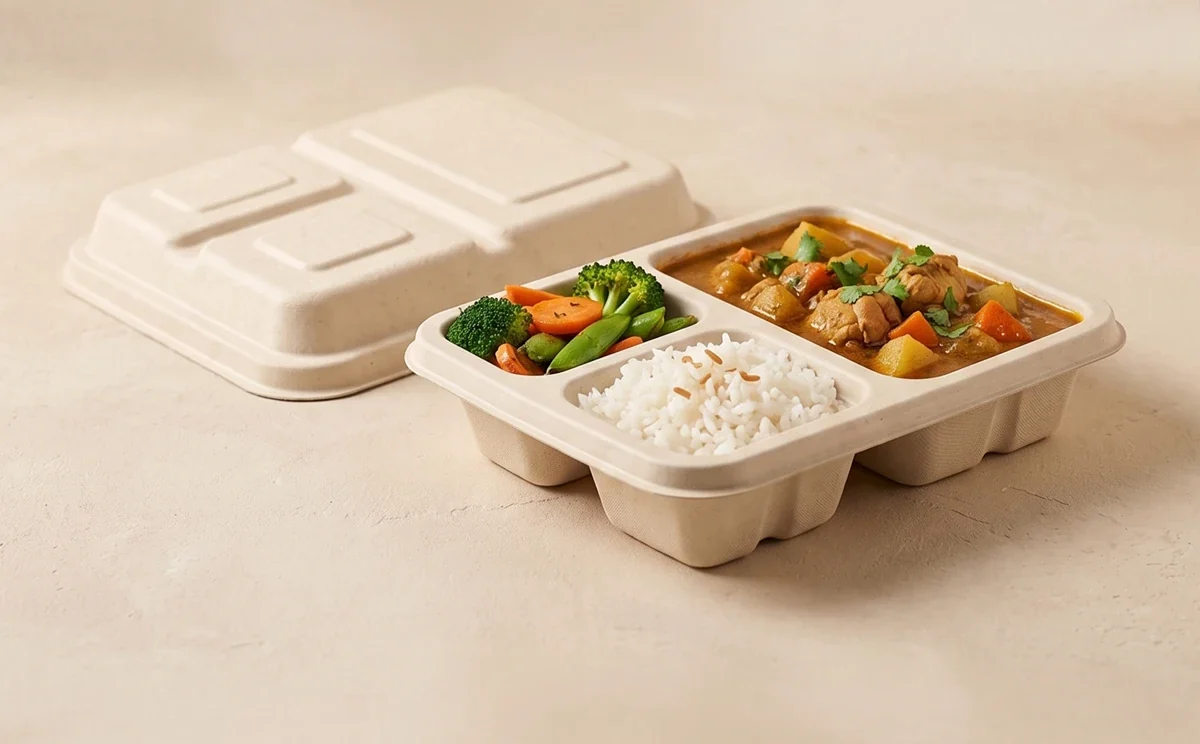
Ekoroll’s bagasse products are:
- For hot and cold food. Curries, rice, pasta, fried food, salads and desserts.
- Microwave- and freezer-safe. Suitable for reheating at the customer’s end and for frozen storage in meal-prep and catering programs.
- Water- and oil-resistant. For sauces, dressings and greasy dishes.
- PFAS-free. No per- and polyfluoroalkyl substances are used for grease resistance.
- Plastic-free. Made of 100% bagasse fiber, with no plastic lining or film.
Across the wider market these properties are not automatic. Some fiber containers rely on fluorinated chemistry for grease resistance, and some formats soften with long holding times. Always test samples with your real menu: the hottest and wettest dish, your longest delivery time and your reheating routine. Ekoroll gives no fixed temperature ratings; the right test is your own food in your own service.
For delivery-heavy menus, the rim and lid design matter as much as the fiber. Ekoroll’s leak-resistant Anti-Leak Series uses a precision-formed rim and matched lid for liquid-rich meals. Our guide to compostable takeout containers for soups and sauces explains why containers leak and how to test them, and the bagasse meal box guide covers formats and compartments for takeaway.
Is bagasse packaging compostable?
Bagasse is a plant fiber, so it can biodegrade. But “compostable” is a claim that needs evidence for the exact product, not just the material. Two different claims are used in the market.
Home compostable
Home composting happens in a garden heap or home bin, where conditions are cooler and less stable than in an industrial plant. TÜV AUSTRIA’s OK compost HOME scheme certifies products that break down completely in these home conditions. It is the stricter of the two claims because the product must break down without the controlled heat of an industrial facility.
Ekoroll’s bagasse products are home compostable & 100% bagasse, certified by TÜV AUSTRIA (OK compost HOME). The certificate is held by the producing mill, and a copy is available on request.
Industrially compostable (EN 13432)
EN 13432 is the European standard that sets requirements for packaging recoverable through composting and biodegradation. It is the reference for industrial compostability claims in the EU. It assesses four things:
- Biodegradability: whether the material is converted by microorganisms within a set test period.
- Disintegration: whether the packaging breaks into fragments small enough to disappear in the compost during biological treatment.
- No negative effect on the process: the packaging must not disturb the composting plant.
- Compost quality: the resulting compost must stay within limits, including heavy metals and ecotoxicity.
Under EN 13432, a multi-component pack is not compostable as a whole unless each component is. A bagasse base with a plastic lid, for example, is only compostable once the lid is separated. When you compare suppliers, check whether a certificate covers the complete item you buy, including its lid.
What a compostability certificate should show
Check that each certificate names the product or product family you are buying, the holder (usually the producing mill), the scheme or standard, and a valid date. A certificate for a different company or a different product does not support your claim. For the wider terminology, read our explainer on compostable vs biodegradable packaging.
Bagasse vs PLA, EPS Foam, Plastic and Paper
Most buyers choose between five material families for takeaway food packaging: bagasse, PLA or CPLA (bio-based plastic), expanded polystyrene (EPS) foam, rigid plastic such as PP or PET, and coated paperboard. The table summarizes the practical differences.
| Factor | Bagasse (100% fiber) | PLA / CPLA | EPS foam | Rigid plastic (PP, PET) | Coated paperboard |
|---|---|---|---|---|---|
| Raw material | Sugarcane fiber, a by-product of sugar production | Plastic made from fermented plant sugars (corn, sugarcane) | Fossil-based polystyrene | Fossil-based polymers | Wood fiber plus a barrier coating |
| Counts as plastic under the EU SUP Directive | No, when made of unmodified fiber | Yes (bio-based plastic) | Yes | Yes | Partly, if lined or coated with plastic |
| EU status for food containers | Allowed | Allowed; consumption-reduction rules | Banned (food and beverage containers, cups) | Allowed; consumption-reduction rules | Depends on the coating |
| Hot food | Suitable | CPLA for hot use; standard PLA softens with heat | Suitable | Depends on the polymer | Suitable with the right barrier |
| Grease and liquids | Good when the formulation, format and lid are right | Good | Good | Very good | Depends on barrier and seams |
| Rigidity | High, keeps shape when loaded | High | Low to medium | High | Medium; folded formats can open at the seams |
| End of life | Composting where certified; organic waste where accepted | Usually industrial composting only, where collected | Recycling rarely available | Recycling where collected; often not with food residue | Paper recycling depends on coating and soiling |
| Cost | Quoted per project | Quoted per project | Quoted per project | Quoted per project | Quoted per project |
No material wins on every row. Bagasse is strongest where you want a rigid, plastic-free container for hot and greasy food. Clear plastic still wins where customers must see the product, and folded paper formats are useful for dry food and printed branding.
Bagasse vs PLA and “cornstarch” packaging
PLA (polylactic acid) is made from plant sugars, but it is a plastic. The EU’s Single-Use Plastics Directive and the Commission’s guidelines treat bio-based and biodegradable plastics as plastic, so PLA cups, lids and containers stay in the scope of the Directive. PLA products are usually certified for industrial composting under EN 13432 rather than home composting, and standard PLA softens with heat, which is why hot-food items use crystallized PLA (CPLA). Products sold as “cornstarch” tableware are often starch blended with polymers such as PP or PLA; check the full composition before you compare them with 100% fiber.
Bagasse vs EPS foam
EPS foam is light and insulating, but the EU has banned food containers, beverage containers and cups made of expanded polystyrene. Bagasse clamshells, bowls and trays are among the main replacements. Many markets outside the EU have local foam bans too, so check the rules in each market you sell into.
Bagasse vs other molded fibers and palm leaf
Bamboo, wheat straw and wood pulp are molded by the same wet-molding process as bagasse; what matters is the specific product’s barrier, documentation and performance rather than the fiber name. Palm leaf plates are pressed from fallen leaves and suit plates and platters, but not containers with lids.
For deeper comparisons, see bagasse vs plastic food containers, bagasse vs paper food containers and bagasse plates vs paper plates.
Which EU rules apply to bagasse packaging?
Bagasse is not exempt from packaging law. It is simply treated differently from plastic.
Single-Use Plastics Directive (EU) 2019/904
The Directive defines plastic as a polymer material to which additives may have been added, but it excludes natural polymers that have not been chemically modified. Cellulose fiber such as bagasse is a natural polymer. Packaging made wholly of unmodified bagasse is therefore not a single-use plastic product and falls outside the Directive’s restrictions and marking rules.
Two caveats matter:
- Coatings, linings and lids. The Commission’s guidelines treat products with a plastic coating or lining as partly plastic. A bagasse item with a plastic film, or a pack with a plastic lid, brings that component back into scope.
- The foam ban. The Directive bans food containers, beverage containers and cups made of expanded polystyrene (EPS). Bagasse is one of the main replacements for these items.
Ask your supplier to confirm the full composition of each item, including any additives and the lid, so your team can classify it correctly for each market.
Packaging and Packaging Waste Regulation (EU) 2025/40
The PPWR has applied since 12 August 2026 and covers all packaging, whatever the material. For bagasse buyers the most relevant points are:
- PFAS in food-contact packaging. Food-contact packaging may not be placed on the market at or above 25 ppb for any single PFAS or 250 ppb for the sum of PFAS measured by targeted analysis, or 50 ppm for total PFAS including polymeric PFAS. Fiber packaging has historically been one of the product types where fluorinated grease-proofing was used, so PFAS test evidence belongs in every bagasse supplier file.
- Importer obligations. An EU business that places packaging made outside the EU on the EU market takes on importer obligations, including checking the manufacturer’s conformity documentation.
- Further rules follow. Recyclability criteria, harmonized labels and reuse targets apply in stages from 2028 to 2030 through delegated and implementing acts and dated provisions.
Food-contact rules
Regulation (EC) No 1935/2004 applies to every material that touches food: packaging must not transfer constituents to food in quantities that could endanger health or change the food unacceptably, and it must be traceable. Paper and fiber materials have no harmonized EU specific measure, so declarations of compliance usually also refer to national rules in the market where the product is sold. Ask for a declaration of compliance that names the product and its conditions of use.
What bagasse packaging formats are available?
A complete bagasse range covers almost every takeaway, delivery and catering need. Ekoroll supplies these families, each with its own page:
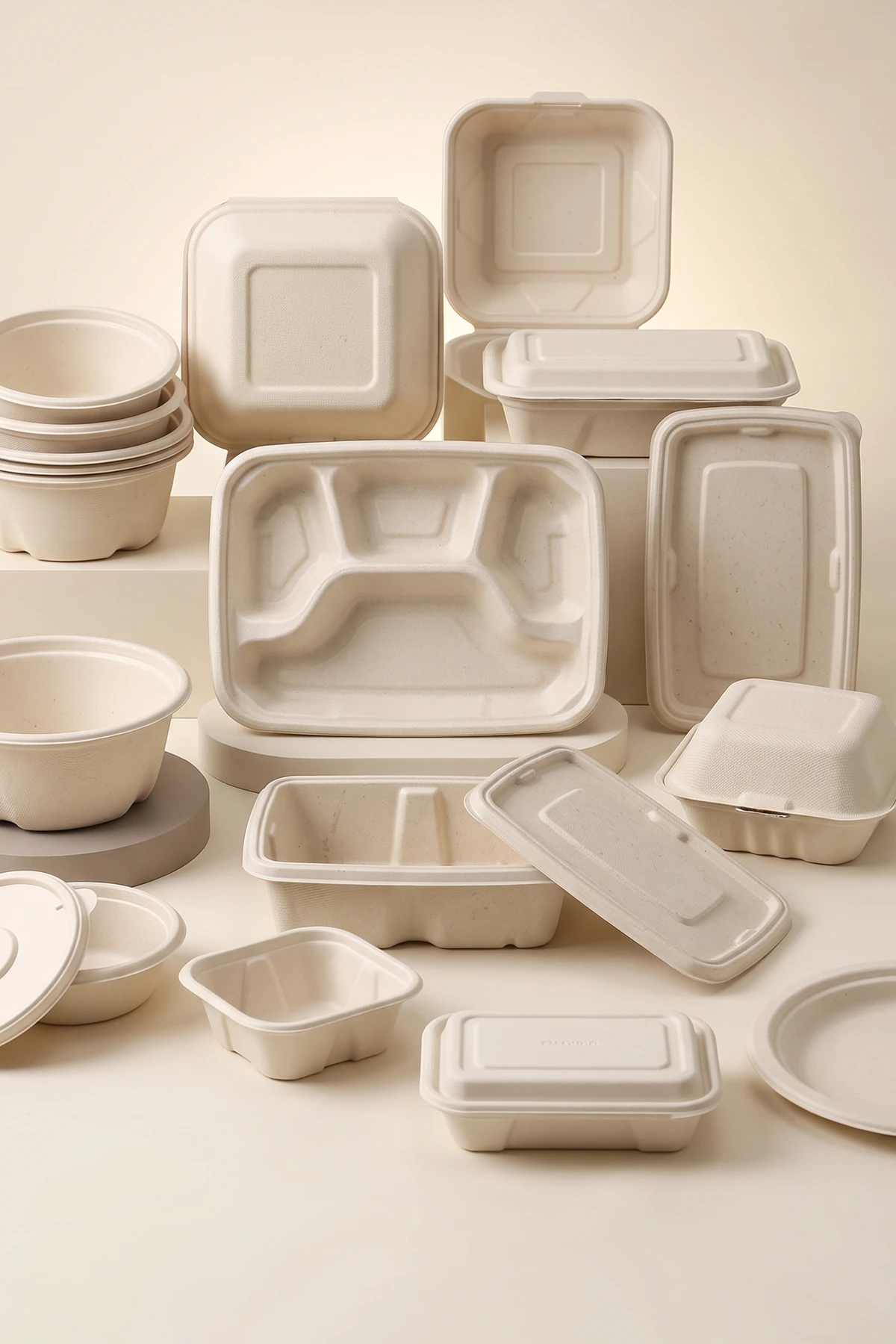
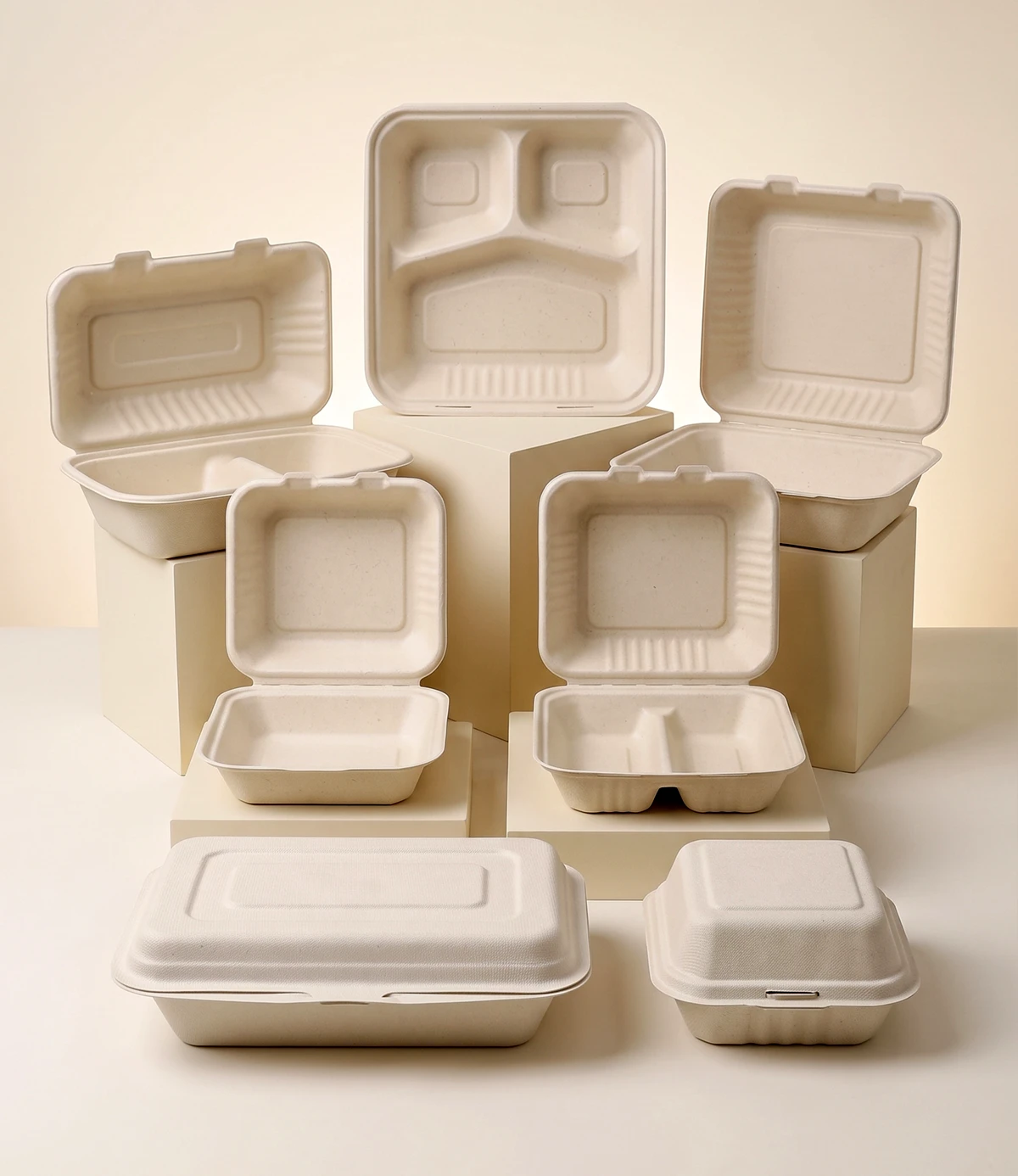
- Clamshell boxes. Hinged meal and burger boxes with the lid molded on, for fast packing in quick service and delivery.
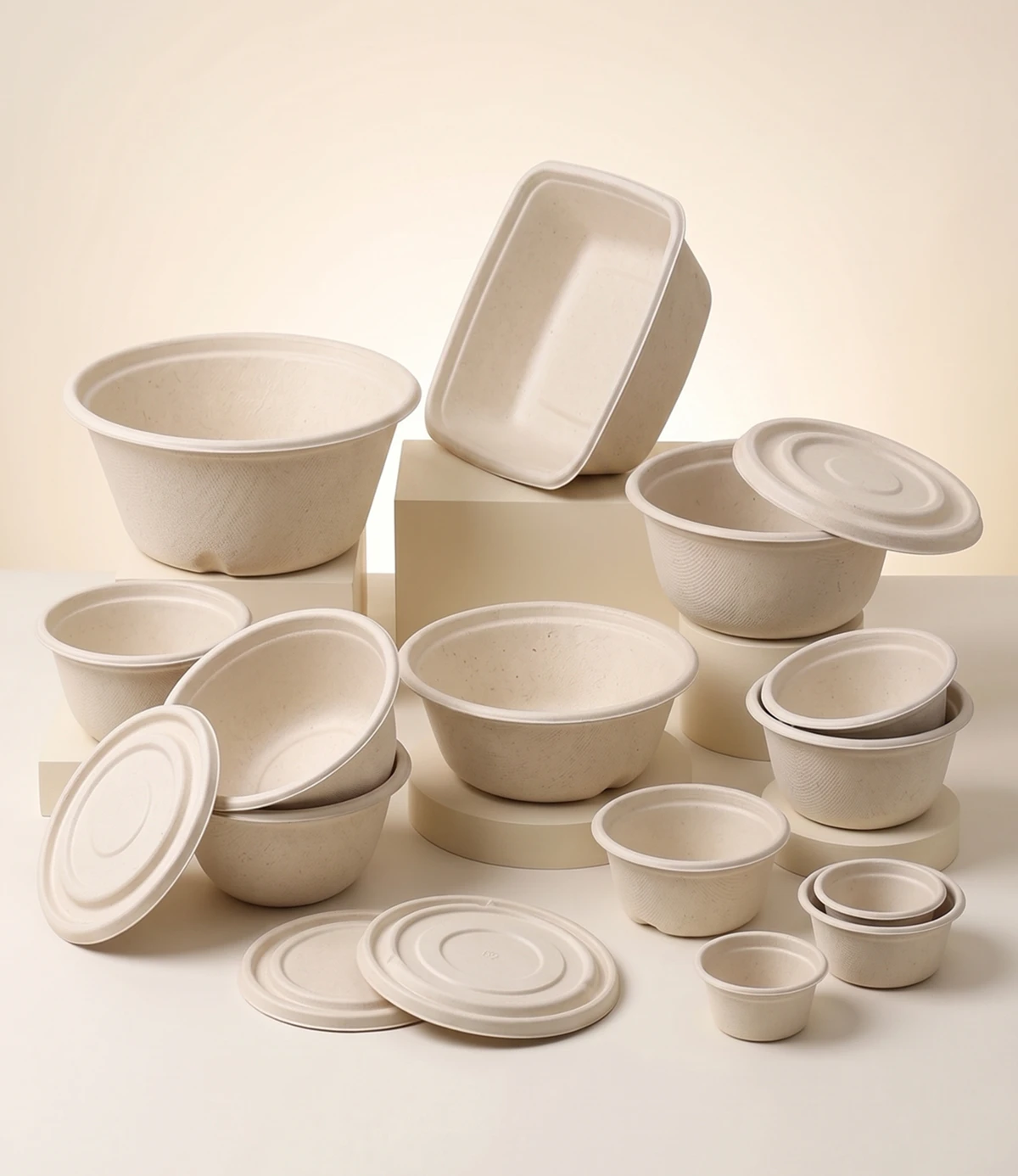
- Bowls and lids. Round, square and oval bowls for poke, salads, noodles, rice and soups.
- Plates. Round, square, deep, compartment and oval plates for events, canteens and catering.
- Compartment meal trays. Multi-compartment trays with fiber lids for complete meals, schools, airlines and institutions.
- Rectangular containers and lids. Flat-stacking containers with shared lids for delivery bags and meal prep.
- Leak-resistant containers. The Anti-Leak Series of bowls, containers and meal trays with a precision-formed rim for liquid-rich meals.
- Cups, soup cups and lids. Fiber cups for soups, sauces and drinks, with matching lids.
- Ice cream cups and bowls. Dessert cups and bowls for gelaterias, cafés and events.
- Trays and serving accessories. Open trays, cup carriers, food-and-drink holders and pizza boxes.
To keep a whole program in one material, combine containers with molded fiber lids. The bagasse food containers overview shows the complete range in one place.
Bagasse Guides by Format
Each bagasse family has its own buyer’s guide, with formats, sizes, uses and what to test:
- Bagasse burger boxes and clamshells: hinged boxes for burgers, meals and street food.
- Bagasse bowls with lids: poke, salad, noodle, rice and soup bowls.
- Bagasse plates vs paper plates: round, compartment and oval plates for events and catering.
- Bagasse compartment trays: meal trays for canteens, schools and contract catering.
- Compostable takeout containers for soups and sauces: leak-resistant containers for delivery.
- Bagasse cups, lids and ice cream cups: soup and portion cups, cup lids and gelato bowls.
- What is bagasse? Common questions answered: the material, compostability, microwave use and PFAS.
What should you ask a bagasse packaging supplier?
A good bagasse supplier answers these questions in writing and sends the documents with the first quote. Use this checklist when you compare bagasse food container manufacturers and wholesale suppliers.
Documents
- Food-contact compliance. A declaration of compliance with Regulation (EC) No 1935/2004 and good manufacturing practice, naming the product, the food types and the conditions of use, plus migration test reports where your specification requires them.
- Compostability certificates. The certificate itself, not a logo, showing the scheme (home or industrial), the product it covers, the holder and the validity date.
- PFAS test evidence. Targeted PFAS analysis and total fluorine screening against the PPWR limits, from an accredited laboratory.
- Mill quality systems. BRCGS Packaging Materials or ISO 9001 certification of the producing mill, so you know the production site is audited.
- Product specification. Material, color (natural or bleached), dimensions, tolerances, lid fit and packing.
Samples
- Test with your hottest, wettest and greasiest dishes, your longest delivery time and your reheating and freezing routine.
- Check that samples come from the same production route as the bulk order.
- Test the lid fit on the base you will actually use, including after stacking in a delivery bag.
Printing and customization
- Ask whether the item can carry embossing or printing, and which inks are used for food contact.
- For high volumes, ask about custom tooling: new shapes, sizes and compartment layouts developed with dedicated molds.
- Confirm that private-label cartons and mixed orders across families are possible if you are a distributor.
Commercial terms
- Pricing, minimum order quantities and lead times depend on the format, quantity, customization and destination; ask for them per project and in writing.
- Ask where each item is produced, the shipping route and which customs documents apply.
Sourcing bagasse packaging with Ekoroll
Ekoroll is a manufacturer-direct supply partner based in İzmir, Türkiye. We supply restaurant groups, caterers, delivery brands and distributors with a complete bagasse food container range: clamshells, bowls, plates, meal trays, rectangular containers, the Anti-Leak Series, cups, ice cream cups and serving accessories.
Ekoroll’s bagasse products are home compostable & 100% bagasse, certified by TÜV AUSTRIA (OK compost HOME). They are PFAS-free, microwave- and freezer-safe, water- and oil-resistant and made for hot and cold food. The certificates are held by the producing mill, and copies are available on request. Food-contact documentation is provided according to the final product specification and production route.
Pricing, minimum order quantities and lead times are quoted per project, and samples are available so you can test the range with your own menu. Browse the packaging catalog or send us your brief to request samples and a quote.
Products in this article
Sources
- Green energy from sugar crops: bagasse-based cogeneration, biogas and biomethane (MECAS(23)17) — International Sugar Organization, 2023-11-17
- Sugar cane bagasse energy cogeneration: lessons from Mauritius — United Nations DESA (K. Deepchand, Mauritius Sugar Authority), 2005-10-05
- Renewable energy technologies cost analysis series: Biomass for power generation — International Renewable Energy Agency (IRENA), 2012-06
- Directive (EU) 2019/904 on single-use plastic products — EUR-Lex
- Commission guidelines on single-use plastic products (2021/C 216/01) — EUR-Lex
- Regulation (EU) 2025/40 on packaging and packaging waste (PPWR) — EUR-Lex
- Regulation (EC) No 1935/2004 on materials intended to come into contact with food — EUR-Lex
- EN 13432:2000 Packaging: requirements for packaging recoverable through composting and biodegradation — BSI Knowledge
- OK compost HOME certification — TÜV AUSTRIA