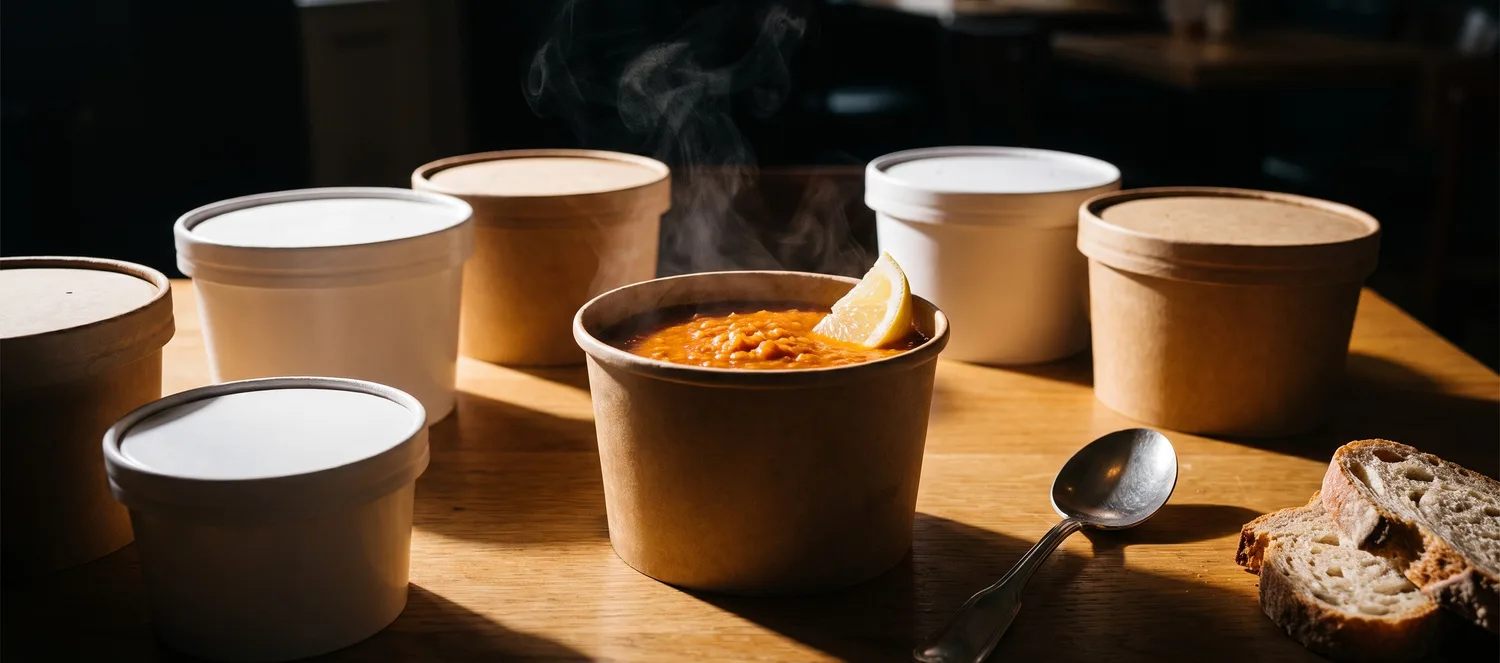
A paper soup bowl, or soup cup, is a round paperboard container with a liquid barrier inside and a tight lid, made to carry hot soup, stews and broths to go. To choose one, start from the portion — 12 oz (about 360 ml) is the usual single serving — then pick a lid made for the bowl’s rim, single or double wall for heat, and the barrier your market requires. Most leaks come from the lid and the fill level, so test the bowl and lid together with your own hot soup before ordering.
This guide covers soup cup sizes, lid types, single and double wall, coatings and EU rules, how to keep soup from leaking in delivery, and when a bagasse bowl is the better choice.
Paper Soup Cup Sizes
| Size | Approx. ml | Typical use |
|---|---|---|
| 8 oz | about 240 ml | Small cup, side soup, kids’ portion |
| 12 oz | about 360 ml | Standard single portion |
| 16 oz | about 480 ml | Large portion, soup as a main |
| 24 oz | about 720 ml | Stews, noodle soups, large portions |
| 32 oz | about 960 ml | Sharing, family portions, takeaway by the liter |
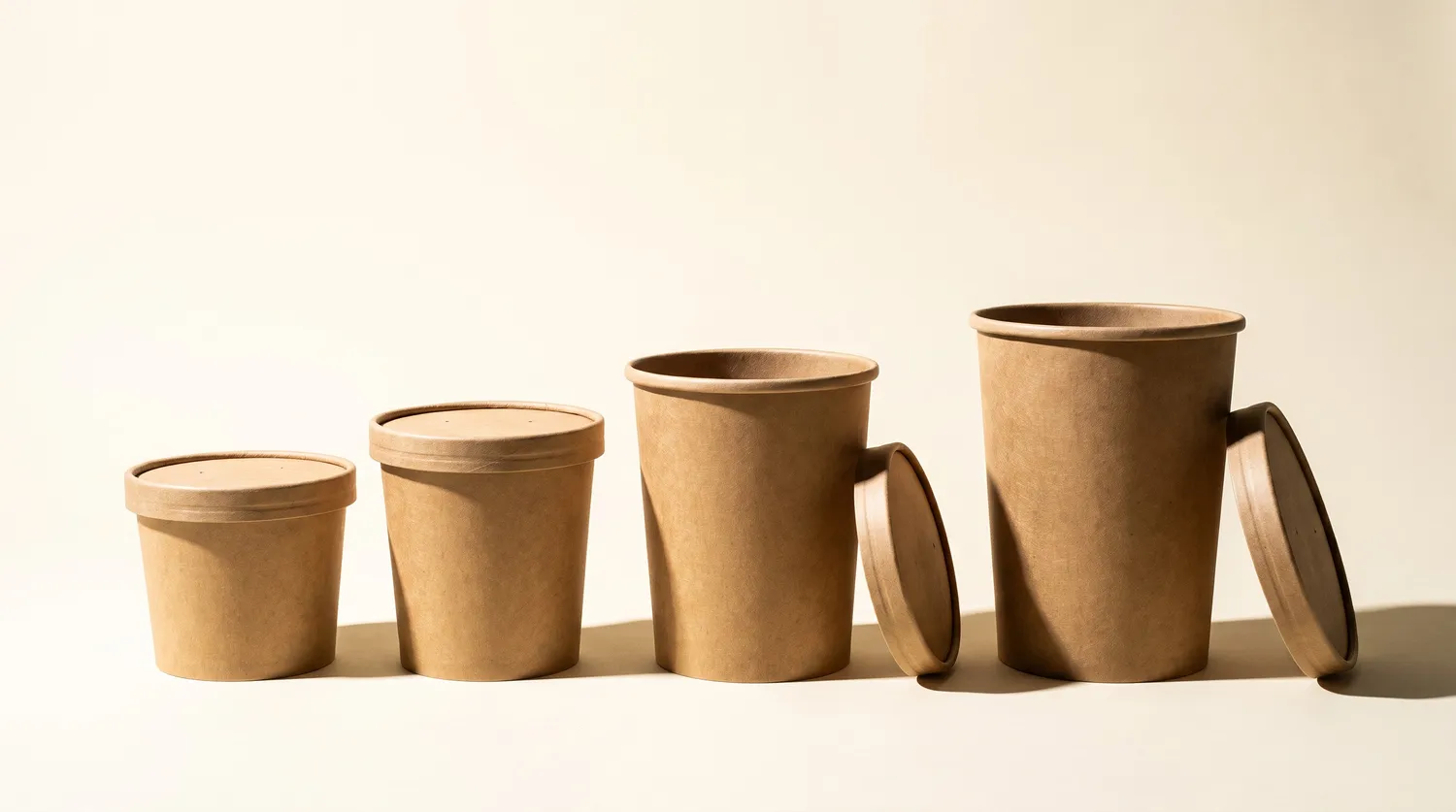
Exact capacities vary by range. Within one range, several sizes often share a rim diameter, so one lid closes more than one size — ask which sizes each lid fits.
Which Lid for Soup?
| Lid type | Strengths | Watch for |
|---|---|---|
| Flat paper lid | Keeps the pack paper-based; stacks well | Must seal all the way round the rim |
| Vented plastic lid (PP or PET) | Lets steam escape; clear options show the soup | Plastic; counts toward single-use plastic rules |
| Molded fiber lid | Reduces plastic; rigid | Fit and moisture resistance; test with hot soup |
| Lid with a sip or spoon opening | Eat or sip on the go | Spill risk if the cup tips |
A lid only seals a cup with the same rim diameter and rim profile. Two 12 oz cups from different ranges can have different rims, so never mix cups and lids from different suppliers without testing. For fiber lids, see our molded fiber lids.
Single Wall or Double Wall?
- Single wall is the standard for soup served in a bag, a box or on a tray.
- Double wall adds an insulating layer, so the outside stays comfortable to hold and the soup keeps its heat longer — useful for soup carried by hand or eaten on the street.
Coatings and EU Rules
Paperboard alone absorbs liquid, so soup cups have a barrier inside: a PE or PLA lining, or a water-based coating.
- Single-Use Plastics Directive (EU) 2019/904. Food containers for food eaten from the container without further preparation are covered when they are made wholly or partly of plastic; the European Commission’s guidelines treat bio-based plastics such as PLA as plastic too. Plastic-lined soup cups fall under consumption-reduction measures and extended producer responsibility.
- Packaging and Packaging Waste Regulation (EU) 2025/40. Since 12 August 2026, food-contact packaging containing PFAS above set limits may not be placed on the EU market. Ask for the PFAS status of the cup and the lid in writing.
- Food contact. Ask for a declaration of compliance under Regulation (EC) No 1935/2004 for the cup and the lid.
For a deeper look at barriers, see water-based coating vs PE coating.
How to Keep Soup from Leaking in Delivery
- Use a matched cup and lid from the same range.
- Fill to about 80–90% so the lid does not touch the soup.
- Press the lid all the way round the rim and check it by running a finger along the edge.
- Let steam escape for a moment before closing, or use a vented lid, so pressure does not lift the lid.
- Seal it: a tamper or seal sticker across the lid also shows the customer the soup was not opened.
- Keep it upright: use a cup holder, a carrier or a box in the delivery bag.
Test before you order: fill with your hottest soup, close, hold the cup upright, tilted and upside down for a few seconds, then carry it in a delivery bag for a typical trip and check the rim and the outside of the cup.
Paper Soup Cups or Bagasse Bowls?
| Paper soup cup | Bagasse bowl (Ekoroll) | |
|---|---|---|
| Material | Paperboard with a liquid barrier | 100% molded sugarcane fiber, no coating |
| Branding | Full-color logo print is easy | Plain, embossed or custom-shaped |
| Heat on the hand | Double wall available | Rigid fiber wall |
| Microwave | Depends on the coating and lid | Microwave- and freezer-safe |
| Leak resistance | Depends on the lid and rim | Anti-Leak Series with precision rim and matched lid |
| End of life | Depends on the coating and local collection | Home compostable & 100% bagasse (TÜV AUSTRIA OK compost HOME) |
| Best for | Counter service, branded takeaway, quick delivery | Soups that wait or travel longer, reheating |
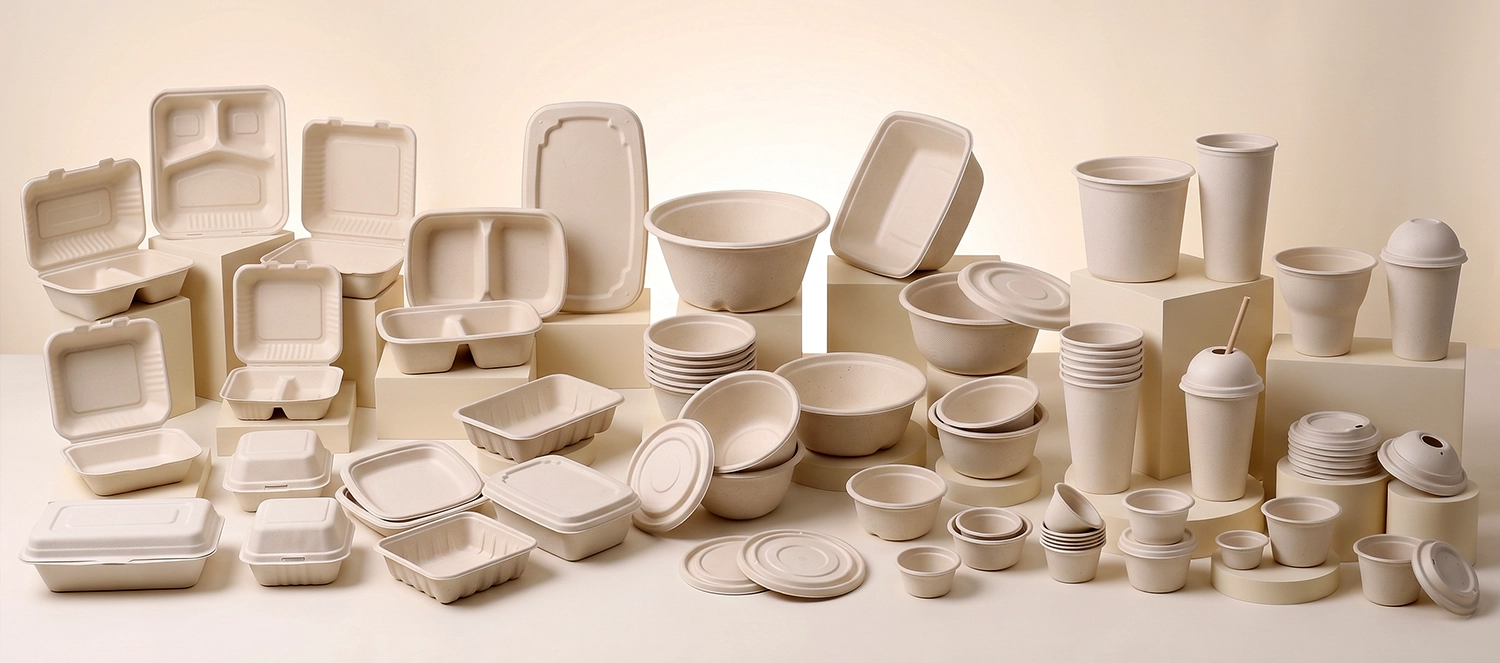
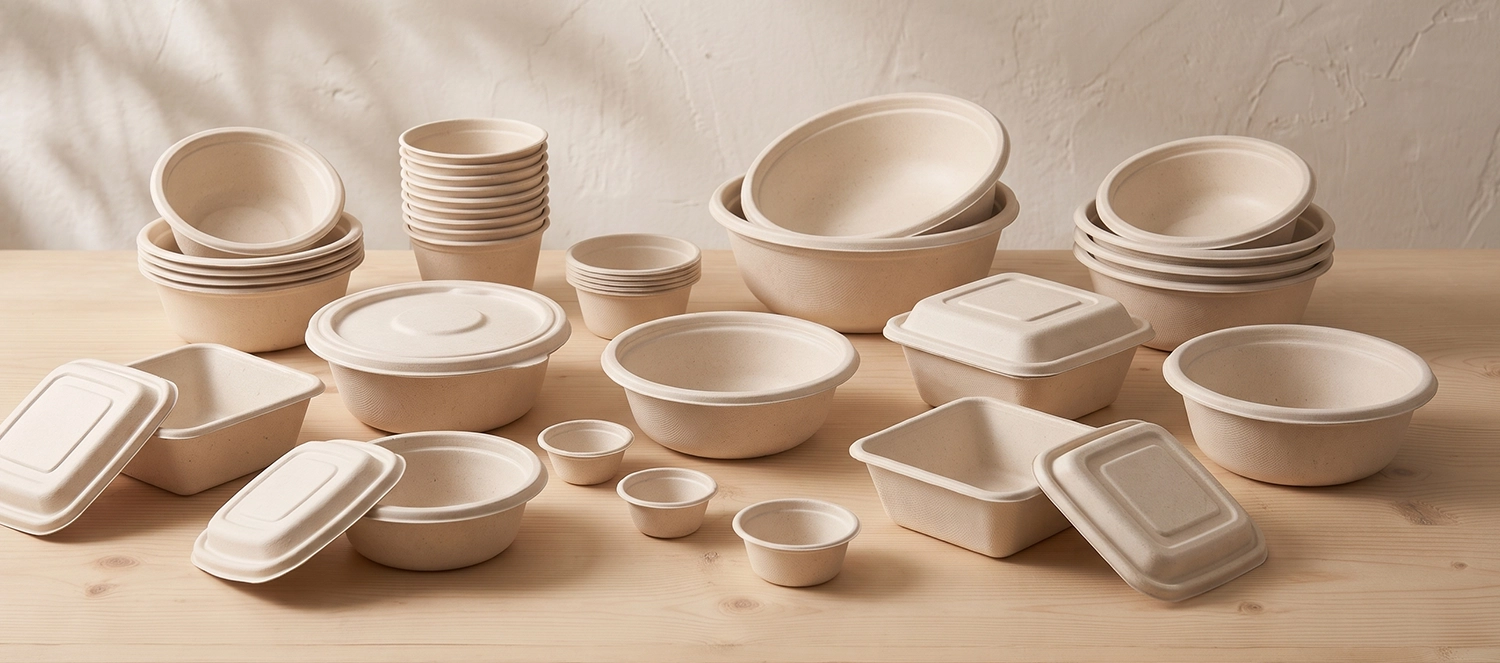
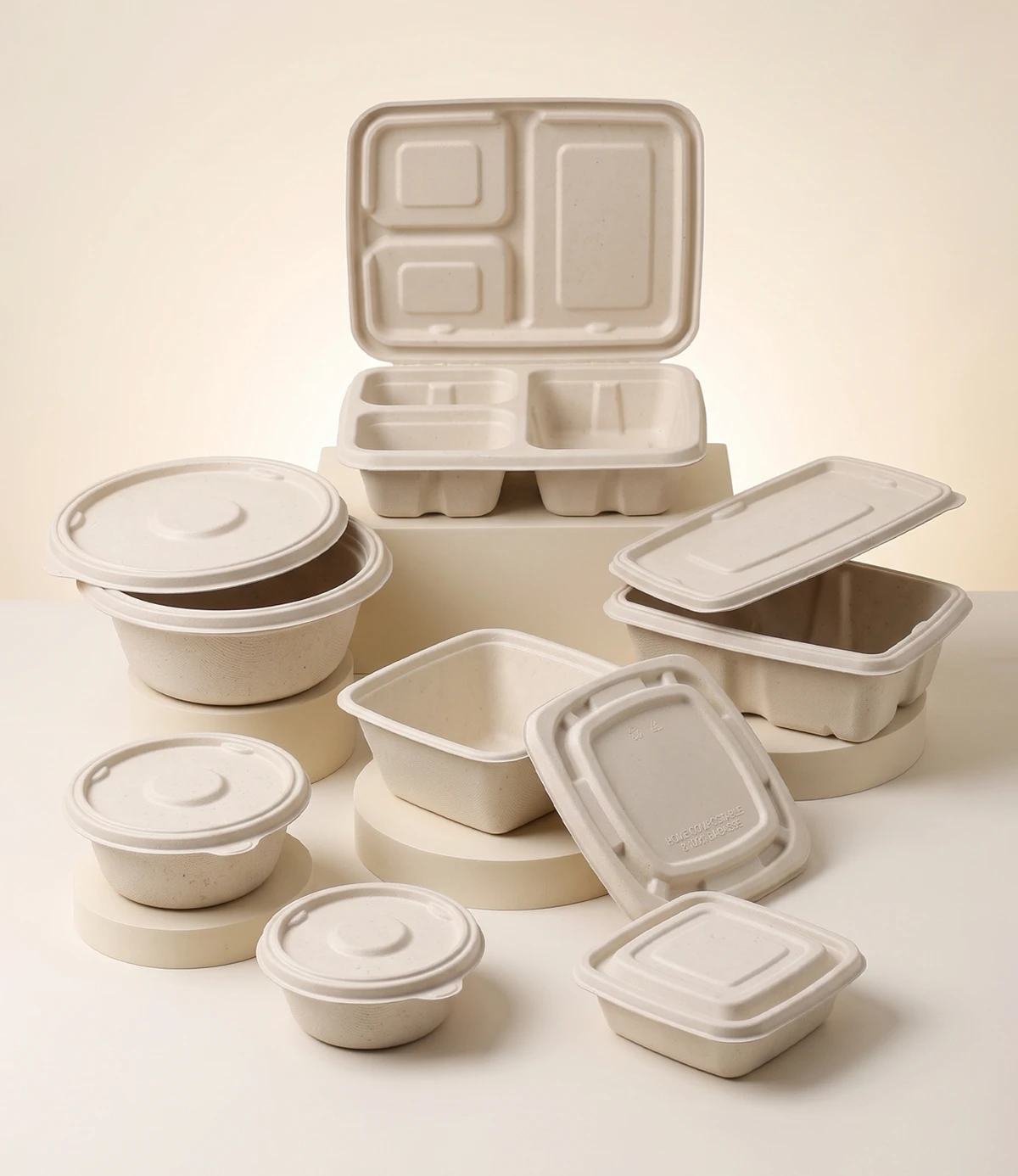
For bagasse soup bowls, see our bagasse bowls guide and the Anti-Leak Series.
What to Ask a Supplier
- Capacity and rim diameter of each cup, and which lids fit which sizes.
- Barrier type (PE, PLA or water-based) and PFAS status, in writing.
- Food-contact declaration for the cup and the lid.
- Single or double wall, board type and color (kraft or white).
- Printing: colors and print area on the cup and the lid.
- Packing: units per sleeve and carton, carton size.
- Lead time and minimum order: confirmed in the quote.
- Samples of every cup and lid combination you plan to order.
Soup Cups and Bowls from Ekoroll
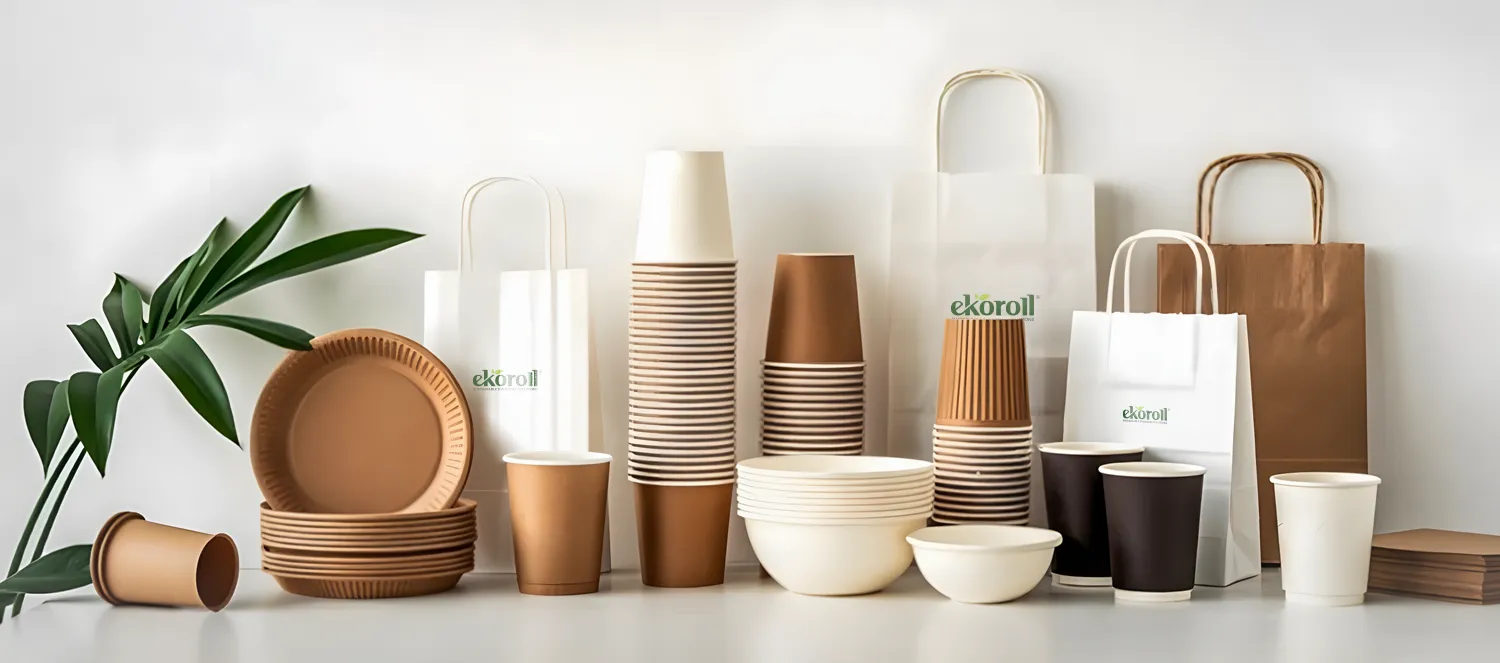
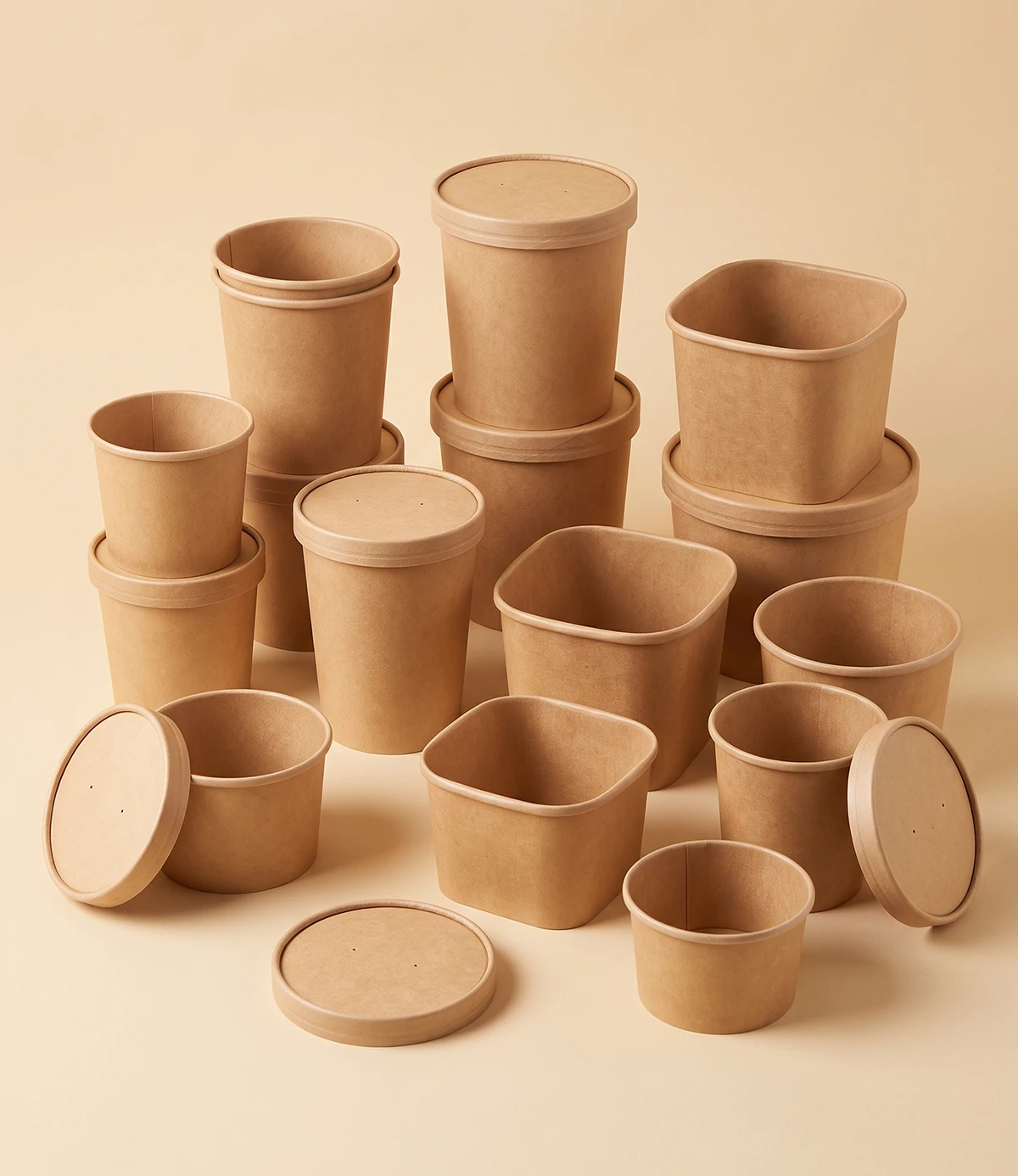
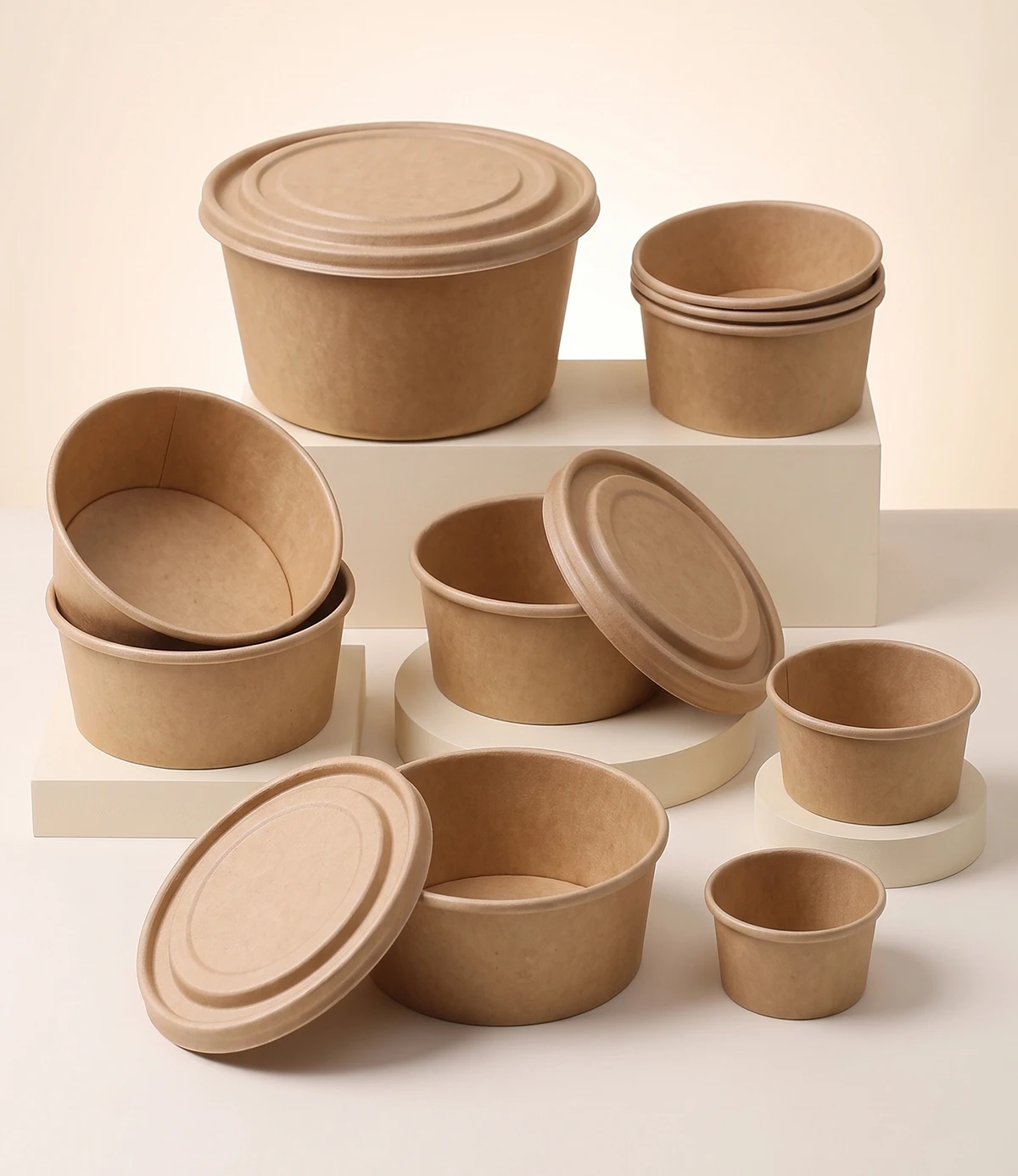
Ekoroll supplies round and square paper food pails for soups and kraft paper bowls with lids in kraft and white board, with custom print, and, for soups that travel longer, bagasse bowls and the leak-resistant Anti-Leak Series. Water-based coating is our main barrier option for paper; food-contact documentation is provided according to the final product specification. We supply food businesses and distributors in Türkiye, Europe, the Middle East and Africa, with samples before the first order.
Send us your soups, portion sizes and market, and we will propose cups, lids and sizes, send samples and quote in writing. Request a quote or browse the catalog.
Products in this article
Sources
- Directive (EU) 2019/904 on the reduction of the impact of certain plastic products on the environment (SUP Directive) — EUR-Lex
- Commission guidelines on single-use plastic products in accordance with Directive (EU) 2019/904, C(2021) 3762 final — European Commission (copy published by Spain's Ministry for the Ecological Transition), 2021-05-31
- Regulation (EU) 2025/40 on packaging and packaging waste (PPWR) — EUR-Lex
- Regulation (EC) No 1935/2004 on materials and articles intended to come into contact with food — EUR-Lex